 XHLUX
XHLUX
A surface linear light is a long luminaire fixed to the visible ceiling face—not hidden in a slot, profile void or suspended on cables.
Use this page when recessing is off the table: concrete slabs, tight programmes, exposed structure or ceilings where cutting a continuous line is rejected.
For basic commercial linear vocabulary, start here:
→ Qu’est-ce qu’un luminaire suspendu linéaire commercial ? Guide du débutant
If suspend versus recess is still undecided, read the suspend-or-recess guide first. This page assumes the ceiling must stay uncut.
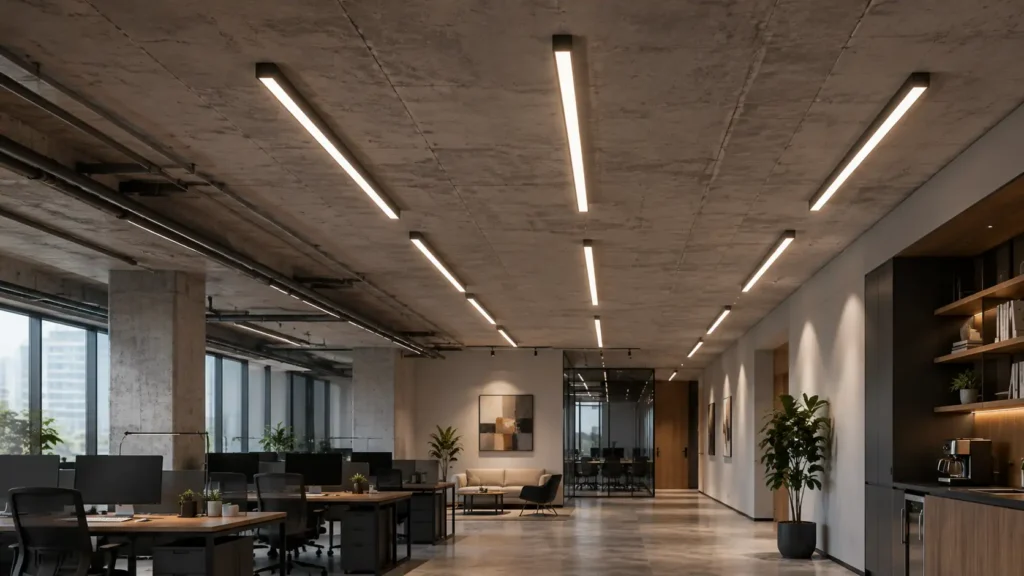
TL;DR : Confirm no-recess is fixed. Then match the ceiling face, fixture profile and install access—not a catalogue photo of a slim bar. Surface lines stay visible; approve finish, alignment and service before length modules.
1. When no-recess linear lighting is the right path
No-recess linear lighting is a project constraint, not a second-choice apology.
Typical triggers:
- Cast concrete or post-tension slabs with no usable void
- Retrofit ceilings where opening a continuous slot is forbidden
- Fast-track fit-outs that cannot wait for plaster-in channels
- Landlord rules that ban recessed cuts in existing boards
It is not the same decision as “surface versus recessed” when both remain possible—that interface compare belongs elsewhere on this site (#462 when written). Here the brief already says without recessing.
Write one line on the drawing: “No continuous recess—surface mount only.” That note prevents the team from drifting back to profile slots mid-tender.
🎯 Does no-recess always mean surface mount?
Usually on the ceiling plane—confirm suspension is also excluded before you freeze surface details.
2. Match surface linear light ceiling interface to the real build
Surface linear light ceiling work starts with what the line attaches to—not housing colour.
| Ceiling face | Que vérifier |
|---|---|
| Plain plasterboard | Joist or backing, fixings, long-run alignment |
| Concrete soffit | Anchor type, cable route, surface irregularity |
| Exposed structure / services | Clashes, shadow lines, maintenance clearance |
| Tile or grid (surface bar on tile) | Tile layout, weight, edge alignment |
The housing sits proud of the finish. Shadow gaps, end caps and join lines read as architecture—especially on long corridors.
If the design intent was a flush plane, surface mount will always look like surface mount. Do not expect a recessed slot appearance from a surface bar without a visible profile.
🎯 Can you hide a surface linear on a flat ceiling?
Only with coordinated depth and finish—not by calling a recess “surface” on the schedule.
3. Specify surface mounted linear light as a complete fixture
A surface mounted linear light is a luminaire with housing, optics, driver path and mount kit—not an LED strip stuck to the ceiling.
Approve on the submittal:
- Housing depth and visible profile
- Direct, indirect or combined output for the task
- Localisation et accès du chauffeur
- Joiners and end caps for the planned run length
- Finish against adjacent acoustic baffles or structure
Catalogue “surface bars” that omit drivers or joins are incomplete for a commercial run. Treat them like partial kits until the full system is named.
🎯 Is an LED strip on a channel already a surface linear luminaire?
No. You still need the full fixture layers and mount approval—not only adhesive strip.
4. Plan exposed ceiling linear light runs honestly
Exposed ceiling linear light rows compete with ducts, sprinklers, cable trays and acoustic clouds.
Before you freeze centres:
- Mark structure and MEP that cross the intended line
- Decide whether the bar follows architecture or ignores services
- Set alignment datum for long sightlines in corridors
- Plan breaks at doors, columns and access panels
Exposed ceilings punish random spacing copied from a clean render. Coordinate the reflected ceiling plan with the services drawing—not only the lighting layout.
Discomfort-glare checks from CIE 117-1995 and CIE 232:2019 still apply once people occupy the space under bright linear lenses—not only when the housing looks slim in a photo.
🎯 Can you ignore MEP on an exposed ceiling layout?
No. Services often set the only practical run axes—coordinate before you quote length.
5. Choose the surface mount linear fixture profile
A surface mount linear fixture must fit the ceiling task and the visible bulk you are willing to accept.
Compare early:
- Low-profile versus deep housing (optics and heat path differ)
- Single module versus linkable runs
- Surface flange width and shadow at the wall
- IP/IK if the run is near plant or external soffits
- Maintenance: can drivers be reached without removing half the ceiling?
Low profile is not automatically “better”—it may trade beam control or thermal margin for looks.
If recess becomes possible later for part of the zone, stop and re-open the interface decision on this site before mixing details on one drawing.
🎯 Does low profile replace photometric approval?
No. Profile height is an interface choice—approve optics and access on that housing.
6. Surface linear light installation checks (before power)
Surface linear light installation here means approving fixings, feeds and alignment—not a step-by-step wiring manual.
Check before hang or fix:
- Substrate and anchor schedule approved for housing mass
- Cable routes and feed points match module lengths
- Level and straightness tolerance over the full run
- Joiners seated before diffusers are fitted
- Drivers placed where they remain accessible
- Qualified party signs off circuits before energising
For recessed profile channels on other zones, the live profile pre-install checklist is the cut-before-open guide. This page stays on surface-only ceilings.
For a complete surface luminaire system, use the LED linear luminaire install checklist when the SKU names housing, driver, joins and mount—not a bare channel.
🎯 When is a surface linear run ready to energise?
After fixings, joins, accessible gear and circuit checks are approved—not when the diffuser simply clicks on.
What to prioritise on no-recess ceilings
The chart below ranks checklist weight—not product scores.
FAQ
Que faire ensuite ?
Mark “no recess” on the ceiling section. Match the surface linear housing to the real ceiling build, coordinate exposed services, then mock up one run before you lock finish and module lengths.
For project surface linear lighting, XHLUX can review ceiling interface notes, fixture profiles and run schedules before production.
Notes et sources
- CIE 117-1995, Discomfort glare in interior lighting — used for occupied-space glare checks under surface linear rows (plain-text citation; no outbound link).
- CIE 232:2019, Discomfort caused by glare from luminaires with a non-uniform source luminance — used with CIE 117 for indoor linear systems (plain-text citation; no outbound link).
- Project Serper PAA for
surface linear light(2026-07-08) — FAQ from primary pool; chandelier PAA skipped; secondaries had 0 PAA rows. - Project-specific electrical, structural, fire and accessibility rules remain applicable. Confirm local requirements before installation.

![Qu’est-ce qu’un luminaire encastré classé IC : Guide de sécurité critique [2025]](https://www.xhlux.com/wp-content/uploads/2025/07/What-is-IC-Rated-Downlight-560x560.webp "Qu’est-ce qu’un luminaire encastré classé IC : Guide de sécurité critique [2025]")
