 XHLUX
XHLUX

Table des matières
- What Exactly is 0-10V Dimmable Track Lighting?
- The Good, The Bad, and The Practical: Weighing Up 0-10V Track Lighting
- 0-10V Track Lighting vs. The Alternatives: Making the Right Choice for Your Project
- Where Does 0-10V Dimmable Track Lighting Fit Best in 2025?
- Key Considerations for Installing and Using 0-10V Track Lighting
- The Enduring Role of 0-10V in an Evolving Lighting World
- Is 0-10V Dimmable Track Lighting the Right Call for You?
In a world buzzing with the latest smart gadgets and digital wizardry, it’s easy to assume older technologies are fading into obscurity. But what if I told you that a straightforward, analog dimming method is still a go-to choice for many lighting projects in 2025? We’re talking about 0-10V Dimmable Track Lighting. It might not have all the bells and whistles of its digital counterparts, but its enduring simplicity, reliability, and smooth performance keep it firmly on the map for professionals and discerning users alike.

What Exactly is 0-10V Dimmable Track Lighting?
Before we get into the nitty-gritty comparisons, let’s make sure we’re all on the same page. What is this 0-10V dimming all about, especially when paired with the versatility of track lighting?
How 0-10V Dimming Works
At its core, 0-10V dimming is an analog lighting control protocol. Imagine a dimmer switch sending a very low DC voltage signal – anywhere between 0 and 10 volts – directly to your light fixture’s driver or ballast. This signal tells the driver precisely how much power to deliver to the light source, thus controlling its brightness.
- 0 Volts (or close to it): Typically signals the driver to dim the light to its minimum level. This might be 1%, 10%, or sometimes completely off, depending on the driver’s design (we’ll touch on “dim-to-off” later).
- 10 Volts: Instructs the driver to operate at 100% brightness.
- Anything in between (e.g., 5 Volts): Delivers a proportional light output (e.g., around 50% brightness).
It’s a beautifully simple concept: the voltage level directly dictates the light level. This direct relationship is what often leads to its characteristic smooth dimming. This is a “current sink” or “current source” control method, where the dimmer manipulates the current on the control line, which the driver interprets as a voltage.
Integrating 0-10V Control into Track Lighting Systems
Track lighting, with its inherent flexibility in positioning fixtures, becomes even more adaptable with 0-10V dimming. Here’s what’s involved:
- 0-10V Dimmable Drivers: Each track head (or a group, if wired that way internally) must be equipped with an LED driver specifically designed to accept a 0-10V control signal.
- Dedicated Control Wires: This is crucial. Besides the standard mains power wires (line, neutral, ground), 0-10V dimming requires a separate pair of low-voltage wires. These are typically color-coded purple (+10V) and gray (common/signal ground) and run from the dimmer to each fixture’s driver. Some modern track systems offer 5-conductor or even 7-conductor tracks to accommodate these extra wires neatly.
- 0-10V Dimmer Switch: You’ll need a wall-mounted dimmer specifically designed for 0-10V control. These dimmers don’t handle the main power to the lights directly; they only send the low-voltage signal.
Key Characteristics: Simplicity and Reliability
The beauty of 0-10V dimming lies in its straightforward nature. It’s a well-established, understood technology. There are no complex programming or addressing schemes involved for basic operation, which often translates to reliable performance when installed correctly. Think of it as the trusty workhorse of the dimming world.
The Good, The Bad, and The Practical: Weighing Up 0-10V Track Lighting
Like any technology, 0-10V dimming for track lighting comes with its own set of advantages and disadvantages. Let’s lay them out honestly so you can see the full picture.

The Upsides: Why 0-10V Still Earns Its Place
- Smooth, Continuous Dimming: This is often touted as 0-10V’s biggest strength. It generally provides a very smooth, flicker-free dimming curve, often down to 1% or even 0.1%, which can be superior to some phase-cut dimming methods, especially with LEDs. This makes it ideal for applications where ambiance and visual comfort are key.
- Cost-Effectiveness for Certain Setups: While the extra wiring can add to installation costs (especially in retrofits), the 0-10V drivers themselves and basic dimmer controls are often more affordable than their more sophisticated digital counterparts like DALI. For new builds where wiring is straightforward, it can be a budget-friendly choice for reliable dimming.
- Robust and Reliable Performance: Because it’s a simple analog system with fewer complex electronic components involved in the basic control signal, 0-10V systems are generally very robust and have a long track record of reliability when properly installed.
- Wide Compatibility with LED Drivers: 0-10V is a widely adopted standard for LED drivers, meaning you’ll find a vast selection of compatible track fixtures and drivers from numerous manufacturers. This gives you flexibility in fixture choice.
- Simplicity in Control for Basic Needs: If all you need is to dim a zone or bank of track lights up and down smoothly without individual control or complex scenes, 0-10V is refreshingly simple to operate.
The Downsides: Where 0-10V Shows Its Age
- Limited Control (Zonal, Not Individual Addressing): This is a big one. All fixtures connected to the same 0-10V dimmer will respond identically. You can’t individually control or address specific track heads on the same circuit like you can with DALI or many smart systems. It’s zonal dimming, pure and simple.
- Requires Dedicated Control Wiring: Those two extra low-voltage wires (purple and gray) must be run from the dimmer to every fixture. In new construction, this is manageable. In retrofits, pulling these extra wires can be labor-intensive and costly, sometimes making it a non-starter.
- No Feedback or Advanced Features: 0-10V is a one-way street. The dimmer sends a signal, but the fixtures don’t send anything back. This means no status updates (like lamp failure), no energy monitoring, and no complex scene programming or integration capabilities found in digital systems.
- Potential for Voltage Drop over Long Runs: Being an analog voltage signal, it can suffer from voltage drop if the control wires are too long or too thin. This can lead to inconsistent dimming levels between fixtures closer to and further from the dimmer. Proper wire gauge selection is critical. (E.g., up to 300 ft for 18AWG, potentially 1000 ft for 12AWG, but always check manufacturer specs).
- On/Off Control Often Separate: A standard 0-10V dimmer only controls the light level. Sending a 0V signal might dim the lights to their minimum, but not necessarily turn them completely off. To achieve a true “off” state, you typically need a separate switch (often integrated into some 0-10V dimmers as an additional relay or switch mechanism, or a completely separate mains switch upstream). Look for drivers and dimmers that explicitly support “dim-to-off” if this is crucial.
0-10V Track Lighting vs. The Alternatives: Making the Right Choice for Your Project
Understanding where 0-10V stands in relation to other common dimming methods is key to choosing wisely. Let’s break down some common comparisons.
0-10V vs. Phase-Cut (Triac/Leading Edge & ELV/Trailing Edge) Dimming
Phase-cut dimming (the kind that often uses existing 2-wire setups) is common in residential settings.
- Wiring: Phase-cut is simpler, using just the two main power wires. 0-10V needs the extra pair.
- Performance: 0-10V generally offers smoother dimming performance with LEDs and is less prone to flicker or buzzing compared to some leading-edge (Triac) phase-cut dimmers. Trailing-edge (ELV) phase-cut dimmers are better for LEDs but compatibility can still be tricky.
- Cost: Phase-cut dimmers are often cheaper upfront, but if performance with LEDs is poor, the “savings” might not be worth it.
- Best for: Phase-cut can be fine for simple residential dimming if compatibility is ensured. “0-10V dimmable LED track lighting” is often preferred where smooth, reliable dimming is a higher priority, even if it means extra wiring.
0-10V vs. DALI (Digital Addressable Lighting Interface)
DALI is a digital protocol often seen as a step up, especially in commercial applications.
- Control: DALI allows individual addressing of up to 64 fixtures per line, group control, scene setting, and bi-directional communication for status feedback and advanced programming. 0-10V is strictly zonal and one-way.
- Wiring: DALI also uses a 2-wire control bus (polarity insensitive), but it’s a digital bus, not analog voltage.
- Complexity & Cost: DALI systems are more complex to commission and generally have a higher upfront cost for components (drivers, controllers). 0-10V is simpler and often cheaper for basic setups.
- Best for: DALI excels in projects needing granular control, flexibility, and smart building integration. 0-10V is better for straightforward, reliable zonal dimming where advanced features aren’t needed.
0-10V vs. Modern Wireless/Smart Lighting (Zigbee, Wi-Fi, Matter)
Smart lighting systems offer app control, voice commands, color tuning, and easy scene creation, often wirelessly.

- Control & Features: Smart systems win hands-down on features, individual control (often), and ease of use for tech-savvy users.
- Installation: Wireless smart systems can be much easier to retrofit as they often don’t require new control wiring to each fixture (though some require hubs).
- Reliability & Security: Hardwired 0-10V is inherently very reliable and secure, with no reliance on Wi-Fi networks or potential for wireless interference/hacking. Smart systems’ reliability can depend on network quality and protocol.
- Cost: Can vary wildly, but smart fixtures and hubs can add up.
- Best for: Smart lighting is fantastic for homes and spaces wanting maximum flexibility, cool features, and easy integration with other smart devices. 0-10V is for those prioritizing simple, robust, hardwired dimming.
Quick Comparison Table: Finding the Sweet Spot
| Fonctionnalité | 0-10V Dimmable Track Lighting | Phase-Cut (Typical LED) | DALI Track Lighting | Wireless/Smart Track Lighting |
|---|---|---|---|---|
| Type de contrôle | Analog, Zonal | Analog, Zonal | Digital, Individual/Group | Digital, Individual/Group |
| Dimming Quality | Very Smooth | Varies, potential flicker | Very Smooth, Standardized | Generally Good |
| Câblage | Mains + 2 Low-Voltage Control Wires | Mains Only (2-3 wires) | Mains + 2 Digital Control Wires | Mains Only (fixture); Hub? |
| Feedback | No | No | Yes (Status, Energy, etc.) | Often Yes |
| Complexity | Low-Moderate | Faible | Moderate-High (Commissioning) | Varies (Setup, App) |
| Cost (System) | Low-Moderate | Faible | Haut | Moderate-High |
| Retrofit Ease | Challenging (new wires) | Facile | Challenging (new wires) | Easy-Moderate |
| Idéal pour | Reliable zonal dimming, smooth fades | Simple residential | Granular control, smart buildings | Flexibility, features, smart home |
Where Does 0-10V Dimmable Track Lighting Fit Best in 2025?
Despite the rise of more advanced technologies, 0-10V dimmable track lighting still carves out a significant niche. Here’s where it makes a lot of sense, even today:
- Commercial Spaces Requiring Reliable Zonal Dimming: Think large office floors, corridors, warehouses, or back-of-house retail areas. Here, the need is often for simple, reliable dimming of large zones of lights to save energy or adjust for daylight, without the complexity or cost of individual addressing.
- Retail Environments for Consistent Accent Lighting: For certain retail applications, especially those on a tighter budget or where the lighting layout is fairly static, 0-10V can provide excellent, smooth accent lighting for displays. If all you need is to dim a whole track run uniformly, it’s a solid choice. (Consider “0-10V track lighting for retail displays”).
- Educational and Healthcare Facilities: In classrooms, lecture halls, or non-critical patient areas, the simplicity and reliability of 0-10V can be advantageous. It’s easy for staff to use and less prone to the complexities that might come with software-based systems if not managed well.
- Budget-Conscious New Builds or Renovations with Basic Dimming Needs: When a project is being built from scratch (making wire runs easier) and the primary goal is smooth, basic dimming without breaking the bank, 0-10V offers a great balance of performance and value.
- Applications Prioritizing Smooth Dimming over Complex Control: For spaces like art studios (not necessarily galleries needing DALI’s precision), small auditoriums, or conference rooms where the quality of the dimming experience is paramount and intricate control schemes are overkill, 0-10V delivers.
Key Considerations for Installing and Using 0-10V Track Lighting
A successful 0-10V track lighting installation hinges on a few key details. Mess these up, and that smooth dimming can turn into a headache.
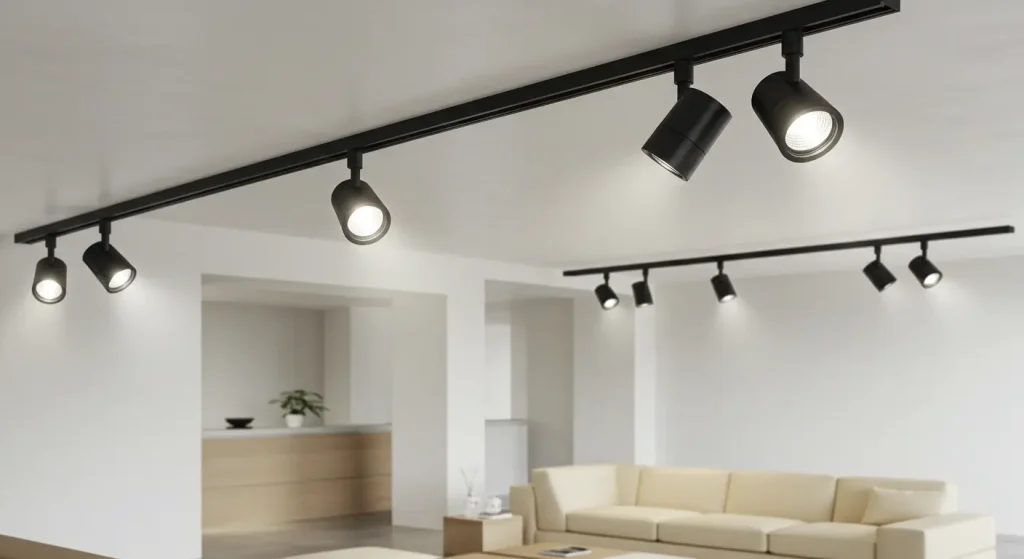
Understanding Wiring Requirements (The Crucial Low-Voltage Pair)
This can’t be stressed enough: 0-10V needs its own dedicated pair of low-voltage control wires (Class 2 circuit). These are separate from the mains power.
- Polarity: Yes, it usually matters. Purple is typically the +10V positive, and gray is the common/signal ground. Mixing these up can lead to improper operation or no dimming at all.
- Wire Gauge & Distance: Use the correct wire gauge for the distance of your runs to avoid voltage drop. Consult manufacturer guidelines, but generally, 18 AWG might be good for up to 300 feet, while 12 AWG could extend to 1000 feet.
- Separation/Shielding: While not always mandatory, running control wires separate from mains power, or using shielded cable, can help prevent electrical noise or interference that might affect dimming performance.
Selecting Compatible Drivers and Dimmers
- Ensure your track heads have pilotes à gradation 0-10 V. Not all LED drivers are.
- Choose a 0-10V dimmer switch that is compatible with the total current load of the drivers it will control. Dimmer spec sheets will indicate how many drivers they can typically handle (often based on the current sinking or sourcing capacity).
- Decide if you need “dim-to-off” functionality and select drivers and dimmers that support this. Otherwise, you’ll need a separate switch for full power off.
Grouping and Zoning Strategies
Plan your zones carefully. Since all lights on one 0-10V dimmer control circuit dim together, you need to wire your track runs and connect them to dimmers based on how you want those zones to behave. This is where “0-10V track light zoning” becomes a key design element.
Managing Potential Issues
- Flicker: Usually due to incompatible dimmer/driver, incorrect wiring, or electrical noise.
- Inconsistent Dimming: Could be voltage drop on long runs or an overloaded dimmer.
- Lights Don’t Turn Fully Off: Standard 0-10V behavior unless “dim-to-off” is supported.
When to Call in a Professional
If you’re not comfortable with electrical wiring, especially running new low-voltage lines and understanding driver/dimmer compatibility, it’s always best to hire a qualified electrician or lighting installer. They’ll ensure it’s done safely and correctly.

The Enduring Role of 0-10V in an Evolving Lighting World
So, with all the smart tech buzzing around, is 0-10V dimming on its last legs? Not quite.
Market Perspective: Is 0-10V Fading or Holding Steady?
While the hype cycle definitely favors newer digital and wireless technologies, 0-10V remains a workhorse, particularly in the commercial sector. Its simplicity, proven reliability, and often lower cost for basic dimming functionality ensure it continues to be specified in many new construction projects globally. The overall growth in the LED lighting market also means continued demand for compatible control systems, and 0-10V is a deeply entrenched standard. Specific market reports for “0-10V dimmer market growth” show it’s still an active segment.
Integration with Smarter Systems
Interestingly, 0-10V isn’t always an “either/or” against smart systems. Many smart building control systems or even advanced home automation setups can integrate 0-10V lighting. This is often done using smart relays or interface modules that can take a digital or wireless command and translate it into a 0-10V signal for the luminaires. This allows projects to leverage the wide availability and smooth dimming of 0-10V fixtures while still gaining some level of centralized or automated control.
The “Keep It Simple” Philosophy: When Less is More
There’s a certain elegance in simplicity. For many applications, the added complexity and potential points of failure of a highly networked system are simply not needed or desired. If straightforward, reliable dimming is the goal, 0-10V often embodies the “less is more” principle perfectly. Not every light needs to be individually addressable or change colors on command.
Expert Take: Why 0-10V Isn’t Disappearing Overnight
Chat with seasoned lighting designers and electrical contractors, and many will tell you that 0-10V still has a firm place in their toolkit. It’s a known quantity. They understand how it works, how to troubleshoot it, and when it’s the most practical and cost-effective solution. Until digital or wireless solutions can universally match its simplicity and price point for basic dimming applications and overcome the inertia of an established standard, 0-10V will continue to be a relevant player.
Is 0-10V Dimmable Track Lighting the Right Call for You?
So, back to our original question: is 0-10V Dimmable Track Lighting still shining bright in 2025? The answer is a resounding “yes,” but with an important “it depends on the application.”
If your project demands intricate individual control, bi-directional feedback, complex scene programming, or seamless wireless integration with a multitude of smart home gadgets, then newer digital or smart lighting avenues are likely your best bet.

However, if you’re looking for:
- Exceptionally smooth and reliable zonal dimming.
- A cost-effective solution for new builds where control wiring is straightforward.
- A well-understood technology with wide fixture compatibility.
- Simplicity over a plethora of features you might not need.
…then 0-10V dimmable track lighting remains a robust, practical, and highly effective choice. It’s a testament to the fact that sometimes, the most enduring solutions are those that do a fundamental job exceptionally well.
Don’t let the “analog” label fool you. When implemented correctly, 0-10V control offers a quality of dimming that can enhance any space. If your priorities align with its strengths, it’s a technology that continues to deliver solid value.
Thinking about using 0-10V dimmable track lighting for your next project or have more questions? Consulting with a lighting professional can help you weigh all the factors and ensure you get the best results for your specific needs.