 XHLUX
XHLUX

If you have been specifying or sourcing commercial lighting recently, you have likely come across the term “48V magnetic track lighting.” It shows up in high-end retail projects, luxury hotel lobbies, and upscale showrooms — and for good reason. But what exactly is it, how does it differ from conventional track lighting, and when does it actually make sense to specify it?
The Basic Definition
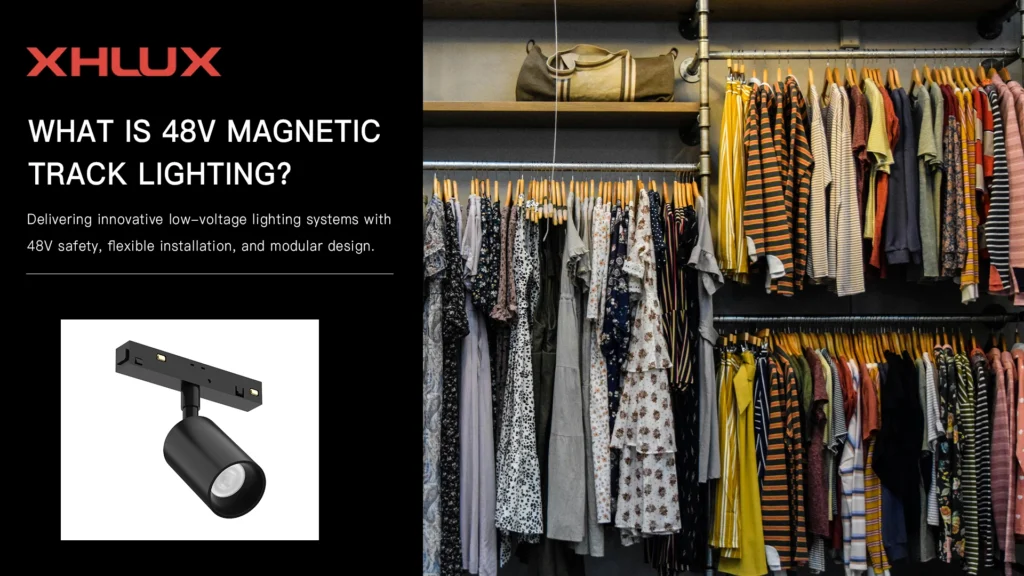
48V magnetic track lighting is a low-voltage lighting system where fixtures attach to the track rail using magnets rather than mechanical adapters or clips. The track operates at 48 volts DC — significantly lower than the 220V or 110V mains voltage used in conventional track systems.
The combination of magnetic attachment and low-voltage operation is what defines the system and drives most of its practical advantages.
How It Works
The track rail itself contains copper conductors that carry 48V DC power, supplied by a driver unit connected to the mains. Fixtures have integrated magnets and electrical contacts on their base. When a fixture is placed against the track, the magnets hold it in position while the contacts automatically connect to the power conductors — no tools, no adapters, no wiring.
This means fixtures can be installed, repositioned, or removed anywhere along the track length in seconds. There are no fixed mounting points and no predetermined spacing.
Why 48V and Not Higher?
The 48V threshold is significant. Under most international electrical safety standards — including IEC 60364 — voltages at or below 50V DC are classified as Safety Extra-Low Voltage (SELV). At this level, the risk of electric shock from accidental contact with live conductors is considered negligible under normal conditions.
In practical terms, this means:
- Installers can handle the track and reposition fixtures without isolating the circuit first
- Live track rails can be exposed without protective covers in most jurisdictions
- The system is inherently safer in environments with frequent fixture adjustments — retail, galleries, hospitality spaces
This is a meaningful operational advantage compared to mains-voltage track systems, where any live contact must be treated as a shock hazard.
Key Advantages for Commercial Projects
Clean, Minimal Aesthetics
Because 48V magnetic track systems do not require bulky mechanical adapters or locking mechanisms, both the track profile and the fixture base can be extremely slim. Track depths of 10–15mm are common, compared to 30–50mm for conventional systems.
The result is a ceiling detail that reads as a refined architectural line rather than a visible lighting infrastructure. This is a primary reason the system has been adopted so widely in luxury retail, high-end hospitality, and museum environments where ceiling aesthetics are part of the design intent.
Tool-Free Repositioning
In any commercial environment where layouts change — seasonal retail displays, rotating gallery exhibitions, reconfigured restaurant seating — the ability to move fixtures without tools or electricians has direct operational value.
With a conventional track system, repositioning a fixture requires loosening a locking mechanism, sliding the adapter, and re-tightening. With a magnetic system, the fixture lifts off and reattaches in a new position in under five seconds. Over the lifespan of a retail or hospitality project, this flexibility significantly reduces the cost and disruption of lighting adjustments.
Consistent Power Delivery Across the Full Track Length
In mains-voltage track systems, voltage drop across long track runs can affect fixture performance — particularly with dimming, where inconsistent voltage produces inconsistent output levels.
48V DC systems, when properly designed with appropriate driver capacity, deliver stable voltage across the track length. This produces consistent dimming behaviour and uniform light output across all fixtures, regardless of their position on the track.
Dimming Performance
48V magnetic track fixtures are typically driven by constant-voltage LED drivers with integrated dimming capability. Common protocols include DALI-2, 0/1–10V, and increasingly Bluetooth or ZigBee for wireless scene control.
Because the driver stage is separated from the fixture, dimming is handled at the system level rather than inside each individual luminaire. This generally produces smoother, flicker-free dimming performance across the full range — an important consideration in retail and hospitality environments where lighting scenes are actively managed.
Where 48V Magnetic Track Lighting Is Most Commonly Specified
The system is not a universal replacement for conventional track lighting. It carries a higher unit cost per fixture and per metre of track, and the driver infrastructure adds to the installation budget. It makes the most sense in projects where its specific advantages justify that premium:
Luxury retail — Fashion boutiques, jewellery stores, and flagship stores where ceiling aesthetics, high CRI accent lighting, and frequent display changes all matter simultaneously.
Hotels and hospitality — Lobbies, corridors, F&B spaces, and public areas undergoing periodic brand refreshes. The low-voltage safety characteristic is also relevant in spa and wellness environments.
Galleries and museums — Permanent and temporary exhibition spaces where curators need to re-aim and reposition fixtures regularly without specialist electrical involvement.
Showrooms — Automotive, furniture, and product showrooms where lighting must adapt to changing display configurations while maintaining a refined visual appearance.
High-specification offices — Executive areas, reception spaces, and meeting rooms where lighting quality and aesthetics are part of the interior specification.
What to Confirm Before Specifying
If you are evaluating 48V magnetic track lighting for a project, these are the practical points to verify with your supplier:
Driver capacity and load calculation — Each driver has a maximum connected load. For longer track runs or high-fixture-count installations, multiple drivers are required. Confirm the calculation before finalising the track layout.
Dimming protocol compatibility — Ensure the fixtures and driver are compatible with your control system. A DALI-2 fixture on a 0–10V system will not dim correctly.
CRI and CCT options — The optical performance of the fixture matters as much as the track system. For retail and hospitality, specify CRI 95 or above and confirm SDCM 3 or below for colour consistency across the installation.
Track profile and finish options — Most systems are available in white, black, and brushed aluminium as standard. Custom RAL colours may be available for OEM orders with sufficient volume.
Certifications — Confirm CE, TÜV, or other market-relevant certifications on both the track and the fixtures. As a SELV system, 48V track has specific certification requirements distinct from mains-voltage products.
48V Magnetic vs. Conventional Mains-Voltage Track
| Fonctionnalité | 48V Magnetic Track | Conventional Mains Track |
|---|---|---|
| Operating voltage | 48V DC (SELV) | 110V / 220V AC |
| Fixture attachment | Magnetic, tool-free | Mechanical adapter, locking |
| Track profile depth | 10–15mm typical | 30–50mm typical |
| Repositioning | Seconds, no tools | Requires locking/unlocking |
| Installation safety | Safe to handle live | Mains shock risk |
| Unit cost | Plus haut | Inférieur |
| Dimming performance | Smooth, consistent | Varies by system |
| Best fit | Luxury / high-spec projects | General commercial projects |
XHLUX Série D52 48V Magnetic Low Voltage LED Track Light 10-12W
If you want to see what a 48V magnetic track fixture looks like in practice, the XHLUX D52 Series is a good reference point. It is a 10–12W spot designed for accent and display lighting — the kind of application this system was built for. Boutique retail, hotel corridors, gallery installations, showrooms.
The fixture runs on a 48V DC magnetic track, attaches tool-free, and has an adjustable head for beam direction. CRI, CCT, and beam angle options are available depending on project requirements. OEM and ODM configurations are also supported for brands sourcing at volume.
Résumé
48V magnetic track lighting is a low-voltage system that combines magnetic fixture attachment with SELV-rated electrical safety. Its practical advantages — slim track profiles, tool-free repositioning, consistent dimming, and safe handling — make it the preferred specification for commercial environments where aesthetics, flexibility, and operational efficiency all carry weight.
It is not the right system for every project. But for the applications where it fits, it delivers performance and adaptability that conventional track systems cannot match.
If you are evaluating 48V magnetic track lighting for an upcoming project and want to discuss product options, load calculations, or OEM requirements, contact the XHLUX team directly — we supply 48V magnetic track systems to distributors and project contractors worldwide.
Why XHLUX?
XHLUX (Shenzhen Xinghuo LED Tech) has been manufacturing commercial LED lighting since 2011, supplying track lights, downlights, linear lights, and 48V magnetic track systems to clients in over 100 countries.
All products are certified to TÜV, GS, SAA, CE, CB, EMC, ErP, and RoHS standards, 100% QC inspected before shipping. IES and LDT photometric files are available on request. OEM and ODM services are supported across the full product range.
Contactez-nous to discuss your requirements or request a sample.