 XHLUX
XHLUX
![Que sont les lumens dans les luminaires ? Guide complet [2025]](https://xhlux.com/wp-content/uploads/2024/05/news.webp)
Table des matières
- The Simple Answer: What Are Lumens in a Light Fixture?
- The Great Debate: Lumens vs. Watts – The Only Metric That Matters Now
- How Many Lumens Do You Actually Need? A Practical Guide
- Room-by-Room Lumen Recommendation Chart
- Lumens Are Only Half the Story: Other Factors in “Good” Light
- Final Word: Think in Lumens, Design with Confidence
- FAQ About Lumens Light Fixtures
You’ve found the perfect light fixture. It has the right style, the right finish, the right shape… but then you look at the technical specifications. 800 lumens. 9 watts. 3000K. Suddenly, choosing a light feels less like a design decision and more like a science exam.
If these terms have you feeling lost, you’re not alone. For years, we were all taught to shop for lighting based on a single, simple number: watts. But in the modern world of ultra-efficient LED technology, that old rule no longer applies.
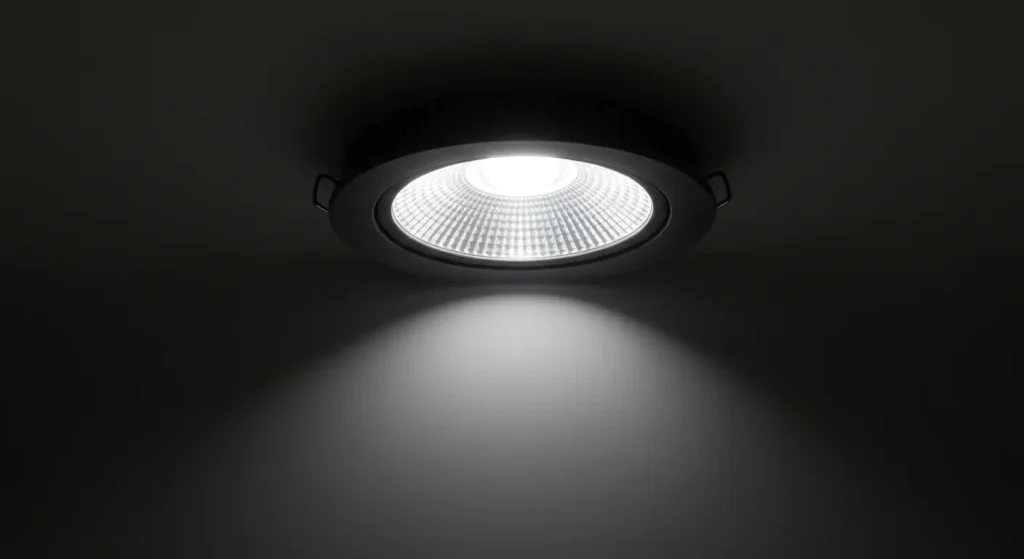
This guide will demystify the single most important factor in choosing a new light fixture: lumens. We will provide a crystal-clear definition, explain why it has replaced wattage as the key metric for brightness, and, most importantly, give you a simple, professional framework to figure out exactly how many lumens you need for any room.
The Simple Answer: What Are Lumens in a Light Fixture?
Let’s start with the most direct definition possible.
Lumens (lm) are the measure of the total brightness, or the total amount of visible light, emitted by a light source.
That’s it. The higher the lumen number, the brighter the light fixture will be. It is a direct and honest measurement of light output.
A “lumens light fixture” isn’t a specific type of fixture. Rather, any light fixture—from a recessed downlight to a decorative pendant to a shop light—has a lumen rating that tells you how bright it is. An 800-lumen downlight is simply a downlight that produces 800 lumens of light.
Think of it like this: if your light fixture was a showerhead, the lumens would be the total amount of water coming out.
The Great Debate: Lumens vs. Watts – The Only Metric That Matters Now
For decades, we used watts to gauge brightness. A 100W bulb was for a big lamp; a 40W bulb was for a small one. This worked because incandescent bulbs were all terribly inefficient in the same way. But a watt is a measure of energy consumption, not brightness.
To continue our analogy: if lumens are the water flow, watts are the energy bill you get for running the pump.
With modern LEDs, this distinction is critical. An LED fixture can produce the same amount of light as an old incandescent bulb while using a tiny fraction of the energy.
| Light Output (Brightness) | Old Incandescent Bulb | Modern LED Equivalent | Energy Savings |
|---|---|---|---|
| ~450 lumens | 40 Watts | ~5 – 6 Watts | ~85% |
| ~800 lumens | 60 Watts | ~8 – 9 Watts | ~85% |
| ~1100 lumens | 75 Watts | ~11 – 13 Watts | ~85% |
| ~1600 lumens | 100 Watts | ~16 – 18 Watts | ~82% |
The key takeaway: When you shop for a light fixture in 2025, you should choose it based on the lumens (brightness) you need, and then look at the watts to see how energy-efficient it is.
How Many Lumens Do You Actually Need? A Practical Guide
This is the real question you need to answer to ensure your room is perfectly lit. The professional method is surprisingly simple and based on your room’s size and function.
The 3-Step Formula for Calculating Lumen Needs
Professionals use “lumens per square foot” (also known as foot-candles) to determine the right light level for a space. Here’s how you can do it too.
Step 1: Calculate Your Room’s Square Footage
Multiply the length of your room in feet by its width in feet.
- Example: A home office is 10 feet long by 10 feet wide. Its area is 10 x 10 = 100 square feet.
Step 2: Find Your Room’s Recommended Brightness Level
Different rooms require different levels of light. Use the chart below, which is based on standards from design authorities like the Illuminating Engineering Society (IES), to find the “lumens per square foot” needed for your room’s purpose.
- Example: For a home office, the chart recommends 60-70 lumens per square foot.
Step 3: Multiply to Find Your Total Lumen Target
Multiply your room’s area by the recommended lumens per square foot.
- Example: 100 sq ft (office size) x 65 lumens/sq ft (mid-range recommendation) = 6,500 total lumens.
This target of 6,500 lumens is the total amount of light you need from all the light fixtures in that room combined. If you plan to use two main light fixtures, you would look for fixtures that produce around 3,250 lumens each.
Room-by-Room Lumen Recommendation Chart
| Room / Area | Recommended Lumens/Sq. Ft. | Why This Brightness Level? |
|---|---|---|
| Living Room, Family Room | 20 – 40 | Focused on flexibility. Lower levels for relaxing, higher for activities. Dimming is essential. |
| Kitchen (Task Areas) | 70 – 80 | For safety and precision during food prep over counters and sinks. |
| Kitchen (General/Walkways) | 30 – 40 | Comfortable ambient light for navigating the space. |
| Salle à manger | 30 – 40 | Bright enough for dining, but requires excellent dimming for creating an intimate mood. |
| Bedroom (General) | 10 – 20 | Focused on relaxation. Ambient light should be soft and indirect. |
| Bedroom (Task Areas) | 50 – 60 | For reading in bed or at a desk, or for a dressing area/closet. |
| Home Office / Study | 60 – 70 | Promotes focus, reduces eye strain, and provides excellent visibility for reading and computer work. |
| Bathroom (Vanity) | 70 – 80 | Critical for grooming tasks. Needs bright, high-quality light on the face. |
| Bathroom (General) | 30 – 40 | Good ambient light for the overall space. |
| Hallway / Entryway | 10 – 20 | Focused on safe and comfortable navigation. |
| Laundry Room / Garage | 50 – 60 | Bright, functional light for seeing details and working safely. |
Lumens Are Only Half the Story: Other Factors in “Good” Light
Achieving a beautifully lit room requires more than just getting the brightness right. Once you know your target lumens, consider these crucial factors.
1. Color Temperature (CCT): The “Mood” of the Light
Lumens measure brightness, while Color Temperature (measured in Kelvin or “K”) measures the “warmth” or “coolness” of the white light.
- 2700K (Warm White): A cozy, yellowish glow, like an old incandescent bulb. Perfect for bedrooms and relaxing spaces.
- 3000K (Soft White): A cleaner, more neutral white. The most popular all-rounder for homes.
- 4000K (Blanc froid) : A crisp, neutral white with no yellow. Excellent for offices and garages.
2. Color Rendering Index (CRI): The “Quality” of the Light
CRI is a score out of 100 that measures how accurately a light source reveals the true colors of objects. For any space in your home, demand a CRI of 90 or higher. This ensures your food, your decor, your clothes, and your skin tone all look natural and vibrant.
3. The Golden Rule of Modern Lighting
This is the most important piece of practical advice for anyone choosing light fixtures: It is always better to have more lumens than you need and control them with a dimmer.
You can always make a bright light dim, but you can never make a dim light brighter. Installing high-quality dimmer switches is not a luxury; it is the key to unlocking the full potential of your space. It gives you the bright, functional light you need for tasks and the soft, atmospheric light you want for relaxing, all from the same fixture.
Final Word: Think in Lumens, Design with Confidence
Understanding lumens in light fixtures is the foundational skill for modern lighting design. It frees you from the outdated and confusing language of watts and empowers you to make clear, confident decisions based on a true measure of brightness.
By using the simple “lumens per square foot” calculation, you can create a lighting plan that is perfectly tailored to your space and your life. You’ll no longer be guessing in the lighting aisle; you’ll be armed with the knowledge to choose the right brightness every single time, ensuring your home is not just lit, but lit well.
Ready to create a lighting plan that perfectly fits your needs?
Calculating your lumen target is a huge step forward. If you need help translating that target into a complete lighting layout with the right fixtures, beam angles, and controls, our team of lighting specialists is here to help.
Contact us today for a professional consultation and let’s bring your vision to life.