XHLUX
XHLUX

A sistema de iluminación magnética is a low-voltage (typically 48V DC) track lighting platform where LED fixtures attach to a powered aluminium rail via magnets rather than mechanical clips or screws. The magnets simultaneously provide physical hold and complete the electrical circuit — snap a light module onto the track anywhere, and it turns on instantly. No tools, no wiring, no electrician required to reposition a fixture.
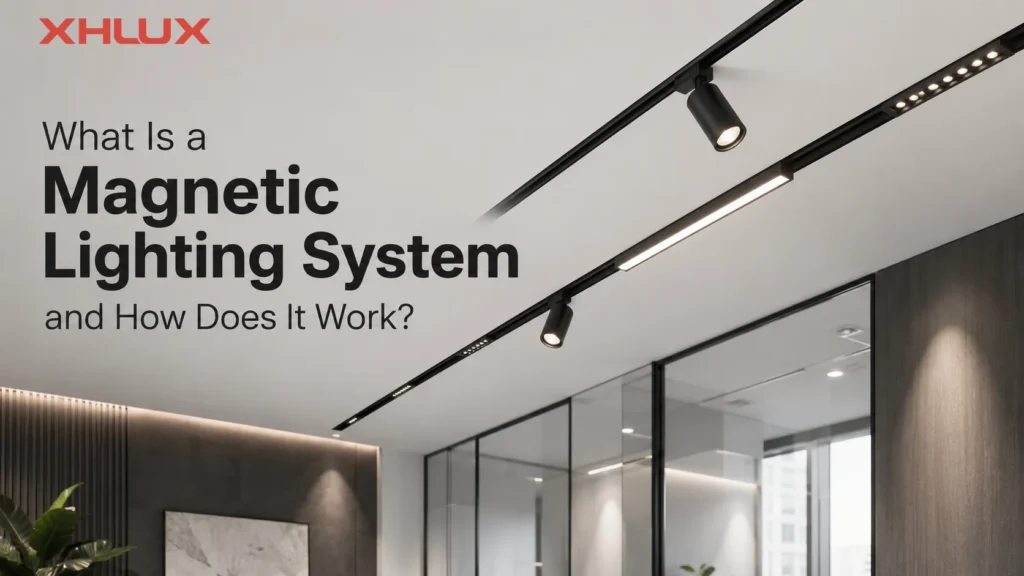
This is the fastest-growing segment in commercial track lighting. Where traditional H-type or L-type tracks lock fixtures into fixed positions, a magnetic system treats the ceiling as a reconfigurable canvas. For retailers who move displays monthly, gallery directors rotating exhibitions, or office managers reshuffling floor plans, that reconfigurability translates to near-zero labour cost for lighting changes.
Related: Track Lighting Systems: Types, Parts and Selection Guide — the pillar page covering all four track lighting families.
How a Magnetic Lighting System Works
The system has three layers:
1. Power conversion. A driver (power supply unit) converts standard mains AC voltage (120–240V) to 48V DC. This driver sits remotely — in the ceiling void, inside a junction box, or above a cabinet — not inside the visible fixture. The output is Safety Extra Low Voltage (SELV), a classification defined by IEC 61140 (protection against electric shock) with a voltage limit of 120V ripple-free DC — well above the 48V operating level. In the US market, the corresponding requirement appears in NEC Article 411, which sets a ≤60V DC threshold for low-voltage lighting systems. Both frameworks classify 48V DC as touch-safe.
2. The track. An aluminium extrusion containing continuous copper conductor strips carries the 48V DC current along its entire length. The track can be surface-mounted, recessed flush with the ceiling, or suspended on cables. It accepts fixtures at any position — there are no fixed mounting points or connector slots.
3. Magnetic attachment. Each LED light module has neodymium magnets and spring-loaded contact pins on its base. Placing the module onto the track causes the magnets to grip the aluminium rail while the contact pins press against the embedded copper strips, completing the circuit. The light turns on. To remove or reposition, pull the module off and snap it elsewhere — seconds per fixture.
Because the system operates at 48V DC, the conductors are safe to touch even when the track is powered. This is a meaningful safety difference from line-voltage (120–277V AC) traditional track, where exposed conductors carry mains voltage and require proper insulation and earthing.
Key Components
| Component | What It Does |
|---|---|
| Track rail | Aluminium profile (commonly 20mm or 35mm wide) housing copper conductor strips. Available in surface-mount, recessed, and suspended formats. |
| módulos LED | Spotlights (adjustable accent), linear bars (diffused ambient), wall washers (asymmetric vertical illumination), grille/laserblade lights (anti-glare), and pendant adapters. All magnetically attachable. |
| Power supply (driver) | Converts AC mains to 48V DC. Sized to the total wattage of all fixtures on the track. Supports DALI, Casambi BLE, ZigBee, 0–10V, and TRIAC dimming. |
| Connectors | L-joints (90° corners), T-joints (three-way splits), flexible connectors (variable angles), and power feeds (end-feed or mid-feed) to route the track around room geometry. |
| End caps and suspension kits | Terminate exposed track ends and suspend the track from higher structural ceilings using steel cables or threaded rods. |
Magnetic vs. Traditional Track Lighting
| Factor | 48V Magnetic Track | Traditional H/J/L Track |
|---|---|---|
| Voltaje | 48V DC (SELV, touch-safe) | 120–277V AC (requires insulation) |
| Mounting | Magnetic snap-on, tool-free | Mechanical clip or screw-lock |
| Reconfiguration | Reposition any fixture in seconds | Unclip, move, reclip — tools often needed |
| Profile | Ultra-slim (visible rail as narrow as 20mm) | Bulkier housing |
| Dimming and control | DALI, Casambi BLE, ZigBee, 0–10V, TRIAC | Typically TRIAC or 0–10V only |
| Upfront cost | Higher hardware cost | Lower hardware cost |
| Reconfiguration labour | Near zero | Requires access equipment and labour time |
The trade-off is straightforward: magnetic systems cost more to install but dramatically less to change. For projects where the lighting layout stays fixed for years, traditional track may be the more cost-effective choice. For spaces that reconfigure frequently — retail floors that rotate displays each season, galleries with changing exhibitions — the labour savings from tool-free repositioning can offset the higher hardware cost over the system’s operating life.
What to Look for in a Commercial-Grade Magnetic System
Track Build Quality
The track extrusion should be thick-gauge aluminium with visible copper conductors — thin aluminium profiles with barely-there copper strips indicate cost-cutting that can lead to poor electrical contact over time. The magnetic hold should feel firm; a module that wobbles on the track or disconnects with a light tug will cause reliability problems in commercial use.
Driver Quality
As with all LED fixtures, the driver is the component most likely to fail. Commercial-grade magnetic systems should offer branded driver options (Tridonic, Philips, Osram, HEP) with isolated topology and power factor above 0.9. The driver should be separately accessible for replacement — a failed driver behind a sealed ceiling is a maintenance problem waiting to happen.
Dimming Protocol Compatibility
Confirm the driver supports the building’s control protocol. DALI is the standard for wired commercial building management systems. Casambi BLE is increasingly specified for wireless retrofit projects where running new control wiring is impractical. ZigBee and Tuya are common in smart-home and light-commercial applications.
Proceso de dar un título
For European projects, look for ENEC or TÜV GS certification on both the track system and the power supply — these are third-party verified, not self-declared (unlike CE alone). For North America, UL listing. For Australia/New Zealand, RCM + SAA.
Anti-Glare Accessories
Commercial spaces with prolonged occupancy — offices, classrooms, healthcare waiting areas — should specify anti-glare modules (grille or deep-recessed optics) that keep UGR below 19, as required by EN 12464-1. Magnetic systems support the same accessory ecosystem as traditional track: honeycomb louvres, snoots, and barn-door attachments.
Factory-Direct Example: XHLUX DC48V Magnetic Track System
XHLUX (Shenzhen Xinghuo LED Tech, founded 2011) manufactures a DC48V magnetic track system alongside its traditional H-type track light and downlight ranges. The DC48V system includes:
- Track: surface-mounted, recessed, and suspended aluminium profiles
- módulos LED: adjustable spotlights, linear light bars, pendant adapters, and wall washers
- Power supply: 48V DC drivers with DALI, Casambi BLE, ZigBee, and 0–10V dimming support
- Common specs: CRI up to 98+, CCT 2700K–6500K plus tunable white, SDCM ≤ 3, beam angles 15°/24°/38°/60°, 5-year warranty
- Certifications: ENEC, TÜV GS, CE, CB, SAA (third-party tested)
For contractors and procurement teams evaluating magnetic track for commercial projects, the ability to source the complete system — track, modules, drivers, and accessories — from one manufacturer eliminates the integration risk of mixing components from different suppliers with slightly different tolerances.
See XHLUX DC48V Magnetic Track System → Full product specifications and installation details