XHLUX
XHLUX
A hanging downlight solves a high-ceiling problem by moving the light source closer to the task instead of asking a distant recessed fixture to do all the work.
The correct drop is not a universal number. It depends on the target plane, beam angle, sightlines, ceiling structure, cable route and how the fitting will be maintained.
If recessed, surface-mounted and suspended construction are still being compared, start here:
→ Métodos de instalación de focos LED empotrables: empotrados vs. montaje en superficie vs. ajustables
If the light must remain at ceiling level, compare the high-ceiling recessed alternative:
→ Large Downlight for High Ceilings: Cut-Out, Beam & Spacing
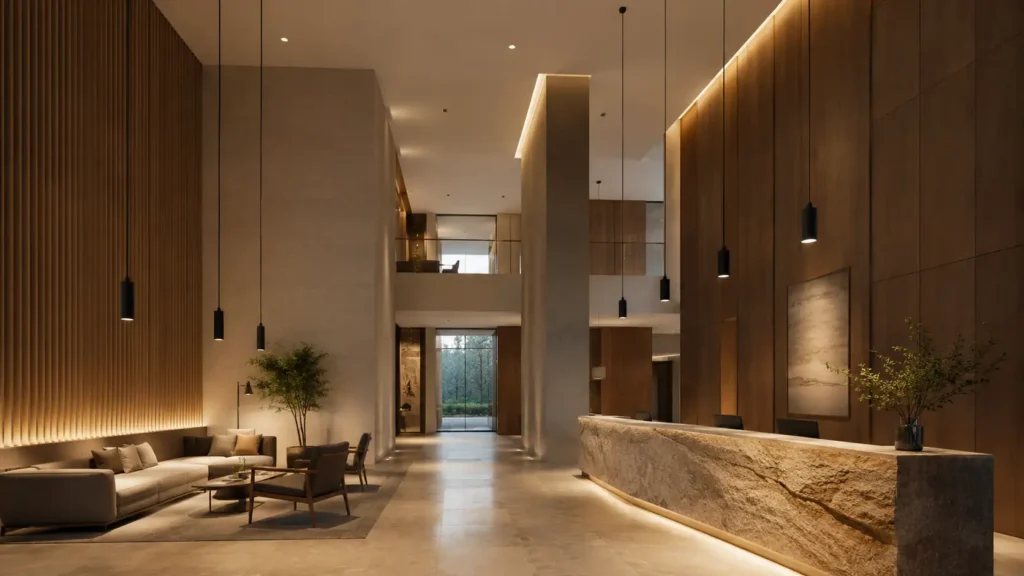
TL;DR: Lower a hanging downlight only enough to achieve useful beam coverage and intensity without blocking views, creating glare or weakening the ceiling composition. Define the target first, calculate the remaining throw distance, then verify structure, cable, driver, control and maintenance access with the exact fitting.
1. Start with the target, not the ceiling height
A six-metre ceiling does not automatically need a three-metre suspension. The useful dimension is the distance from the light source to the object, floor, counter or table that must be illuminated.
Mark the target plane before choosing the drop:
- Floor or circulation plane
- Reception or service counter
- Retail display surface
- Dining or meeting table
- Product, sculpture or feature object
- Vertical sign or wall surface
Then record the acceptable visual zone for the fitting. A suspended head over an open lobby can sit higher than one over a fixed counter because people may walk below it.
This is the main value of pendant-style downward lighting in a high space: the designer can separate architectural ceiling height from optical working height.
🎯 Does a higher ceiling always require a longer suspension?
No. The target location, beam, required effect and clear sightlines determine the useful source height, not the ceiling dimension alone.
2. Calculate the remaining throw after the drop
Lowering the fitting reduces the distance to the target. That changes beam diameter and can increase illuminance on the useful surface without changing the nominal wattage.
Estimate the initial beam diameter with:
Diámetro del haz ≈ 2 × distancia al objetivo × tan(ángulo del haz ÷ 2)
Consider a 6 m ceiling above a floor target. A ceiling-mounted source with a 30° beam produces an approximate 3.22 m beam diameter at the floor. Lower the source by 2 m, and the remaining 4 m throw produces about 2.14 m.
The shorter throw creates a smaller pool from the same beam angle. It may provide more useful accent intensity, but it also reduces coverage. A wider optic or additional fittings may be needed if the goal is broad general illumination.
Use this calculation only as a geometry check. Model-specific photometry must decide target illuminance, uniformity and glare.
🎯 Does lowering a downlight always make the space brighter?
It usually concentrates the beam over a shorter throw, but the useful result still depends on lumen output, optic, aiming, target reflectance and layout.
3. Set a drop zone, not one magic height
El hanging fixture drop height should be defined as an acceptable range before the final cable or rod length is ordered. That range must satisfy optics, people and architecture at the same time.
Establish three limits:
- Highest useful position: the beam still meets the target requirement.
- Lowest safe position: the fitting clears people, doors, equipment and sightlines.
- Preferred visual position: the fitting aligns with nearby beams, services or architectural datums.
The final point should fall inside all three limits. If no overlap exists, the fixture type or location is wrong.
For fixed tables or counters, the source can often sit lower because people do not walk beneath it. In open circulation, the minimum clear zone becomes more important than optical efficiency.
Rows of suspended heads also need a common datum. Small height differences become obvious across a long sightline, especially under exposed ceilings.
🎯 Should every hanging downlight in a room use the same drop?
Not necessarily, but changes should follow deliberate zones or architecture; accidental variations make the installation look poorly coordinated.
4. Check sightlines and glare before approving the drop
A lower source is closer not only to the target but also to people’s eyes. The fitting may enter views from entrances, stairs, mezzanines, counters or seated areas.
Check the visible aperture from the main approach directions. Deep baffles, controlled cut-off and dark internal reflectors can reduce source brightness, but they cannot hide a poorly located fitting from every viewpoint.
The diagram separates the key dimensions only. It is not a mounting-height or code prescription.
Consider reflections as well. A bright suspended aperture may appear in glass balustrades, polished counters or mirrors even when the direct view seems controlled.
🎯 What is the first visual test for a proposed drop?
View the sample from entrances, stairs and occupied positions; reject the height if the bright aperture dominates normal sightlines.
5. Verify structure, suspension and cable management
A suspended downlight installation must support the complete luminaire independently of decorative ceiling finishes. Confirm the structural fixing, suspension type, cable load, anti-sway needs and any seismic requirements that apply locally.
The electrical cable is not automatically a mechanical suspension. Some products use separate steel wires, rigid stems or purpose-designed suspension kits. Follow the exact manufacturer’s mounting instructions.
Check these items before ordering:
- Complete luminaire and driver weight
- Approved fixing point and substrate
- Maximum supplied cable or rod length
- Field-shortening or adjustment method
- Strain relief and cable entry
- Canopy dimensions and ceiling interface
- Anti-rotation or anti-sway provision
- Driver location and access
- Local clearance and electrical requirements
On exposed ceilings, cable appearance becomes part of the design. Power cables, suspension wires and control cables should run straight and terminate consistently.
🎯 Can the power cable carry the hanging downlight?
Only when the manufacturer explicitly designs and rates it as part of the suspension; otherwise use the specified independent mechanical support.
6. Match the application to the right optic and form
El mejor pendant downlight application has a defined target below the fitting and benefits from bringing the source closer. Counters, retail islands, reception desks and fixed tables are stronger candidates than open flexible floor areas.
Compare the main routes:
| Condición del proyecto | Strong first option | Main risk to check |
|---|---|---|
| High ceiling over fixed counter | Suspended downlight | Glare and exact drop datum |
| High ceiling over open floor | Ceiling-level high-output fitting | Long throw and maintenance |
| Exposed ceiling with repeated bays | Suspended row | Alignment and cable appearance |
| Flexible retail layout | Track or adjustable system | Future target movement |
| Decorative hospitality focal point | Pendant plus supporting layers | Expecting one fitting to do every job |
A narrow beam can help with a long throw, but it may create isolated bright spots. A wider beam improves coverage but loses peak intensity. Freeze the job and optic before increasing wattage.
For lumen planning by room and task, use:
→ ¿Qué nivel de brillo deben tener los focos LED empotrables? Guía de lúmenes por habitación.
🎯 When is a hanging downlight the wrong solution?
Avoid it when furniture moves frequently, sightlines cannot clear the fitting, structure is unsuitable or maintenance access becomes harder than a ceiling-level alternative.
7. Plan adjustment and maintenance from floor level
Suspension length often needs fine adjustment after installation. Ceiling tolerances, sloped structure and cable stretch can make identical factory lengths appear uneven.
Ask whether the suspension can be adjusted safely after the canopy is fixed. Confirm the adjustment range, locking method and whether excess cable can be stored without sharp bends or visible loops.
Maintenance is the other half of the decision. Lowering a source may make optics easier to clean, yet the fitting can still sit beyond safe reach. Check how technicians will access the driver, canopy, suspension lock and light engine.
If one fitting in a repeated row fails, replacement must match:
- Body dimensions and finish
- Light output and colour
- Beam and reflector appearance
- Cable or rod type
- Canopy and fixing position
- Exact suspension datum
Approve a service plan before a long row of custom-length fittings is ordered.
A 90-second drop-height decision
Use this sequence before releasing the specification:
- Define the target plane and lighting effect.
- Measure ceiling-to-target distance.
- Test the ceiling-level beam and output first.
- Lower the source only if the optical or visual result improves.
- Establish highest useful, lowest safe and preferred visual positions.
- Check sightlines, reflections and clearance.
- Verify structure, suspension, cables, drivers and controls.
- Install one sample and approve the real drop before ordering all lengths.
If the fitting has no documented target or acceptable height range, its drop remains an aesthetic guess rather than a lighting decision.
¿Qué hacer a continuación?
- Mark fixed targets and open circulation separately.
- Calculate the remaining throw at several candidate drops.
- Compare a suspended sample with a ceiling-level alternative.
- Review structural and electrical details with the responsible professionals.
- Freeze the drop only after checking sightlines from the occupied space.
- Ask XHLUX or another project supplier for photometry, suspension drawings, driver data and a representative sample before production.
Notas y fuentes
- The beam-diameter formula is an initial geometry check, not a replacement for model-specific photometry or maintained-light calculations.
- Structural fixing, suspension and electrical work must follow the exact luminaire instructions and applicable local requirements.
- External authorities are identified as plain text only when needed. No external website receives a clickable link.