 XHLUX
XHLUX

Tabla de contenido
- 1. Why Reliable Architectural Lighting Suppliers Are Essential to Project Success
- 2. What Is an Architectural Lighting Supplier?
- 3. Six Key Qualities That Define a Reliable Architectural Lighting Supplier
- 4. How to Verify if a Lighting Supplier Is Truly Reliable
- 5. Project Type Differences — Which Supplier Qualities Matter Most?
- 6. Common Mistakes to Avoid When Choosing a Lighting Supplier
- 7. FAQ About Architectural Lighting Suppliers
- Q1: What’s the difference between an architectural lighting supplier and a standard LED vendor?
- Q2: How do I know if a supplier can handle large commercial projects?
- Q3: Should every architectural fixture have IES files?
- Q4: Is it risky to work with overseas lighting suppliers?
- Q5: Can suppliers provide customization?
- 8. Conclusión
1. Why Reliable Architectural Lighting Suppliers Are Essential to Project Success
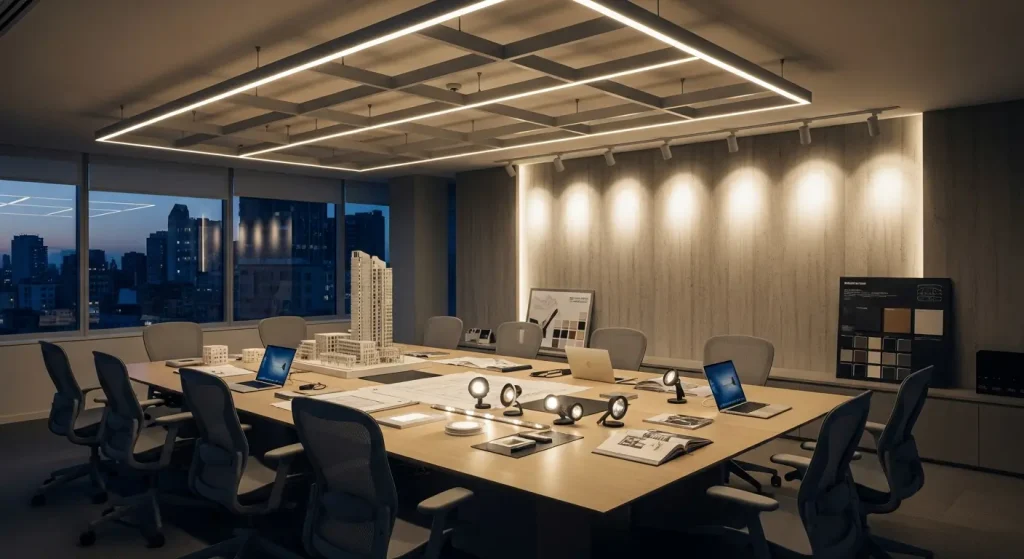
In modern commercial architecture—hospitality, retail, offices, cultural spaces, and mixed-use developments—lighting is no longer a secondary component. It determines how a space feels, functions, and performs. Poor lighting leads to:
- visual discomfort,
- reduced brand impact,
- energy inefficiency,
- costly change orders,
- inconsistent light quality, and
- project delays.
A reliable Architectural Lighting Supplier is far more than a “fixture vendor.” The best suppliers provide:
- technical consultation,
- photometric expertise,
- compliance documentation,
- project coordination,
- custom fixture solutions,
- on-time delivery, y
- long-term support.
This article delivers a practical, authoritative guide to help you evaluate your lighting partner with confidence.
2. What Is an Architectural Lighting Supplier?
A true Architectural Lighting Supplier is not just a product source—they operate as a technical partner throughout the project lifecycle.
Typical Areas of Supply:
- Architectural linear lighting
- Recessed downlights & spotlights
- Track lights & accent lighting
- Wall washing & grazing systems
- Custom-built fixtures for specialty conditions
- Exterior architectural luminaires
Unlike a general LED vendor, architectural suppliers:
- Provide IES files, photometric reports, and lighting calculations
- Understand cutoff, UGR, beam control, wall-washing, grazing, and vertical illumination
- Communicate directly with architects, lighting designers, MEP teams, and contractors
- Ensure standards compliance (UL, ETL, CE, DLC, RoHS)
- Support installation details, control integration, and aiming/commissioning
In short: The reliability of your lighting supplier determines the reliability of your lighting environment.
3. Six Key Qualities That Define a Reliable Architectural Lighting Supplier
Here are the six non-negotiable attributes that top-performing suppliers share.
3.1 Deep Lighting Expertise & Technical Knowledge
A great supplier must understand lighting not as a commodity, but as a building system.
They should be fluent in:
- Architectural lighting principles
- Glare control (UGR)
- Beam angles & optics
- Photometrics & IES files
- Color quality (CRI, TM-30, CCT consistency)
- Wall-washing & grazing techniques
- Indirect vs. direct lighting strategies
- Human-centric lighting
Resources like Signify Lighting Academy emphasize that technical accuracy is essential to performance.
Signals of a technically strong supplier:
- Can discuss lighting plans with architects fluently
- Provides photometric simulations
- Suggests proper optics for tasks & vertical illumination
- Understands IES recommendations & EN12464-1 standards
A supplier who understands lighting theory reduces risk and improves project outcomes.
3.2 High-Quality, Reliable Products
Lighting fixtures must perform consistently for years in demanding environments.
Buscar:
- High efficacy (≥100 lm/W)
- High CRI & good color consistency
- Robust thermal management
- Quality drivers (flicker-free, UL listed)
- Durable materials (aluminum, PC, PMMA, coated steel)
- Tested optics & stable beam distribution
- UL / ETL / DLC / CE certificates
- Long expected lifetime (50,000–70,000 hrs)
A reliable supplier provides consistent product data and transparent technical documentation.
Companies like ERCO y Zumtobel set benchmarks for durability and optical precision.
3.3 Customization Ability (OEM / ODM / Project-Specific Engineering)
Projects often require non-standard solutions:
- special fixture lengths
- unique housing colors
- custom optics
- modified installation brackets
- accesorios antirreflejos
- SKD export kits to reduce tariffs
- retrofit modifications for old buildings
A capable supplier should offer:
- CAD & BIM support
- Prototype development
- Custom-size linear lighting
- Custom apertures for ceiling integration
- Bespoke lenses or baffles
For many global buyers, OEM/ODM capability is a decisive advantage because it adds flexibility, reduces costs, and ensures consistency across multiple locations.
3.4 Stable Supply Chain & On-Time Delivery
Delays in lighting supply can halt entire construction schedules.
A reliable supplier must demonstrate:
- Large-scale production capacity
- Predictable lead times
- Rigorous quality inspection
- Robust packaging & export handling
- Ability to fulfill large-volume orders
- Reliable logistics partners
For international projects, suppliers must also understand:
- SKD packaging
- Export documentation
- Customs compliance
- Long-distance freight protection
A supply chain failure is a project failure—reliability is everything.
3.5 Strong Engineering Support & Project Assistance
Reliable lighting suppliers actively support the implementation phase.
They should provide:
- Installation details
- Wiring & control diagrams
- Recomendaciones sobre el ángulo del haz
- Mounting methods for abnormal ceilings
- Troubleshooting for contractors
- On-site or remote technical support
- Aiming & commissioning assistance
- Dimming system programming (DALI / 0–10V / CASAMBI)
As stated by Fagerhult y Acuity Brands Lighting Education, project support is essential for seamless integration.
This is especially critical in hospitality, museum, retail, or public building projects where quality control is high.
3.6 Robust After-Sales Service & Warranty Structure
True reliability continues after installation.
Look for suppliers offering:
- 3–5 year warranty coverage
- Clear replacement procedures
- Spare part availability
- Modular design for easy maintenance
- Technical training for on-site staff
- Quick response for failures or adjustments
After-sales support protects the project’s long-term performance and reduces ownership costs.
4. How to Verify if a Lighting Supplier Is Truly Reliable
Use this actionable checklist:
✔ Project Experience
¿Tienen? real case studies with site photos?
✔ Technical Literacy
Can they explain UGR, optics, IES files, and lighting strategy?
✔ Certifications
Do products have UL / ETL / DLC / CE documentation?
✔ Custom Capability
Can they modify fixtures or produce OEM/ODM solutions?
✔ Photometric Files
Can they provide IES files for every architectural fixture?
✔ Delivery Reliability
Have they delivered large-volume orders on time?
✔ After-Sales
Do they provide warranties and spare parts?
✔ Scalability
Can they support both small and large projects?
This checklist eliminates low-quality or inexperienced vendors immediately.
5. Project Type Differences — Which Supplier Qualities Matter Most?
Supplier selection depends on the nature of your project.
5.1 Hospitality (Hotels / Resorts / Restaurants)
Priorities:
- color quality
- warm ambience
- decorative + architectural integration
- reliable dimming control
- long-term durability
Hospitality projects require both aesthetic excellence y system reliability.
5.2 Offices & Public Spaces
Priorities:
- visual comfort (UGR <19)
- uniformity & consistent lighting levels
- energy efficiency
- daylight integration
- EN12464-1 compliance
EN12464-1 reference.
5.3 Retail & Flagship Stores
Priorities:
- high CRI
- precision beam control
- adjustable track systems
- consistent CCT
- fast lead times for seasonal changes
Retail is dynamic—suppliers must be flexible and accurate.
5.4 Museums / Galleries / Exhibition Spaces
Priorities:
- beam accuracy
- high CRI (90–97)
- multiple beam spreads
- tunable control
- stable dimming
ERCO and Zumtobel’s museum resources highlight the need for absolute optical precision.
5.5 International Projects & Large-Scale Procurement
Priorities:
- stable supply chain
- SKD packaging
- export documentation
- multi-project consistency
- scalable production capacity
For global contractors or distributors, supplier scalability is everything.
6. Common Mistakes to Avoid When Choosing a Lighting Supplier
❌ Only comparing fixture prices
Lighting is <1% of building cost but impacts 100% of perception.
❌ Ignoring lighting technical expertise
Cheap fixtures with poor optics create massive long-term costs.
❌ Overlooking maintenance and warranty
A bad supplier disappears after installation.
❌ Choosing suppliers with weak supply chains
Delays kill commercial project timelines.
❌ Assuming all LED suppliers are the same
Architectural lighting requires specialized knowledge and precision.
The right mindset:
You are not buying “lights.”
You are buying performance, stability, and long-term value.
7. FAQ About Architectural Lighting Suppliers
Q1: What’s the difference between an architectural lighting supplier and a standard LED vendor?
Architectural suppliers offer design support, photometrics, engineering documentation, and project integration—not just products.
Q2: How do I know if a supplier can handle large commercial projects?
Look for evidence: portfolio, certification, delivery track record, and supply chain capacity.
Q3: Should every architectural fixture have IES files?
Yes. Photometric data is mandatory for lighting design and simulation.
Q4: Is it risky to work with overseas lighting suppliers?
Not if they have stable supply chains, SKD export ability, certifications, and project support.
Q5: Can suppliers provide customization?
Strong suppliers offer full OEM/ODM and project-specific customization.
8. Conclusión
Project success depends on the quality of your lighting partner.
A reliable supplier provides:
- strong technical expertise
- high-quality products
- stable supply chain
- customization ability
- engineering support
- after-sales service
Choosing the right architectural lighting supplier means choosing a better:
- lighting environment,
- user experience,
- building performance,
- brand expression,
- and long-term value.
For international buyers, suppliers with OEM/ODM/SKD capability offer additional advantages in cost, flexibility, and scalability.
The more professional, stable, and knowledgeable the supplier, the better your project will perform—now and in the future.