 XHLUX
XHLUX

Tabla de contenido
- 1. Why Brutalist Lighting Has Returned to the Architectural Conversation
- 2. What Is Brutalist Lighting?
- 3. Where Brutalist Lighting Excels in Large-Scale Architectural Projects
- 4. Where Brutalist Lighting Fails in Large-Scale Projects
- 5. How to Use Brutalist Lighting Effectively in Large Architectural Projects
- 6. Ideal Applications for Brutalist Lighting
- 7. Where Brutalist Lighting Should NOT Be Used
- 8. FAQ About Brutalist Lighting
- 9. Conclusion
1. Why Brutalist Lighting Has Returned to the Architectural Conversation
Brutalism—rooted in the exposed raw concrete, monolithic massing, and rugged structural honesty of the 1950s–1970s—has re-emerged as a major design trend in contemporary architecture and lighting. Its aesthetic vocabulary is grounded in:
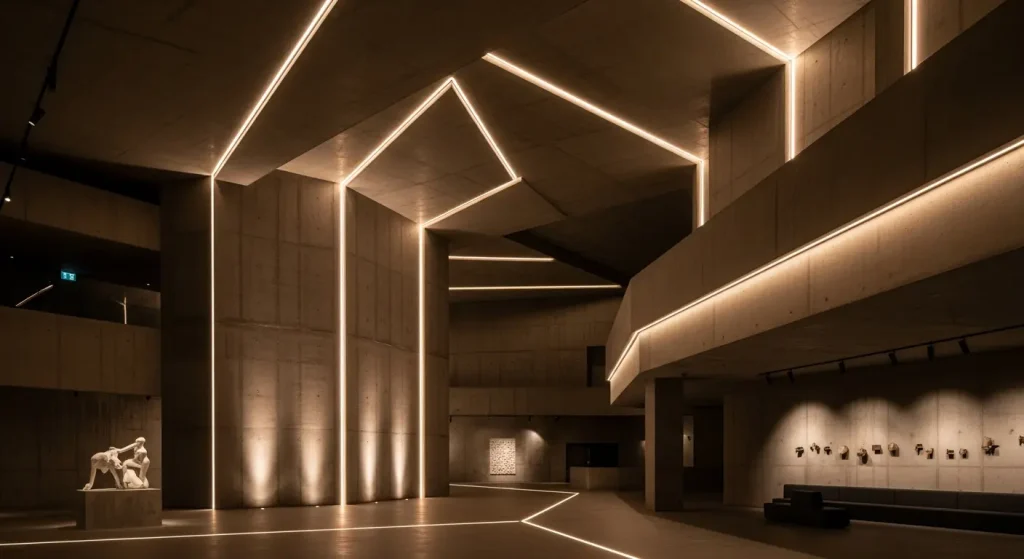
- Unfinished materials
- Raw textures
- Expressed structure
- Geometric forms
- Minimal ornamentation
- Heavy, industrial character
In lighting design, Brutalist Lighting translates this into:
- Sculptural fixtures
- Deep, shadow-rich contrasts
- Industrial-grade metals
- Concrete-like finishes
- Minimalist yet massive forms
- Exposed lighting systems with an architectural presence
As modern commercial spaces shift toward “material truth + architectural honesty”, Brutalism offers both aesthetic drama and cultural relevance.
But one question remains crucial for architects, developers, and lighting designers:Is Brutalist Lighting practical for large-scale architectural projects—or is it only a niche boutique concept?
This article answers that question by examining Brutalist Lighting’s strengths, limitations, implementation strategies, and best-fit architectural environments.
2. What Is Brutalist Lighting?
Brutalist Lighting centers on the material expression of light, rather than soft ambience or decorative warmth.
Key Material Foundations
- Raw concrete
- Rough stone
- Darkened metals (blackened steel, oxidized bronze, cast iron)
- Exposed track systems
- Heavy structural components
Lighting Characteristics
- High contrast between bright accents and deep shadows
- Emphasis on architectural geometry and volume
- Sculptural luminaires with bold massing
- Deep-set optics and anti-glare engineering
- Industrial-style trackheads or surface-mounted fixtures
Typical Brutalist Fixture Types
- Concrete pendant lights
- Stone or cast-metal wall sconces
- Oversized industrial track lights
- Black deep-recessed downlights
- Monolithic geometric ceiling fixtures
3. Where Brutalist Lighting Excels in Large-Scale Architectural Projects
Brutalist Lighting is surprisingly practical when used in the right architectural contexts.
3.1 Emphasizing Structure & Large-Scale Massing
Brutalist Lighting naturally enhances:
- Exposed concrete walls
- Large columns and beams
- Mega-volume spaces
- Loft-like industrial interiors
- Airports, transportation hubs, museums
Its heavy visual language pairs seamlessly with large-scale architectural forms.
3.2 Perfect for Industrial, Minimalist & Material-Driven Design
Modern commercial spaces—especially hospitality and cultural venues—often use:
- Concrete
- Natural stone
- Raw brick
- Metal cladding
- Minimalist detailing
Brutalist fixtures reinforce these material palettes.
Zumtobel architectural cases show how raw textures and strong contrasts elevate modern cultural spaces.
3.3 Strong Visual Identity for Branding
Restaurants, boutique retail, art-driven brands, and experiential spaces often use Brutalist Lighting to create a memorable atmosphere.
It conveys:
- Honesty
- Strength
- Character
- Architectural confidence
This makes it effective for brand storytelling.
3.4 Natural Fit for Public Architecture
Large public buildings already use raw, durable materials.
Examples where Brutalist Lighting excels:
- University buildings
- Libraries
- Cultural centers
- Metro stations
- Government buildings
- Museum circulation areas
In such environments, Brutalist Lighting amplifies the architectural intention.
3.5 Industrial-Grade Lighting = Durability
Many Brutalist fixtures leverage industrial construction:
- Thick metal housings
- High heat tolerance
- Impact resistance
- Long life cycles
Deep-recessed downlights and black-finish architectural luminaires also provide strong glare control—validated by IES lighting best practices.
4. Where Brutalist Lighting Fails in Large-Scale Projects
Despite its strengths, Brutalist Lighting can be challenging or inappropriate in many environments.
4.1 Overly Heavy Atmosphere & Visual Weight
Large-scale projects often require visual balance.
Excessive Brutalist elements can create:
- Oppressive darkness
- Heavy emotional tone
- Low perceived comfort
- Excessive contrast
Not ideal for user comfort–critical spaces.
4.2 Not Suitable for Soft, Comfort-Oriented Environments
Ejemplos:
- Healthcare
- Senior living
- Schools
- Daycare centers
- Family-friendly retail
These spaces require softness, warmth, and psychological ease—contradicting Brutalism’s visual intensity.
Human-centric lighting research from Signify emphasizes emotional comfort.
4.3 High Material & Maintenance Burden
Problems include:
- Concrete fixtures are heavy & fragile
- Metal fixtures can rust without proper finish
- Mounting requires reinforced structure
- Cleaning textured surfaces is difficult
Large-scale rollouts amplify these challenges.
4.4 May Not Align with Brand Identity
Not every brand wants:
- Harshness
- Rawness
- Industrial weight
- Stark contrasts
Brutalist aesthetic must match brand tone and messaging.
4.5 Not Designed for High-Output Functional Lighting
Brutalist fixtures emphasize:
- Material expression
- Narrow beams
- Iluminación de acento
They are not designed for:
- Warehouse-level illuminance
- Big-box retail
- Uniform high-lumen environments
For such needs, industrial/functional luminaires must be used—supported by EN12464-1 guidance on illuminance standards.
5. How to Use Brutalist Lighting Effectively in Large Architectural Projects
To make Brutalist Lighting successful at scale, designers must combine aesthetic strategy + lighting engineering.
Strategy 1: Use Three Lighting Layers
Never rely solely on Brutalist fixtures.
Usar:
- Iluminación ambiental (general illumination)
- Iluminación de acento (structure, artwork, features)
- Material lighting (grazing walls, highlighting textures)
ERCO guidance emphasizes layering for architectural clarity.
Strategy 2: Avoid “Full Brutalism” Across an Entire Project
Blend Brutalist fixtures with:
- Architectural linears
- Recessed downlights
- Wall-wash systems
- Indirect lighting for balance
This prevents visual heaviness.
Strategy 3: Choose Engineering-Friendly Materials
Instead of real concrete:
- Lightweight composites
- GFRC shells
- Resin-concrete mixes
- Faux-stone finishes
This reduces weight while preserving texture.
Strategy 4: Use Proper Photometrics to Prevent Dim Spaces
Key tools:
- Wall-wash
- Grazing techniques
- Indirect cove light
- Beam spreads 24° / 36° / 60° for general illumination
Architectural lighting ensures functionality.
Strategy 5: Prioritize Maintenance, Supply Chain, and Longevity
Especially for:
- Export projects
- High-traffic spaces
- Multi-level buildings
- International hotel chains
Durability and serviceability matter as much as aesthetics.
6. Ideal Applications for Brutalist Lighting
Brutalist Lighting works beautifully in:
- Hotel lobbies & public atriums
- Upscale restaurants, bars, speakeasies
- Art museums, galleries, exhibition halls
- High-end fashion retail
- Corporate lobby spaces
- Cultural institutions
- University architecture buildings
- Transit hubs, metro entrances
- Exterior colonnades & public plazas
These environments benefit from material expression + structural drama.
7. Where Brutalist Lighting Should NOT Be Used
Avoid in:
- Hospitals
- Medical clinics
- Schools (K–12)
- Comfortable family-oriented spaces
- Big-box retail
- Industrial high-bay functional lighting
- Warm, cozy brand concepts
- Rapid-build, budget-constrained commercial rollouts
Brutalist Lighting requires aesthetic alignment + construction capacity.
8. FAQ About Brutalist Lighting
Q1. Does Brutalist Lighting make a space too dark?
Yes—if used alone.
Combine with wall-wash, indirect light, and linear systems to maintain balance.
Q2. Can Brutalist Lighting be combined with high-tech interiors?
Sí.
Black linears + industrial metal + concrete finishes blend well with tech-centric atmospheres.
Q3. Are concrete luminaires suitable for large projects?
Generally no.
Weight + fragility + installation complexity → use lightweight alternatives.
Q4. Can LED architectural lighting achieve a Brutalist effect?
Absolutamente.
Using optics + contrast + shadow + material lighting, designers can create Brutalist moods without heavy fixtures.
Q5. Do large-scale Brutalist projects require custom fixtures?
Often yes.
Scale, material, and visual impact may require bespoke solutions.
9. Conclusion
Yes — but only when used strategically and selectively.
Ideal para:
- High-end commercial spaces
- edificios públicos
- Art + culture venues
- Hospitalidad
- Statement architecture
- Material-driven environments
Not suitable for:
- Comfort-first applications
- High-lumen functional spaces
- Budget-driven rollouts
- Environments needing warmth & softness
The winning formula:
Brutalist Fixtures + Architectural Lighting Systems (linear, wall-wash, indirect, downlights)
→ Strength + Balance + Function + Aesthetic clarity
With the right design team and photometric planning, Brutalist Lighting can scale beautifully—even in monumental architecture.