 XHLUX
XHLUX

Inhaltsverzeichnis
- 1. What Is Commercial Suspended Track Lighting?
- 2. Main Types of Suspended Track Lighting Systems
- 3. Common Track Fixture Types & Their Applications
- 4. Key Technical Specs and Selection Criteria
- 5. Application Scenarios — How to Use Suspended Track Lighting
- 6. Step-by-Step Selection Workflow
- 7. FAQ About Commercial Suspended Track Lighting
- 8. Final Summary
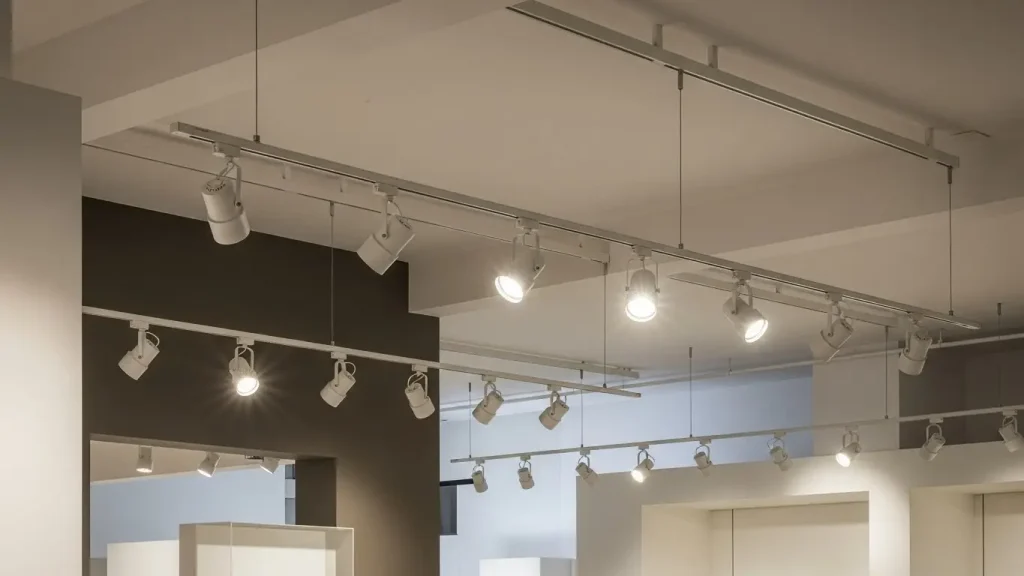
Commercial suspended track lighting is an overhead lighting system where electrified track rails are suspended from the ceiling using cables or rods. It is widely used in retail stores, galleries, showrooms, offices, and hospitality spaces because it provides flexible positioning, adjustable beam control, and modern architectural aesthetics.
1. What Is Commercial Suspended Track Lighting?
Suspended track lighting is a ceiling-mounted track system hung using steel cables, rods, or suspension kits, allowing the track to float below the structural ceiling. Compared with surface-mounted or recessed tracks, suspended systems:
- Create a clean, modern architectural look
- Work well with high ceilings (3–10 m)
- Allow lighting to be brought closer to the merchandise or workspace
- Support flexible reconfiguration without rewiring the ceiling
- Enable a mixture of spotlights, linear luminaires, wall-washers, and pendants
1.1 How It Differs From Other Track Installations
| Track Type | Montage | Best Use Case |
|---|---|---|
| Surface-Mounted | Direct to ceiling | Renovations, low ceilings |
| Recessed Track | Flush inside ceiling | Premium office, gallery |
| Suspended Track | Hanging by cable/rod | High ceilings, retail, showrooms |
Suspended systems are especially useful in commercial spaces where:
- Ceilings are high or uneven
- Existing electrical routing is difficult to modify
- Retail or showroom layouts change frequently
Suspended systems = maximum flexibility + modern design reliability.
2. Main Types of Suspended Track Lighting Systems
2.1 Linear Suspended Track Lighting
The most common type, consisting of:
- Straight linear rails
- Sleek minimal design
- Compatible with most track heads (H/J/L type)
- Ideal for retail aisles, galleries, offices
Suitable for long spans and uniform grid layouts.
2.2 Curved / Flexible / Custom-Shaped Suspended Tracks
Architectural designers increasingly use:
- Curved rails
- S-shape tracks
- Modular multi-segment configurations
These allow creative lighting paths for:
- Luxuseinzelhandel
- Museums
- Hotels
- Brand experience centers
Curved systems guide customer movement and enhance visual flow.
2.3 Single-Circuit vs Multi-Circuit / Three-Phase Tracks
Single-Circuit Tracks
- All fixtures controlled together
- Low cost
- Best for small stores or simple layouts
Multi-Circuit (Two- / Three-Phase) Tracks
- Fixtures grouped into independent circuits
- Ideal for scene control and layered lighting
- Suitable for large retail, showrooms, museums
For example:
| Circuit | Funktion |
|---|---|
| Circuit 1 | Ambientebeleuchtung |
| Circuit 2 | Akzentbeleuchtung |
| Circuit 3 | Display windows |
Multi-circuit tracks are used in many XHLUX projects — see Commercial Track Lights.
2.4 Different Suspension Methods
Steel Cable Suspension
- Most common
- Adjustable height
- Clean appearance
- Ideal for modern retail and offices
Rigid Rod Suspension
- More stable than cables
- Preferred for industrial-style design or heavy-duty fixtures
Rod + Cable Hybrid
- Used for long continuous track runs
- Adds stability to prevent sway
Suspension method affects loading, safety compliance, and visual aesthetics.
2.5 Surface-Mounted vs Suspended vs Recessed: When to Use Which?
| Method | Am besten geeignet für | Pros | Einschränkungen |
|---|---|---|---|
| Ausgesetzt | High ceilings, retail, showrooms | Flexible, aesthetic | Requires suspension kits |
| Surface-Mount | Renovation | Easy installation | Less architectural appeal |
| Vertieft | Corporate, galleries | Cleanest look | Needs solid ceiling structure |
Suspended tracks offer the best balance of flexibility + aesthetics, especially for commercial spaces.
3. Common Track Fixture Types & Their Applications
Suspended tracks can host an entire family of fixtures.
3.1 Narrow Beam Spotlights (Accent Heads)
- 10°–24° beam angles
- High CRI (>90 or Ra97)
Ideal für:
- Product highlighting
- Art displays
- Window displays
- Focal merchandising
Spot heads with COB chips + PMMA lenses deliver high-contrast accent lighting.
Explore XHLUX Track Spotlights.
3.2 Flood Heads (General / Ambient Lighting)
- 36°–60° beam
Used for:
- Retail ambient coverage
- Büros
- Shared spaces
- Circulation areas
Flood heads create even, soft lighting.
3.3 Wall-Washer and Asymmetric Heads
Vertical illumination is crucial for:
- Display walls
- Advertising graphics
- Museum exhibition walls
Asymmetric optics provide uniform brightness from top to bottom.
3.4 Pendant & Decorative Track Fixtures
Suspended tracks can carry:
- Pendant lights
- Cylindrical decorative fixtures
- Dining and hospitality lighting
This is increasingly used in restaurants and café chains.
See LED-Pendelleuchten for examples.
3.5 Linear Track Luminaires
For spaces needing clean, uniform light:
- Büros
- Co-working spaces
- Hallways
- Retail back zones
Explore XHLUX Lineare Beleuchtung for suspended linear modules.
4. Key Technical Specs and Selection Criteria
To build a professional suspended track system, you must evaluate optical and electrical specs properly.
4.1 Beam Angle & Photometric Distribution
| Beam Type | Angle | Anwendungsfall |
|---|---|---|
| Narrow Spot | 10°–15° | Products, artwork |
| Medium Spot | 20°–24° | Feature displays |
| Flood | 36°–60° | General illumination |
| Wall Wash | Asymmetric | Vertical surfaces |
4.2 Lumens & Lux Recommendations
General guidance:
- Retail: 800–2000 lm per head
- Galleries: 1500–3000 lm
- Offices: 300–500 lux on work plane
4.3 CCT & CRI Selection
| Raum | CCT | CRI |
|---|---|---|
| Einzelhandel | 3000–3500 K | CRI 90–95+ |
| Galerie | 3000–4000K | CRI 95+ |
| Büro | 3500–4000 K | CRI ≥90 |
| Gastfreundschaft | 2700–3000 K | CRI ≥90 |
SDCM < 3 is recommended for high uniformity.
4.4 Dimming & Controls
Suspended systems work with:
- Triac
- 0–10 V
- DALI-2 (see DALI-Allianz)
- Bluetooth / WiFi (Tuya, Casambi)
- Multi-circuit switching
DALI-2 is recommended for premium commercial applications.
4.5 Structural Safety & Installation Standards
Consider:
- Load-bearing capacity
- Suspension kit certifications
- Ceiling material
- Vibration resistance
- Electrical compliance (UL / CE / RoHS)
XHLUX provides complete Beleuchtungslösungen including safety documentation.
5. Application Scenarios — How to Use Suspended Track Lighting
5.1 Retail Stores
Goals:
- Highlight products
- Guide customer flow
- Reduce shadows on shelves
Empfohlen:
- Spotlights + wall washers
- 3-circuit track for scene switching
- CRI 90–95+
- 3000–3500 K
5.2 Galleries & Exhibition Spaces
Requirements:
- High CRI (95–97)
- Minimal glare
- Clean beam edges
Verwenden:
- Zoom spotlights
- Framing projectors
- Wall washers
XHLUX Zoombare Schienenleuchten are ideal.
5.3 Offices & Co-working Spaces
Verwenden:
- Linear suspended track luminaires
- Low-glare optical designs (UGR<19)
- 3500–4000K neutral white
Combine with LED-Linearleuchten for modern design.
5.4 Hospitality: Restaurants / Hotels / Bars
Verwenden:
- Warm white (2700–3000K)
- Pendant fixtures + accent spots
- Decorative elements to shape atmosphere
5.5 Automobile Showrooms / Furniture Stores / High-End Retail
Requirements:
- High-ceiling lighting
- Multi-circuit controls
- Strong accent beams (15°–24°)
Suspended tracks allow perfect aiming for large items.
XHLUX Lighting Realistic Case Study
A luxury furniture showroom used XHLUX suspended track lighting with CRI 95 spotlights and 3-circuit tracks. After installation, the showroom achieved a 34% increase in customer engagement due to improved product highlight quality and cohesive lighting zones.
6. Step-by-Step Selection Workflow
Step 1 — Define Space Requirements
- Deckenhöhe
- Visual goals
- Merchandise or tasks
- Layout flexibility needs
Step 2 — Choose Track System & Suspension Method
- Linear vs curved
- Cables vs rods
- Single vs multi-circuit
Step 3 — Select Fixtures
- Spot / flood / wall-wash
- Pendants / linear modules
- Beam angle + CRI + CCT
Step 4 — Electrical & Safety Requirements
- Load capacity
- Driver compatibility
- Control system (DALI / 0–10V)
Step 5 — Allow Future Flexibility
- Modular heads
- Replaceable optics
- Easy maintenance access
7. FAQ About Commercial Suspended Track Lighting
What type of track lighting is best for high ceilings?
Suspended track lighting is ideal because it lowers the lighting plane closer to the activity zone.
What is the difference between suspended and surface track lighting?
Suspended systems hang from cables or rods for better flexibility and aesthetic design.
Can suspended track lights be dimmable?
Yes. With compatible drivers, they work with Triac, 0–10V, and DALI-2 systems.
Is multi-circuit track worth it?
Yes for commercial spaces needing scene control, such as retail and showrooms.
Can wall-washer heads be used on suspended tracks?
Absolutely. They are ideal for merchandise walls and gallery displays.
8. Final Summary
Commercial suspended track lighting is one of the most flexible, modern, and visually effective solutions for commercial interiors. Whether you’re building a retail store, gallery, office, or showroom, suspended systems offer:
- Architectural aesthetics
- Adjustable lighting
- Einfache Rekonfiguration
- Compatibility with LED, DALI, and smart controls
- Excellent lighting quality for products & experiences
To build your project with professional-grade lighting:
👉 Explore XHLUX Commercial Track Lighting:
👉 Need a layout or lighting plan? Get a free proposal:
👉 Browse full product categories: