 XHLUX
XHLUX

Inhaltsverzeichnis
- Why Hotel Corridor Downlights Fail
- Why Hotel Corridor Lighting Requires Special Attention
- What Type of Downlights Are Best for Hotel Corridors?
- Key Factors to Consider When Selecting Hotel Corridor Downlights
- Recommended Lighting Layout for Hotel Corridors
- Illuminance Targets: How Bright Should Hotel Corridors Be?
- Common Mistakes in Hotel Corridor Downlight Selection
- Controls, Dimming, and Hotel Operations (Often Overlooked)
- How to Choose the Right Downlights for Your Hotel Project
- Comparison Table: Basic vs Professional Hotel Corridor Downlights
- FAQ About Hotel Corridor Downlights
- Welcome to discuss business cooperation
Why Hotel Corridor Downlights Fail
Hotel corridors require lighting that runs for long hours, supports guest comfort (especially at night), and maintains a consistent, high-end atmosphere. Yet many corridor projects still end up with glare, uneven lighting, cold “clinical” mood, oder frequent driver/LED failures—even when the downlights look good on paper.
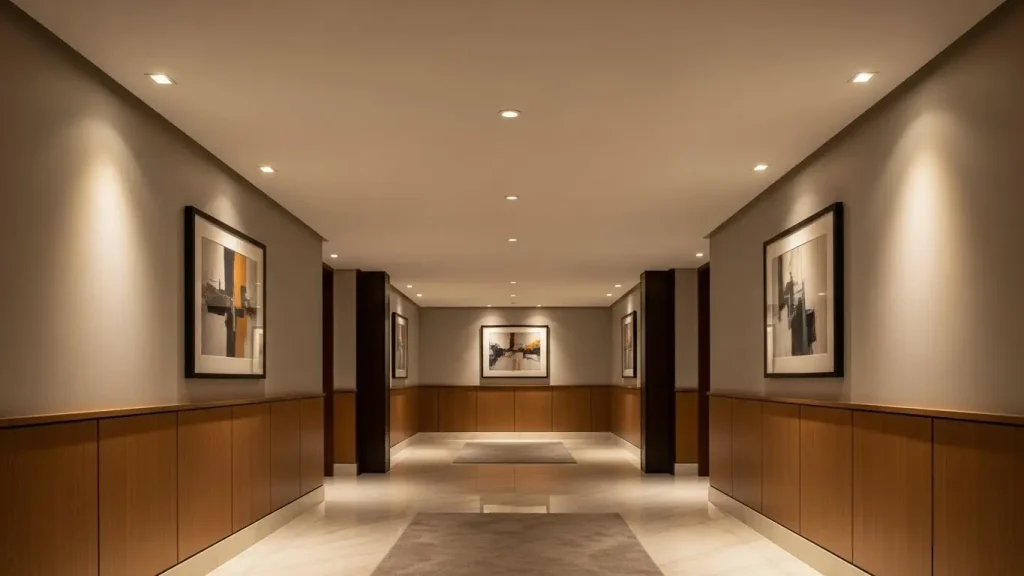
Poorly selected hotel corridor downlights can quietly damage the guest experience: harsh brightness after waking up, uncomfortable glare while walking with luggage, and a corridor that feels “cheap” instead of calm. Operationally, failures create maintenance pressure, guest complaints, and reputation risk—because corridors are high-visibility zones used every day.
This guide explains how to select the right LED-Einbaustrahler for Hotelkorridorbeleuchtung, balancing Blendschutz, Sehkomfort, color temperature, CRI, Strahlwinkel, lighting uniformity, and long-hour reliability—so the corridor feels premium and stays stable with minimal maintenance.
For fixture selection and project support, you can reference:
- LED-Spot-Downlights (core corridor downlight category)
- LED-Linearbeleuchtung (optional continuous lines / wall-grazing / ambient backbone)
- Lighting Solutions & Services (spec support, control options, layout guidance)
- Projektfälle (application references)
- Contact & Quote (fast project-based selection)
Why Hotel Corridor Lighting Requires Special Attention
Why is hotel corridor lighting important?
Hotel corridor lighting ensures guest safety, visual comfort, and a consistent atmosphere—especially during nighttime and low-activity hours.
Corridors are not like retail aisles or office hallways. They are “transitional spaces,” but they are also part of the hotel’s emotional brand experience. Guests use them:
- Arriving with luggage (often tired, eyes adapting from outdoor brightness)
- Returning late at night (low-adaptation state, glare sensitivity is high)
- Walking to elevators, rooms, emergency exits (safety and wayfinding matter)
- During quiet hours when atmosphere must feel calm, not aggressive
How corridors differ from offices, malls, and residential hallways
A corridor in a hotel is typically:
- Long-hour operation (often 18 hours/day, sometimes 24/7)
- Low-noise visual environment (calmness matters)
- High repetition (many identical fittings; consistency is critical)
- Guest-facing (any flicker, color mismatch, or glare is noticed)
This is why “just choose wattage + cut-out” is the wrong approach. Corridor downlights must be selected as part of hospitality lighting design, where comfort and operational stability are equally important.
What Type of Downlights Are Best for Hotel Corridors?
What downlights are best for hotel corridors?Recessed LED downlights with good glare control, soft beam distribution, and high reliability are ideal for hotel corridor lighting.
Most professional corridor solutions use Einbaustrahler because they:
- Keep ceilings clean and consistent (important for premium perception)
- Reduce fixture clutter along long corridor runs
- Allow controlled optics for glare reduction
- Integrate well with emergency lighting, sensors, and dimming scenes
The “hotel-grade corridor downlight” checklist
A corridor-appropriate recessed downlight typically includes:
- Glare-control optics (deep recess, baffle, honeycomb option)
- Stable beam distribution (no harsh floor hotspots)
- Consistent color across batches (tight binning, SDCM < 3 for premium consistency)
- High-quality driver (low failure rate, stable dimming)
- Long lifespan planning (target L70/B50 lifetime 50,000 hours)
- Durable thermal design (e.g., Kühlkörper aus Aluminiumdruckguss)
- Optical components that hold shape and clarity over time (e.g., PMMA-Linse)
- Light source quality (e.g., COB-Chip options for smooth, controlled beams)
If you’re building a corridor spec library, start from Spot Downlight Series and shortlist beam angles + glare-control structures by corridor width and ceiling height.
Key Factors to Consider When Selecting Hotel Corridor Downlights
This section is the “avoid mistakes” core. Every factor below connects guest experience to a practical selection decision.
Glare Control and Visual Comfort
Why is glare control important in hotel corridors?
Glare control prevents discomfort—especially for guests walking through corridors at night or after waking up.
Glare is the #1 complaint that guests won’t verbalize. They won’t say “UGR is too high.” They will simply feel:
- irritated
- rushed
- less comfortable walking down the corridor
Where glare comes from in corridors
- Downlights with shallow optics (bright source visible at normal viewing angles)
- Too narrow beam in a low ceiling (high luminance hotspots)
- Over-bright horizontal illuminance relative to surroundings
- Reflective finishes (gloss paint, polished tiles, mirrors, metal trims)
Practical glare-control targets
While corridor requirements vary, many designers use indoor comfort thinking similar to standards like EN 12464-1 when talking about glare and visual comfort, especially in adjacent “work-like” zones. Some projects target comfort levels such as UGR < 19 (commonly referenced for office-type comfort) as a conservative benchmark—especially near reception-adjacent corridors or staff circulation.
Glare-control design moves you can actually specify
- Deep recessed anti-glare structure (dark baffle / deep reflector)
- Honeycomb or louver accessories for critical sightlines
- Medium beam angles instead of ultra-narrow in low ceilings
- Dimming scenes at night (lower output reduces discomfort drastically)
XHLUX internal link (selection shortcut):
For corridor-friendly glare-control downlights, start your shortlist in LED-Spot-Downlights, then filter by optics depth and beam angle.
Color Temperature: Creating a Calm Hotel Atmosphere
Corridor CCT is not a “taste decision.” It’s a brand and comfort decision.
Typical CCT ranges in hospitality corridors:
- 2700K–3000K: warm, premium, calm (often used in upscale hotels)
- 3000K–3500K: common mainstream corridor choice (balanced warmth + clarity)
- Avoid overly cool CCT for guest corridors unless the design concept specifically requires it (cooler light can feel clinical, especially at night)
Why warmer CCT often wins in corridors
- Better for night adaptation (less harsh perception)
- Supports calmness and quiet luxury mood
- Works well with wood, stone, and warm interior finishes
A practical CCT selection table
| Hotel Type / Design Goal | Recommended CCT | Why it works |
|---|---|---|
| Luxury / boutique, “quiet premium” | 2700K–3000K | warm, calming, upscale atmosphere |
| Business hotel, modern neutral | 3000K–3500K | clean, comfortable, still warm enough |
| Design-led concept (specific palette) | 3000K or tuned | consistency with interior finishes |
If your project uses dimming, consider “night scene” levels that reduce output and visual stress rather than forcing the same brightness 24/7.
Beam Angle and Light Distribution
Beam angle is not a corridor decoration choice—it controls lighting distribution, perceived safety, and whether the floor becomes patchy with hotspots.
What beam angles typically work in corridors
Most corridors benefit from medium beam angles that provide coverage without harsh spots:
- 24°–36°: common corridor range for balanced distribution
- 36°–60°: used when ceilings are lower and uniformity is priority, or when downlights are spaced farther apart
Avoid extremes unless you have a specific intent:
- Very narrow beams can create dramatic pools and glare
- Very wide beams can feel flat and under-emphasize rhythm
Corridor distribution goals
A well-designed corridor downlight distribution should:
- Avoid “dot-dot-dot” bright spots on the floor
- Create a calm visual rhythm along the axis
- Provide comfortable vertical brightness so walls don’t feel like dark tunnels
Design insight: In corridors, wall brightness often matters as much as floor brightness. Standards and studies often reference wall illuminance ranges (commonly tens to low hundreds of lux depending on use). (Fagerhult)
Optional upgrade path: In premium corridors, adding a soft wall wash or linear detail can dramatically increase perceived quality without increasing overall brightness. That’s where LED-Linearbeleuchtung becomes useful as a complementary layer.
CRI and Color Quality
Corridors don’t “sell products,” but CRI still influences guest perception:
- Skin tones in mirrors or reflective surfaces
- Artwork and decorative elements on corridor walls
- The “premium feel” of finishes and materials
Typical CRI approach:
- CRI ≥ 80: basic baseline for hospitality corridors
- CRI ≥ 90: recommended for higher-end hotels, boutique properties, and corridors with strong design elements
For premium projects, aim higher and keep consistency tight:
- CRI > 90 / Ra97 for luxury-grade color fidelity
- SDCM < 3 for consistent appearance across a long corridor run (very noticeable when many fixtures repeat)
Energy Efficiency and Long Lifespan LED (Long-Hour Operation Reality)
Hotel corridors run long hours, so total cost of ownership matters more than fixture price.
What long-hour operation demands
- Stable driver performance (lower failure rate)
- Thermal stability (to protect lumen maintenance)
- Consistent output and color over time
Practical targets used in commercial specs:
- Efficiency: 100–130 lm/W (project-dependent)
- Lifetime planning: L70/B50 50,000 hours (reduces maintenance cycles)
- High-quality materials and thermal management: Kühlkörper aus Aluminiumdruckguss, robust driver design
- Optical stability: PMMA-Linse for controlled distribution
- Light source stability: COB-Chip options for smooth beam and consistent appearance
Recommended Lighting Layout for Hotel Corridors
How should downlights be arranged in hotel corridors?
Downlights should be evenly spaced to provide uniform illumination while maintaining a calm and comfortable visual rhythm.
Layout is where many projects fail—even with good products. Corridor success comes from spacing + optics + ceiling height working together.
A practical corridor spacing framework (starting points)
Actual spacing must be validated by photometric simulation, but these are common starting heuristics:
- Medium beams (24°–36°): closer spacing to maintain uniformity
- Wider beams (36°–60°): slightly larger spacing possible
- Lower ceilings: reduce beam intensity and tighten glare control
Chart: Corridor layout decision table (spec-first)
| Corridor Condition | Recommended Approach | Warum |
|---|---|---|
| Narrow corridor + low ceiling | medium-to-wide beam + deep glare control | reduces hotspots and discomfort |
| Long corridor with repetitive fittings | tight SDCM + consistent optics | prevents visible “patchwork” effect |
| Premium corridor with artwork | CRI ≥ 90 + balanced vertical brightness | improves perceived quality |
| High traffic + long hours | 50,000h planning + stable driver | lowers maintenance burden |
Symmetry and rhythm (guest psychology)
Corridors feel “premium” when lighting rhythm is:
- visually consistent
- not overly bright
- not chaotic or uneven
Designers often aim for a “soft cadence” rather than dramatic theatrical pools of light—because corridors are used repeatedly and must remain comfortable.
Internal link (solution support):If you want layout support (beam + spacing + glare control choices), use Lighting Solutions & Services or review similar implementations in Projektfälle.
Illuminance Targets: How Bright Should Hotel Corridors Be?
This is where many buyers ask for a number. The correct answer is: it depends on concept, finishes, and safety requirements—but we can still provide professional ranges.
Many references suggest corridor light levels around 100 lux for general corridors/hallways. Some hospitality-focused guidance mentions corridor/walkway minimums around 10 foot-candles (~108 lux) for accessibility-driven discussions. (switchhotelsolutions.com.au)Other compilations list hotels corridors/elevators/stairs often in the 10–20 foot-candles range (about 108–215 lux).
Practical interpretation (what professionals do)
- Use illuminance targets as a baseline
Then balance:
- glare control (comfort)
- vertical brightness (walls and faces)
- night scene dimming (lower output during quiet hours)
Key hotel corridor insight:A corridor can feel brighter without increasing lux if wall brightness and uniformity are improved. That’s why adding a subtle wall component (or improving distribution) can outperform simply increasing wattage.
Common Mistakes in Hotel Corridor Downlight Selection
Competitors often list generic mistakes. Here are corridor-specific failure modes tied to guest experience and operations.
Mistake 1: Over-bright corridors (especially at night)
- Guests feel harshness after waking up
- The corridor loses “calm premium” atmosphere
- Brightness becomes stress, not safety
Fix: add dimming scenes; specify optics for comfort; reduce ceiling luminance.
Mistake 2: Poor glare control
- Discomfort, especially in long corridors with repeated fixtures
- Guests avoid looking up; corridors feel hostile
Fix: deeper anti-glare structures, medium beams, better aiming strategy, night dimming.
Mistake 3: Cold color temperature
- Corridors feel clinical, not hospitality
- Warm interior finishes look “wrong”
Fix: 2700K–3000K for premium, 3000K–3500K for mainstream; avoid “office-cool” unless concept demands it.
Mistake 4: Buying on price only (maintenance trap)
- Driver failures become a constant task
- Color shifts across replacements become visible
- Guest perception becomes inconsistent
Fix: specify commercial-grade lifetime planning, stable driver, consistent binning (SDCM < 3), and proven materials.
Controls, Dimming, and Hotel Operations (Often Overlooked)
Corridor lighting is one of the best places to use control strategy because usage patterns are predictable.
Why dimming matters in hotel corridors
- Day/evening/night scenes reduce discomfort and improve mood
- Lower output at night reduces glare sensitivity
- Energy savings scale quickly due to long operating hours
Typical control options
- DALI / DALI-2 scene control for centralized building management (common in hospitality projects) — reference: DALI-Allianz
- 0–10V or other local dimming methods depending on region and system design
Motion or presence sensors (use carefully)
Sensors can reduce energy, but poor tuning creates a “cheap” guest experience (lights popping on/off). If using sensors:
- keep transitions smooth (fade-in/out)
- maintain a minimum background level for comfort and safety
- ensure uniform behavior across the corridor, not patchy activation
How to Choose the Right Downlights for Your Hotel Project
Here is a corridor-focused selection checklist you can use in procurement, design review, and contractor coordination.
Hotel corridor downlight selection checklist
Visual comfort
- Low-glare optics and deep recessed structure
- Avoid visible bright source at normal viewing angles
- Comfort targets (project-dependent; conservative projects consider office-like comfort references such as UGR < 19 in sensitive zones)
Atmosphere
- CCT aligned with brand: typically 2700K–3500K (premium often 2700–3000K)
- Stable dimming scenes for night comfort
Performance
- Balanced beam angle and distribution (avoid floor hotspots)
- Good uniformity across long runs
- CRI baseline ≥ 80; upscale projects often CRI ≥ 90 / Ra97
- Color consistency: SDCM < 3 for premium continuity
Operations
- Efficiency target often 100–130 lm/W
- Long lifespan LED planning: L70/B50 50,000 hrs
- Reliable driver (low failure rate)
- Thermal management: die-cast aluminum heatsink
- Optical stability: PMMA lens
- Light source option: COB chip for controlled beam quality
xhlux project reality
In corridor projects that run long hours, the difference between “looks OK at opening” and “stays premium after 12–24 months” usually comes down to:
- glare-control optics (guest comfort)
- stable drivers and thermal design (maintenance)
- tight color consistency across batches (visual continuity)
That is why corridor downlight selection should be treated as both a Gästeerlebnis decision and an operations decision.
Next step:
- Start your corridor downlight shortlist: LED-Spot-Downlights
- Add architectural ambient detail if needed: LED-Linearbeleuchtung
- Review application references: Projektfälle
- Request spec + layout support: Contact & Quote
Comparison Table: Basic vs Professional Hotel Corridor Downlights
| Decision Area | “Basic” Choice | Professional Corridor Choice | Warum das wichtig ist |
|---|---|---|---|
| Blendschutz | shallow optics | deep anti-glare optics / baffle | night comfort, less irritation |
| Color quality | CRI ~80 | CRI ≥ 90 (premium Ra97) | premium perception, artwork quality |
| Farbkonsistenz | loose bins | SDCM < 3 | long corridor visual continuity |
| Lifetime planning | unspecified | L70/B50 50.000 Std. | fewer call-backs and replacements |
| Thermische Auslegung | minimal | Kühlkörper aus Aluminiumdruckguss | lumen maintenance and reliability |
| Distribution | hotspot risk | balanced beam + uniformity | calm rhythm, safer walking |
| Controls | on/off only | dimming scenes (e.g., DALI) | night comfort + energy savings |
FAQ About Hotel Corridor Downlights
What is the best lighting for hotel corridors?
A layered approach works best: recessed LED-Einbaustrahler for a clean ambient base, combined with strong Blendschutz, warm/neutral CCT, and (when needed) subtle wall or linear lighting for premium atmosphere.
How bright should hotel corridor lighting be?
Many references suggest corridor lighting around 100 lux as a baseline, with project-specific adjustment based on finishes, safety requirements, and night scene dimming strategy. (lightingequipmentsales.com)
What color temperature is best for hotel hallways?
Most hospitality corridors use warm to neutral white. Premium hotels often prefer 2700K–3000K, while mainstream hotels commonly use 3000K–3500K, avoiding overly cool “office-like” lighting. (Goodlux Lighting)
Are LED downlights suitable for hotel corridors?
Yes—recessed LED downlights are one of the most common solutions because they provide clean aesthetics, controllable distribution, and compatibility with dimming and long-hour operation requirements.
How do hotels reduce glare in corridor lighting?
Use deep anti-glare optics (baffles/honeycombs), avoid ultra-narrow beams in low ceilings, aim for balanced distribution and night dimming scenes, and control reflections from glossy finishes.
Welcome to discuss business cooperation
Hotel corridor lighting is not a “small detail.” It’s one of the most repeated guest touchpoints and one of the longest-operating lighting zones in a property. The right corridor downlight selection protects both:
- Guest comfort (glare control, calm atmosphere, safe wayfinding)
- Operations (long lifespan, stable drivers, lower maintenance cycles)
If you want corridor lighting that works long-term, build your selection around:
- Deep Blendschutz optics
- Warm/neutral color temperature aligned to hospitality mood
- Balanced Strahlwinkel and distribution (no harsh floor hotspots)
- CRI ≥ 90 / Ra97 where premium feel matters
- SDCM < 3 for consistent long-corridor appearance
- 100–130 lm/W efficiency and L70/B50 50.000 Std. planning
- Robust construction: Kühlkörper aus Aluminiumdruckguss, PMMA-Linse, COB-Chip options
Direct next steps:
- Corridor downlight selection: LED-Spot-Downlights
- Add architectural ambient layers: LED-Linearbeleuchtung
- See references: Projektfälle
- Request a corridor spec + layout recommendation: Contact & Quote
If you’d like, please tell me the corridor width, ceiling height, and the target hotel category (luxury/business/economy). I will then provide you with a ready-to-use lighting design proposal, including recommended beam angles, spacing logic, color temperature/color rendering index targets, and a procurement list.