 XHLUX
XHLUX

Inhaltsverzeichnis
- Why Hotel Lighting Design Fails Even in “High-End” Projects
- What Is Hotel Lighting Design?
- Why LED Downlights Are Essential in Hotel Lighting Design
- Key Hotel Areas Where LED Downlights Are Used
- Key Design Tips for Hotel Lighting Using LED Downlights
- Common Mistakes in Hotel Lighting Design with Downlights
- How to Optimize Hotel Lighting Design for Long-Term Performance
- Comparison Table: LED Downlights vs Decorative Fixtures in Hotel Lighting Design
- FAQ About Hotel Lighting Design
- Welcome to discuss business cooperation
Why Hotel Lighting Design Fails Even in “High-End” Projects
Hotel lighting design must balance three things at the same time: aesthetics, guest comfort, Und long-term operational efficiency. Yet many hotel projects still fail because lighting decisions are made based on “looks” or basic parameters alone—then problems appear after opening.
Harsh brightness, visible glare, inconsistent lighting tone, or flicker can quietly reduce guest satisfaction and damage a hotel’s perceived quality. The most painful part is that guests rarely complain directly. They simply feel the corridor is “uncomfortable,” the lobby is “not premium,” or the guestroom is “not relaxing.” Meanwhile, operations teams deal with failure rates, driver issues, and high replacement labor cost—especially in long-hour zones.
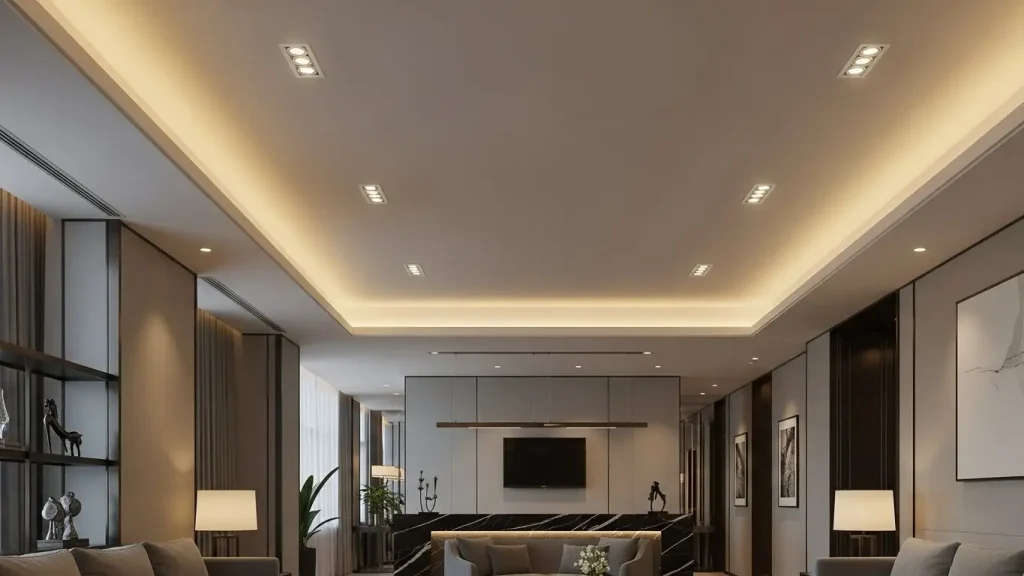
When specified and applied correctly, LED-Einbaustrahler can become the “workhorse” of hospitality lighting: creating elegant, comfortable Umgebungsbeleuchtung with clean ceilings, stable performance, and controllable running cost. This guide explains hotel lighting design in a way that translates “atmosphere and experience” into fixture selection + layout logic + operational reliability—so the hotel looks better, feels better, and stays stable for years.
If you’re already building a fixture shortlist, start with hotel-ready LED spot downlights as the core recessed solution, then expand with lineare Beleuchtungssysteme for architectural lines and wall effects.
What Is Hotel Lighting Design?
What is hotel lighting design?Hotel lighting design is the strategic use of lighting to enhance guest comfort, define atmosphere, and support hotel operations across different spaces.
Hotel lighting is not simply “making the space bright.” It is a designed experience that shapes:
- First impression (lobby arrival, perceived luxury level)
- Visual comfort (no glare, no fatigue, no harsh transitions at night)
- Wayfinding and safety (corridors, elevator lobbies, stairs, emergency paths)
- Behavior and mood (calm guestroom, inviting restaurant, premium lounge)
- Operational efficiency (long-hour operation, reduced maintenance, predictable replacement cycles)
what we see in real hotel projects
In many hotel retrofits and new-build specifications, the “lighting failure” isn’t because LED technology is weak—it’s because the design did not translate hospitality requirements into measurable decisions: Blendschutz, CCT, CRI, Gleichmäßigkeit, Und driver reliability. When those are specified properly, even a “simple” recessed downlight system can produce a noticeably more premium atmosphere with fewer call-backs.
For project-level support (layout logic, spec alignment, and product matching), hotels often start from a solution approach rather than individual SKU—see lighting solutions & services.
Why LED Downlights Are Essential in Hotel Lighting Design
Why are LED downlights important in hotels?LED downlights provide uniform, comfortable ambient lighting while maintaining clean aesthetics and energy efficiency in hotel spaces.
LED downlights are often the backbone of hospitality lighting because they deliver four core advantages that other decorative fixtures cannot scale as effectively:
1) Clean ceiling aesthetics
Hotels require a calm visual language—especially in corridors and guestrooms. Recessed downlights keep the ceiling clean, reduce clutter, and let decorative elements (pendants, feature chandeliers, wall fixtures) stand out where they should.
2) Scalable ambient lighting with stable distribution
A hotel is a repeat environment: dozens (or hundreds) of rooms, long corridors, multiple floors. Downlights are suited for repeated spacing and predictable lighting uniformity, which supports a consistent brand experience across the property.
3) Better control over comfort and glare
Hospitality comfort is often “silent”—guests don’t praise low glare; they punish discomfort. Downlights can be engineered with deep recess, baffles, and controlled optics to reduce visible brightness and improve Sehkomfort.
4) Operating efficiency and reliability
Hotels run long hours. Downlights—when built with commercial-grade drivers and thermal design—can reduce replacement frequency and support predictable maintenance schedules, especially when targeting L70/B50 lifetime (50,000 hrs).
Internal link (shortlist): Start your core hotel downlight evaluation from LED-Spot-Downlights and build variants by beam angle, glare-control structure, and CRI.
Key Hotel Areas Where LED Downlights Are Used
Hospitality lighting works best when you design by zone, not by fixture. Below are the most common hotel spaces where Einbaustrahler play a primary or supporting role.
Hotel Lobby Lighting
The lobby must feel premium, clear, and welcoming—without looking over-lit.
- Downlights provide a calm ambient base for circulation
- Accent downlights can highlight concierge desks, art, brand walls
- Decorative fixtures add the “signature” statement, but downlights keep the space functional and balanced
Pro tip: In premium lobbies, CRI matters because finishes (stone, wood, metal) can look “flat” under low-quality light. Many projects specify CRI ≥ 90, sometimes pushing toward Ra97 for luxury material truth.
For architectural continuity (coves, lines, ceiling details), lobbies often pair downlights with linear lighting solutions.
Hotelkorridorbeleuchtung
Corridors are used frequently and often at night. The corridor must feel safe, calm, and non-glary.
- Downlights provide consistent rhythm and wayfinding
- Glare control is critical for night comfort
- Uniformity matters more than dramatic contrast
- Reliability matters because replacement labor is expensive across long runs
If you want corridor-specific downlight guidance, use the same selection logic but prioritize: UGR / glare control, medium beam distribution, stable driver, and consistency (SDCM < 3 where premium).
Guestroom Lighting
Guestrooms must support relaxation and perceived cleanliness—without fatigue.
- Downlights can provide ambient base lighting (soft, comfortable)
- Bedside fixtures and wall lights deliver task and mood
- Dimming scenes are a major experience upgrade (even more than “more lumens”)
Guestrooms often benefit from warm CCT (commonly 2700K–3000K for premium relaxation, 3000K–3500K for modern mainstream). Pair this with high color quality to make skin tones and fabrics look natural.
For projects seeking consistent guestroom style, you can also consider architectural layers like pendant lighting options in suites or feature rooms—while maintaining downlights as the functional base.
Restaurant & Public Areas
These spaces are mood-sensitive and strongly influenced by color quality.
- Warm/neutral CCT builds comfort and appetite
- High CRI preserves food and interior material appearance
- Glare control matters for dining comfort (no harsh spots on tables)
In dining and lounge zones, it’s common to use downlights as a base and add accents strategically.
Key Design Tips for Hotel Lighting Using LED Downlights
This is the “spec-first” section where hotel experience becomes measurable decisions.
Choose the Right Color Temperature
Color temperature (CCT) is one of the strongest drivers of hotel atmosphere.
Common hospitality ranges:
- 2700K–3000K: premium, warm, relaxing (boutique/luxury)
- 3000K–3500K: mainstream hotel balance (clean + comfortable)
- Avoid overly cool light in guest-facing zones unless the design concept demands it (cool light often feels “office-like” at night)
Hotel rule of thumb:Warmth supports relaxation. Neutral supports clarity. Choose based on brand positioning and interior finishes—not personal preference.
Focus on Glare Control and Visual Comfort
Why is glare control important in hotel lighting design?Glare control improves visual comfort and prevents guest discomfort, especially in corridors and guestrooms.
Glare is where many hotel projects lose perceived quality. A space can be “bright enough,” yet still feel uncomfortable if the light source is visually harsh.
What to specify for glare control
- Deep recessed anti-glare structure (baffle / deep reflector)
- Optional honeycomb/louver for sensitive zones
- Avoid very narrow beams in low ceilings
- Consider comfort benchmarks in critical zones; many spec documents reference values like UGR < 19 for glare-sensitive environments (often discussed in relation to indoor comfort standards)
Engineering details that correlate with comfort
- Controlled optics: PMMA-Linse or well-designed reflectors for stable beam shaping
- Smooth beam quality: COB-Chip options often produce cleaner distribution
- Thermal stability: Kühlkörper aus Aluminiumdruckguss helps maintain consistent output and reduces color shift over time
Ensure Lighting Uniformity
Uniformity in hotels is not only technical—it’s psychological. A corridor with patchy “dot-dot-dot” pools feels cheaper than one with a calm rhythm.
Uniformity design actions
- Choose beam angles appropriate to ceiling height and spacing
- Avoid spacing that creates dark gaps or harsh hotspots
- Balance horizontal (floor) and vertical (wall) brightness to prevent a tunnel effect
Practical goal: consistent visual rhythm, not maximum brightness.
Use High-Quality LED Drivers for Reliability
Drivers are the hidden “maintenance multiplier.” Hotels run long hours, and failures compound across many fixtures.
What reliable projects usually target
- Stable driver design with low failure rate
- Flicker-controlled performance (guest comfort and perceived quality)
- Compatibility with control systems where needed (scene setting)
- Lifetime planning aligned with L70/B50 50.000 Std. for LED systems
Operational reality:A downlight that is slightly cheaper but fails more often becomes far more expensive after labor, guest disruption, and replacement scheduling.
For consistent supply and project support, many commercial buyers also value ODM customization and stable production capability—review about XHLUX for manufacturing and service positioning.
Common Mistakes in Hotel Lighting Design with Downlights
What are common hotel lighting design mistakes?Common mistakes include excessive brightness, poor glare control, unsuitable color temperature, and choosing low-quality fixtures.
Here are the most common hotel-specific mistakes—and how they impact both guests and operations.
Mistake 1: Too bright in guest-facing zones
Over-bright corridors and guestrooms feel harsh—especially at night when guests are more glare-sensitive.
Fix: use layered lighting and dimming scenes; reduce ceiling glare and redistribute light to walls and key areas.
Mistake 2: Cold CCT in hospitality areas
Cool CCT can make a corridor feel clinical and reduce the “warm premium” perception.
Fix: typically 2700K–3500K depending on hotel positioning; keep consistency across zones.
Mistake 3: Ignoring glare control optics
Shallow downlights with visible bright sources reduce comfort even if illuminance is “correct.”
Fix: specify deep anti-glare structures and verify viewing angles.
Mistake 4: Buying based on initial cost only
Cheaper fixtures often create higher total cost due to driver failures, inconsistent color, and frequent maintenance.
Fix: specify commercial targets: efficiency 100–130 lm/W, L70/B50 50.000 Std., stable driver, and premium projects should push CRI > 90 / Ra97 mit SDCM < 3.
How to Optimize Hotel Lighting Design for Long-Term Performance
This is where “premium design” meets “hotel operations.”
The hotel downlight optimization checklist
Comfort & experience
- Low glare design; deep optics; controlled beam distribution
- Warm/neutral CCT aligned with brand (often 2700–3500K)
- Scene control and dimming for night comfort
- Vertical brightness strategy to avoid tunnel feeling
Color & brand consistency
- CRI ≥ 90 for premium guest-facing areas; consider Ra97 in luxury zones
- SDCM < 3 for long corridors and repeated fixture runs
- Stable optics and thermal design to prevent color shift
Operations
- Commercial lifetime planning: L70/B50 50.000 Stunden
- Energy efficiency: 100–130 lm/W (project-dependent target range)
- Robust construction: Kühlkörper aus Aluminiumdruckguss, stable driver
- Easy installation and maintenance planning (tooling, cut-out consistency, replacement strategy)
Controls & protocols
For multi-scene hospitality control, many projects integrate protocols such as DALI-2 (scene setting, zoning, building integration) via the DALI-Allianz. If you are considering standardized modular interfaces in broader lighting ecosystems, Zhaga is also a common reference point.
Comparison Table: LED Downlights vs Decorative Fixtures in Hotel Lighting Design
| Area | LED-Einbaustrahler | Decorative Fixtures (Pendants / Wall Lights) | Best Practice |
|---|---|---|---|
| Primary role | Ambient base, uniformity, comfort | Signature mood, feature moments | Use downlights as backbone + decor as highlights |
| Scale suitability | Excellent for large quantities | Limited (cost & complexity) | Combine for cost-effective premium feel |
| Wartung | Predictable if driver quality is high | Often harder (custom parts) | Downlights reduce operational burden |
| Blendschutz | Strong when optics are deep & controlled | Varies widely | Specify low glare for guest-facing zones |
| Brand consistency | High (repeatable spec) | High for feature areas only | Downlights ensure consistency floor-to-floor |
FAQ About Hotel Lighting Design
1) What lighting is best for hotels?
Hotels perform best with layered lighting: downlights for ambient comfort, accents for focal points, and task lighting where needed. The key is comfort (glare control), consistent CCT, and reliable operation.
2) What color temperature is best for hotel lighting?
Most hospitality projects use 2700K–3500K depending on positioning. Luxury and boutique hotels often prefer 2700K–3000K, while mainstream modern hotels commonly use 3000K–3500K.
3) Are LED downlights suitable for hotels?
Ja. LED-Einbaustrahler are widely used because they provide clean aesthetics, stable ambient lighting, and strong scalability—especially when specified with low glare optics and reliable drivers.
4) How bright should hotel lighting be?
There is no single number that fits all areas. Lobbies, corridors, guestrooms, and restaurants require different targets. The better approach is balancing brightness with Sehkomfort, glare control, and vertical illumination (walls) for a premium feel.
5) How does lighting affect hotel guest experience?
Lighting shapes first impression, comfort at night, perceived quality of finishes, and overall relaxation. Poor glare control and wrong CCT reduce comfort and make spaces feel less premium.
6) What CRI should hotels use?
A common baseline is CRI ≥ 80, but guest-facing premium areas often perform better with CRI ≥ 90. Luxury zones may specify Ra97 for maximum color fidelity and material truth.
Welcome to discuss business cooperation
The most successful hotel lighting design treats lighting as both Gästeerlebnis Und hotel operations:
- Verwenden LED-Einbaustrahler as the scalable ambient foundation
- Specify comfort: deep optics, Blendschutz, and practical targets (often referencing concepts like UGR < 19 in sensitive zones)
- Choose brand-aligned color temperature (typically 2700K–3500K)
- Protect perception with CRI > 90 / Ra97 in premium areas
- Maintain consistency with SDCM < 3 for repeated runs
- Build for operations: efficiency 100–130 lm/W, L70/B50 50.000 Std., stable drivers
- Prefer robust construction: Kühlkörper aus Aluminiumdruckguss, PMMA-Linse, COB-Chip options
- Keep procurement flexible with ODM customization and clear maintenance planning
Direct next steps
- Start your hotel downlight shortlist: LED-Spot-Downlights
- Add architectural ambient layers: LED-Linearbeleuchtung
- See implementation references: Projektfälle
- Get solution-level support: Lighting Solutions & Services
- Compare families quickly: Produktkatalog
- Request a spec + layout recommendation: Contact & Quote
If you can provide information on the hotel type (luxury/business/economy), ceiling height, and key areas (lobby, corridors, guest rooms, restaurant), we can provide a proposal that includes recommended color temperature/color rendering index targets, beam angle strategies, glare control options, and a layout plan that can be used directly for construction.