XHLUX
XHLUX
Search for linear lighting products and you may see several names: line light fixture, linear light, linear fixture and linear fitting. But do these terms actually describe the same thing?
When buyers search for a line light fixture, linear light or linear fixture, they are often looking at overlapping product ideas—not three sealed, unrelated categories. Different suppliers still label the same long housing with different words.
We often see RFQs that match on name and still miss on mount, optic or control. The terminology may vary, but the actual fixture design, optical system and installation requirements matter more than the wording used in a catalog.
TL;DR: A line light fixture usually describes a long, continuous lighting form. Linear lighting is the broader category. Catalog names swap freely—check mount, size, light output, optics and drivers before you treat two labels as identical products.
Innehållsförteckning
- 💡 1. What is a line light fixture?
- 🔄 2. Is a line light fixture the same as linear lighting?
- 🏷️ 3. Why do suppliers use different names for similar linear products?
- ✅ 4. What should you check beyond the product name?
- 🔧 5. Are linear light fittings and linear fixtures the same?
- 📍 6. How to choose the right linear lighting product for a project
- Vad man ska göra härnäst
- 🏁 Conclusion
- Vanliga frågor
💡 1. What is a line light fixture?
A line light fixture is typically a luminaire with a long, continuous lighting form.
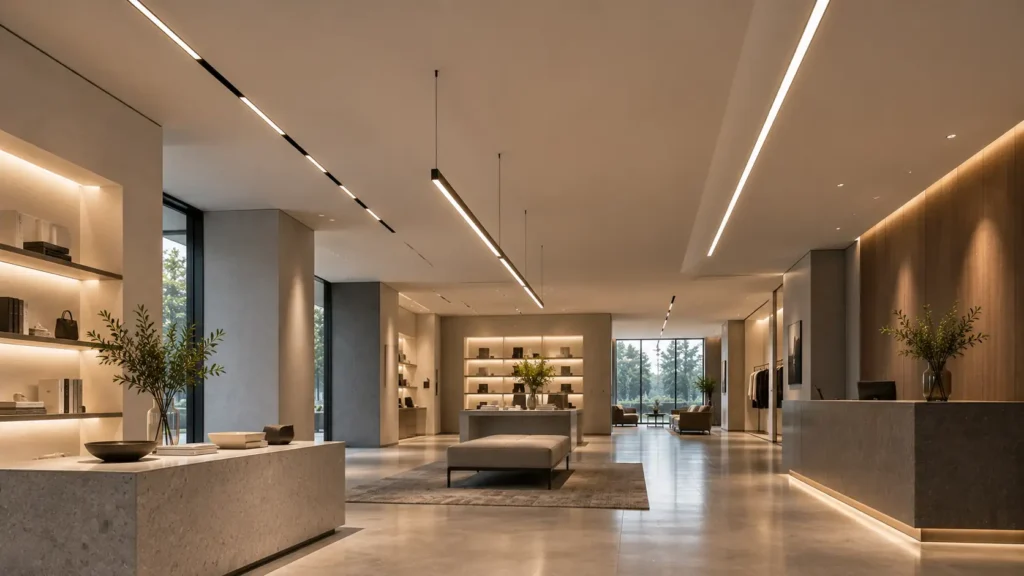
It is built to create linear illumination—a line of light rather than a single bright point. Teams use that form in architectural and commercial ceilings, walls and open volumes when they want connected visual rhythm.
Treat the phrase as a description of shape and light behaviour, not as one fixed product SKU family. Minimalist line lighting briefs often point at the same long form with quieter finishes—still a form language, not a separate physics class.
There is no single global rule that only “line light fixture” is the correct English label. Catalogs keep inventing near-synonyms for the same silhouette.
🎯 What does “line light fixture” usually mean?
A long, continuous luminaire form for linear illumination—not one exclusive product category name.
🔄 2. Is a line light fixture the same as linear lighting?
Often the products look related. The scope of each phrase can still differ.
| Term | Usually refers to |
|---|---|
| Line light fixture | A descriptive name for a linear-shaped fixture |
| Linear lighting | A broader lighting category or system |
| Linear fixture | A complete linear luminaire / product |
In practice, buyers and suppliers swap these words. One quote may say “line light,” another “linear lighting system,” another “linear fixture”—and still mean a similar bar family.
Linear lighting can also mean a whole approach: runs, joins, controls and layout logic. A single line light fixture label may point at one housing in that system.
After the terms are clear, browse linjär belysning families as products—not as dictionary debates.
🎯 Are the names always interchangeable?
They overlap often, but “linear lighting” can mean a wider system than one descriptive fixture name.
🏷️ 3. Why do suppliers use different names for similar linear products?
Markets do not share one vocabulary list.
Some regions prefer “fitting,” others “fixture.” Manufacturers also name from different angles: design language, ceiling type, or engineering family codes. Catalog copy is marketing shorthand; drawings use tighter language.
In search and RFQs you may see:
- line light fixture
- linear light fitting
- straight line ceiling fixture
- linear ceiling fixture
Those labels still leave open: mounting type, dimensions, optical performance and application. We see two “same-name” quotes diverge once mount kits and optic codes appear.
🎯 Why do catalogs disagree on names?
Regions, marketing angles and engineering labels differ—names are shortcuts, not complete specs.
✅ 4. What should you check beyond the product name?
Do not stop at the search phrase.
Use the name only as a door into the datasheet. Then walk a short checklist—enough to compare apples to apples, not a full procurement manual.
| Kontrollera | Varför det spelar roll |
|---|---|
| Monteringstyp | Sets the installation path (suspend, recess, surface) |
| Fixture dimensions | Checks ceiling and layout fit, including available lengths and configurations |
| Ljusflöde | Matches task and ambient needs without inventing a one-size number |
| Optical design | Steers distribution, uniformity and comfort |
| Driver and control options | Supports dimming and building protocols |
Line fixture installation follows the mount and feed path you actually buy—not the adjective in the title block.
When the checklist is filled, shortlist complete linear light fixtures from the same family language you already reviewed in the category—not from the keyword alone.
🎯 What beats the catalog title?
Mount, size, light output, optics and driver/control options—read those before treating two names as one product.
🔧 5. Are linear light fittings and linear fixtures the same?
In many commercial briefs, yes—they both point at a complete linear luminaire.
“Fitting” shows up more in some English markets. “Fixture” is common in North American and engineering texts. Either way, the useful meaning is usually a finished luminaire with housing, optics and a power path—not a bare LED strip on a reel.
Do not mix a thin decorative strip with a commercial linear fitting or fixture built for continuous runs, joins and project controls. Same “line” silhouette in a photo can still be different products in the submittal.
If your market searches “linear light fittings,” keep reading mount and optic fields the same way you would for “linear fixtures.”
🎯 Fitting vs fixture—does the word change the product?
Often both mean a complete linear luminaire; neither should be confused with a bare LED strip.
📍 6. How to choose the right linear lighting product for a project
Choose from the project, not from the search string.
Ask what the space needs, which mounting method the ceiling allows, what lighting performance the zones require, and whether the system must join, dim or talk to building controls.
Office floors, retail paths and hospitality lobbies can all use linear forms—and still need different optics, lengths and mount kits. The right pick comes from those requirements.
When you are ready to match a brief to installed references, review linear lighting projects and case patterns that show real mounts and runs—not only catalog synonyms.
🎯 How should you decide after the names blur?
Match space needs, mount path, performance and system compatibility—then pick the product, not the keyword.
Vad man ska göra härnäst
- Write down the three catalog names you saw—and one shared checklist row for mount, size and optic.
- Separate “complete linear luminaire” from bare strip language before you compare prices.
- Match mount path to the real ceiling before you pick length options.
- Review installed project references for how similar forms land on site.
- Need a project review or quotation? Contact the XHLUX team with zone tasks, preferred mount and the names your suppliers used.
🏁 Conclusion: What is a line light fixture?
The name may change, but the right linear lighting choice depends on the fixture itself.
Terminology varies across markets and catalogs. Specifications—and the project—decide whether two labels are truly the same product.
Start from the form you need, read the checklist fields, then align the supplier’s wording to that brief.
Utforska våra relaterade blogginlägg:
- Hur man väljer linjär LED-belysning: Pendlad, utanpåliggande eller infälld?
- How to Choose Modern Linear Lighting for Offices and Retail in 4 Steps
Anteckningar och källor
- No invented lumen, wattage or millimetre thresholds; comparisons stay qualitative.
- Product and project URLs are live XHLUX category and case pages for conversion after terminology sections.
- Naming examples reflect common catalog English; they are not a claim of exclusive standard terminology.