 XHLUX
XHLUX

At a Glance
- Modern track lighting is defined by three design shifts from traditional track: slim rail profiles (as narrow as 20mm), integrated LED sources (no separate bulb or GU10 socket visible), and smart control compatibility (DALI, Casambi, Zigbee, 0–10V). The visual language is minimalist — the track is designed to blend into the ceiling rather than stand out from it.
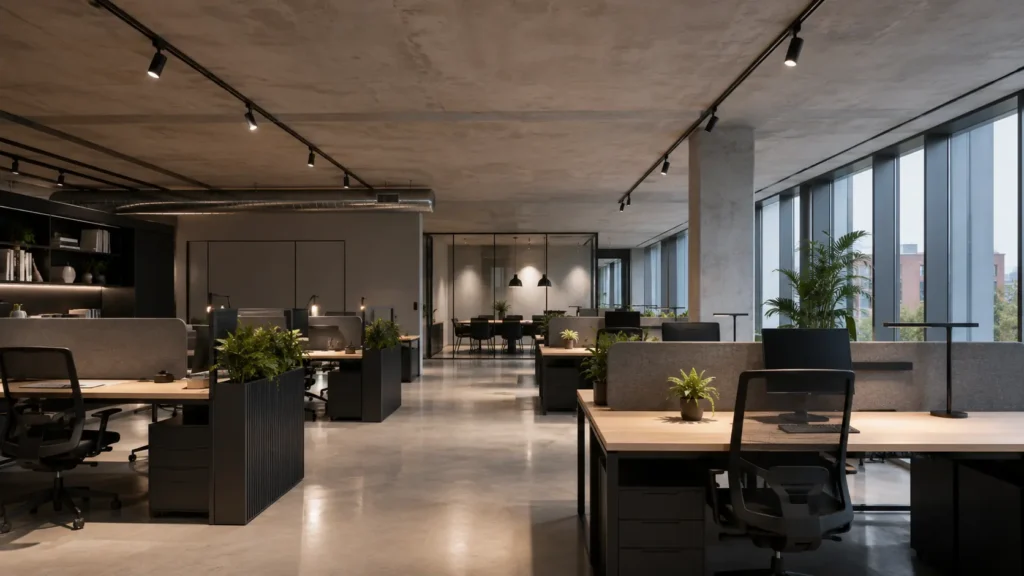
- The dominant aesthetic trend in commercial interiors since 2020 has been toward cleaner ceiling planes. In retail and office spaces where the ceiling is exposed, the track is now specified in white, black, or brushed-metal finishes that match the ceiling colour and HVAC ductwork, creating a cohesive industrial palette rather than a contrasting one.
- For spaces where the ceiling itself is an architectural finish — exposed concrete soffits, timber rafters, or open plenum designs — modern track serves as both the lighting infrastructure and a deliberate ceiling-level design element. The track layout and finish are chosen to complement the ceiling architecture, not fight it.
What Makes Track Lighting “Modern”
The term “modern” in track lighting refers not to a single style but to a set of design characteristics that distinguish current-generation track systems from the previous generation:
Slim Rail Profiles
Traditional track rails are 30–40mm wide and 20–25mm deep — visible on the ceiling from any angle. Modern track rails are typically 20–25mm wide and can be as slim as 10–15mm in depth for low-voltage magnetic systems. The reduced cross-section makes the rail less visually prominent, particularly when viewed from an angle.
The slim profile is not only an aesthetic choice — it also reduces the amount of material in the extrusion, which reduces weight and material cost. However, a slimmer rail has less internal space for conductors, which limits the maximum circuit count. Modern 48V magnetic track typically carries two conductors (positive and negative), while traditional line-voltage track carries three or more.
Integrated LED
Traditional track fixtures use replaceable light sources — halogen or metal halide bulbs, or GU10/MR16 LED retrofit bulbs. The bulb and socket are visible. Modern track fixtures use integrated LED modules where the light source is built into the fixture head — there is no separate bulb, no visible socket, and no user-replaceable lamp. The entire fixture head is replaced when the LED reaches end of life.
This has both aesthetic and practical implications. Visually, the fixture head is a sealed unit — cleaner and more compact. Practically, the LED module is factory-aligned with the optics, so beam pattern and colour consistency are controlled at the manufacturing stage rather than depending on which bulb the user installs.
Finish Consistency
Modern track systems are available in matched finishes — white rail with white fixture heads, black with black, brushed aluminium with matching aluminium heads. The finish consistency extends to connector fittings, end caps, and power feeds, so the entire track assembly reads as a single coordinated system rather than a collection of separately finished components.
For commercial interiors where the ceiling is visible, black track on a dark-painted exposed ceiling or white track on a white-painted ceiling creates a near-invisible installation — the track disappears into the background, and only the light is visible.
Smart Control Integration
Modern track fixtures are designed for digital control from the specification stage. Rather than adding dimming as an afterthought, modern track systems have drivers that support DALI-2, 0–10V, or wireless protocols (Casambi, Zigbee) as standard options. This allows per-fixture dimming, scene recall, occupancy-based control, and daylight harvesting without additional control wiring beyond the track’s internal busbars.
For office environments with daylight-responsive lighting requirements (such as those seeking LEED or BREEAM certification), the ability to dim individual fixtures on the same track independently — fixtures near windows dimming while interior fixtures maintain full output — is a defining modern capability.
Contemporary Finishes and Aesthetics
| Avsluta | Bäst för | Ceiling Context |
|---|---|---|
| White | Retail, healthcare, education | White-painted ceiling; track blends in with the ceiling plane |
| Black | Restaurant, bar, gallery, exposed-services ceiling | Dark-painted ceiling or open plenum; track disappears into the dark overhead |
| Brushed aluminium / silver | Office, co-working, contemporary retail | Exposed concrete or grey-painted ceiling; complements HVAC ducts and structural steel |
| Custom RAL / powder coat | Branded retail, flagship stores | Matched to brand colour palette; specified per project |
Black track on a white ceiling — once a common aesthetic in the 1990s — is now generally avoided in contemporary interiors unless the black track is deliberately used as a graphic design element (for example, black track forming a geometric pattern on a white ceiling as an architectural feature).
Where Modern Track Lighting Is Used
Contemporary Retail
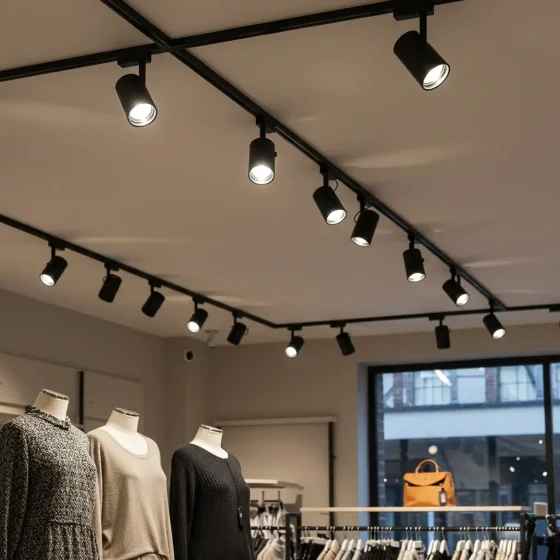
In fashion retail, the lighting must make the merchandise look desirable without drawing attention to the light source. Modern track achieves this with slim white or black rails that sit close to the ceiling, and small fixture heads that direct light precisely onto display surfaces. The customer notices the merchandise, not the lighting.
In luxury retail, modern track is often recessed into the ceiling or integrated into architectural bulkheads so that only the fixture heads are visible below the ceiling line. The track infrastructure is concealed, and the effect is of individual spotlights floating in a clean ceiling plane.
Modern Office Interiors
Open-plan offices with exposed ceilings use modern track as both lighting infrastructure and a visual element that reinforces the industrial-modern aesthetic. Black or grey track runs parallel to the desk rows, with fixture heads positioned above individual workstations for task lighting and above circulation routes for ambient illumination.
In offices with suspended ceiling grids, modern track replaces rows of ceiling tiles for a continuous linear lighting effect. The track integrates into the grid pattern, and the fixture heads are the only elements that protrude below the ceiling plane.
Hospitality and Co-Working
Hotel lobbies, co-working lounges, and café areas use modern track for its dual role: functional lighting that can be aimed at specific seating areas or architectural features, and a design element that contributes to the interior aesthetic. Pendant adaptors on modern track allow decorative pendant lights to be hung from the same rail as functional spotlights.
Selecting Modern Track for a Project
1. Choose the rail finish first. The rail is the most visible part of the system. Select a finish that matches or deliberately contrasts with the ceiling colour. The fixture heads, connectors, and end caps should be available in the same finish.
2. Match the rail profile to the ceiling scale. A 20mm-wide rail on a 3-metre-high ceiling is barely visible from floor level. A 40mm-wide rail on a 2.4-metre ceiling is prominent. For standard commercial ceiling heights (2.7–3.5m), a 22–28mm rail profile is the sweet spot — visible enough to be read as a design element, slim enough not to dominate the ceiling.
3. Confirm smart control compatibility before ordering. Not all modern track fixtures support all control protocols. If DALI-2 or wireless control is required, confirm that the track’s internal busbar configuration supports the control wiring topology, and that the fixture drivers are available in the required protocol.
4. Plan the layout as a design element. In contemporary interiors, the track layout is part of the architectural design, not an afterthought. Parallel runs, perpendicular grids, or diagonal patterns should be deliberate. Avoid the “single straight track down the middle of the room” approach — it reads as a budget retrofit decision, not a design choice.
Frequently Asked Questions
What to Do Next
Modern track lighting is defined less by any single specification and more by how the system integrates into the ceiling design. The rail finish, profile width, fixture style, and layout pattern should be chosen together as a coordinated design decision — not selected independently as separate components.
Data notes: Rail profile dimensions, finish availability, and control protocol compatibility are representative of commercially available modern track lighting systems. Specific values vary by manufacturer and model. Smart control protocols (DALI, 0–10V, Casambi, Zigbee) require compatible control infrastructure beyond the track and fixtures. Verify control compatibility with the manufacturer’s product specification before procurement. Electrical installation must be performed by a licensed electrical contractor.
![Behöver jag downlight-skydd: Bästa omfattande guiden [2025]](https://www.xhlux.com/wp-content/uploads/2025/07/Do-i-Need-Downlight-Covers-560x560.webp "Behöver jag downlight-skydd: Bästa omfattande guiden [2025]")