 XHLUX
XHLUX

Table of Contents
- 1 Why adjustable angle downlights are reshaping commercial lighting logic
- 2 What an “Adjustable Angle Downlight” really means
- 3 Why fixed angle downlights are struggling in real commercial projects
- 4 Core value: adjustable angle downlights are project “insurance”
- 5 Where adjustable angle downlights work best
- 6 The decision logic: adjustable angle downlights vs fixed downlights
- 7 Data table: beam angle planning
- 8 What to check when choosing adjustable angle downlights
- 9 Why adjustable angle downlights are ideal for large projects and chain replication
- 10 Data chart: where adjustable downlights sit in the “clean ceiling vs flexibility” spectrum
- 11 Common mistakes (and how to avoid them)
- 12 FAQ About Rectangular gimbal downlight shop
- 13 Welcome to collaborate
If you’ve ever finished a shop lighting install and then heard: “We’re moving the display wall,” “The mannequins changed,” or “The shelves are now 600mm forward,” you already know the painful truth: fixed-beam downlights look perfect on drawings, but real retail moves.
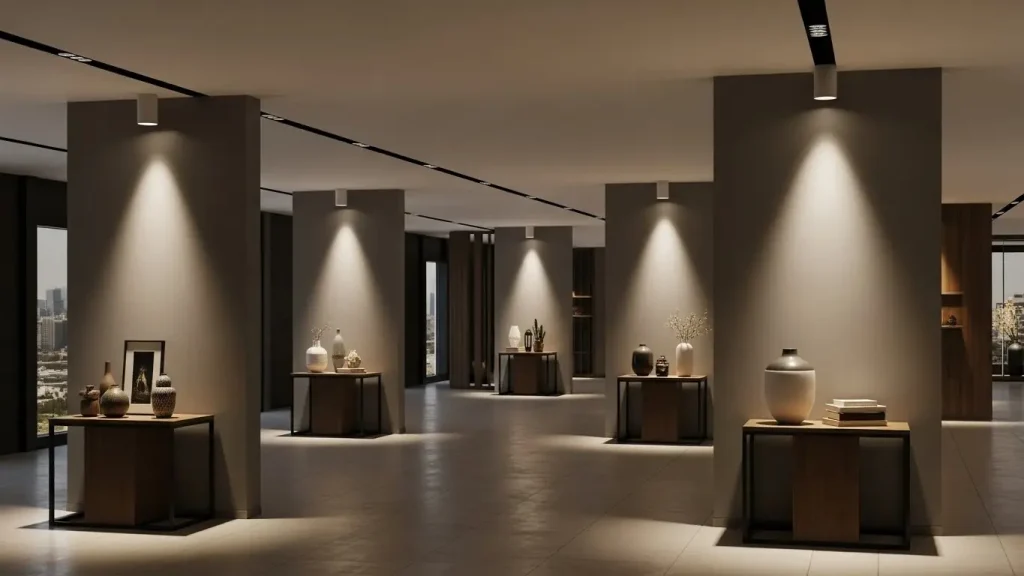
This is exactly why adjustable angle downlights (also called adjustable gimbal LED downlights, tilt adjustable recessed downlights, or recessed adjustable spotlights) have become a go-to tool in modern commercial projects. They give you a cleaner ceiling than track, but far more aiming flexibility than fixed downlights—meaning fewer compromises, fewer change orders, and fewer “we’ll live with it” lighting outcomes.
1 Why adjustable angle downlights are reshaping commercial lighting logic
Commercial lighting is no longer about “even brightness everywhere.” In most shop lighting solutions—retail, showroom, hospitality retail corners, galleries inside malls—lighting has to do three things well:
- Highlight priority products (new arrivals, hero SKUs, premium materials)
- Guide attention and traffic flow (visual rhythm + focal points)
- Survive change (layouts, seasons, merchandising cycles)
The problem: fixed angle recessed downlights are unforgiving. If the ceiling cutout shifts, if the joinery changes, if the display height changes—your light ends up on the floor, on signage glare, or washing the wrong wall. In a real store, that’s not “minor.” That’s lost presentation quality.
Adjustable angle downlights exist for one reason:
When the ceiling position is fixed, the beam direction can still be corrected.
That’s why you’ll see them specified as:
- adjustable gimbal downlights for retail stores
- commercial adjustable recessed downlights
- directional recessed downlights for shop displays
- tilt adjustable LED downlights for wall display
- anti-glare gimbal downlights for boutique lighting
2 What an “Adjustable Angle Downlight” really means
An adjustable angle downlight is a recessed luminaire where the light engine can tilt (and often rotate). Unlike a fixed recessed downlight where “cutout = final beam direction,” adjustable units allow aiming after installation.
Typical adjustment mechanics:
- Tilt: often 10°–30° (some go higher depending on design)
- Rotation: 350°–360° for flexible aiming
So the real difference isn’t just structure—it’s workflow:
- Fixed downlight workflow: ceiling position must be perfect → beam is locked
- Adjustable gimbal workflow: ceiling position can be “good” → beam can be refined onsite
In commercial build-outs, that shift matters because it reduces risk—especially in:
- fast-track retail rollouts
- tenant fit-outs with late design changes
- multi-store “repeatable” ceiling plans
- renovations where existing ceiling constraints exist
3 Why fixed angle downlights are struggling in real commercial projects
Fixed downlights often fail not because the product is bad, but because the project reality is messy:
- Furniture packages change after lighting rough-in
- Brand planograms update
- Displays move to chase conversion
- “Feature zones” appear late (seasonal, promo, collaboration walls)
Common symptoms of a fixed-downlight mismatch:
- Light hits the aisle instead of the display
- Product faces look flat while floor is bright
- Graphics are uneven or washed out
- Reflections appear on glass cabinets
- “Hot spots” create cheap-looking contrast
In high-turnover retail, fixed beam = high risk.
4 Core value: adjustable angle downlights are project “insurance”
Here’s the simplest way to explain the value to a contractor, designer, or owner:
- The ceiling doesn’t change easily.
- Merchandising changes constantly.
- Therefore: make the beam adaptable.
Key benefits (real-world):
- Correction capability
If a cutout is 150mm off, you can still put light on the intended display. - Fewer change orders / less rework
Instead of cutting new holes or adding track later, you aim what you have. - Cleaner ceiling than track lighting
Many brands want “quiet ceilings” with recessed solutions. Better control of accent vs ambient
With the right beam angle, an adjustable downlight can behave like a hidden spotlight.- Higher success rate across stores
For chain retail: one ceiling plan, multiple layouts—aiming handles the variation.
If you’re building a spec, request the photometric pack early: IES files + beam options + tilt/rotation range.→ Use: Project Consultation
5 Where adjustable angle downlights work best
These are the most common “wins”:
Retail stores and chain shops
- wall displays, gondola ends, mannequin zones, feature tables
- “same ceiling, different merchandising” scenarios
- boutique lighting that needs controlled highlights
Showrooms
- product sizes vary, the “hero” area moves
- you need directional light without track clutter
Hospitality retail zones (hotel lobby retail corners / café retail)
- accenting merchandise corners while keeping a refined ceiling
Restaurants with retail display walls (wine walls, product walls)
- tilt helps avoid glare and place beam precisely on labels
Office reception / brand walls
- subtle directional accent without the industrial look of track
6 The decision logic: adjustable angle downlights vs fixed downlights
Instead of a spec-table battle, use a project-risk lens:
| Decision Factor | Fixed Downlights | Adjustable Angle Downlights |
|---|---|---|
| Tolerance to layout change | Low | High |
| Onsite aiming | No | Yes |
| Ceiling cleanliness | High | High |
| Accent capability | Limited | Strong (with correct optics) |
| Retrofit / tenant fit-out suitability | Medium | High |
| Risk of “light on the wrong thing” | Higher | Lower |
Key takeaway: In commercial projects, controlling risk often beats saving a few dollars on a single fixture.
Want help deciding where to use adjustable vs fixed vs track in the same store?→ Project Consultation
7 Data table: beam angle planning
Aiming flexibility is only useful if the beam angle matches the task. Here’s a practical table using a simple lighting geometry approximation:
Beam diameter ≈ 2 × distance × tan(beam_angle ÷ 2)
(Useful for early planning and onsite aiming—final results depend on optics and cut-off design.)
Beam diameter examples (approx.) for retail ceiling heights
| Mounting height to target | 15° beam | 24° beam | 36° beam | 60° beam |
|---|---|---|---|---|
| 2.5 m | ~0.66 m | ~1.06 m | ~1.62 m | ~2.89 m |
| 3.0 m | ~0.79 m | ~1.27 m | ~1.94 m | ~3.46 m |
| 3.5 m | ~0.92 m | ~1.48 m | ~2.27 m | ~4.04 m |
| 4.0 m | ~1.05 m | ~1.70 m | ~2.60 m | ~4.62 m |
How to use this fast:
- 15°–24°: accents / hero products / mannequins / feature walls
- 36°: general accent + small zone fill
- 60°: broad fill (often better handled by other fixture types if you need uniform ambient)
If you tell us ceiling height + target size, we can recommend beam angles and send IES files for simulation.→ Contact Page
8 What to check when choosing adjustable angle downlights
This is where many projects go wrong: teams buy “adjustable” but not “commercial-grade.”
A) Adjustment range + mechanical stability
Ask:
- What is the tilt angle (e.g., 20° / 30°)?
- Is it tilt + rotate, or tilt only?
- After aiming, does it hold position over time (vibration, heat cycles)?
If an adjustable gimbal downlight “drifts” after months, your lighting design slowly collapses.
B) Glare control (anti-glare matters more than watts)
In shops, glare destroys comfort and perceived quality. Look for:
- deep recess optics
- baffles / snoots / honeycomb louver options
- controlled cut-off angles
Even without quoting a specific UGR number, commercial designers recognize glare control as a “must” for premium retail.
For boutique or luxury retail, ask for anti-glare options (deep baffle / honeycomb) before sampling.→ OEM Inquiry
C) Color rendering: CRI is the baseline, R9 is the truth test
For retail and display, color quality isn’t optional. CRI explains how faithfully colors are rendered compared to a reference illuminant.
- CRI90: good commercial baseline for most retail
- CRI95+: premium materials, cosmetics, high-end apparel
- If you care about reds (skin tones, warm materials), pay attention to R9 (often not shown unless requested). (UL Solutions)
D) Dimming and control compatibility
Control decisions can make or break a store:
- Phase-cut / Triac is common in renovations; it can be sensitive and cause issues depending on driver compatibility
- 0–10V is widespread in North America for commercial dimming
- DALI / DALI-2 is preferred in complex projects where interoperability and consistent behavior matter; DALI-2’s certification focus is designed to improve cross-vendor interoperability.
If you’re specifying adjustable downlights for a chain rollout, control consistency across sites matters as much as fixture quality.
E) Documentation and project readiness
A reliable commercial downlight supplier should be able to provide:
- IES files (photometric data)
- cut sheets and installation guides
- driver and control options list
- warranty terms
- packaging plan for project delivery
Need a “submittal-ready” package (IES + cut sheet + driver options)?→ Project Consultation
9 Why adjustable angle downlights are ideal for large projects and chain replication
Chain retail doesn’t want “beautiful once.” It wants repeatable success.
Adjustable angle recessed downlights support repeatability because:
- You can standardize ceiling cutouts across stores
- You can keep the same SKU family
- You can tune final aiming to match local store conditions (window light, layout differences)
That means fewer SKUs, simpler maintenance, and fewer “store exceptions.”
This is the same logic that makes modular lighting platforms attractive at scale.
10 Data chart: where adjustable downlights sit in the “clean ceiling vs flexibility” spectrum
Think of commercial lighting tools as a tradeoff:
| Fixture type | Ceiling appearance | Flexibility after install | Best use |
|---|---|---|---|
| Fixed recessed downlight | Very clean | Low | ambient / circulation lighting |
| Adjustable angle downlight | Clean | Medium–High | retail accents without track |
| Track spotlight | Visible track | Very high | maximum flexibility + frequent changes |
| Linear lighting (recessed/surface) | clean to medium | low–medium | ambient structure + guidance |
Most modern stores combine these. Adjustable gimbal downlights often become the “bridge” between clean architecture and display flexibility.
If you’re planning a mixed system (linear + downlight + accent), we can help build a fixture schedule that reduces SKUs.→ Project Consultation
11 Common mistakes (and how to avoid them)
Mistake 1: buying “adjustable” with minimal tilt range
If the tilt is too small, it won’t solve the real-world misalignment.
Mistake 2: ignoring beam angle options
Aiming doesn’t fix a wrong optic. Choose beams based on mounting height and target size (see table above).
Mistake 3: skipping anti-glare decisions
Retail customers should see product sparkle—not the LED source.
Mistake 4: assuming dimming “will work”
Driver + dimmer mismatch creates flicker, drop-out at low levels, or limited dimming range. Field conditions matter.
Mistake 5: not planning for logistics and duty strategy on scale
For multi-country rollouts, shipments and import duty can become a major cost driver. That’s where SKD (semi-knocked-down) supply can help in some markets—by shipping key components for local assembly to support logistics and duty planning (where regulations allow).
If your market is duty-sensitive, ask about SKD track/downlight component supply and project packing plans.→ OEM Inquiry
12 FAQ About Rectangular gimbal downlight shop
Q1: Are adjustable angle downlights the same as adjustable gimbal LED downlights?
In most commercial specs, yes. “Gimbal” usually implies a tilt/rotate mechanism. “Adjustable angle recessed downlight” is the broader term that includes gimbal-style designs.
Q2: Can adjustable downlights replace track lighting in retail stores?
They can replace track in many zones where a clean ceiling is required. But track still wins when you need extreme flexibility (frequent relocations, changing beam directions weekly, or complex merchandising shifts).
Q3: What beam angles are best for shop lighting with adjustable recessed spotlights?
Common retail accents typically use 15°–36° depending on ceiling height and target size. Use the beam diameter table above as a quick planning tool.
Q4: Do adjustable angle downlights cause more glare than fixed downlights?
They can if the optic is shallow or the source is visible at normal viewing angles. Choose anti-glare gimbal downlights with deeper recess, baffles, or honeycomb options for premium retail.
Q5: What CRI is recommended for retail and showroom lighting?
Many retail projects specify CRI90+ as a baseline, with higher CRI for cosmetics, luxury materials, and art-related retail. CRI describes color rendering relative to a reference. (UL Solutions)
Q6: Which dimming is better for commercial adjustable downlights: Triac, 0–10V, or DALI-2?
- Triac/phase-cut: common in retrofits, but compatibility varies by driver and installation conditions
- 0–10V: common commercial standard in North America
- DALI-2: strong for larger systems where interoperability and consistency matter; DALI-2 emphasizes certification for interoperability. (dali-alliance.org)
Q7: What documents should a supplier provide for adjustable downlights in a project?
At minimum: cut sheets + IES files + driver/dimming options + installation guidance + warranty.
Q8: Can you support OEM/ODM and project-based lighting solutions (not just products)?
This is exactly what serious commercial buyers should ask. A project-ready supplier should support fixture customization (trim/finish/optics), control options, and packaging plans—plus provide solution support for retail, showroom, office, hospitality, and other commercial lighting scenarios.
13 Welcome to collaborate
If you’re specifying adjustable angle downlights for a shop, showroom, or multi-site commercial rollout, the fastest way to de-risk the project is to align on a few inputs:
- ceiling height + target sizes
- preferred beam angles (e.g., 15°/24°/36°)
- anti-glare requirement level (standard vs boutique/luxury)
- dimming/control (Triac, 0–10V, DALI/DALI-2)
- CRI target (CRI90/95+) and any special color needs
- delivery strategy (standard shipment vs SKD component supply where applicable)
We operate as an indoor commercial lighting product matching & solutions provider—helping you select the right fixture family, optics, controls, and project documents so your install performs in real life, not just in drawings.
Next step:
- Start a conversation: Contact Page
- Private label / customization / SKD: OEM Inquiry
- Send your floor plan and get a quick fixture strategy: Project Consultation
- Browse ranges and shortlists: Download Catalog