XHLUX
A surface mounted linear wall washer is a linear luminaire that throws a controlled beam onto a wall. It is not simply a long bar that happens to sit on a ceiling.
Three labels sit in the name. Surface-mounted is how the housing is fixed. Linear is the elongated format. Wall washer is the lighting job: broad, even light on a vertical plane.
Those three do not travel together by default. A surface linear with a general downlight optic is still a linear light. It is not a wall washer until the distribution is built for the wall.
This page covers product structure, optical principles, surface versus recessed mounting, wall washing versus wall grazing, and typical applications. For mount family choices across linear lighting, start with Como escolher a iluminação linear LED: suspensa, de superfície ou embutida?.
Resumindo: Surface-mounted means the housing sits on the ceiling or wall, not fully in a recess. Linear means a long run that can light a continuous wall section. Wall washer means the optic aims that light at the wall. Judge the photometric file, the setback and the wall finish—not the catalogue silhouette alone.
Índice
- 💡 1. What Is a Surface-Mounted Linear Wall Washer?
- 🔦 2. How Does a Surface-Mounted Linear Wall Washer Work?
- 🏗️ 3. How Is a Surface-Mounted Linear Wall Washer Different from a Recessed Linear Wall Washer?
- 🎨 4. What Is the Difference Between Wall Washing and Wall Grazing?
- 🏢 5. Where Are Surface-Mounted Linear Wall Washers Used?
- 🏁 Conclusão
- Perguntas frequentes
💡 1. What Is a Surface-Mounted Linear Wall Washer?
The product is defined by mount, format and wall-lighting optics together—not by any one of those words.
Surface-mounted. The fixture is fixed onto a ceiling or wall face. The whole housing does not have to disappear into a prepared recess. Fixings, wiring and clearance still have to exist on that surface.
Linear. The body is elongated. Along a wall, that shape can support a continuous band of light instead of a row of separate spots.
Wall washer. The optical system directs light onto the wall so the vertical surface reads as broadly illuminated. Asymmetric reflectors, lenses or other controlled optics are typical tools for that job. A symmetric ambient linear is a different tool.
Not every surface-mounted linear light is a wall washer. If the intensity distribution is aimed at the floor or the room volume, the housing can still be linear and surface-mounted. It will not wash the wall the way a wall-washer file predicts.
🎯 Is every surface-mounted linear light a wall washer?
No. The mount and the long body are not enough. The optic has to be designed for wall illumination.
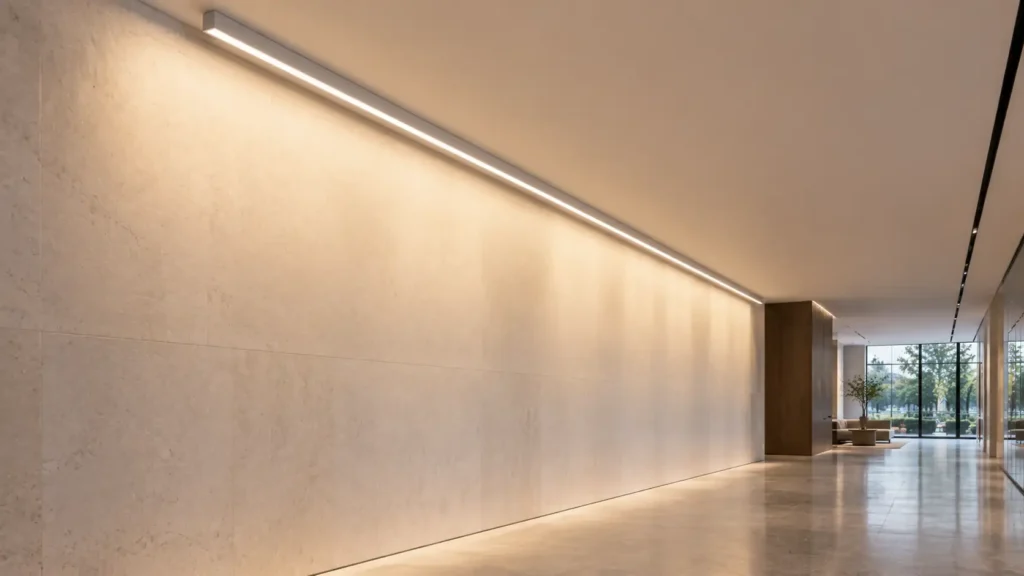
🔦 2. How Does a Surface-Mounted Linear Wall Washer Work?
The wall effect comes from the optic plus geometry—not from the extruded profile alone.
Light leaves the LEDs and is shaped by reflectors, lenses or other optical parts. Those parts set where intensity is strong: toward the upper wall, across a wide vertical field, or in a tighter graze. Two fixtures that look similar on a drawing can still have different polar curves.
Mounting position and distance from the wall change how that curve lands. Closer to the wall, the same optic can look hotter at the top and darker farther down. Farther away, scallops and dark corners can appear if the distribution was never meant for that setback. There is no universal millimetre offset that fits every product.
Photometric data matters for that reason. An IES or LDT file, plus the maker’s wall-washer notes, show how the luminaire actually throws light. A product photo alone cannot predict the finished wall effect. Without checking the photometric file in the context of the actual installation, the result may include visible bands or uneven illumination.
Fixture spacing and wall size affect continuity. Joints, door openings and changes in wall length all interrupt a “smooth” wash. Uniformity is a result of the specific luminaire, the wall reflectance and the installed geometry—not a catalogue adjective.
Use the manufacturer’s photometry and the real room when you need numbers. Do not copy a setback or spacing from another brand’s application note.
🎯 What actually creates the wall-wash effect?
The optic’s intensity distribution, plus where you place the fixture relative to that wall.
🏗️ 3. How Is a Surface-Mounted Linear Wall Washer Different from a Recessed Linear Wall Washer?
The lighting job can be similar. The building work is not.
| Aspecto | montado em superfície | Encastrado |
|---|---|---|
| Instalação | Mounted onto a ceiling or wall surface | Installed into a prepared recess |
| Ceiling preparation | Does not require the entire fixture housing to be recessed | Requires a suitable recess and compatible ceiling construction |
| Aparência | The fixture remains visible on the mounting surface | The fixture can sit more flush with the ceiling |
| Installation planning | Needs suitable fixing points, wiring and mounting clearance | Needs coordination of the recess, wiring and ceiling build-up |
| Acesso para manutenção | Depends on the mounting and fixture design | Depends on the fixture design and access provisions |
Neither method is automatically better. A surface housing can be the practical choice when the ceiling cannot take a full recess. A recessed linear wall washer can disappear into the plane when the void, aperture and optic are designed together.
Ceiling type, services in the void, the intended visual line and access for later service all weigh more than a preference for “hidden” or “simple.” For surface linear work when the ceiling must stay uncut, see Luminárias lineares de montagem à superfície para tetos sem encastramento.
🎯 Is surface-mounted always easier than recessed?
Not always. Surface avoids a full housing recess, but it still needs fixings, wiring routes and a visible body that the design can accept.
🎨 4. What Is the Difference Between Wall Washing and Wall Grazing?
They both put light on a wall. They are not interchangeable names for the same effect.
Wall Washing
Wall washing aims for relatively even illumination across the wall. The wall itself should read as a broad, visually consistent surface—paint, a graphic, or a calm architectural plane.
That needs a distribution and a position that keep brightness from collapsing into hot bands or dark patches. The right optic is the one whose file supports that evenness on esse wall, not a fixture labelled “washer” with no photometry.
Wall Grazing
Wall grazing places light close to the wall and sends it across the surface at a shallow angle. Texture, joints, stone relief and other irregularities then throw strong shadows.
That emphasis is the point of grazing. The same close geometry used on a smooth painted wall can look blotchy rather than “architectural.”
Choose the technique from the desired effect, the wall material and the fixture geometry. A linear wall washer is built for washing. A grazer (or a washer used too close) will not automatically deliver the other result.
🎯 Are wall washing and wall grazing the same?
No. Washing evens the plane; grazing rakes texture. Optic and distance from the wall decide which one you get.
🏢 5. Where Are Surface-Mounted Linear Wall Washers Used?
Use them where a vertical plane needs controlled wash and the mount can sit on the surface. Do not treat one product as a universal wall tool.
Commercial Interiors
Corridors, receptions and hospitality rooms often use a continuous wash so a long wall reads as part of the architecture. Ceiling height, wall length and whether the housing may stay visible all affect whether a surface linear washer is a fit.
Retail and Display Spaces
Wall light can support product backdrops, display walls and selected architectural features. The wash still has to suit the merchandise and the viewing positions. A bright stripe on glossy finishes is a layout and optic problem, not a reason to add more wattage at random.
Galerias e Espaços de Exposição
Architectural surfaces and some displays use wall illumination. Artwork needs its own illuminance, uniformity and glare checks for that collection and conservation brief. A linear washer on the ceiling does not automatically become gallery lighting.
Architectural Facades
Facade use is only appropriate when that exact luminaire is rated for outdoor exposure and the install meets the required environmental and electrical protection. Indoor surface linears are not outdoor fixtures by another name.
Match the product file, IP/IK (or equivalent) rating, mounting and the wall job. A corridor washer and a wet-location facade grazer are different specifications even if both are “linear” and “on the surface.”
🎯 Can one surface linear wall washer cover every wall job?
No. Interior wash, display, gallery and facade work each need the optic, rating and geometry that match that wall.
🏁 Conclusion: What Is a Surface-Mounted Linear Wall Washer?
A surface-mounted linear wall washer combines a surface-mounted install, a linear body and optics intended to illuminate a wall.
The right application still depends on the lighting effect you want, the mounting conditions, the wall surface and the luminaire’s photometric performance. Mount method alone does not choose the optic—and a wall-washer label does not replace the file.
Explore outros artigos relacionados do nosso blogue:
- Luminárias de parede LED: Iluminação de lavagem versus iluminação rasante e qual o espaçamento ideal entre elas.
- Quando devo usar um plafon de embutir para iluminação de parede?
- O que é uma luminária linear?
Perguntas frequentes
Linear Lighting Configurations for Commercial Projects
A XHLUX fabrica luzes lineares de LED and supports project configuration of mounting, length and optical packages. Surface versus recessed mounting, wall-oriented distributions and service access can be reviewed against drawings. Configuração OEM/ODM is available when the optic and housing must match a defined ceiling or wall detail.
Send the wall type, mounting method and any photometric target you already have. We do not list a dedicated wall-washer catalogue line here; suitability is a configuration and photometry question for the actual product.