 XHLUX
XHLUX

Tilt angle is the aiming offset from vertical on an adjustable LED downlight.
It does not change the LED module’s total lumen output.
It changes where that light lands, how far it travels, and how large and oval the pool becomes on the target.
Wrong tilt wastes flux on the floor or ceiling edge.
Right tilt puts the beam centre on the wall, display, or desk you actually need.
Principais conclusões
– Tilt is measured from vertical: 0° = straight down; steeper tilt = longer throw and a larger, more oval pool.
– Tilt, beam angle, and fixture-to-target distance must be specified together.
– Steeper tilt spreads the same lumens over more area — peak lux on the target drops.
– Recessed tilt/gimbal housings usually need more void depth than fixed models with the same aperture.
– On slopes, tilt must cover ceiling pitch plus the aiming you still need — and the gimbal must hold.
1. What Tilt Angle Means
Tilt angle is measured from the vertical axis of the fixture.
- 0° — beam centre straight down (nadir)
- 20–30° — common wall-wash / display aiming band on many commercial gimbals
- Max tilt — product-dependent (often about 15–35° on commercial sheets)
Rotation (often up to ~360°) sets the compass direction of that tilted beam.
Catalogue wording you will see: tilt LED downlights, angled recessed, gimbal, adjustable beam.
🎯 What does tilt angle control?
Tilt sets where the beam centre lands and how far the light travels to the target surface.
2. How Tilt Changes Performance
Total lumens stay the same.
At steeper tilt:
- Path length to the target increases
- The footprint grows and becomes more oval
- Illuminance (lux) at a point on the target usually falls
Photometric layouts must use the aimed position — not the nadir candela curve alone.
If you only pick a lumen package and ignore tilt, on-target lux will miss the brief.
🎯 Does steeper tilt reduce lux on target?
Yes — the same lumens spread over a larger oval footprint, so peak lux on the target typically drops as tilt increases.
3. Quick Math: Aim Landmarks
Use these as starting proportions, then verify with the fixture’s IES/LDT data.
| Cenário | Starting geometry | Starting tilt band |
|---|---|---|
| Wall wash, ~2.7 m ceiling | ~600 mm off the wall | ~20–30° to put beam centre near eye level |
| Display table / merch | Target ~1.0–1.2 m from fixture | Often shallower ~15–20° |
| Sloped soffit | Add ceiling pitch into the tilt budget | Max tilt must cover pitch + remaining aim |
Wall-wash spacing along the wall often starts at roughly the fixture-to-wall distance — this is a rule of thumb, not a cited standard — refine with photometry. (IES or equivalent reference to be added when confirmed.)
🎯 What tilt band fits a typical wall wash?
For ~2.7 m ceilings with ~600 mm setback, about 20–30° is a common starting band — confirm with that fixture’s photometry.
4. Application Decision Tree
Need light only on the floor/desk directly under the cutout?
→ Fixed downlight; skip tilt cost and depth.
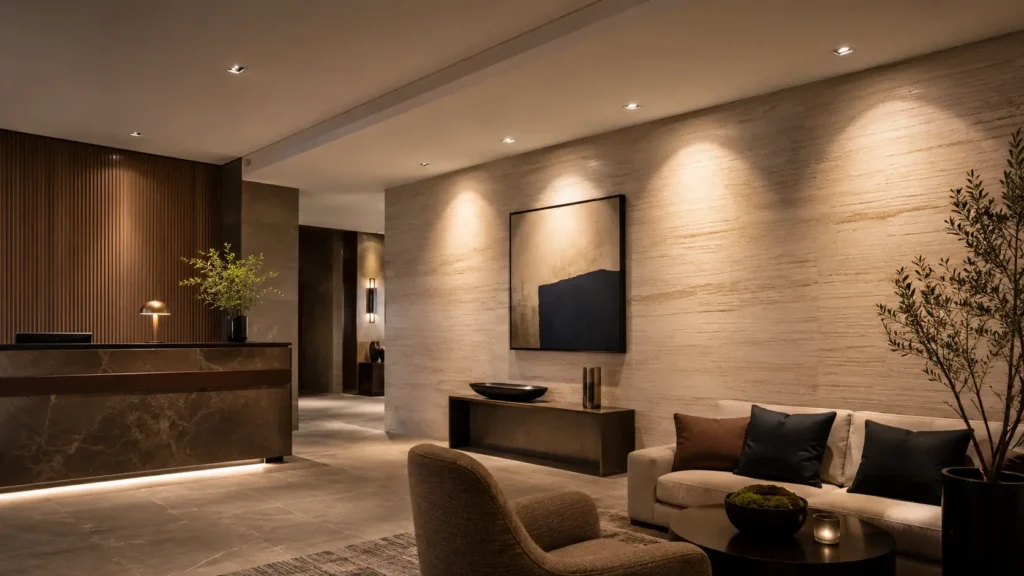
Need wall, art, or merch accent from the ceiling?
→ Tilt LED / gimbal; match narrow–medium beam to target size.
Furniture or displays will move?
→ Prefer adjustable aim + consider dimming on the same schedule.
Ceiling is pitched?
→ Confirm holding force and that max tilt covers pitch + aim.
Void is shallow?
→ Check gimbal depth vs fixed; consider surface tiltable if recessed fails.
🎯 When is tilt worth specifying?
When the target sits off-axis, will move, sits on a slope, or needs wall-wash aiming that fixed nadir light cannot provide.
5. Symptom → Cause → Fix
| Symptom | Likely cause | Consertar |
|---|---|---|
| Accent lands too low / on floor | Tilt too small or setback too large | Increase tilt or move closer per photometry |
| Hot centre, dark edges on display | Beam too narrow for target width | Step up beam class or add heads |
| Oval wash, weak peak lux | Tilt very steep for the distance | Reduce tilt, raise output, or shorten throw |
| Glare at desks | Bright aperture in sight line | Deeper set, baffle/honeycomb, re-aim, or lower lumen |
| Head droops on slope | Weak gimbal friction / no lock | Specify locking or high-friction gimbal; sample first |
| Fire cert risk at extreme aim | Cert assumed at nadir only | Use a luminaire fire-test certificate that covers the intended tilt |
🎯 What fails first when tilt is wrong?
Usually on-target lux and pool shape fail first — then glare or lock issues show up on site.
6. Dimming and Controls
Tilt aims the beam; dimming sets level.
Hospitality and retail often need both on the schedule.
Common protocols: DALI, 0–10 V, TRIAC, Casambi — match the driver to the project system.
Dimming does not fix a wrong tilt.
It only scales intensity on whatever surface the aim already hits.
🎯 Can tilt and dimming replace each other?
No — tilt sets direction and pool shape; dimming only changes intensity on that already-aimed surface.
7. Buyer Checklist Before Order
- Required aim angle from geometry (setback, height, target height).
- Datasheet max tilt ≥ required aim (include ceiling pitch if sloped).
- Recuado housing depth ≤ measured void (three points minimum).
- Beam angle matched to target size at that distance (IES/LDT check).
- Aim holding / lock method acceptable for slope or public spaces.
- Fire-test coverage includes the intended tilt if the ceiling is a compartment.
- Driver protocol matches the dimming system if levels must change by scene.
- Sample aim on a real surface before bulk order when the effect is critical.
🎯 What is the one sheet check that blocks orders?
Max tilt and housing depth must clear your measured geometry and void — if either fails, change the model before tender.
8. Notes & Sources
Planning bands above (tilt ~15–35°, wall-wash 20–30° at ~600 mm, beam classes) are commercial catalogue defaults, not universal laws.
Always close against the specific product sheet and a layout calculation.
Sources
- XHLUX. LED Downlight Product Catalogue and Technical Datasheets. https://www.xhlux.com/led-downlight-manufacturer/
- CEN. EN 12464-1 (Light and lighting — Lighting of work places — Indoor). https://www.cen.eu/
Fire-rated recessed use: require the product’s fire-test certificate to cover the intended tilt angle (intumescent / hood performance can change when aimed). Do not treat a generic construction-element fire standard as a substitute for the luminaire certificate.
O que fazer a seguir
- Adjustable vs fixed — choose type before dialling tilt.
- Directional accent & task — scene aiming and glare.
- Ceiling types — void and substrate gates.
- LED downlight category — fixed and gimbal families.
- Contato — depth, tilt, and IES data against your layout.
![O que é uma luminária de trilho regulável sem moldura: Guia completo [2025]](https://www.xhlux.com/wp-content/uploads/2025/06/Minimalist-Trimless-Track-Lighting-with-Smooth-Dimming-Control-560x560.webp "O que é uma luminária de trilho regulável sem moldura: Guia completo [2025]")