XHLUX
XHLUX
A single downlight is a single-head fixture used as one point in a wider lighting layout. It does not mean one fitting should illuminate an entire room.
Use single heads when each ceiling position, beam or circuit needs independent control. Use twin heads when two light sources should remain together as one architectural element.
If the mounting method and ceiling construction are still open, start here:
→ Métodos de instalação de luminárias LED embutidas: montagem em sobrepor vs. montagem ajustável
If the project has not yet fixed output per fitting, check lumens before comparing quantities:
→ Qual deve ser o brilho ideal dos spots de LED embutidos? Um guia de lúmens por ambiente.
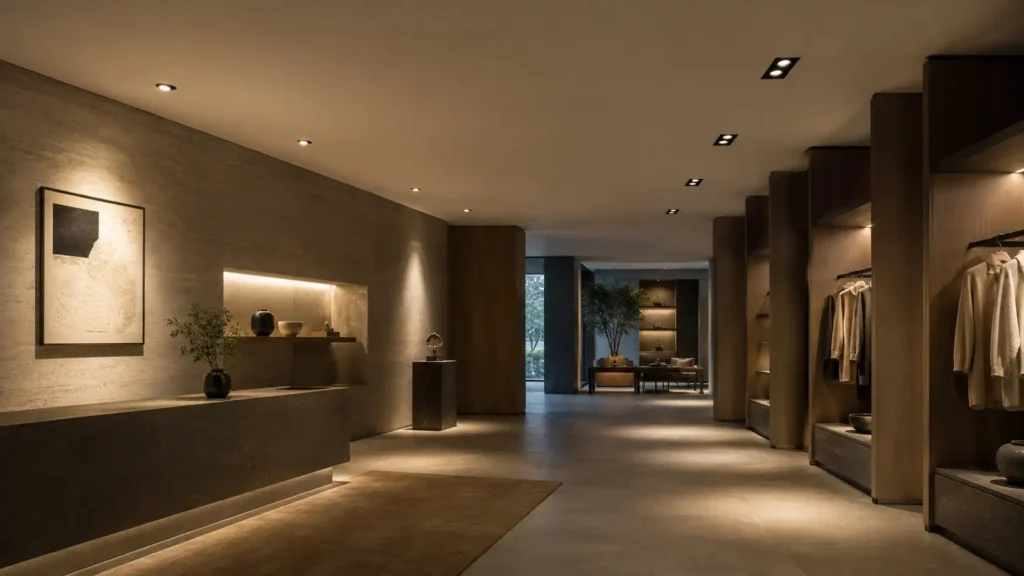
Resumindo: Single heads give the designer more freedom to move, space, aim, switch and replace each light point. Twin housings create a stronger visual rhythm and can simplify ceiling coordination, but the two sources remain tied to one physical position. Choose from the lighting tasks and ceiling plan—not from fixture shape alone.
1. Define “single” and “twin” before comparing them
A single-head downlight contains one optical opening in one housing. Several single heads can still form a row, grid, perimeter or task-based arrangement.
A twin downlight places two light sources in one rectangular or paired housing. The heads may be fixed or adjustable, share a common trim, and use separate or combined drivers depending on the product.
This distinction matters because two layouts can contain the same number of light sources but behave differently:
- Four single heads create four independent ceiling positions.
- Two twin housings create two ceiling positions and four light sources.
- A twin housing fixes the distance between its two sources.
- Separate singles allow that distance to change with the room and task.
Do not assume that a twin fitting has one driver, one circuit or one dimming channel. Confirm the actual wiring and control arrangement on the selected product data sheet.
🎯 Does “single downlight” mean one light for the room?
No. It describes one light source per fixture; a complete layout normally uses as many fixtures as its tasks and calculations require.
2. Choose single heads when the ceiling needs flexibility
The main advantage of separate heads is positional freedom. Single downlight placement can respond to walls, shelving, tables, circulation routes and ceiling services one point at a time.
That flexibility helps when:
- The room is irregular or changes width.
- Furniture and display positions do not follow a simple grid.
- Each feature needs a different aiming direction.
- Sprinklers, detectors, grilles or access panels interrupt the ceiling.
- Perimeter spacing differs from central spacing.
- Future tenant layouts may change.
A single recessed spotlight can also be rotated or tilted without forcing the adjacent beam to move with it. This is useful for retail displays, artwork, reception desks and hospitality details where the targets are not an equal pair.
The trade-off is coordination. More individual housings mean more ceiling marks, more positions to set out and potentially more drivers or connection points to accommodate.
🎯 What is the strongest reason to use single heads?
Each source can follow its own target, spacing and ceiling constraint instead of inheriting the position of a paired housing.
3. Choose twin housings when pairing is intentional
Twin downlights work best when the lighting task itself occurs in pairs. Examples include two display faces, two sides of a reception desk, repeated retail bays or a corridor rhythm built around rectangular ceiling modules.
A twin housing can make the ceiling look calmer because two sources read as one object. It may also reduce the number of large trim outlines and simplify repeated setting-out where every bay is identical.
However, pairing removes freedom. If one beam needs to move 300 mm while the other stays fixed, the housing cannot follow both instructions. A twin unit may also be visually heavy in a narrow or lightly furnished ceiling.
Use a twin configuration when all three statements are true:
- Two nearby lighting tasks recur throughout the plan.
- The fixed distance between heads suits those tasks.
- The rectangular housing aligns with the ceiling architecture.
If any statement fails, separate single heads are usually easier to coordinate.
🎯 Does a twin housing reduce the required number of light sources?
Not automatically. It packages two sources together; output, beam coverage and maintained light levels still decide the required quantity.
4. Compare ceiling rhythm—not only fixture count
The same four sources can produce very different reflected ceiling plans.
The diagram compares positional freedom only. It is not a universal spacing plan or photometric calculation.
An orderly one-light ceiling layout means one head at each planned ceiling point—not one light for the whole room. That approach creates a lighter visual rhythm and lets the designer vary spacing where the architecture demands it.
Twin housings produce fewer but larger ceiling objects. They suit repeated modules, but every pair should align with a real architectural or lighting reason. Avoid alternating singles and twins merely to fill empty ceiling space.
5. Test beam control before fixing the configuration
Fixture count alone does not predict the result. Compare both options using the exact lumen package, beam angle, aiming range, mounting height and target surfaces.
For each proposed source:
- Mark the intended task or surface.
- Draw the beam axis rather than only the ceiling point.
- Estimate the initial beam diameter at the target plane.
- Check overlap, dark gaps and bright spots.
- View adjustable heads from normal approach directions.
- Confirm the baffle and cut-off control direct glare.
The initial beam diameter can be estimated as:
Diâmetro do feixe ≈ 2 × distância ao alvo × tan(ângulo do feixe ÷ 2)
Use that result only as a geometry check. It does not predict maintained illuminance, surface reflectance, uniformity or glare.
For a twin unit, perform the check for both heads. Two beams inside one housing may overlap, separate or cross depending on their tilt and rotation limits.
🎯 Can two adjustable heads aim anywhere independently?
Only within the product’s stated tilt, rotation and cut-off limits; the shared housing position still constrains both beams.
6. Compare wiring and controls from the real product
The ceiling appearance does not reveal the electrical arrangement. Single downlight wiring may use one driver per fitting, a remote shared driver, loop-in connections or a project-specific control system.
A twin housing may contain:
- One driver feeding both sources
- Two drivers inside or above the housing
- Separate channels for independent switching or dimming
- One common channel controlling both heads together
These options affect circuit loading, dimmer compatibility, emergency-lighting strategy and fault behaviour. Request a wiring diagram and driver schedule for the exact model; do not infer them from the words “single” or “twin.”
Calculate connected load from the complete input power of every driver, including control gear where relevant. Confirm inrush-current limits, minimum and maximum dimmer loads, control protocol, cable access and local electrical requirements with the responsible professional.
🎯 Does one twin housing always need one connection?
No. The housing may contain one or multiple drivers and control channels, so the product wiring diagram must decide the connection plan.
7. Plan maintenance and replacement before ordering
Single heads usually isolate physical failure more clearly. One damaged fitting can often be accessed and replaced without disturbing a neighbouring light point. They can also make phased replacement easier when the product remains available.
Twin housings concentrate components. That may reduce the number of ceiling assemblies, but failure of a shared driver can darken both sources. If the complete twin fitting must be replaced, the finish, cut-out and mounting dimensions must still be available years later.
Compare these service questions:
| Verificar | Single heads | Twin housing |
|---|---|---|
| Position adjustment | Independent | Pair moves as one housing |
| Optical aiming | Independent by head | Independent only within shared-body limits |
| Driver failure | Usually affects one point | May affect one or both heads |
| Ceiling opening | More separate openings | Fewer, larger rectangular openings |
| Replacement matching | Match one small fitting | Match complete housing dimensions and finish |
| Future layout change | Easier to alter selectively | Pair spacing remains fixed |
Do not compare purchase price per housing. Compare cost per light source, number of drivers, installation time, ceiling preparation, controls and likely replacement scope.
8. Use a sample ceiling bay to make the final choice
Before approving a full project, mock up one representative bay with the actual ceiling finish and intended furniture or display target.
Review it from the entrance and main circulation directions. Check the ceiling rhythm with the lights off, then assess beam coverage, glare and aiming with the lights on. Dim the system through its required range and confirm that paired heads behave as intended.
Choose single heads when the project values independent spacing, aiming, switching or replacement. Choose twins when repeated paired tasks and architectural modules justify a shared housing.
🎯 What should decide between single and twin downlights?
Choose from target positions, ceiling rhythm, beam independence, wiring architecture and maintenance—not from the apparent number of fittings.
O que fazer a seguir
- Mark every lighting target and ceiling obstruction.
- Compare the same number of light sources as singles and twins.
- Check beam axes, not only reflected ceiling points.
- Request the exact housing, driver and control diagrams.
- Price the complete installed and serviceable system.
- Approve one representative ceiling bay before ordering the full quantity.
If the project also needs independent aiming, use the adjustable-versus-fixed guide before freezing the optic:
→ What’s the Difference Between Adjustable and Fixed Downlights?
XHLUX can help project teams compare single- and twin-head configurations against the ceiling module, required optics, drivers, controls and finish schedule before a production specification is locked.
![O que é um trilho de luz dimerizável com zoom: Guia completo [2025]](https://www.xhlux.com/wp-content/uploads/2025/06/Precision-Beam-Zoomable-Dimmable-Track-Light-for-Product-Displays-560x560.webp "O que é um trilho de luz dimerizável com zoom: Guia completo [2025]")