XHLUX
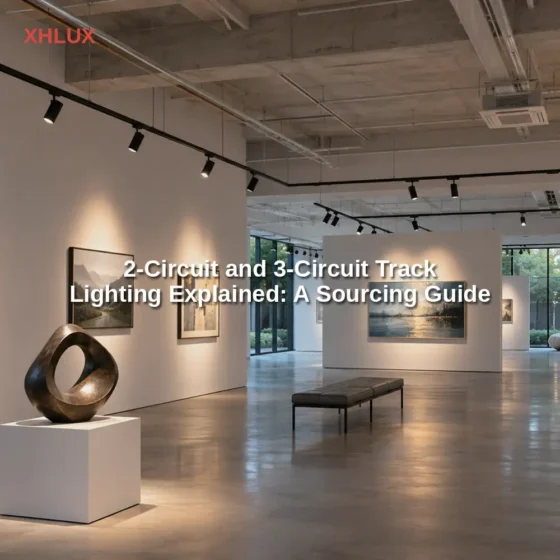
Commercial buyers comparing 2 circuit track lighting with three-circuit systems usually ask the same practical questions: how many independently controlled lighting groups does the project need, how is the track wired, are heads and adapters interchangeable, and which specifications must be locked before purchase.
Circuit count alone does not define the complete electrical configuration or prove compatibility. Neutral arrangement, voltage rating, adapter geometry and control interfaces still have to match the project—and each other.
For how “3-phase track” language often means three selectable circuits rather than a three-phase supply, see What Is a 3-Phase Track Light?.
Resumindo: A 2-circuit track supports two independently switched lighting groups; a 3-circuit track supports three. Two circuits are often enough when the layout needs only two switched scenes. Before you source either system, verify the manufacturer’s conductor/neutral configuration, ratings, wiring diagram, and adapter compatibility—not only the “2-circuit” or “3-circuit” label.
Índice
- 1. What Are the Key Differences Between 2-Circuit and 3-Circuit Track Lighting?
- 2. What Is the Difference Between 2-Circuit/1-Neutral and 2-Circuit/2-Neutral Track Systems?
- 3. What Voltage and Electrical Ratings Should You Check for Each Track System?
- 4. How Do Switching and Dimming Work on 2-Circuit and 3-Circuit Track Lighting?
- 5. Are 2-Circuit and 3-Circuit Track Heads Interchangeable?
- 6. How Can You Identify an Existing 2-Circuit or 3-Circuit Track System?
- 7. Can You Replace or Extend an Existing 2-Circuit or 3-Circuit Track System?
- 8. What Should You Check Before Sourcing a 2-Circuit or 3-Circuit Track Lighting System?
- Conclusão
⚖️ 1. What Are the Key Differences Between 2-Circuit and 3-Circuit Track Lighting?
The practical difference is how many conventionally switched lighting groups one compatible rail can support—two versus three—not which label is “better.”
What Does a Circuit Mean in Track Lighting?
In track lighting, a circuit is a separately switchable live path that can feed a lighting group. Heads with a circuit selector connect to one of those paths.
Circuit count is not automatically the same as the total number of conductors in the extrusion. Neutral, protective earth and any data conductors are additional. Always read the manufacturer’s conductor schedule.
How Does 2-Circuit Track Lighting Work?
A 2-circuit system provides two independently controlled live paths on one rail. Compatible heads select circuit 1 or circuit 2 through the adapter. That supports two switched groups without a second physical track—for example ambient and accent, or general merchandise lighting and promotional display lighting in a retail bay.
How Does 3-Circuit Track Lighting Work?
iluminação em calha de três circuitos adds a third independently controlled live path. Compatible heads select circuit 1, 2 or 3. That supports three conventionally switched groups on one rail when the project needs that extra split.
Detailed group planning, connector geometry and feed layout for three-circuit projects belong in a dedicated planning workflow—see How to Plan a 3-Circuit Track Lighting System when you move from comparison into layout.
2-Circuit vs 3-Circuit: Key Differences at a Glance
| Tema | 2-circuit system | 3-circuit system |
|---|---|---|
| Independently controlled groups | Up to two (with compatible heads) | Up to three (with compatible heads) |
| Switching flexibility | Two conventional switched scenes | Three conventional switched scenes |
| Circuit selection | Adapter selects 1 or 2 | Adapter selects 1, 2 or 3 |
| Electrical configuration | Manufacturer-specific lives, neutrals, earth | Manufacturer-specific lives, neutrals, earth |
| Adapter compatibility | Must match that track family | Must match that track family |
| Typical project need | Two lighting groups on one rail | Three lighting groups on one rail |
Neither column is universally better. Choose by required groups, electrical design and the exact system you can support with spare parts.
🎯 What mainly separates 2-circuit and 3-circuit track?
How many conventionally switched lighting groups one compatible rail can support—two versus three—not a universal quality ranking.

🔌 2. What Is the Difference Between 2-Circuit/1-Neutral and 2-Circuit/2-Neutral Track Systems?
These labels describe manufacturer-specific conductor arrangements. They are not a single international classification for every 2-circuit product.
How Does a 2-Circuit/1-Neutral System Work?
Some commercial track families use two live conductors with one shared neutral (plus protective earth as specified). Both circuits share a neutral conductor. Load balance, dimming and protection then follow that manufacturer’s wiring diagram—not a generic “2-circuit” assumption.
A documented example is the LSI Lighting TR 2, a 120 V, 2-circuit / 1-neutral system with two live conductors and one shared neutral. LSI specifies a 20 A rating per circuit. These ratings apply to the TR 2 product and should not be treated as universal specifications for other two-circuit track systems.
Do not assume every 2-circuit rail uses a shared neutral. For a clickable contrast with a separate-neutral design, Lighting Services Inc Surface POWERTrack specifications describe two-circuit models with a separate neutral busbar for each circuit e 20 A maximum per circuit (POWERTrack specifications PDF). That is a different manufacturer’s 2-circuit / separate-neutral arrangement, not a substitute label for TR 2.
How Does a 2-Circuit/2-Neutral System Work?
Other families provide separate neutrals with the two circuits. Documented Amerlux examples:
- Global TEK — TEK Track, 2-Circuit/2-Neutral, 120 V (Amerlux states independent dimming is supported when dimmable sources are used)
- Global HTEK — HTEK Track, 2-Circuit/2-Neutral, 277 V (Amerlux states two 20-amp circuits originating from the same phase; treat as this product’s published arrangement, not a universal 2-circuit rule)
Those pages describe Amerlux’s own systems. They do not redefine every other brand’s 2-circuit product.
What Does the Neutral Configuration Mean for Track Lighting Buyers?
- Supply design must match the published conductor arrangement.
- Shared-neutral and separate-neutral products can behave differently under dimming and load sharing.
- Always check the manufacturer wiring diagram before you approve a substitute.
- Do not treat two “2-circuit” catalogues as interchangeable because both say “2-circuit.”
🎯 Is 2-circuit/1-neutral a global standard?
No. It is a manufacturer configuration class. Confirm the published wiring diagram for the exact system on order.
⚡ 3. What Voltage and Electrical Ratings Should You Check for Each Track System?
Select track products for the project’s supply and published ratings. Voltage is not implied by the circuit count.
What Input Voltage Does the Track System Support?
Track systems are designed for specific input voltages. Match the published rating to the project supply—do not infer voltage from the “2-circuit” or “3-circuit” label. Documented North American examples in this guide include Amerlux TEK at 120 V and Amerlux HTEK at 277 V; other markets use other rated voltages. Always take the value from the datasheet for the exact SKU and region.
If you are still choosing between line-voltage and low-voltage track architectures (including 48 V / 24 V magnetic systems, which are a different product class from multi-circuit mains track), see How to Choose Between 240V, 48V and 24V Track Lighting as related reading on supply voltage—not as a list of 2-circuit / 3-circuit interchangeable rails.
How Should You Check Current and Load Ratings?
On the datasheet, find the rated current per circuit and any total system capacity stated separately. They are not always the same figure.
Work both numbers on the same datasheet: per-circuit rating first, then any whole-rail or feeder capacity. Clickable examples already linked above: LSI Surface POWERTrack states 20 A maximum each circuit with a separate neutral per circuit; Amerlux HTEK states two 20-amp circuits from the same phase on its 277 V 2-circuit / 2-neutral track. Use each figure only for that product. When two manufacturers publish different ampere numbers, keep them on separate RFQ lines—never merge them into one “typical 2-circuit” rating.
What Electrical Specifications Should Match the Project?
Check the datasheet and wiring diagram for:
- Input voltage and frequency for the destination supply
- Rated current per circuit, plus any separate whole-rail or feeder capacity
- Conductor / neutral configuration
- Earthing / grounding arrangement
- Certifications required for the destination market
If two vendors quote different voltage or current values for similarly named “2-circuit” rails, treat them as different systems until both wiring diagrams are compared side by side.
Why Should You Check the Manufacturer’s Wiring Diagram?
Different manufacturers use different internal arrangements. Appearance, colour codes and “circuit 1/2/3” labels are not enough. Supply, protection and terminations must be verified by qualified electrical professionals against the published diagram for that system.
🎛️ 4. How Do Switching and Dimming Work on 2-Circuit and 3-Circuit Track Lighting?
Circuit selectors assign heads to live paths; independent dimming needs matching drivers, dimmers and a configuration that the manufacturer allows.
How Are Track Lights Assigned to Different Circuits?
The adapter’s circuit selector connects each head to one live path. Two-group layouts use positions 1 and 2; three-group layouts use 1–3 on a compatible three-circuit rail. Keep a circuit schedule so later moves stay documented.
Can Each Circuit Be Switched Independently?
Yes, when the electrical design feeds each live path through the intended switches or contactors. The track makes those paths available; the switching devices and wiring still have to be designed for the building.
Retail example: on one compatible 2-circuit rail, circuit 1 can light general merchandise while circuit 2 lights a promotional display. Independent switches then turn those groups on or off separately. If the project also needs each group dimmed on its own curve, you must still verify drivers, dimmers and the track’s published electrical arrangement—switching groups and dimming groups are related tasks, not automatic twins.
Can 2-Circuit and 3-Circuit Track Lighting Be Dimmed Independently?
Independent dimming is possible only when drivers, dimmers (or control interfaces) and the track’s electrical arrangement support it. Shared-neutral and separate-neutral products may impose different constraints. Circuit count alone does not guarantee independent dimming of every head or every group.
Can Multi-Circuit Track Lighting Work with DALI or Other Smart Controls?
DALI, 0–10 V, Casambi / wireless and dedicated data-bus tracks are separate control architectures. Ordinary multi-circuit switching is not the same as digital addressing. Check the control interfaces and required components against the manufacturer’s datasheet. A supported control protocol does not mean that every track variant includes the necessary control infrastructure.
🔧 5. Are 2-Circuit and 3-Circuit Track Heads Interchangeable?
Only when the manufacturer states that the adapter, contacts and selector match that exact track family. Circuit count alone is not a fit certificate.
Why Do Track Heads Need Compatible Adapters?
Adapters must match mechanical retention, electrical contact positions, polarity / grounding and the circuit-selector design of the rail. A head that “looks similar” can still miss contacts or sit incorrectly.
Can a 2-Circuit Track Head Fit a 3-Circuit Track?
Sometimes only inside one documented system family—and only if the adapter contacts and selector are approved for that rail. Do not assume a 2-circuit head can land safely on a different brand’s 3-circuit extrusion.
Can a 3-Circuit Track Head Fit a 2-Circuit Track?
A track head may physically fit a rail but still fail to make the correct electrical contacts or select the intended circuit. Extra selector positions or contact layouts can be meaningless—or unsafe—on a two-circuit rail. Appearance cannot establish compatibility.
Can You Mix Track Lighting Brands?
Commercial markets also use distinct mechanical track/adapter standards—including H, J and L families and their variants. Those letters name mechanical/electrical interface families; they are não another way of saying “2-circuit” or “3-circuit.” A J-type 2-circuit rail still needs the heads and clips that manufacturer lists for that J family.
For example, WAC Lighting’s J2 track documentation is specific to its J-family 2-circuit system and the heads/accessories approved for it—use that kind of official compatibility list, not a cross-brand visual guess. Use components from different manufacturers only when their compatibility is documented and the resulting system meets the applicable electrical and safety requirements. Sample testing can help verify fit and operation, but it does not replace documented compatibility or required approvals.
For a practical head-to-rail identification checklist beyond circuit-count differences, see Este projetor de calha é compatível com a sua calha?.
🎯 Can circuit labels prove head interchangeability?
No. Adapter geometry, contacts and the manufacturer’s compatibility statement decide fit—not the “2-circuit” or “3-circuit” wording alone.
🔍 6. How Can You Identify an Existing 2-Circuit or 3-Circuit Track System?
Identify the installed family from profile, contacts, markings and documents before you order replacements.
Check the Track Profile and Conductor Arrangement
Photograph the cross-section, conductor positions, polarity marks and grounding structure. Compare them with manufacturer drawings—not with memory of another brand.
Do not identify the system from conductor count alone. Two rails can show a similar number of conductors and still belong to different brands, different neutral arrangements or different adapter families. Always pair the photos with manufacturer, series, track model, adapter model and the wiring diagram when those are available.
Identify the Track Adapter and Contact Configuration
Note adapter shape, contact positions and the circuit selector. Many families are recognisable only from the adapter, not from the painted finish.
Find the Manufacturer and Track Model
Look for brand stamps, model labels, original catalogues, install manuals and drawings. If labels are missing, treat the system as unidentified until a supplier or manufacturer confirms it.
What Information Should You Send to a Supplier?
- Full track photographs
- Track cross-section photographs
- Track-head adapter photographs
- Manufacturer and model information (if known)
- Electrical specifications on site
- Existing installation documents
Keep identification separate from redesign: first name the system, then judge compatibility.
🔄 7. Can You Replace or Extend an Existing 2-Circuit or 3-Circuit Track System?
Replace heads or extend rails only inside a documented compatible system; otherwise plan a full system change.
Can You Replace Existing Track Heads Without Changing the Track?
Yes when the new heads use approved adapters for that rail and match electrical and control requirements. If the adapter family is obsolete or undocumented, keeping the old rail may still force a system change.
Can You Extend an Existing Track with Additional Sections?
Use matching track sections, connectors and feeds from the same system. Using connectors that are not approved for the existing track system can result in mechanical or electrical incompatibility.
Can You Use Components from Different Manufacturers?
When extending an already-installed rail, treat the check as a parts match against that installed system—not as a fresh brand-mix design exercise.
Before you order extension parts:
- Confirm the existing track manufacturer, series and model.
- List the proposed track sections, connectors, feeds and adapters by exact part number.
- Obtain the manufacturer’s written compatibility statement for those new parts on that existing system.
- Recheck voltage, per-circuit current and any whole-rail capacity after the extension length and loads are added.
If the installed model cannot be confirmed, or the new part numbers are not approved for it, plan a full system change instead of a mixed extension.
When Is Replacing the Complete Track System Necessary?
- The existing model cannot be identified.
- New components are incompatible.
- Electrical ratings no longer meet the project.
- Original parts are discontinued and no approved equivalent exists.
📋 8. What Should You Check Before Sourcing a 2-Circuit or 3-Circuit Track Lighting System?
Lock the full system configuration, accessories, controls, documents and sample results before you release a bulk Trilho de luz LED order.
Earlier sections explain por que each check matters. Use this section as the supplier-facing action list: what to request, what to compare and what to accept on samples.
Confirm the Complete Track System Configuration
Ask the supplier to state, on one line per item:
- 2-circuit or 3-circuit
- Neutral / conductor arrangement (including 1-neutral vs 2-neutral where applicable)
- Rated voltage and frequency
- Rated current per circuit and any separate system capacity
- Installation type (surface, recessed, suspended)
Verify Track Heads, Adapters and Accessories
Request part numbers for LED track heads, adapters, power feeds, connectors, end caps and mounting accessories on one compatible bill of materials—not a mixed catalogue shortlist.
Check Dimming and Control Compatibility
Ask for the driver type, dimming or control protocol, controller/interface part numbers and a statement that those parts match the track family’s published electrical arrangement.
Review Product Certifications and Technical Documents
Request, as separate files where possible:
- Product datasheets for track and heads
- Electrical wiring diagrams
- Installation instructions
- Applicable certifications for the destination market
- IES / LDT photometric files where the project needs them
Test Samples Before Confirming Bulk Orders
On production-intent samples, record pass/fail for track/head fit, independent switching, dimming behaviour (if required), optical performance, finish and any other project-specific checks before bulk release.
What Should a Track Lighting RFQ Include?
| Information | Details required |
|---|---|
| Tipo de trilha | 2-circuit / 3-circuit |
| Project voltage | Required input voltage |
| Track configuration | Neutral and conductor arrangement |
| Track heads | Models, power and quantities |
| Controlar | Switching / dimming requirements |
| Accessories | Adapters, feeds and connectors |
| Instalação | Surface / recessed / suspended |
| Documents | Electrical wiring diagrams; product datasheets; installation instructions; applicable certifications |
Also evaluate supplier capability: lead time, MOQ, spare-parts continuity and OEM/ODM options for adapters, optics and electrical interfaces.
🎯 What should you lock before a track RFQ?
Circuit count, neutral/voltage ratings, adapter family, controls, documents and sample results—not the catalogue nickname alone.
Conclusão
What should you decide before sourcing 2-circuit or 3-circuit track? First set how many independently controlled lighting groups the project needs. Then verify electrical configuration and ratings, confirm track/head/adapter compatibility, and review drawings plus samples before bulk purchase.
A 2 circuit track lighting label answers only part of the question. Neutral arrangement, voltage, controls and adapter family decide whether the system will install and stay serviceable.
XHLUX manufactures commercial LED track luminaires and supports OEM/ODM projects for distributors, wholesalers, contractors and project buyers who need defined circuit counts, adapter interfaces, optic packages, wattage / CCT / CRI bands or dimming and control options. Discuss the track family and electrical envelope your project requires.
Explore outros artigos relacionados do nosso blogue:
- How Does Tunable White Track Lighting Work?
- Comparação do desempenho de projetores de calha de diferentes tipos, todos com 20 W
- Pedir um orçamento de iluminação