 XHLUX
XHLUX

Índice
- 1 What Is Art Gallery Lighting?
- 2 Core Design Principles for Art Gallery Lighting
- 3. Key Components of a Professional Art Gallery Lighting System
- 4. Lighting Strategies by Art Type
- 5. Design Process — From Concept to Commissioning
- 6. How to Choose a Reliable Gallery Lighting Supplier
- 7. FAQ About Art Gallery Lighting
- 8. Conclusão
Light is the bridge between art and space.In a gallery, every beam of light shapes emotion, perspective, and value.A well-engineered art gallery lighting system goes far beyond basic illumination—it determines how each painting, sculpture, or installation is perceived.
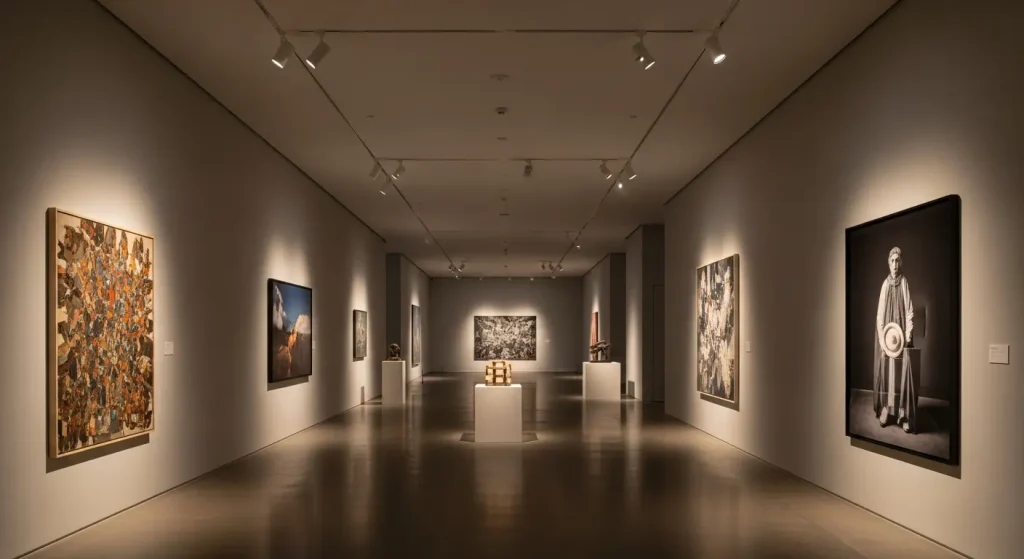
For architects, lighting designers, and system integrators, understanding how to design art gallery lighting means mastering the balance between artistic aesthetics e technical precision.
This article explains what defines professional gallery lighting, its design logic, and how to build systems that meet international standards such as ENEC, CE, e CIE 157—while maintaining both visual comfort and artistic authenticity.
1 What Is Art Gallery Lighting?
1.1 Definition and Purpose
Art gallery lighting refers to a specialized lighting system designed for art exhibition environments such as galleries, cultural centers, and brand showrooms.
Its primary objectives are:
- To reveal true color and fine detail without altering the artist’s intent.
- To guide visitor attention through layers of light and shadow.
- To build immersive emotional experiences that complement architecture and artwork.
A professional system integrates optical precision, anti-glare engineering, intelligent control, and architectural integration—allowing curators to shape how every visitor experiences the collection.
1.2 How Gallery Lighting Differs from Commercial Lighting
| Comparison Aspect | Art Gallery Lighting | Commercial Lighting |
|---|---|---|
| Color Quality | CRI ≥ 95 / R9 ≥ 90, full spectrum | CRI 80–90, standard spectrum |
| Illuminance Control | 50–200 lux precision range | No strict lux limit |
| Controle de brilho | Deep recess optics / honeycomb louver | Basic reflector control |
| Smart Dimming | DALI / Casambi / DMX | Manual or 0–10 V dimming |
| UV & IR Protection | No UV/IR radiation | Not optimized for art safety |
Unlike general retail lighting, art-grade systems emphasize color rendering, glare suppression, and conservation safety.
They operate within controlled lux levels to prevent pigment fading and ensure a neutral perception across materials and textures.
💡 Download Gallery Lighting Comparison Guide
Discover detailed technical benchmarks between commercial and art lighting.
👉 Download Now ›
2 Core Design Principles for Art Gallery Lighting
Designing an effective lighting scheme requires understanding both human perception e light physics.
Below are the five principles that define high-quality LED art gallery lighting.
2.1 Color Rendering and Spectral Accuracy
Color is the soul of art.
To reproduce artwork faithfully, luminaires must use CRI ≥ 95 e R9 ≥ 90 full-spectrum LEDs.
High R9 values ensure the vivid reproduction of reds and warm pigments, while tight binning (≤ 3 SDCM) guarantees uniform color among multiple fixtures.
Boas práticas:
- Use warm white 2700 K–3000 K for classical paintings.
- Usar 3500 K–4000 K neutral white for contemporary works and photography.
- Choose LEDs tested under LM80 / TM21 to ensure color stability over time.
These specifications align with European gallery standards such as EN12464-1 e CIBSE LG8, ensuring both fidelity and longevity.
2.2 Beam Angle and Illuminance Control
Lighting must sculpt the artwork—not wash it out.
Each piece demands its own ângulo do feixe e lux level based on size, surface, and reflectivity.
| Artwork Type | Ângulo de feixe recomendado | Lux Range | Propósito |
|---|---|---|---|
| Oil Paintings | 15°–24° | 100–200 lux | Enhance texture & depth |
| Sculptures | 15°–36° | 150 lux | Create contrast and shadow |
| Photography | 36°–60° | 50–100 lux | Maintain grayscale accuracy |
| Mixed Media | Variable | 80–150 lux | Balanced visual hierarchy |
Rule of thumb:
Maintain an illuminance uniformity ≥ 0.8 and a contrast ratio of 3 : 1 to 5 : 1 between focal and ambient light.This balance keeps visitors’ attention guided without visual fatigue.
2.3 Anti-Glare and Visual Comfort
Viewers should see the art—not the light source.
That means designing systems with UGR < 19, refletores profundamente embutidos, e shielding accessories such as honeycomb grids or anti-glare rings.
Tech recommendations:
- Usar black-coated or matte silver reflectors to minimize specular reflections.
- Combine multiple layers of optics—primary lens + secondary reflector—for a soft-edge beam.
- Avoid direct line-of-sight exposure from audience viewing angles (30°–45° offset).
Comfortable lighting enhances dwell time and emotional engagement, directly influencing how long visitors stay—and how they remember the exhibition.
2.4 Smart Lighting and Scene Management
Digital control transforms static illumination into an adaptive storytelling tool.
Modern gallery lighting systems integrate DALI-2, Casambi Bluetooth mesh, ou DMX512 to provide precise dimming and multi-scene programming.
Common scene presets:
| Scene | Illuminance Level | Use Case |
|---|---|---|
| Exhibition Mode | 100–200 lux | Normal viewing |
| Cleaning Mode | 300 lux | Maintenance tasks |
| Night Mode | 10–20 lux | Security or standby |
| Event Mode | Variable + DMX | Openings or interactive shows |
These systems allow curators to adjust ambience instantly—highlighting one collection today and another tomorrow, without rewiring or fixture changes.
📘 Consult Our Lighting Engineer
Need help integrating DALI or Casambi control into your next gallery project?
👉 Contact XHLUX Engineering Team ›
2.5 Maintaining Energy Efficiency and Sustainability
Beyond aesthetics, galleries face growing environmental and operational pressures.
Usando high-efficacy LED drivers (≥ 120 lm/W) and smart sensors reduces energy consumption by 40–60 %.
Coupled with Daylight Harvesting e Occupancy Sensors, museums can maintain consistent lux levels while minimizing energy waste.
Key sustainability features:
- Aluminum housings for recyclable design.
- Long lifespan ≥ 50,000 h (L80/B10).
- 0 UV / IR emission for artwork safety.
Sustainability not only protects the planet but also strengthens brand credibility among environmentally conscious visitors and curators.
💡 Download Lighting Design Principles Guide
Get detailed charts on CRI, beam angles, and energy efficiency benchmarks for galleries.
👉 Download Now ›
3. Key Components of a Professional Art Gallery Lighting System
To design a reliable gallery lighting solution, every component—from LED source to control protocol—must align with international standards.
A gallery lighting system typically includes six integrated modules: light source, optical system, control interface, installation method, thermal management, and safety certification.
| Module | Função | Technical Highlights |
|---|---|---|
| Light Source Module | Deliver accurate color rendering | CRI 95+ full-spectrum COB LEDs, R9 > 90, LM80-certified |
| Optical System | Define beam shape and distribution | Interchangeable reflectors / lenses / honeycomb grids |
| Sistema de controle | Enable dimming and scene control | DALI-2 / Casambi / DMX512 compatibility |
| Mounting System | Provide flexibility in layout | Track, recessed, or pendant options |
| Thermal Design | Maintain performance & lifespan | Aluminum die-cast housing, < 25 °C temperature rise |
| Safety & Certification | Meet EU project compliance | CE / ENEC / CB / RoHS / ISO 9001 |
3.1 Light Source Quality
A true art-grade luminaire starts with the LED engine.
Full-spectrum LEDs simulate natural daylight, providing balanced red, green, and blue wavelengths—critical for preserving pigment accuracy.
3.2 Optical System Design
The optical system defines how the beam interacts with artwork.
High-reflectivity aluminum reflectors (≥ 95 %) and PMMA secondary lenses ensure smooth, halo-free transitions.
A modular design allows curators to replace optics in minutes—switching from narrow 15° spotlights for sculptures to 60° floods for wall-wide installations.
3.3 Control and Connectivity
Modern galleries require networked lighting control.
DALI-2 provides centralized precision and interoperability; Casambi Bluetooth mesh simplifies retrofits with wireless configuration; and DMX512 enables dynamic sequences for digital exhibitions.
All XHLUX systems integrate seamlessly with BMS (Building Management Systems) for unified operation.
3.4 Mounting and Maintenance
Mounting design defines flexibility.
Track systems enable mobility and easy repositioning; recessed systems provide a minimalist architectural finish; pendant systems suit double-height spaces.
Front-maintenance access ensures that even in permanent installations, drivers and optics can be serviced without dismantling ceilings.
💡 Download System Layout Blueprint
Explore a complete map of track, recessed, and pendant configurations.
👉 Download Gallery System Layout ›
4. Lighting Strategies by Art Type
Different artistic media require different light behaviors.
Understanding each category’s optical and spectral needs is key to curating visually balanced galleries.
| Art Type | Lighting Objective | Recommended Configuration |
|---|---|---|
| Oil Paintings | Reproduce pigment richness and texture | 24° spotlight, CRI 95+, 3000 K warm white |
| Sculptures | Highlight contours and depth | 15° narrow beam, 3500 K neutral white |
| Photography | Maintain grayscale precision | 36° flood beam, 4000 K |
| Installation / Mixed Media | Support interaction and movement | DMX programmable system + Tunable White 2700–4000 K |
4.1 Oil Painting Exhibitions
Oil paintings depend on subtle color transitions and surface sheen.
Usar warm color temperatures (2700–3000 K) to enhance golden tones while keeping shadow softness.
The ideal beam is 24°, set at a 30°–35° incident angle to avoid glare on glass frames.
Combine accent lighting (120 lux) with ambient fill (60 lux) for dimensional balance.
4.2 Sculpture Galleries
Sculptures communicate form through light and shadow.
Three-point lighting—front, side, and back—reveals contour while preserving drama.
Usar narrow beams (15°) com CRI 95+ neutral white 3500 K.
Avoid overhead hotspots by staggering fixtures across the ceiling grid.
4.3 Photography and Contemporary Works
For digital prints or photographs, neutral color fidelity is crucial.
Opte por 4000 K LEDs with minimal color shift.
A 36° flood ensures even illumination across large frames, and dimming via DALI maintains tonal consistency between different prints.
4.4 Interactive and Installation Art
New-media exhibitions often use motion, sound, or projection.
Pair DMX lighting with sensors or Casambi app triggers for adaptive responses.
Dynamic tunable-white fixtures (2700–4000 K) transition from warm to cool tones, supporting evolving curatorial narratives.
🏛️ Download Gallery Lighting Design Manual
Get detailed settings for each art type: beam charts, lux targets, and layout drawings.
👉 Download Now ›
5. Design Process — From Concept to Commissioning
Creating a museum-grade lighting environment follows a structured workflow that blends artistic intent with engineering discipline.
| Stage | Objective | Deliverables |
|---|---|---|
| 1. Requirement Analysis | Understand exhibition goals, artwork materials, and space geometry | Lighting Brief Document |
| 2. Optical Simulation | Model beam spread and illuminance distribution | Dialux / Relux Renderings |
| 3. Prototype Testing | Validate light quality and glare comfort | CRI / UGR Test Reports |
| 4. System Integration | Configure control networks and zoning | DALI / Casambi Mapping Files |
| 5. Handover & Support | Provide training, maintenance schedule, warranty registration | User Manual + Maintenance Plan |
5.1 Requirement Analysis
Every successful lighting concept begins with a conversation.
Designers must document artwork materials, wall finishes, ceiling heights, and daylight conditions.
For sensitive works, note conservation limits—such as ≤ 100 lux for oil paintings ou ≤ 50 lux for paper artifacts.
5.2 Simulation and Testing
Using Dialux or Relux, designers can visualize beam overlap, shadow formation, e uniformity ratios before procurement.
Mock-ups help verify that color temperature and lux distribution meet expectations under real-world conditions.
5.3 Integration and Control
Once luminaires and drivers are selected, mapping DALI addresses or Casambi nodes ensures scalability.
Group lights by artwork category or zone to simplify future programming.
Include occupancy sensors for automatic fade-in/fade-out sequences, maintaining elegance and efficiency.
5.4 Final Commissioning
After installation, calibrate each fixture’s aiming angle, intensity, and dimming curve.
Record baseline data for maintenance reference.
Proper commissioning ensures the designed “story of light” matches the curatorial narrative exactly.
💬 Request a Free Lighting Consultation
Need help designing your next art gallery lighting layout?
👉 Talk to XHLUX Engineers ›
6. How to Choose a Reliable Gallery Lighting Supplier
The quality of your lighting partner determines the reliability of your entire project.
For architects, contractors, and lighting brands, the ideal supplier combines engineering precision, certification compliance, and ODM flexibility.
6.1 Verify Certification and Compliance
European and international art spaces demand strict quality and safety standards.
Always check for the following certifications before specifying any lighting system:
| Certification | Propósito | Por que isso importa |
|---|---|---|
| CE / ENEC | EU electrical & photobiological safety | Ensures compliance for EU tenders |
| CB / RoHS | Global safety & environmental health | Confirms eco-friendly materials |
| LM80 / TM21 | LED lifetime and lumen maintenance | Guarantees ≥50,000 h operation |
| CIE 157:2004 | UV/IR emission limitation | Protects artworks from light damage |
| ISO 9001 | Quality management system | Ensures consistent production process |
✅ Tip: Request the LM80/TM21 reports e ENEC certificate numbers to confirm authenticity.
Certified luminaires provide assurance not just for performance—but for museum-level conservation safety.
💡 Request Certification Pack
Need documentation for CE or ENEC approval?
👉 Download Compliance File ›
6.2 Evaluate Technical and Optical Support
A competent supplier provides design collaboration, not just hardware.
Procurar:
- IES/LDT files for lighting simulation in Dialux or Relux.
- BIM models for integration with Revit or Archicad.
- Custom optical tuning—beam angle, reflector color, anti-glare accessories.
- On-site or virtual aiming support during commissioning.
This collaboration shortens design cycles, eliminates rework, and ensures the final light effect matches the original concept.
6.3 Assess ODM/OEM Capability
For lighting brands and system integrators, a qualified ODM partner means rapid market expansion with minimal engineering cost.
XHLUX ODM advantages:
- Customizable housing shape, finish, and optics.
- Branding options with private-label logos and packaging.
- Flexible beam modules (10°–60°) e Tunable White (2700–4000 K) systems.
- Full compatibility with DALI-2, Casambi, and DMX protocols.
- EU warehouse and 3-week sampling for fast deployment.
💬 Start Your ODM Partnership
Build your private-label art lighting line today.
👉 Contact XHLUX ODM Team ›
6.4 Review Warranty and After-Sales Service
Art gallery installations operate daily under strict visual demands.
Select manufacturers that provide:
- 5-year full warranty on driver and LED engine.
- 48-hour response time for technical queries.
- Availability of spare modules for at least 5 anos.
- Preventive maintenance documentation and user training.
Long-term reliability protects both your project investment and your client’s artwork.
7. FAQ About Art Gallery Lighting
Q1: How is gallery lighting different from museum lighting?
Gallery lighting focuses on artistic presentation and commercial ambience, while museum lighting prioritizes conservation stability and long-term preservation.
Q2: Will LED lights damage paintings or photos?
No.
High-quality LEDs emit no ultraviolet or infrared radiation and comply with CIE 157 standards—making them completely safe for artworks.
Q3: What is the recommended illuminance level for galleries?
Typically 50–200 lux, depending on material sensitivity and exhibition duration.
Usar 50–100 lux for paper or textile art, and up to 200 lux for oil paintings and sculptures.
Q4: Can gallery lights integrate with smart control systems?
Yes.
All professional systems from XHLUX support DALI-2, Casambi, e DMX protocols for wireless dimming, scene presets, and centralized management.
Q5: Does XHLUX provide OEM/ODM customization?
Absolutely.
We specialize in optical design, structure customization, and branding solutions—with CE, ENEC, and RoHS certification for European market entry.
📘 Download Case Studies Pack
Explore how XHLUX lighting systems enhance European galleries and art museums.
👉 View Project Gallery ›
8. Conclusão
In an art gallery, lighting is more than visibility—it is emotion, narrative, and connection.
A truly professional lighting design allows the audience to see every color, texture, and shadow exactly as the artist intended.
By combining CRI 95+ full-spectrum LEDs, anti-glare optics, smart dimming, e architectural integration,
today’s galleries can transform from simple display venues into immersive sensory environments.
For over 15 years, XHLUX has delivered ENEC-certified, museum-grade lighting systems to galleries, museums, and design brands across Europe, the Middle East, and Asia—helping clients achieve both aesthetic excellence and technical precision.
✨ Why Lighting Professionals Choose XHLUX
- 15+ years of manufacturing in museum & gallery lighting
- Certified under CE / ENEC / CB / RoHS / ISO 9001
- Expert in CRI 95+ optics e UGR < 19 anti-glare design
- Compatible with DALI / Casambi / DMX / 0–10 V
- Completo ODM/OEM customization for private-label brands
- 5-year warranty e EU warehouse for rapid delivery
📞 Take immediate Action
Looking to create your own gallery-grade lighting system?
Partner with XHLUX for high-precision, sustainable LED solutions designed for professional art environments.
👉 Converse pelo WhatsApp | Solicite um orçamento | Baixar catálogo | View Projects