 XHLUX
XHLUX

Índice
- 1. What Is a Gallery Lighting System?
- 2. Core Components of a Gallery Lighting System
- 3. Key Design Concepts in Gallery Lighting Systems
- 4. Smart and Digital Control in Gallery Lighting
- 5. Common Applications and Lighting Strategies
- 6. How to Choose a Reliable Gallery Lighting Supplier
- 7. FAQ About Gallery Lighting Systems
- 8. Conclusão
Light defines how art is seen.In galleries, it is more than illumination — it is the silent language that shapes atmosphere, perception, and emotion.A well-engineered gallery lighting system does more than brighten a room: it reveals the artist’s intention, protects the artwork, and immerses the audience in an emotional dialogue between space and creation.
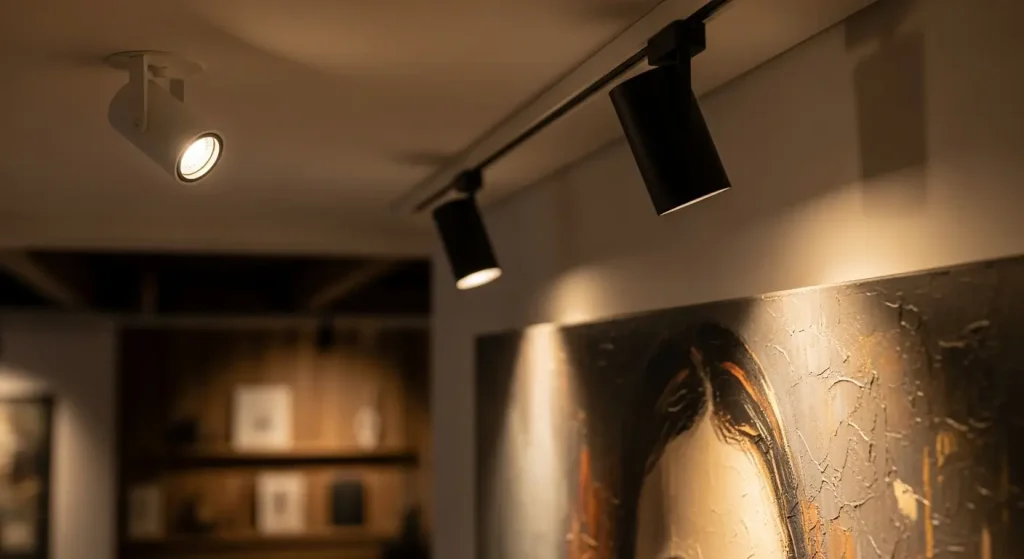
This article explores the definition, structure, and design principles of modern gallery lighting systems — explaining how professionals can achieve museum-grade results through high-CRI LEDs, anti-glare optics, and intelligent control platforms.
💡 Download Technical Catalog
Explore CRI 95+ LED gallery lighting systems with DALI/Casambi control.
👉 Download Catalog ›
1. What Is a Gallery Lighting System?
1.1 Definition and Function
A Sistema de iluminação da galeria is a specialized lighting infrastructure designed specifically for art display environments such as museums, private galleries, and brand exhibition spaces.
It typically consists of four integrated components:
- Luminaires and Light Sources — LED track lights, recessed downlights, wall washers.
- Optical Control — reflectors, lenses, and anti-glare structures that shape and soften light.
- Smart Control System — digital platforms like DALI-2, Casambi, ou DMX512 that regulate intensity, color, and timing.
- Mounting Framework — track rails, recessed frames, and suspension systems to support flexible installation.
Together, these modules deliver precise lighting that reproduces artwork color faithfully, prevents UV/IR damage, and enhances the visitor experience.
1.2 Gallery Lighting vs. Commercial Lighting
| Comparison Metric | Sistema de iluminação da galeria | Standard Commercial Lighting |
|---|---|---|
| Color Quality | CRI ≥ 95 / R9 ≥ 90 | CRI 80–90 |
| Illuminance Control | 50–200 lux (precisely managed) | No strict control |
| Light Damage Protection | UV/IR-free LEDs | Minimal protection |
| Sistema de controle | DALI / Casambi / DMX | Manual or fixed dimming |
| Visual Comfort | Anti-glare < UGR 19, flicker-free | Standard diffusion |
Unlike retail or office lighting, gallery systems focus on visual fidelity and conservation rather than general brightness.
💡 Learn More
Compare CRI 95+ gallery fixtures vs. conventional commercial LEDs.
👉 Download Comparison Sheet ›
2. Core Components of a Gallery Lighting System
Each element of a gallery lighting ecosystem contributes to the precision, control, and longevity required in art presentation.
2.1 Light Source Module
- High-CRI LEDs: CRI ≥ 95 / R9 ≥ 90 ensure accurate color reproduction of pigments and materials.
- Full-spectrum emission: balanced wavelength output prevents hue distortion.
- Color consistency: ΔSDCM ≤ 3 guarantees uniform tone across fixtures.
- Flicker-free drivers: eliminate stroboscopic effects in sensitive viewing environments.
- Lumen maintenance: > 90 % over 50,000 hours for sustained quality.
2.2 Optical Design
Optical architecture determines how light interacts with texture and depth.
- Interchangeable beam angles: 15°, 24°, 36°, 60° provide adaptable focus for different artwork sizes.
- Soft-edge beams: avoid harsh transitions and shadows.
- Anti-glare reflectors: recessed structure (UGR < 19) improves viewer comfort.
- High-reflectivity materials: aluminum vacuum-coated surfaces (reflectance > 95 %).
| Ângulo do feixe | Use Case | Effect |
|---|---|---|
| 15° | Sculpture or small objects | Creates dramatic highlights |
| 24° | Medium paintings | Balanced focus and spread |
| 36° | Large canvases | Uniform illumination |
| 60° | Wall washing | Even surface light distribution |
2.3 Smart Control System
Digital lighting control transforms static illumination into a responsive, adaptive environment.
- DALI-2 for centralized wired control across zones.
- Casambi for wireless Bluetooth mesh networks, ideal for retrofits.
- DMX512 for dynamic installations or multimedia exhibits.
- 0–10 V analog dimming for small-scale, cost-effective setups.
Each system allows independent programming of intensity, timing, and color temperature — ensuring artworks remain optimally lit under changing ambient conditions.
2.4 Mounting Architecture
Gallery ceilings vary widely — from minimalist drywall to industrial truss designs — requiring flexible mounting systems:
| Mount Type | Descrição | Vantagem |
|---|---|---|
| Track | Surface or recessed rail supporting multiple adjustable heads | Maximum flexibility |
| Recessed | Fixtures integrated into ceiling plane | Minimalist visual impact |
| Pendant | Suspended spotlight for high ceilings | Enhanced spatial focus |
Modular mounting enables future exhibit reconfiguration without structural reconstruction — a key benefit for galleries with rotating displays.
📊 System Layout Download
Access complete gallery lighting layout diagrams and installation schematics.
👉 Download Lighting System Layout ›
3. Key Design Concepts in Gallery Lighting Systems
Designing an effective gallery lighting system requires far more than installing bright fixtures.
It is an art-science balance — controlling color, glare, and spatial rhythm to create emotional harmony between the viewer, artwork, and architecture.
3.1 Color Rendering and Spectral Fidelity
Accurate color reproduction is the foundation of professional gallery illumination.
High-quality LED systems deliver CRI ≥ 95 e R9 ≥ 90, ensuring faithful presentation of reds, yellows, and subtle skin tones often distorted by low-quality lighting.
Key Parameters:
| Métrica | Valor recomendado | Effect on Artwork |
|---|---|---|
| CRI (Ra) | ≥ 95 | True-to-life color representation |
| R9 Value | ≥ 90 | Enhanced red and warm tones |
| SDCM (Color Consistency) | ≤ 3 | Prevents multi-lamp color mismatch |
| Flicker Index | < 1% | Comfortable, flicker-free viewing |
👉 Tip: Full-spectrum LED chips with low blue peaks provide more natural illumination while reducing long-term pigment degradation — an important factor for fine art conservation.
3.2 Beam Control and Light Field Precision
Light direction defines visual hierarchy.
A balance between spot, flood, and wall wash lighting provides both focus and ambience.
- Spotlights (10°–24°): For highlighting individual artworks or sculptures.
- Floodlights (24°–36°): For medium-sized paintings or grouped displays.
- Wall washers (60°): For background uniformity and visual rhythm.
Illuminance Ratio:
Maintain a 3:1 to 5:1 ratio between accent lighting and ambient light to guide viewer attention naturally.
Avoid “hard shadows” or visible beam edges — smooth transitions enhance a sense of calm and continuity within the exhibition space.
3.3 Glare Control and Visual Comfort
Museums and galleries often require long dwell times, meaning visual comfort is as critical as color accuracy.
A low UGR (Índice Unificado de Ofuscamento) under 19 ensures the viewer sees only the artwork — not the light source.
Techniques to achieve low-glare environments:
- Deep-recessed reflectors to hide LED chips.
- Honeycomb louver ou snoot accessories to cut stray light.
- Black-finished reflectors to minimize reflections.
- Anti-flicker drivers to reduce visual fatigue.
The result: light that is present but not perceived — enhancing both comfort and sophistication.
3.4 Illuminance and Luminance Balance
Lighting levels in galleries must follow conservation and aesthetic principles simultaneously.
| Artwork Material | Recommended Illuminance | Uniformity (Emin/Eavg) |
|---|---|---|
| Oil Paintings | 100–150 lux | ≥ 0.8 |
| Watercolors / Drawings | 50–100 lux | ≥ 0.8 |
| Sculptures / Installations | 150–200 lux | ≥ 0.7 |
| Archival Materials | ≤ 50 lux | ≥ 0.9 |
Using light sensors or smart controllers to maintain consistent illumination ensures visual stability across changing daylight conditions.
🏛️ Get Lighting Design Guide
Download detailed illuminance standards for various art forms and materials.
👉 Download Lighting Design Guide ›
4. Smart and Digital Control in Gallery Lighting
A modern gallery lighting system is not static — it evolves with exhibitions, visitor flow, and ambient conditions.
Intelligent lighting systems introduce dynamic adaptability and energy optimization without sacrificing conservation requirements.
4.1 DALI-2 Control Systems
O DALI-2 (Digital Addressable Lighting Interface) is the backbone of most professional gallery lighting networks.
Vantagens:
- Zone-based dimming and scene programming.
- Independent fixture addressing (up to 64 devices per line).
- Seamless integration with Building Management Systems (BMS).
- Stable wired control with minimal latency.
Ideal para large-scale or permanent exhibitions, DALI ensures precision and reliability.
4.2 Casambi Wireless System
Casambi is a Bluetooth mesh-based control system designed for smaller galleries, temporary exhibitions, or retrofit projects.
Características:
- App-based wireless dimming and color control.
- Scene presets and scheduling.
- No need for additional cabling.
- Real-time synchronization across fixtures.
Casambi empowers curators and designers to fine-tune lighting scenes directly from a tablet or smartphone — saving time and installation costs.
4.3 DMX for Dynamic and Multimedia Art
Para interactive or multimedia exhibitions, DMX512 remains the industry standard for programmable lighting dynamics.
Benefícios:
- Control over brightness, color, and movement effects.
- Real-time synchronization with video or music.
- Integration with projection mapping and digital installations.
New media art spaces increasingly rely on DMX-compatible LED fixtures to merge light, sound, and digital storytelling into immersive experiences.
📘 Explore Smart Lighting Projects
Discover how DALI and Casambi systems transform European galleries.
👉 View Project Demo ›
5. Common Applications and Lighting Strategies
Every gallery’s lighting system should be tailored to its unique layout, exhibit type, and curatorial philosophy.Below are several proven configurations that combine flexibility, efficiency, and visual excellence.
| Gallery Type | Recommended Fixture Type | Lighting Objective | Optical Configuration |
|---|---|---|---|
| Oil Painting Room | Track Spotlights / Recessed Adjustable Lights | Highlight brushwork and texture | 24° beam, CRI 95+, 3000 K |
| Sculpture Zone | Adjustable Beam Spotlight | Accentuate depth and form | 15° beam, 3500 K |
| Photography Exhibition | Linear Wall Washer | Even light, gray-scale accuracy | 36° beam, 4000 K |
| Brand Art Space | Recessed Downlights + DMX Dynamic Control | Ambient flow and contrast | 2700–4000 K Tunable White |
💡 Pro tip: Combine adjustable track lights with recessed wall washers to achieve a balance between directional focus e ambient cohesion — ideal for both classical and contemporary spaces.
📊 Download Gallery Lighting Solutions PDF
Access full layout guides, fixture specs, and installation drawings.
👉 Download Lighting Solutions ›
6. How to Choose a Reliable Gallery Lighting Supplier
Selecting the right manufacturer or supplier is as crucial as the lighting design itself.
A qualified partner ensures technical consistency, certification compliance, and reliable after-sales service — key factors for high-value gallery and museum projects.
6.1 Verify Certifications and Compliance
Before approving a supplier, confirm their product certifications meet European safety and performance standards.
| Certification | Propósito | Por que isso importa |
|---|---|---|
| CE / ENEC | Electrical safety and quality for EU market | Legal compliance for EU projects |
| CB / RoHS | Environmental and electrical standardization | Ensures product sustainability |
| LM80 / TM21 | LED lifetime and lumen maintenance tests | Predicts long-term reliability |
| CIE 157:2004 | Optical radiation safety standard | Protects artworks from UV/IR |
| ISO 9001 | Quality management certification | Ensures manufacturing consistency |
✅ Tip: Always prioritize ENEC-certified products — they guarantee conformity with EU lighting safety norms and often qualify for museum and architectural tenders.
💡 Request Compliance Pack
Need CE, ENEC, and LM80 documentation for tender submission?
👉 Download Certification File ›
6.2 Technical Support and Optical Engineering Expertise
Professional galleries require customized optical solutions and engineering precision.
A competent supplier should provide:
- IES / LDT photometric files for Dialux or Relux simulation.
- BIM / STEP files for architectural coordination.
- Custom optics (reflectors, lenses, beam angles).
- On-site or virtual commissioning support for complex installations.
By offering full engineering collaboration, suppliers help shorten design cycles and ensure lighting uniformity across multiple exhibit zones.
6.3 ODM/OEM Capabilities
For lighting brands, integrators, and distributors, private-label manufacturing ensures exclusive differentiation in the premium art-lighting segment.
Key ODM/OEM Services:
- Logo and packaging customization.
- Custom optical systems (beam, reflector color, CRI tuning).
- Driver integration (DALI, Casambi, DMX, 0–10V).
- Rapid prototyping — sample in 3–4 weeks, mass production in 6–8 weeks.
- EU warehouse service for fast delivery and small-batch projects.
💬 Start Your ODM Partnership
Build your private-label LED gallery lighting line with XHLUX.
👉 Contact Engineering Team ›
6.4 After-Sales Service and Warranty
A lighting system is a long-term investment.
Reliable support ensures product longevity and consistent performance throughout exhibition cycles.
What to expect from a top-tier supplier:
- 5-year warranty on all fixtures and drivers.
- 48-hour technical response time.
- Spare-parts availability for 5+ years.
- Periodic firmware updates for smart control systems.
These guarantees are essential for maintaining continuity in permanent gallery installations.
7. FAQ About Gallery Lighting Systems
Q1: What’s the difference between gallery lighting and museum lighting?
Gallery lighting emphasizes atmosphere, aesthetics, and sales conversion, while museum lighting prioritizes long-term preservation and conservation standards.
Q2: Do LED lights damage artworks?
No. High-quality CRI 95+ LEDs emit no UV or IR radiation, in full compliance with CIE 157 standards — completely safe for pigments, canvas, and paper-based artworks.
Q3: What is the recommended illuminance for gallery lighting?
It depends on the artwork:
- Paintings: 100–150 lux
- Watercolors / Paper works: 50–100 lux
- Sculptures: 150–200 lux
Consistency is key — maintain uniformity ≥ 0.8 for optimal results.
Q4: Can gallery lighting systems be automated or controlled wirelessly?
Yes. XHLUX systems support DALI-2, Casambi, e DMX protocols, enabling scene switching, motion sensing, daylight adjustment, and energy optimization.
Q5: Does XHLUX offer custom design or ODM service?
Absolutely. XHLUX provides ODM/OEM lighting design, incluindo custom reflectors, tunable CCT ranges, private labeling, e control system integration.
📘 Download Project Reference Pack
Explore European gallery projects powered by XHLUX lighting systems.
👉 View Project Gallery ›
8. Conclusão
A gallery lighting system is more than a technical installation — it is an interpretive medium that transforms space into storytelling.Each beam of light shapes emotion, directs attention, and conveys meaning.
A great lighting system unites engineering, aesthetics, and human experience:
- Engineering delivers precision and reliability.
- Optics reveal beauty without distortion.
- Smart control brings flexibility and sustainability.
XHLUX combines all three — offering high-CRI LED systems, UGR < 19 anti-glare optics, e intelligent lighting controls — to empower curators, designers, and lighting brands worldwide.
With 15+ years of manufacturing experience, Iluminação XHLUX has become a trusted partner for European museums, art galleries, and design-build projects, providing ENEC-certified, DALI-ready, and fully customizable ODM lighting solutions.
✨ Why Choose XHLUX for Gallery Lighting Systems
- 15+ years of LED lighting manufacturing experience
- Certified under CE / ENEC / CB / RoHS / ISO 9001
- Expertise in CRI 95+ full-spectrum optics & anti-glare systems
- Compatibility with DALI, Casambi, and DMX control
- ODM/OEM services for private-label lighting brands
- 5-year warranty & fast EU warehouse delivery
📞 Tome medidas imediatas
Ready to design a professional gallery lighting system?
Get a customized plan from our engineering team today.
👉 Converse pelo WhatsApp | Solicite um orçamento | Baixar catálogo | View Projects