 XHLUX
XHLUX

For decades, the office downlight had one job: to make the space bright enough to work. It was a purely functional component, often resulting in ceilings dotted with fixtures that produced harsh, uniform, and utterly uninspiring light. The consequence? Headaches, eye strain, afternoon slumps, and a general sense of unease we all accepted as “just part of office life.”
Those days are over.
Today, in 2025, we understand that light is a fundamental pillar of a healthy, productive, and engaging workplace. The modern office downlight is no longer a simple utility; it is a sophisticated tool for enhancing human performance and well-being. For the facility manager, architect, or business leader, specifying the right lighting has transformed from a mundane task into a strategic decision with a profound impact on your people and your profits.
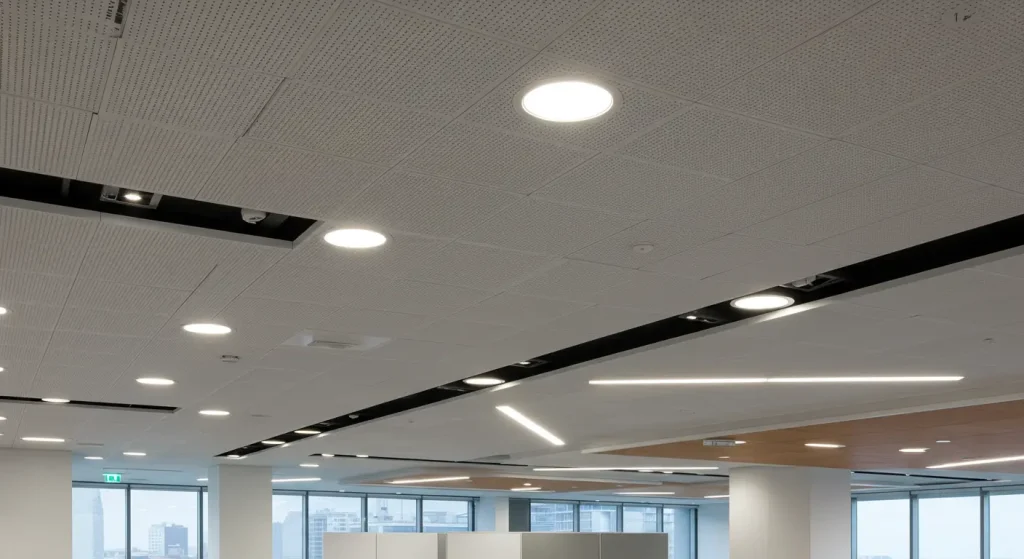
You’re here because you’re looking for more than a fixture. You’re looking for a solution to create a better work environment. This guide will cut through the technical jargon and focus on what truly matters: how to leverage advanced downlighting to create an office that people want to be in—a space that is not just illuminated, but energized.
The Human-Centric Mandate: Why Your Lighting is Your Greatest Asset
The conversation around the modern office has fundamentally shifted. It’s no longer just about space; it’s about experience. This is where human-centric lighting comes in. It’s an approach that puts the health, mood, and cognitive function of the employee at the center of the design.
The business case is not just compelling; it’s overwhelming.
- Productivity & Focus: A study from the American Society of Interior Designers found that 68% of employees are dissatisfied with the lighting in their office. Poor lighting, particularly glare, is a direct cause of distraction and reduced concentration.
- Employee Well-being & Talent Retention: De acordo com o Padrão de construção WELL, a leading framework for healthy buildings, light is a core component affecting our circadian rhythms, sleep quality, and mood. In a competitive job market, an office that actively supports employee health is a significant differentiator for attracting and retaining top talent.
- Measurable Energy Savings: The U.S. Energy Information Administration notes that lighting is one of the largest consumers of electricity in commercial buildings. Modern LED downlights paired with smart controls can reduce lighting-related energy costs by 50-75% or more, delivering a powerful ROI.
Investing in the right office downlights is not an operational expense; it is a direct investment in your most valuable asset: your people.
The Anatomy of a High-Performance Office Downlight: Beyond the Spec Sheet
A standard downlight cannot meet the demands of a modern, productive workspace. A true office-grade downlight is an engineered solution focused on visual comfort and performance. Here are the non-negotiable specifications for 2025.
1. The War on Glare: Your #1 Priority
If you take only one thing away from this guide, let it be this: glare is the enemy of productivity. Glare from ceiling lights creates reflections on computer screens, causes eye strain, and leads to physical discomfort and fatigue.
- Unified Glare Rating (UGR): This is the globally accepted metric for quantifying glare. It’s a scale, and for office environments, the lower the number, the better.
- UGR < 19: Este é o mandatory standard for any area where people are working on computers. It signifies a high level of visual comfort.
- UGR < 16: Considered “very low glare,” this is the benchmark for excellence in demanding visual task areas.
- UGR > 22: Unacceptable for office work. This level of glare will actively hinder performance and cause discomfort.
- How to Achieve Low UGR: This isn’t about the bulb; it’s about the fixture’s design. Look for:
- Deep-Regressed LED Source: The LED chip is positioned high up inside the fixture, shielding it from the direct line of sight.
- High-Quality Reflector/Baffle: A well-designed reflector controls the light beam precisely. A black baffle is particularly effective, absorbing stray light rays before they can become glare. Avoid cheap, shallow downlights where the light source is nearly flush with the ceiling.
2. The Quality of Light: Color, Consistency, and Flicker
Once you’ve solved for glare, you can focus on the quality of the light itself.
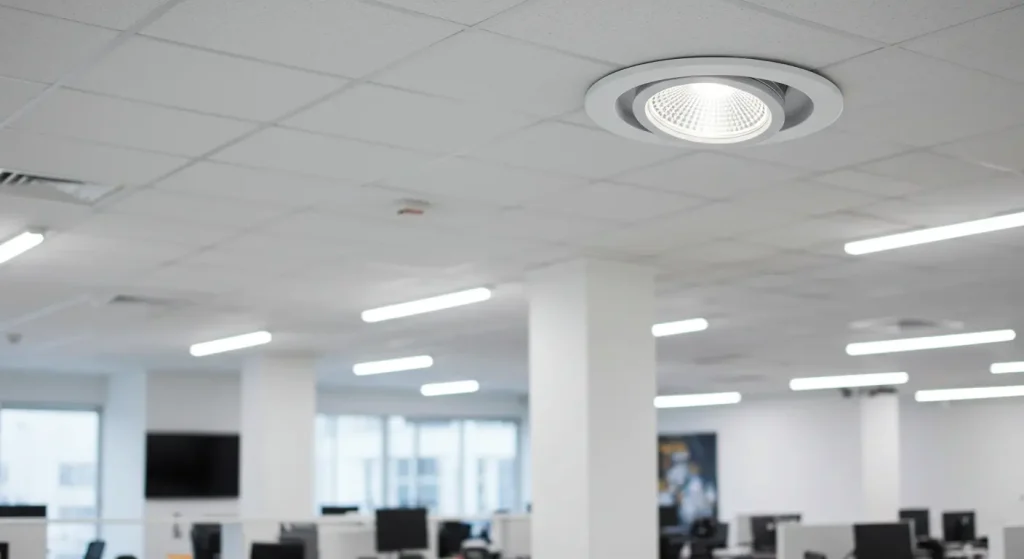
- Índice de Reprodução de Cores (IRC): This measures how accurately colors are rendered. A CRI of 80+ is acceptable, but a CRI of 90+ is highly recommended. It creates a more vibrant, natural, and pleasant environment, making everything from brand colors to the food in the breakroom look its best.
- Flicker-Free Performance: Many cheap LED drivers produce high-frequency flicker. While often invisible to the naked eye, this subliminal strobing can cause headaches, eye strain, and neurological issues for sensitive individuals. Demand fixtures with high-quality drivers that are certified “flicker-free” or operate with imperceptible flicker levels (typically <5%).
- Temperatura de cor (CCT): This determines the “cool” or “warm” appearance of the light. The trend is moving away from a one-size-fits-all approach.
| Temperatura de cor | Psychological Effect | Best Office Application |
|---|---|---|
| 3000K (Warm White) | Calming, relaxing, inviting | Breakout areas, social hubs, reception, cafeterias. |
| 3500K (Neutral White) | Balanced, professional, clear | A versatile choice for general open-plan areas and private offices. |
| 4000K (Cool White) | Alerting, energizing, stimulating | The most common choice for focused work areas, conference rooms, and task-oriented spaces. |
| 5000K (Daylight) | Highly stimulating | Best used sparingly or in dynamic systems. Can feel clinical if used statically all day. |
3. Dynamic Lighting: Tunable White and Intelligent Controls
The most significant evolution in iluminação de escritório is the move from static to dynamic systems.
- Tunable White Lighting: This technology allows you to change the CCT of the downlights throughout the day. It’s the core of a human-centric lighting strategy. A typical schedule might be:
- Morning (9 AM): Tune to a cool 4000K-4500K to suppress melatonin and promote alertness.
- Mid-day (1 PM): Increase intensity to combat the post-lunch dip.
- Afternoon (4 PM): Begin warming the light down to 3500K to ease the transition towards the end of the day.
This automated shifting mimics the natural rhythm of daylight, supporting the body’s circadian clock, which can lead to better focus during the day and improved sleep at night.
- Smart Control Systems (DALI, PoE):
- DALI (Digital Addressable Lighting Interface): A robust digital protocol that gives each downlight a unique address. This allows for ultimate flexibility in zoning, scene-setting, and monitoring from a central system.
- PoE (Power over Ethernet): An emerging technology where low-voltage downlights are powered and controlled by the same Ethernet cables that run your data network. This simplifies installation and integrates lighting directly into a building’s IT infrastructure.
A Zone-by-Zone Lighting Strategy for the Modern Office
A successful office lighting plan is not a uniform grid. It’s a layered, zoned approach that provides the right light for the specific task at hand.
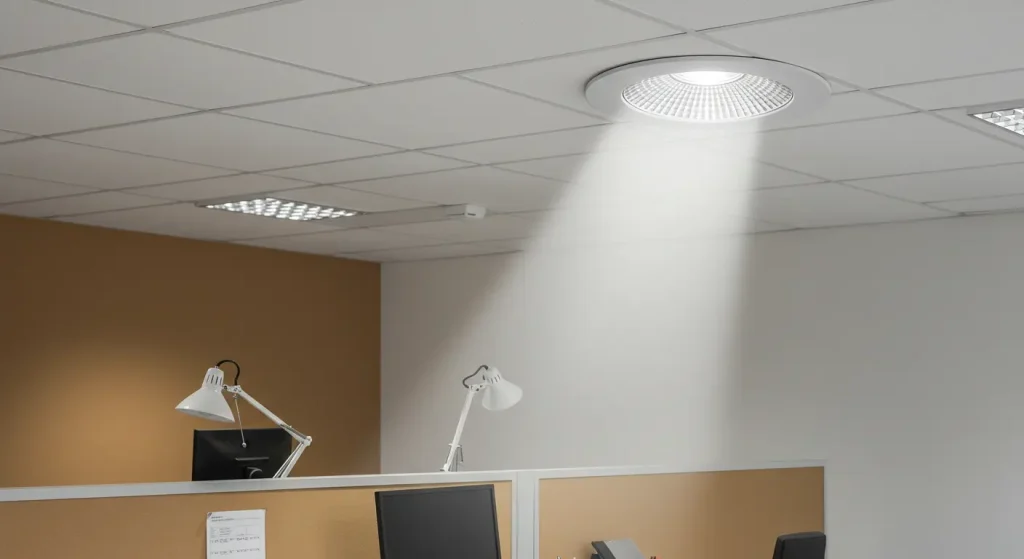
The Open-Plan Workspace
- The Challenge: Balancing general illumination with individual comfort and avoiding a monotonous feel.
- A solução: Use low-glare (UGR < 19) downlights as the primary layer for ambient light, tuned to 3500K or 4000K. Break up the ceiling plane by integrating other light forms like linear pendants over collaborative zones or decorative fixtures in breakout areas. Empower employees with task lighting at their individual desks.
Conference & Meeting Rooms
- The Challenge: The lighting must be flexible enough for various scenarios: presentations on a screen, video conferencing, and paper-based collaborative work.
- A solução: A multi-scene control system is essential.
- “Presentation” Scene: Dims the downlights over the screen to zero while keeping light on the table so people can take notes.
- “Video Conference” Scene: Ensures faces are well-lit from the front to avoid shadows. This often requires supplementing downlights with vertical light sources.
- “General Meeting” Scene: Bright, clear, uniform light (4000K) to encourage discussion and alertness.
Corridors & Circulation Spaces
- The Challenge: Guiding people safely while contributing to the office’s overall aesthetic.
- A solução: This is an opportunity to be more creative. Use wall-washer downlights to highlight brand messaging or artwork. Create a “scalloped” light effect along a wall for visual interest. Light levels can be lower here than in task areas.
Breakout Areas & Cafeterias
- The Challenge: Creating a relaxing, restorative atmosphere that encourages employees to disconnect from their work.
- A solução: Shift to a warmer CCT (3000K). Use downlights with a wider beam spread for a softer feel. This is the perfect place to integrate decorative pendants and other fixture types to create a distinct, hospitality-like vibe.
The office downlight has been fundamentally redefined. It is no longer a passive component but an active system designed to improve the human condition at work. By prioritizing visual comfort, embracing high-quality, dynamic light, and implementing a thoughtful, zone-based strategy, you can create a workplace that doesn’t just function, but thrives. You can build an environment that tangibly demonstrates your investment in your people’s health and empowers them to do their best work, every single day.