 XHLUX
XHLUX

Índice
- Why Some Restaurants Feel “Comfortable” and Others Feel Like a Canteen
- Why Lighting Brightness Matters in Restaurant Design
- Lighting Brightness vs Atmosphere: Finding the Right Balance
- How Different Brightness Levels Create Different Dining Experiences
- The Role of Accent Lighting in Managing Brightness
- Lighting Brightness by Restaurant Type
- Common Brightness Mistakes in Restaurant Lighting
- How to Control Lighting Brightness Effectively in Restaurants
- 1) Build layered brightness (ambient + accent + decorative)
- 2) Use zoning: brightness should follow function
- Chart 3: Restaurant Brightness Control Zones (Recommended Control Intent)
- 3) Choose glare control and optics before raising brightness
- 4) Specify commercial-grade performance (hospitality reality: long hours)
- 5) Dimming and control: DALI / TRIAC and scene logic
- The “Brightness Fix” That Actually Changes Atmosphere
- Comparison Table: Track Lighting vs Downlights for Restaurant Brightness Control
- FAQ About restaurant lighting brightness
- 1) How bright should restaurant lighting be?
- 2) Does dim lighting improve restaurant atmosphere?
- 3) Can lighting brightness affect dining experience?
- 4) What lighting is best for restaurant ambiance?
- 5) Should restaurant lights be dimmable?
- 6) Why does my restaurant look bright but still feel uncomfortable?
- 7) Is higher CRI important when the restaurant is dimmer?
- 8) Track lights or downlights—which is better for controlling brightness?
- Conclusão
- Consultas comerciais são bem-vindas.
Why Some Restaurants Feel “Comfortable” and Others Feel Like a Canteen
Many restaurants invest heavily in interior design—premium materials, curated décor, signature furniture, and branded details—yet the space still feels “off” the moment customers walk in. The most common symptom is not the décor. It’s the lighting brightness.
Many restaurants struggle to create the right atmosphere, even with good-looking fixtures, because the overall brightness and brightness distribution are not designed intentionally.
Lighting that is too bright can feel harsh, fast-paced, and uninviting—customers eat quickly and leave. Lighting that is too dim can feel inconvenient or even uncomfortable—menus are hard to read, faces look dull, and the space loses energy. Worse, poorly controlled brightness often triggers glare, reflections on glossy surfaces, and inconsistent “hotspots” that make a restaurant feel cheap even when the budget is high.
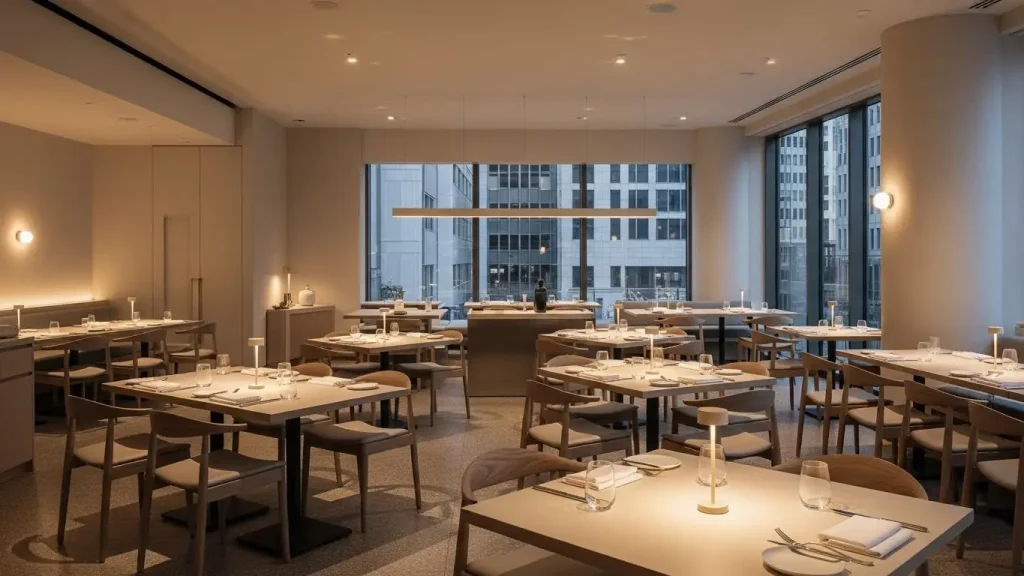
The best restaurant lighting is not simply “bright” or “dim.” It is brightness with structure: layered lighting, clear zones, controlled contrast, low glare, and reliable dimming. When brightness is designed properly, the restaurant feels comfortable, engaging, and memorable—while remaining practical for staff and operations.
This guide explains restaurant lighting brightness like a decision tool for operators, designers, contractors, and B2B buyers. You’ll learn how to balance ambience and usability, how to use accent lighting to keep tables clear while keeping the room comfortable, and how to choose the right fixture types (track lights vs downlights) and control systems.
If you want a fast overview of fixture options commonly used to build layered brightness in hospitality, you can browse our LED track lighting series e LED spot downlight series, then match specifications in the catálogo de produtos.
Why Lighting Brightness Matters in Restaurant Design
Restaurant lighting brightness affects far more than visibility. It shapes how people feel, how they behave, and how they remember the place.
Brightness influences emotion, dwell time, and perceived value
- Mood and comfort: A calm, premium restaurant usually avoids harsh overall brightness, especially in the dining zone.
- Dwell time: Customers tend to stay longer in spaces where lighting feels comfortable and flattering.
- Privacy and intimacy: Lower ambient brightness (with good table lighting) increases the sense of privacy without making the restaurant “dark.”
- Perceived quality: Well-controlled brightness and contrast makes materials look richer and more intentional. Poor brightness distribution makes finishes look flat or worn.
A crucial point that many competitor articles miss:
Brightness ≠ quality.
A restaurant can be dim and still feel cheap if it lacks structure, contrast, and visual clarity. Conversely, a restaurant can be moderately bright and still feel premium if glare is controlled and brightness is layered.
Why is lighting brightness important in restaurants?
Lighting brightness shapes the dining atmosphere, influencing comfort, mood, and how long customers choose to stay.
Visibility is a system outcome—not a single lux number
Restaurant projects sometimes fixate on “lux targets,” but diners don’t experience a restaurant as a spreadsheet. They experience it as a series of visual moments:
- entrance impression
- host stand clarity
- circulation comfort
- table intimacy
- bar energy
- restroom visibility and safety
Each moment requires a different brightness strategy. That’s why professional projeto de iluminação para o setor hoteleiro treats brightness as a zoned and layered system.
To reduce complaint risk in public-facing interiors, many projects use comfort frameworks and glare awareness from standards such as EN 12464-1 and glare terminology like UGR (Índice Unificado de Ofuscamento).
Even when you don’t formally specify UGR in restaurants, the “visual comfort first” logic remains essential.
Lighting Brightness vs Atmosphere: Finding the Right Balance
A common myth online is: “Dim lighting = premium restaurant.” That’s only partially true—and often misleading.
What happens when the restaurant is too bright?
Over-bright ambient lighting pushes the space toward:
- a higher “alertness” feeling (more like retail or a cafeteria)
- reduced intimacy and privacy
- unflattering facial lighting (especially with cool CCT or glare)
- faster eating pace (customers feel less inclined to linger)
What happens when the restaurant is too dim?
Over-dimming causes a different set of problems:
- guests struggle with menus, food presentation, and facial recognition
- staff efficiency drops (order-taking and clearing become slower)
- the space can feel uncomfortable or even unsafe in circulation zones
- the brand loses energy, especially for casual dining concepts
So the goal is not “dim.” The goal is balanced brightness with layered control:
- lower ambient brightness in the dining zone
- focused brightness on tables and focal points
- safe, comfortable brightness in circulation
- energy and sparkle in the bar zone (without glare)
Is brighter lighting better for restaurants?
No. The best restaurant atmosphere comes from balanced lighting brightness, not maximum brightness.
Chart 1: The “Brightness Balance” Model (Ambient vs Accent)
Below is a practical way to think about restaurant atmosphere using two levers—ambient brightness and accent brightness—rather than one “overall brightness” number.
| Restaurant Feel | Ambient Brightness (Room) | Accent Brightness (Tables / Focal Points) | Typical Outcome |
|---|---|---|---|
| Canteen / fast turnover | Alto | Médio | clear, efficient, but less intimate |
| Comfortable social dining | Médio | Medium–High | balanced, welcoming, easy to stay |
| Premium intimate dining | Low–Medium | High (controlled) | intimate, high-end, photogenic |
| Too dim / awkward | Baixo | Baixo | inconvenient, low energy |
| Harsh / glaring | Alto | High (uncontrolled) | stress, glare complaints |
This model explains why many “dim restaurants” fail: they lower ambient brightness but also fail to provide controlled accent brightness, so the space feels dull rather than premium.
How Different Brightness Levels Create Different Dining Experiences
Brightness is a design tool that should match restaurant concept, menu, turnover expectations, and brand positioning. Here’s how high, medium, and low brightness typically translate into experience.
High Brightness: Energetic but Less Intimate
Best fit
- quick service restaurants (QSR)
- food courts and high-turnover dining
- canteen-style or “clean and bright” concepts
- bakery counters (where product visibility is critical)
Strengths
- clear visibility for ordering and circulation
- efficient operations and cleaning perception
- energetic atmosphere
Risks
- feels less intimate
- can amplify glare and reflections
- makes premium décor feel less valuable
High brightness must be paired with strong glare control and careful CCT choice. Otherwise, the restaurant becomes “bright but uncomfortable.”
Medium Brightness: Comfortable and Social (Most Common and Safest)
Best fit
- casual dining
- family restaurants
- chain restaurants requiring consistent experience
- mixed-use restaurant + café concepts
Strengths
- comfortable for conversation
- good menu visibility
- operationally practical
- adaptable via dimming scenes for lunch vs dinner
Risks
- can look generic if contrast is not designed
- can feel flat if accent lighting is missing
Medium brightness is often the best baseline—but it still needs accent lighting to create hierarchy and atmosphere.
Low Brightness: Intimate and Premium (But Needs Precision)
Best fit
- fine dining
- wine bars and lounges
- chef’s table concepts
- premium steakhouse or tasting menu experiences
Strengths
- intimacy, privacy, and emotional comfort
- premium tone, “slow dining” feel
- better for photography when table lighting is controlled
Risks
- can feel inconvenient without proper table illumination
- can look “cheap dark” if color rendering is poor
- can create safety concerns in circulation areas
Low brightness designs require higher precision in optics, glare control, and color quality—especially CRI e color consistency. In hospitality-grade specs, many designers target:
- CRI >90 (Ra97 for premium dining)
- SDCM <3 for consistent color along the space
- stable, flicker-controlled drivers for comfort
What brightness level is best for restaurant atmosphere?
Medium to low brightness, combined with accent lighting, creates the most comfortable and appealing restaurant atmosphere.
The Role of Accent Lighting in Managing Brightness
If you only remember one thing from this article, let it be this:
In restaurants, brightness contrast matters more than overall brightness.
Accent lighting allows you to:
- keep the room comfortable (lower ambient brightness)
- keep tables and food visually clear (higher controlled brightness)
- create hierarchy and “premium focus”
- avoid the flat, uniformly bright look that feels like a canteen
Why track lighting is a powerful brightness tool in restaurants
Track lighting is often the easiest way to add adjustable accent layers without redesigning the ceiling. With properly selected beam angle and glare control, track lights can highlight:
- tabletops (where you want clarity)
- feature walls / art / branding
- bar back displays
- service counters and product zones
A professional LED track lighting system can support restaurant layouts that change seasonally or by concept refresh, because aiming and positioning can be adjusted without re-cutting the ceiling.
For concepts that need variable focus—changing table layouts, seasonal displays, or mixed-use restaurant-retail areas—zoomable track lighting can add flexibility by allowing beam adjustment while maintaining controlled optics.
Why downlights remain essential (especially for comfort zones)
Downlights provide the ambient foundation and can be designed for low glare—especially when the light source is recessed and cut-off is controlled. In restaurants, recessed downlights help:
- keep ceilings clean and calm
- provide safe circulation brightness
- support staff operations without visual clutter
For comfort-focused ambient layers, explore LED spot downlights that prioritize low glare, stable output, and hospitality-grade color quality.
Chart 2: Layered Brightness Plan (What to light, how bright, and with what fixture)
| Restaurant Zone | Brightness Goal | Best Lighting Layer | Common Fixture Choice |
|---|---|---|---|
| Dining tables | clarity + food presentation | accent + task | track spots / focused downlights |
| Dining ambient | comfort + intimacy | ambient base | recessed downlights / soft linear |
| Circulation | safety + orientation | ambient base | low glare downlights |
| Bar counter | energy + highlight | accent + decorative | track spots + pendants |
| Feature wall / branding | identity + depth | accent | track lights / wall wash |
| Restrooms | clarity + safety | ambient | downlights / linear |
For softer ambient layers, especially in modern hospitality interiors, iluminação linear can reduce harsh contrast and help the restaurant feel calmer without losing visibility.
Lighting Brightness by Restaurant Type
Restaurants are not one category. Atmosphere expectations differ dramatically by concept, and brightness should follow that reality. Below are practical brightness strategies that also connect directly to fixture selection and control needs.
Fine Dining: Low Ambient Brightness + Strong, Controlled Focus
Goal: intimacy without inconvenience
Strategy:
- lower ambient brightness in the dining room
- provide controlled, high-quality table lighting
- emphasize texture and premium materials
- maintain comfortable glare control (nighttime sensitivity is high)
Fixture approach:
- low-glare recessed downlights for ambient foundation
- precise accent using track spots or dedicated table lighting
- high color quality: CRI >90 / Ra97, SDCM <3
Casual Dining: Medium Brightness + Soft Contrast
Goal: comfortable social environment
Strategy:
- medium ambient brightness for practicality
- add accent to avoid flatness
- scene control for lunch vs dinner
Fixture approach:
- downlights for base uniformity
- track lights for feature zones and focal moments
- dimming is strongly recommended to adapt dayparts
Café & Bakery: Brighter, Clearer, High CRI
Goal: product visibility and energy
Strategy:
- brighter ambient to support fast ordering
- strong accent on product display
- minimize glare on glass cases and glossy packaging
Fixture approach:
- downlights or linear ambient for clarity
- track lights for showcase highlighting
- strong glare control and careful aiming near display cases
Bar & Lounge: Low Brightness + Decorative Layers
Goal: intimacy, sparkle, “premium night” feel
Strategy:
- low ambient brightness
- highlight bar back, bottles, and feature textures
- add decorative points (but control glare)
Fixture approach:
- track lighting for controlled highlight
- decorative pendants for identity where appropriate
- downlights only where needed for safety and operations
For decorative elements in bars or wider restaurant zones, pendant lighting can add brand personality—provided glare and viewing angles are managed.
Common Brightness Mistakes in Restaurant Lighting
Many restaurants fail not because they chose the wrong fixture type, but because brightness was managed incorrectly. These mistakes are also the most likely to cause complaints, redesign, or expensive on-site adjustments.
Mistake 1: One brightness level for the entire restaurant
Uniform brightness makes the space feel flat. Restaurants need:
- a calmer dining zone
- a clear, safe circulation zone
- focused highlights (tables, branding, bar)
When everything is equally bright, nothing feels premium.
Mistake 2: “Fixing atmosphere” by dimming everything down
Dimming is useful, but dimming without layering often produces:
- poor table visibility
- dull food presentation
- low energy and low perceived cleanliness
The correct approach is: dim ambient, keep controlled highlights.
Mistake 3: Ignoring glare (brightness becomes “harshness”)
Glare is the fastest way to destroy atmosphere. A restaurant can be low brightness but still uncomfortable if people see bright sources directly. That’s why glare control is a baseline requirement, not a bonus.
For comfort terminology and risk awareness, many professionals reference UGR
as a shared language for discomfort glare, even if the project is not formally rated.
Mistake 4: Mixing brightness and color temperature incorrectly
Brightness perception is strongly affected by CCT:
- cool white can feel brighter and more clinical
- warm white can feel softer and more premium at the same measured lux
If you choose a cool CCT and high brightness, the space can become “canteen-like” very quickly.
Mistake 5: Choosing fixtures by lumens only (ignoring optics)
High lumens do not guarantee comfort or good atmosphere. Optics determine:
- beam edge softness
- hotspot severity
- glare risk
- how well accents blend into ambient layers
What are common brightness mistakes in restaurant lighting?
Uniform brightness everywhere, relying only on dimming, ignoring glare, mixing CCT poorly, and selecting fixtures by lumens instead of optical performance.
How to Control Lighting Brightness Effectively in Restaurants
To control restaurant brightness professionally, you need a system approach: fixture mix + zoning + control strategy + optical discipline.
1) Build layered brightness (ambient + accent + decorative)
A practical restaurant lighting structure typically includes:
- Ambient layer: comfortable base brightness for navigation and general comfort
- Accent layer: controlled highlights that create hierarchy and atmosphere
- Decorative layer: identity and sparkle (where concept requires it)
- Optional low-level night mode: for late operations and cleaning transitions
This is exactly why many restaurant projects combine track lights + downlights:
- downlights create comfortable baseline illumination
- track lights create adjustable emphasis without raising overall brightness
Explore relevant fixture families here:
- LED downlights for ambient comfort
- LED track lights for adjustable accents
- linear lighting for soft ambient fill
2) Use zoning: brightness should follow function
At minimum, divide the restaurant into zones such as:
- entrance / host stand
- main dining
- bar
- feature walls / branding
- circulation / service routes
Each zone should have its own brightness target and control channel where possible.
Chart 3: Restaurant Brightness Control Zones (Recommended Control Intent)
| Zone | Recommended Control Intent | Por que |
|---|---|---|
| Main dining ambient | dimmable, comfort-first | sets atmosphere, adapts dayparts |
| Table highlights | stable but adjustable | keeps food/menus visible without bright room |
| Bar zone | flexible scenes | changes from day to night, mood shifts |
| Circulation | stable + safe | avoids trip risk, supports operations |
| Feature wall | independent | creates identity without raising overall brightness |
3) Choose glare control and optics before raising brightness
If a restaurant feels “too dark,” many teams increase brightness. But if the issue is poor distribution or glare, increasing brightness can make it worse.
A better sequence:
- improve distribution and overlap
- fix glare with cut-off and shielding
- add controlled highlights
- only then adjust ambient brightness level
4) Specify commercial-grade performance (hospitality reality: long hours)
Restaurant lighting often runs long hours daily. That means reliability and stability matter. Professional hospitality specifications often include:
- CRI >90 / Ra97 for premium food and skin tone rendering
- SDCM <3 for consistent color appearance across the dining area
- UGR-awareness / low glare design (especially in sightline zones)
- efficiency typically in the 100–130 lm/W range (application and optics dependent)
- lifetime target like L70/B50 50.000 horas to reduce maintenance disruption
- robust thermal management such as a dissipador de calor de alumínio fundido
- stable optics like a quality Lente de PMMA and reliable Chip COB options (where beam quality is critical)
If procurement teams need a quick way to align models, outputs, and optical options, reference the catálogo de produtos.
5) Dimming and control: DALI / TRIAC and scene logic
Dimming is not optional in many restaurant concepts—especially if the restaurant serves both lunch and dinner.
Common approaches:
- Scene-based control: lunch / dinner / late-night / cleaning
- Zoned dimming: dining ambient dimmed lower while table highlights remain effective
- Integration with building systems: for consistent operation and energy management
For larger hospitality projects or centralized control needs, many teams use protocols such as DALI (DALI Alliance).
For smaller renovations, phase-cut (TRIAC) may be used depending on driver compatibility and project constraints.
The “Brightness Fix” That Actually Changes Atmosphere
A common restaurant complaint is: “It’s too bright; it doesn’t feel premium.” The typical quick fix is dimming everything. But that often creates a new complaint: “Now it’s too dark, and the food looks dull.”
In restaurant projects we support, the most reliable atmosphere improvement comes from restructuring brightness, not simply lowering it:
- reduce ambient brightness slightly
- add or re-aim accent lighting so tables and features remain clear
- improve glare control so brightness feels soft instead of harsh
- adjust CCT and color quality so faces and food look flattering
This approach often makes the restaurant feel more premium without sacrificing usability—because the room becomes calm while focal areas remain visually strong.
If you want to implement this method for a specific restaurant layout, we can provide project-based guidance through lighting solution support and reference practical outcomes in project cases.
Comparison Table: Track Lighting vs Downlights for Restaurant Brightness Control
Restaurants typically need both—but understanding their roles helps avoid common mistakes.
| Fator | Iluminação de trilho LED | Luminárias de embutir LED |
|---|---|---|
| Best role | accent + adjustable highlighting | ambient base + comfort foundation |
| Strength | directional control, easy re-aiming | clean ceiling, stable distribution |
| Brightness impact | increases focal brightness without raising overall ambient | sets overall brightness level |
| Risk | glare if aimed into sightlines | dot pattern or harshness if optics poor |
| Best use zones | tables, bar, feature walls, displays | circulation, dining ambient, back-of-house |
To design layered brightness with fewer surprises, many teams start with comfort-grade downlights and then add controllable accents with iluminação de trilho.
For restaurants that frequently change layouts or focal points (events, seasonal branding, flexible seating), zoomable track lighting can reduce rework by letting the beam adapt.
FAQ About restaurant lighting brightness
1) How bright should restaurant lighting be?
There is no single lux number that fits every restaurant. The best approach is layered brightness: keep ambient comfortable, keep tables and focal points clear, and maintain safe circulation lighting. Fine dining typically uses lower ambient with stronger controlled accents; casual dining often uses medium ambient with soft contrast.
2) Does dim lighting improve restaurant atmosphere?
Dim lighting can improve atmosphere only if table visibility and focal clarity are maintained through accent lighting. Dimming everything uniformly often makes the space inconvenient and dull rather than premium.
3) Can lighting brightness affect dining experience?
Yes. Brightness influences mood, perceived privacy, comfort, dwell time, and even how food and faces look. Harsh brightness can make a space feel rushed; well-controlled brightness can make it feel relaxed and memorable.
4) What lighting is best for restaurant ambiance?
A layered combination is usually best: low-glare downlights for ambient comfort, track lights (or focused downlights) for accent, and optional decorative/linear layers for identity and softness.
5) Should restaurant lights be dimmable?
In most concepts, yes. Dimming supports lunch vs dinner transitions, event scenes, and late-night comfort. For larger hospitality projects, scene-based control systems are commonly used, including protocols such as DALI.
6) Why does my restaurant look bright but still feel uncomfortable?
This usually indicates glare, poor distribution, or incorrect aiming—rather than brightness level alone. Improving cut-off optics, reducing visible sources, and restructuring brightness layers often solves the issue faster than simply dimming.
7) Is higher CRI important when the restaurant is dimmer?
Yes—especially in premium dining. When ambient brightness is lower, color quality becomes more noticeable. High CRI helps food, skin tones, and materials look natural and appetizing, preventing the “dull dark” effect.
8) Track lights or downlights—which is better for controlling brightness?
Downlights typically define the ambient brightness baseline; track lights create controllable highlights and contrast. Most successful restaurant lighting uses both, with zoning and dimming scenes.
Conclusão
The difference between a restaurant that feels comfortable and premium—and one that feels harsh or canteen-like—usually isn’t the fixture style. It’s brightness control.
Professional restaurant lighting brightness is built on:
- layered lighting (ambient + accent + decorative)
- brightness zoning (not one level everywhere)
- controlled contrast (table clarity without a bright room)
- low glare optics (comfort as a baseline)
- hospitality-grade color quality (CRI >90 / Ra97, SDCM <3)
- reliable operation (L70/B50 50,000 hours, stable drivers, robust thermal design)
When you treat brightness as a system, you can design a dining atmosphere that is calm, engaging, and operationally practical—without falling into the “too bright vs too dark” trap.
Consultas comerciais são bem-vindas.
If you are currently:
- redesigning a restaurant atmosphere and the space feels too harsh,
- trying to make the dining room feel more premium without making it impractical, or
- comparing fixture types and wondering whether track lights, downlights, and dimming are necessary,
it can help to validate a layered brightness plan (ambient comfort + table highlights + glare control) before final procurement.
You may want to explore:
- Adjustable accent layers for dining tables, bar zones, and feature walls: Iluminação de trilho LED
- Comfort-first ambient foundations for circulation and dining ambient: Luminárias de embutir LED
- Soft ambient fill for modern hospitality interiors: LED linear lighting
- Flexible beam control for changing layouts: zoomable track lighting
- Reference outcomes for confidence: project cases
- Full specs for procurement alignment: catálogo de produtos
If you want project-based support (zoning plan, dimming scenes, fixture selection, beam choices, glare-control strategy), you can reach out here: Contact/Quote.