 XHLUX
XHLUX

Índice
- Why This Article Matters Before You Choose Jewelry Lighting
- 1. Why Jewelry Lighting Is the Brightest
- 2. How Glare Is Actually Created in Jewelry Lighting Projects
- 3. What Is a Honeycomb Anti-Glare Track Spot?
- 4. Why Honeycomb Anti-Glare Is Especially Effective for Jewelry Track Lighting
- 5. Brightness Without Discomfort: The Real Value Proposition
- 6. Honeycomb Anti-Glare in Context
- 7. Where Honeycomb Anti-Glare Track Spots Are Most Effective
- 8. Honeycomb vs Standard Track Spotlights
- 9. How to Evaluate Honeycomb Anti-Glare Track Spots for Jewelry Projects
- 10. FAQ About Commercial Track Lighting Fixtures Wholesale
- 11. Why Honeycomb Anti-Glare Is the “Invisible Advantage” in Jewelry Lighting
- Bem-vindo(a) à Cooperação
Why This Article Matters Before You Choose Jewelry Lighting
Jewelry lighting is one of the most misunderstood areas of commercial lighting design.
Many projects fail not because the lighting is too dim, but because it is too aggressive—producing glare, reflections, and visual fatigue that undermine the perceived value of the jewelry itself.
If you are searching for terms like honeycomb anti-glare track spot or anti-glare lighting for jewelry stores, chances are you are facing a real-world problem:
How can jewelry lighting remain bright, brilliant, and high-contrast—without blinding customers or cheapening the display?
Este artigo explica why honeycomb anti-glare track spotlights have become a preferred solution for professional jewelry lighting, how they work in real projects, and how to select them correctly for long-term commercial success.
1. Why Jewelry Lighting Is the Brightest
Jewelry retail demands more light per square meter than almost any other commercial environment.
Diamonds, gemstones, and polished metals rely on:
- High luminance to activate brilliance and sparkle
- Strong contrast to emphasize cut and clarity
- Focused beams to isolate individual pieces
Yet jewelry stores also contain:
- Highly reflective display cases
- Glass enclosures
- Mirror-polished surfaces
- Customers standing at very close viewing distances
This creates a contradiction:
The brighter the light, the higher the risk of glare.
Unlike fashion or grocery lighting, jewelry lighting must balance intensity with restraint. When glare dominates, customers stop looking at the jewelry—and start noticing the discomfort.
2. How Glare Is Actually Created in Jewelry Lighting Projects
In real jewelry projects, glare is rarely caused by “too much light” alone.
It is caused by how and where light exits the fixture.
Common glare sources in jewelry environments:
- Exposed LED emitters visible at high angles
- Narrow-beam spotlights without cut-off control
- Light reflecting between glass, metal, and stone
- Bright sources positioned directly in customer sightlines
As a result:
- Customers see the light source before the jewelry
- Eye fatigue increases rapidly
- Perceived luxury decreases
- Time spent viewing displays shortens
Industry experience shows that over 70–80% of jewelry lighting complaints relate to glare, not brightness.
3. What Is a Honeycomb Anti-Glare Track Spot?
A honeycomb anti-glare track spotlight uses a precision-engineered grid—typically aluminum or composite—installed at the light exit.
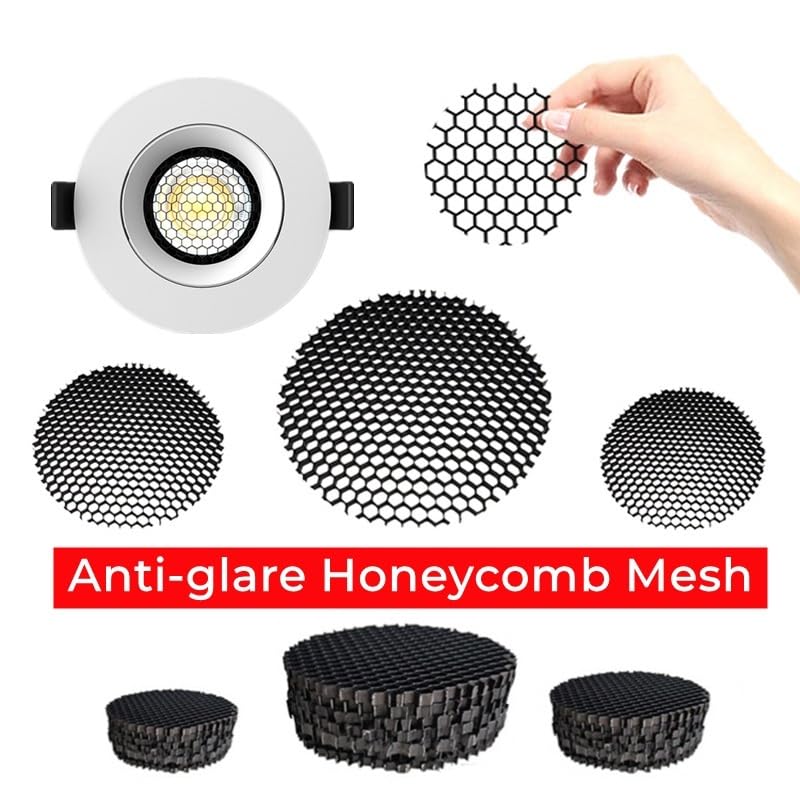
How the honeycomb structure works:
- Blocks high-angle stray light
- Maintains primary beam intensity
- Reduces direct LED visibility
- Improves cut-off angle control
Unlike deep reflector cups or bulky shields, a honeycomb grid controls glare without dramatically increasing fixture size or sacrificing beam precision.
In jewelry lighting, its function is simple but critical:
Hide the light source, reveal the jewelry.
4. Why Honeycomb Anti-Glare Is Especially Effective for Jewelry Track Lighting
Jewelry lighting relies heavily on track-mounted spotlights, which are adjustable, modular, and ideal for evolving displays.
However, track spotlights also place light sources at eye level more often than ceiling-mounted luminaires.
Honeycomb anti-glare solutions excel here because they:
- Preserve narrow beam angles (10°–24° typical for jewelry)
- Maintain high center beam intensity
- Reduce glare without altering aiming flexibility
- Integrate cleanly into premium track designs
Compared to alternative glare-control methods:
| Method | Limitation |
|---|---|
| Deep reflector cups | Bulky, design-restrictive |
| Frosted lenses | Reduce sparkle and contrast |
| Shields / barn doors | Visually intrusive |
| Honeycomb grid | Precise, discreet, effective |
This is why honeycomb anti-glare has become standard practice in luxury jewelry boutiques and flagship stores.
5. Brightness Without Discomfort: The Real Value Proposition
High-end jewelry lighting is not about reducing brightness.
É sobre directing brightness exclusively onto the product.
With a properly designed honeycomb anti-glare track spot:
- The jewelry appears brighter
- The surrounding environment feels calmer
- Customers can look longer without eye strain
- Reflections in glass are significantly reduced
This creates what luxury retailers aim for:
Controlled brilliance instead of visual aggression.
According to retail lighting studies referenced by the
Illuminating Engineering Society, visual comfort directly affects dwell time and perceived product value—especially in high-reflectance environments like jewelry counters.
6. Honeycomb Anti-Glare in Context
Honeycomb alone does not create great jewelry lighting.
It must work together with other critical elements:
6.1 Narrow and Controlled Beam Angles
- Typically 10°–24° for individual pieces
- Minimizes spill light
- Enhances contrast
6.2 High Color Rendering (CRI 90–97)
- Accurate gold, diamond, gemstone colors
- Especially important for reds and warm tones
6.3 High Luminance Output
- Necessary to activate sparkle and fire
- Must be concentrated, not diffused
6.4 Honeycomb Anti-Glare Control
- Prevents glare from reaching the eye
- Maintains luxury visual comfort
Jewelry lighting succeeds when these elements are designed together—not individually.
7. Where Honeycomb Anti-Glare Track Spots Are Most Effective
Globally, honeycomb anti-glare solutions are most commonly applied in:
- Luxury jewelry brand boutiques
- High-end shopping mall jewelry counters
- Diamond and gemstone specialty stores
- Jewelry exhibition booths
- Custom jewelry salons
These environments share three traits:
- High brightness requirements
- Reflective materials
- Close customer viewing distances
Honeycomb anti-glare track spots address all three simultaneously.
8. Honeycomb vs Standard Track Spotlights
Rather than comparing specifications, professional buyers compare outcomes.
Standard track spotlight:
- Sufficient brightness
- High glare risk
- Short customer viewing time
Deep anti-glare reflector:
- Reduced glare
- Larger fixture size
- Design limitations
Honeycomb anti-glare track spotlight:
- High brightness preserved
- Glare significantly reduced
- Clean, professional appearance
Jewelry lighting decisions are about experience, not lumen output.
9. How to Evaluate Honeycomb Anti-Glare Track Spots for Jewelry Projects
Before specifying or purchasing, professional buyers should confirm:
- Honeycomb density (too dense reduces output)
- Compatibility with beam angle design
- Whether the grid is removable or replaceable
- Impact on beam uniformity
- Long-term dust and deformation resistance
- Compatibility with dimming systems (DALI, DALI-2, phase dim)
- Proven jewelry lighting project references
This evaluation prevents common mistakes such as over-darkening displays or uneven beam patterns.
10. FAQ About Commercial Track Lighting Fixtures Wholesale
Q1: Does a honeycomb grid significantly reduce brightness?
No—when properly designed, it mainly blocks high-angle glare, not the core beam.
Q2: Is anti-glare mandatory for jewelry lighting?
In professional jewelry environments, yes. Without it, comfort and perceived value suffer.
Q3: Honeycomb vs deep anti-glare reflector—what’s better?
Honeycomb offers more precise control with less visual bulk.
Q4: Can any track spotlight use a honeycomb grid?
Only if the optical design supports it. Poor matching reduces performance.
Q5: Is honeycomb anti-glare suitable for residential lighting?
Generally no—it is designed for high-brightness commercial applications.
11. Why Honeycomb Anti-Glare Is the “Invisible Advantage” in Jewelry Lighting
Great jewelry lighting is rarely noticed—but poor lighting always is.
Honeycomb anti-glare track spotlights work quietly in the background to ensure:
- Jewelry remains the visual focus
- Customers feel comfortable and confident
- Displays appear refined and premium
- Lighting supports, not competes with, the product
For jewelry brands, designers, and contractors, this translates into:
- Better customer experience
- Stronger perceived value
- More consistent project outcomes
In jewelry lighting, the most important component is often the one you don’t see.
Bem-vindo(a) à Cooperação
If you are working on commercial jewelry lighting projects, choosing fixtures is only one part of the process.
Successful projects depend on optical control, system compatibility, supply stability, and long-term service.
As a provider of commercial interior lighting products and lighting solutions, we support:
- Jewelry lighting track spot solutions
- Anti-glare optical customization (including honeycomb grids)
- OEM / ODM cooperation
- Project-based supply and SKD services
You may explore next steps through:
- Página de contato – discuss your project requirements
- Consultoria de Projeto – review lighting strategies for jewelry spaces
- Consulta OEM – private label and customized solutions
- Baixar catálogo – explore commercial track lighting platforms
The goal is not to sell a single spotlight—but to help you build jewelry lighting that performs beautifully, consistently, and professionally.