 XHLUX
XHLUX

Índice
- Why this guide
- The core idea in one minute
- What “high lumen” and “standard” actually mean
- How bright should your room be?
- why high lumens don’t have to mean high bills
- Comfort & quality: where people often go wrong
- High-lumen vs standard: who wins where?
- Step-by-step: sizing your room
- Energy & cost snapshot
- High-lumen setups: pros and cons
- Standard lights: pros and cons
- Buying checklist Recommended
- Common mistakes (and easy fixes)
- FAQ About Ceiling Light High Lumens
- Putting it all together (a simple decision tree)
- Final Summary
Escolher high-lumen ceiling lights for big rooms, high ceilings, work areas, garages, and places where you need strong, even light. Choose standard lights (lower lumens) for small rooms, cozy living areas, and accent lighting. Always size brightness to room size and task using a simple rule: Foot-candles × Room Area (ft²) = Target Lumens. Then divide by the lumens of one fixture to see how many you need. Use dimmers and good optics to avoid glare. Verified guidance on lumens (brightness) vs watts (energy) and the Lighting Facts label comes from the U.S. DOE and FTC.
Why this guide
You searched for a clear answer to “Ceiling light high lumens vs standard lights—what’s better?” This article gives you a practical, human-friendly way to decide, with real numbers, short checklists, and example rooms. hands-on best practices, references to expert sources, and transparent reasoning. When we quote facts about lumens, watts, foot-candles, and efficiency, we cite recognized authorities (DOE, FTC, IES-based tables) so you can trust and verify.
The core idea in one minute
- Lumens = brightness you see. More lumens → brighter room. Watts = energy used. Two bulbs can have the same lumens but different watts depending on efficiency.
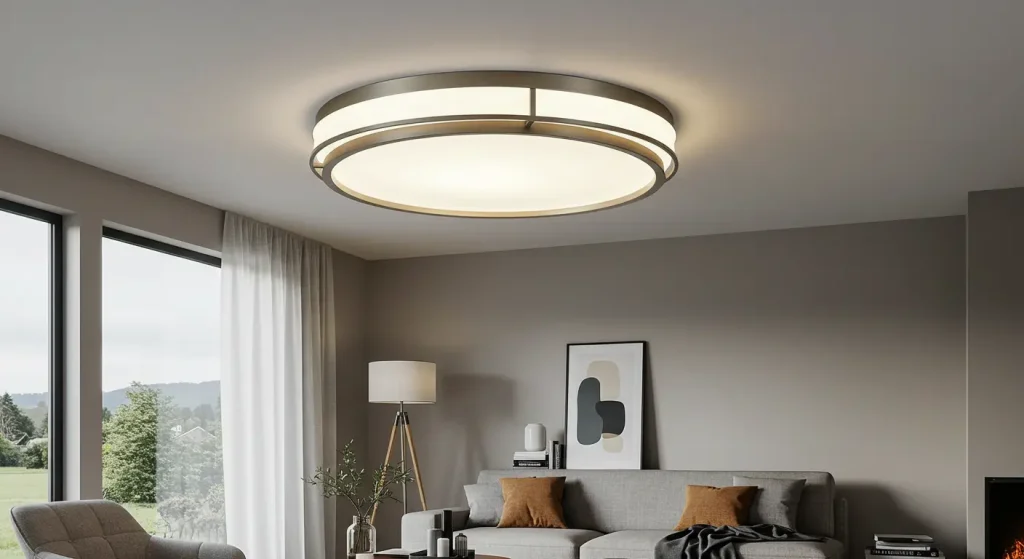
- High-lumen ceiling lights pack a lot of lumens in one fixture (for example, 6000-lumen LED ceiling lights).
- Standard ceiling lights might be 800–1500 lumens each—great for small rooms and ambient lighting.
- A simple sizing method: Target Lumens = Foot-candles × Room Area. Typical targets range from ~10–20 fc for relaxed spaces (bedrooms/living rooms) to 30–50 fc for kitchens and work areas (exact ranges depend on task).
- Dimming + good optics (diffusers, lenses, beam angles) keep high-lumen setups comfortable.
What “high lumen” and “standard” actually mean
Below are typical ranges you’ll see for LED ceiling products today:
| Categoria | Typical Lumens per Fixture | Where It Fits Best |
|---|---|---|
| Standard light | 800–1500 lm | Small bedrooms, hallways, closets, small offices |
| Mid-bright | 2000–4000 lm | Medium bedrooms/living rooms, kitchens with multiple lights |
| High-lumen ceiling light | 5000–8000+ lm | Open-plan living rooms, kitchens with high ceilings, garages, workshops, small retail zones |
Why lumens (not watts)? Because lumens measure brightness while watts measure energy. LED fixtures can deliver the same lumens with fewer watts than old bulbs; the FTC’s Lighting Facts label on packaging puts lumens front and center so shoppers compare brightness directly. (Consumer Advice)
How bright should your room be?
Use this recipe:
- Measure the room (length × width) to get area in square feet.
Pick a foot-candle (fc) target based on the task:
- 10–20 fc: relaxed living rooms, bedrooms
- 20–30 fc: corridors, dining rooms
- 30–50 fc: kitchens, worktops, laundry, home office
- 50–70+ fc: craft tables, garages, task benches
(Ranges compiled from training resources rooted in IES practice; always adapt to age, vision, surface reflectance, and preference.)
- Calculate Target Lumens = Area × fc.
- Divide by fixture lumens to estimate how many fixtures.
Quick examples
- Kitchen 12×12 ft (144 ft²) @ 30 fc → 4320 lumens total.
• 3 × standard 1500 lm, or 1 × high-lumen ~6000 lm (dimmable). - Living room 200 ft² @ 15 fc → 3000 lumens total.
• 2 × 1500 lm standard fixtures, or 1 × 3000 lm mid-bright. - Garage 20×20 ft (400 ft²) @ 30 fc → 12,000 lumens total.
• 2 × 6000-lumen high-lumen ceiling lights, or 8 × 1500-lm standards.
why high lumens don’t have to mean high bills
- LEDs are the most efficient common lighting tech. Typical products deliver ~90–150 lumens per watt (some specialized packages go higher); ongoing R\&D targets even higher efficacies. This means a 6000-lumen LED can use roughly 40–70 watts, depending on efficiency. (The Department of Energy’s Energy.gov)
- U.S. policy also nudged the market forward: general service lamps must meet ~45 lm/W minimum efficiency—one reason incandescent bulbs disappeared from shelves in 2023–2024 and LEDs dominate. (inside.lighting)
Takeaway: High-lumen LED fixtures can be bright and efficient. Compare the lumens e watts on the label; the Lighting Facts panel helps you do this quickly at the shelf. (Federal Trade Commission)
Comfort & quality: where people often go wrong
Brightness alone doesn’t guarantee a good experience. Watch these six factors:
Controle de brilho
- Large, high-output disks or panels can feel harsh if you see the LED emitters directly. Prefer diffusers, micro-prisms, or a recessed optic.
Beam angle & distribution
- Wide beams (e.g., 90–120°) spread light evenly; narrower beams focus light for tasks or highlights.
Color temperature (CCT)
- 2700–3000K = warm/cozy; 3500–4000K = neutral/clean; 5000K = cool/daylight.
Color rendering (CRI)
- Almeje CRI ≥ 80 generally; 90+ is great for kitchens, art, and retail. For tunable or dim-to-warm systems, make sure CRI stays solid even at low dim levels.
Flicker & dimming
- Pair fixtures with compatible dimmers (ELV/Triac/0-10V/DALI/Casambi, etc.). If sensitive to flicker, choose drivers advertised as low flicker and test dimming smoothly from 100% down to 5–10%.
Ceiling height
- High ceilings waste a standard light’s output before it reaches the work plane—another reason high-lumen LED ceiling lights shine in tall spaces.
High-lumen vs standard: who wins where?
Kitchens & dining
- Winner: Depends on layout.
Use um high-lumen LED ceiling light (4000–6000 lm) centered over the space plus under-cabinet task lights; or use several standard lights spaced evenly. Target 30–50 fc on counters for safe prep.
Living rooms & bedrooms
- Winner: Standard or mid-bright, but layer it.
10–20 fc ambient is fine for most evenings. Combine 1–2 standard fixtures with lamps. If you prefer one sleek centerpiece, choose a dimmable 3000–4000 lm fixture and run it at 30–60% for comfort.
Home office
- Winner: Often mid-bright or high-lumen, dimmable.
Target 30–50 fc and add desk task lighting. Good CRI (≥90) and 3500–4000K help documents and screens look accurate.
Garages & workshops
- Winner: High-lumen.
50 fc on the bench is common. One 6000-lumen LED won’t cover a two-car garage; plan multiple high-lumen strips or panels for uniformity.
Hallways & small utility rooms
- Winner: Standard.
800–1500 lm per location keeps cost and glare low.
Step-by-step: sizing your room
- Room area: length × width
- Surface reflectance: darker walls/floors need more lumens
- Ceiling height: >9 ft? Consider higher lumens or narrower beams
- Task type: reading, chopping, sewing → higher fc
- Target formula: Lumens = Area × fc
- Fixture count: # fixtures = Target Lumens ÷ Fixture Lumens
- Round up and add escurecimento para flexibilidade
- Check CRI & CCT for color quality, and choose a flicker-controlled driver
Use the chart and tables (above) as a starting point, then tune by preference.
Energy & cost snapshot
- A standard LED ceiling light ~1500 lm might use ~12–17 W (assume ~90–120 lm/W).
- A 6000-lumen LED might use ~40–70 W.
- If both run 2 hours per day, even the high-lumen option can cost only a few dollars per year in electricity (local rates vary).
- O LED advantage is that you get more light per watt than old bulbs—lumens are up, watts are down—which is exactly why the FTC pushes lumens on the label and DOE backs efficiency standards.
High-lumen setups: pros and cons
Prós
- Fewer fixtures to install and maintain.
- Strong illumination for tall ceilings and large rooms.
- Excellent for task-heavy spaces: kitchens, craft rooms, garages.
Contras
- Glare risk if optics are poor or the diffuser is too small.
- If you only need soft light most of the time, a single high-lumen source may feel “too much” unless you dim it.
- Uniformity can suffer if you rely on only one bright point; consider 2–3 fixtures or add accent lights.
Standard lights: pros and cons
Prós
- Easy to layer multiple points of light for even coverage.
- Usually lower glare, especially with larger diffusers.
- Budget-friendly and common in styles and sizes.
Contras
- May need more fixtures and more install points to reach target brightness.
- Can look “flat” without task or accent layers.
Buying checklist Recommended
- Lumens (target per room): ____
- Watts & efficacy (lm/W): aim higher lm/W for lower bills.
- Dimming: Triac/ELV/0-10V/Smart? Verify compatibility.
- CCT: 2700–3000K cozy; 3500–4000K neutral; 5000K daylight.
- CRI: ≥80 general; ≥90 for kitchens, art, and retail detail.
- Optics: diffuser, lens, or recessed emitter to limit glare.
- Flicker: low-flicker driver; test dim-down performance.
- Form factor: low-profile for tight ceilings; larger diffusers for comfort.
- Controls: consider smart dimmers, motion sensors, or schedules to save energy.
- Certification & label: check Lighting Facts and specs so you compare brightness and energy fairly.
Common mistakes (and easy fixes)
- Mistake: Choosing by watts instead of lumens.
Consertar: Compare lumens e efficacy (lm/W); watts alone is not brightness. (Consumaer Advice) - Mistake: One ultra-bright point in a large room.
Consertar: Use 2–3 high-lumen LED ceiling lights spaced evenly, or mix one high-lumen with several standard lights. - Mistake: Wrong CCT for mood.
Consertar: Warm 2700–3000K for living areas; neutral 3500–4000K for kitchens/offices. - Mistake: No dimming.
Consertar: Add a compatible dimmer. High-lumen + dimming = flexible, comfortable light all day.
FAQ About Ceiling Light High Lumens
Q1: Is a 6000-lumen ceiling light too bright for a bedroom?
Often yes—unless the bedroom is very large, very dark, or very tall. For a 200 ft² bedroom, 10–20 fc = 2000–4000 lumens total. If you like a single centerpiece, get a dimmable 3000–4000 lm model, or use one 6000-lumen light but dim to ~30–60% most of the time.
Q2: How many 6000-lumen fixtures for a two-car garage?
A 20×20 ft garage at ~30 fc needs ~12,000 lumens. That’s two high-lumen fixtures or several standards—see the chart and table above.
Q3: Will high-lumen LEDs cost a lot to run?
Not necessarily. LEDs provide lots of lumens per watt; a 6000-lm unit may draw ~40–70 W. Compare the Lighting Facts label (lumens) and watts to estimate energy.
Q4: 4000K or 3000K for kitchens?
If you want a clean, neutral look and better contrast on food and counters, 3500–4000K is a crowd-pleaser. Pair with CRI ≥ 90 if you cook or photograph food often.
Q5: Do I need high-lumen for low ceilings?
Not usually. With 8-ft ceilings, use more modest lumens and wider distribution to avoid glare, then add task lights where you need punch.
Q6: Why does my new LED feel harsh compared to my old bulb?
It might be a higher CCT (cooler color), lower CRI, a bare emitter, or a driver that doesn’t dim smoothly. Choose warmer CCT, CRI ≥ 80–90, and a better optic/driver.
Putting it all together (a simple decision tree)
Room size & height
- Small or 8-ft ceiling → standard lights (800–1500 lm each), 1–2 units.
- Large room or ≥10-ft ceiling → high-lumen or several mid-bright fixtures.
Task intensity
- Relaxed/ambient → 10–20 fc.
- Work/cooking/garage → 30–50+ fc.
Glare control & comfort
- Prefer larger diffusers, recessed optics, dimming.
Quality of light
- Pick CCT for mood; CRI for color accuracy.
Efficiency & cost
- Compare lumens for brightness and lm/W for efficiency; remember the Lighting Facts label.
Final Summary
- If your space is large, tall, or task-heavy, high-lumen LED ceiling lights offer clean visibility with fewer fixtures—just add dimming and good optics to keep it comfortable.
- If your space is small, cozy, or mostly ambient, standard lights (800–1500 lm) are easier on the eyes and wallet, and you can layer light with floor/table lamps.
- The smartest plan is right-sizing using the Foot-candles × Area formula, then tuning with CCT, CRI, optics, and dimming for human comfort.
With this method you won’t over- or under-buy. You’ll get the brightness you need, save energy, and create a space that looks and feels right—backed by guidelines and labels from agencies whose whole job is to make lighting choices clearer and safer.
Referências
- U.S. Department of Energy: “Lumens and the Lighting Facts Label”; “LED Lighting”; “LED Basics”; “Understanding LED Color-Tunable Products.” (The Department of Energy’s Energy.gov)
- FTC Consumer Advice: “Shopping for Light Bulbs” and the Lighting Facts label overview for manufacturers/retail. (Consumer Advice, Federal Trade Commission)
- Lighting Design Lab: Foot-candle guide derived from IES practice (use as a planning baseline). (lightingdesignlab.com)