 XHLUX
XHLUX

Índice
- What are lumens, lux and footcandles?
- Fast room-by-room brightness guide
- How to calculate lumens for your room
- when is a single high-lumen ceiling fixture appropriate?
- Common real-world examples (practical picks)
- Lumens → watts: how many watts will that LED use?
- what else matters besides brightness?
- Practical shopping checklist
- FAQ About Ceiling Light High Lumens
- Why pick LED high-lumen ceiling lights now?
- Quick cheat-sheet
- 12) Two worked examples you can reuse
- Final short checklist before installation
- Referências
How bright a room should be depends on what you do there, the room size, and the ceiling height. A living room is usually comfortable at 100–300 lux (≈1,000–3,000 lumens for a 10–15 m² room), while task areas like kitchens or home offices need 300–500 lux or more. Use the formula Lumens needed = lux target × area (m²) to plan total ceiling-lumen output.
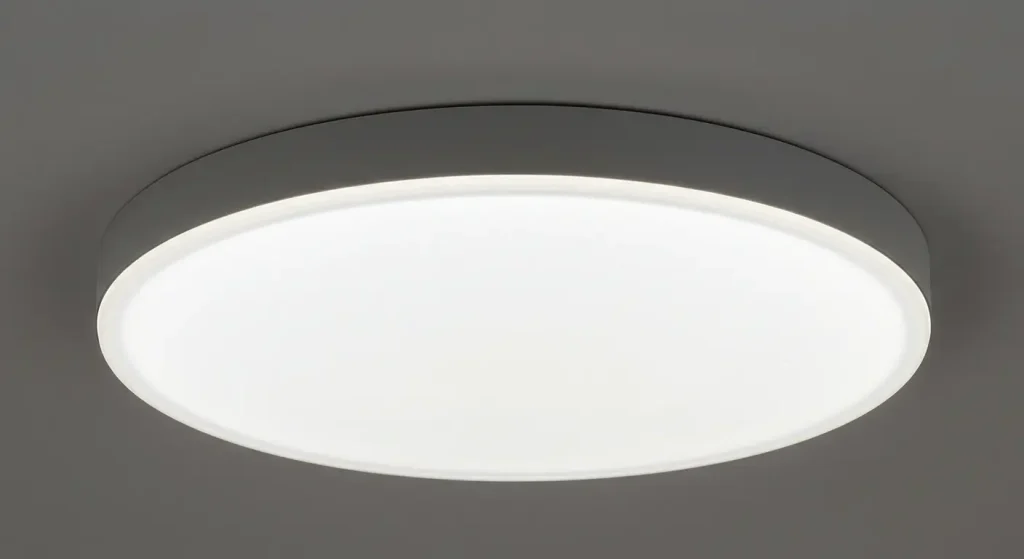
This guide explains simply — step by step — what lumens and lux mean, gives clear room-by-room targets, shows worked examples (including for common ceiling light sizes such as 2000-lumen fixtures), and gives buying tips (CRI, color temperature, dimming, glare). I’ll include a short checklist and a small conversion table so you can pick the right ceiling light high lumens option without second-guessing.
What are lumens, lux and footcandles?
- Lumens (lm) measure the total light output of a bulb or fixture — how much light the lamp produces in all directions.
- Lux (lx) measures illuminance: how many lumens fall onto one square metre (1 lx = 1 lm/m²).
- Footcandle (fc) is the same idea but in imperial units: 1 fc ≈ 10.764 lux.
A quick rule: choose a lux target for the room (based on activity), then multiply by room area (in m²) to get the total lumens you need. The U.S. Department of Energy and lighting guides summarize those unit basics and typical footcandle recommendations for homes.
Fast room-by-room brightness guide
Below is a practical table you can use right away. These are recommended illuminance ranges (lux). For each room I give a short advice and an example of total lumens needed for two common room sizes (12 m² and 20 m²). These ranges come from established lighting guidelines (IES / CIBSE / industry guides).
| Room / Use | Typical lux target (recommended) | Why this level? | Total lumens needed (12 m² / 20 m²) |
|---|---|---|---|
| Living room (general) | 100 – 300 lx | Relaxed, multi-use — lower for ambience, higher for reading corners. | 1,200 – 3,600 lm / 2,000 – 6,000 lm |
| Bedroom (general) | 100 – 200 lx | Cozy plus task areas (reading lamps) as needed. | 1,200 – 2,400 lm / 2,000 – 4,000 lm |
| Kitchen (general & task)** | 300 – 500+ lx | Food prep needs bright, even light—task surfaces often need >500 lx. | 3,600 – 6,000 lm / 6,000 – 10,000 lm |
| Bathroom / Vanity | 300 – 500 lx (mirror areas) | Good color for grooming and makeup. | 3,600 – 6,000 lm / 6,000 – 10,000 lm |
| Home office / study | 300 – 500 lx | Reduce eye strain for reading/screens. | 3,600 – 6,000 lm / 6,000 – 10,000 lm |
| Dining room | 150 – 300 lx | A mix of ambience and table task light. | 1,800 – 3,600 lm / 3,000 – 6,000 lm |
| Hallways / circulation | 50 – 150 lx | Just enough for safe movement. | 600 – 1,800 lm / 1,000 – 3,000 lm |
Note: These figures are design targets. You’ll often combine ceiling lights + lamps + task lights. The total lumens above are for overall room illumination (sum of all light sources).
How to calculate lumens for your room
Formula (metric):Total lumens required = desired lux × room area (m²)
Example 1 — small bedroom:
- Room = 3 m × 4 m = 12 m²
- Target = 150 lx (comfortable general + reading lamps)
- Lumens needed = 150 × 12 = 1,800 lumens
Example 2 — kitchen (work surfaces):
- Room = 4 m × 5 m = 20 m²
- Target = 400 lx (general + task)
- Lumens needed = 400 × 20 = 8,000 lumens
This calculation method is recommended in practical lighting guides and retailer calculators (good for quick planning). If your ceiling is higher than normal, or you have dark finishes, plan a bit more lumens to compensate.
when is a solteiro high-lumen ceiling fixture appropriate?
A single high-lumen ceiling light (for example, a 2000–4000 lm LED fixture) can work, but consider:
- Room size: A single 2,000 lm fixture is great for a small living room or bedroom (≈12 m²–15 m²) when layered with lamps. For a bigger living room or kitchen you’ll need multiple fixtures or higher total lumens.
- Ceiling height: High ceilings lose effective light on the working plane. For ceilings over ~3 m (10 ft), either specify higher-lumen fixtures or use multiple downlights/pendants.
- Task vs ambient needs: Kitchens, home offices, and vanish/vanity areas need brighter, focused task lighting even if the ceiling fixture is bright.
- Glare and uniformity: One very bright central fixture can create glare and uneven lighting. Better to use layered lighting (ambient + task + accent). CIBSE/EN guidance stresses uniform illuminance for tasks to avoid hotspots.
Bottom line: A 2000-lumen ceiling light is not automatically “too bright” — it depends on room size and how you distribute light. For many bedrooms and small living rooms it’s a sensible main light if paired with dimming.
Common real-world examples (practical picks)
2000-lumen ceiling light
- Works well as a main ceiling lamp in a 12–16 m² bedroom or small living room when dimmable. (→ 1,800–3,200 lm needed typical).
3000–5000-lumen ceiling light
- Good for open-plan living rooms ou dining + kitchen when combined with task lights. For a 20 m² kitchen with 400 lx target you need ~8,000 lm — so 2–3 fixtures of 3,000–4,000 lm each (or multiple downlights) are better.
6000–10,000 lumens (very bright)
- Suitable for large kitchens, garages, or workshops. Also useful for high ceilings where each luminaire needs to be powerful.
Always split total lumens across multiple fixtures for even light and lower glare.
Lumens → watts: how many watts will that LED use?
LEDs are sold by lumens, not watts (watts tell energy use). But many people still want a rough idea of wattage:
Estimate using LED efficacy (lm/W):
- Low-efficiency LED: 60 lm/W → 2000 lm ≈ 33 W
- Typical modern LED: 100 lm/W → 2000 lm ≈ 20 W
- High-efficiency LED: 120 lm/W → 2000 lm ≈ 17 W
So a 2000-lm LED ceiling fixture will usually draw around 15–30 W, depending on efficiency. For incandescent equivalents, the U.S. DOE notes ~1600 lm ≈ 100 W incandescent, so 2000 lm ≈ 125 W incandescent-equivalent (approx.). Use the product lm/W spec for a better estimate.
what else matters besides brightness?
Lumens tell you how much light, but temperatura de cor e CRI tell you how it looks.
- Color temperature (Kelvin):
- 2700–3000 K = warm, cozy (bedroom, living room).
- 3000–4000 K = neutral to cool (kitchen, bathroom, work areas).
- 4000–5000 K = bright, daylight-like (task areas, garages).
Choose warmer temps for relaxing spaces and cooler temps where clarity matters.
- CRI (Color Rendering Index):
- CRI ≥ 80 is acceptable for most home uses.
- CRI ≥ 90 is preferable for kitchens, bathrooms (makeup), art, or where true colors matter. The Department of Energy recommends at least CRI 80 for interiors.
- Dimmable fixtures: Dimming is one of the easiest ways to get flexible brightness and mood control. If you pick a high-lumen ceiling light, make sure it’s dimmable and compatible with your dimmer.
Practical shopping checklist
- Decide total lumens needed (lux × room area).
- Confirm fixture lumens (not watts) on the package. Look for delivered lumens, not just LED chip lumens.
- Check CRI — pick ≥80 for general use, ≥90 for makeup/art.
- Pick color temperature for the room (2700–3000K for cozy, 3000–4000K for kitchens).
- Confirm dimming compatibility with your dimmer brand.
- Distribute light — don’t rely on one central point for large rooms; use multiple fixtures or combine with task lights.
FAQ About Ceiling Light High Lumens
Q: Is 2000 lumens too bright for a bedroom?
A: No — for a typical bedroom (≈12 m²) 2000 lm gives ~167 lx which is comfortable for general use; use bedside lamps for reading and a dimmer for mood.
Q: Will a 4000-lumen ceiling light be blinding?
A: It can be if used alone in a small room or without dimming. Spread the light or use diffusers and dimming to avoid glare.
Q: How many 1000-lumen fixtures to light a 20 m² kitchen at 400 lx?
A: Need ~8,000 lm total → roughly eight 1,000-lm fixtures OR three 3,000-lm fixtures (but distribution and task lights matter). Use fewer high-lumen fixtures with good optics or more lower-lumen fixtures for even light.
Why pick LED high-lumen ceiling lights now?
LED lighting is the dominant residential option because of energy savings and flexibility. Recent market analyses show the LED lighting market growing strongly — dozens of industry reports project continued growth as smart lighting and energy-efficiency expand. In practice, residential LEDs save energy and last far longer than incandescent or halogen bulbs.
Quick cheat-sheet
Step 1 — Pick the room target (lux): Living room 100–300 lx | Kitchen 300–500 lx | Office 300–500 lx | Bedroom 100–200 lx.
Step 2 — Measure area: length × width (m²).
Step 3 — Multiply: lumens = lux target × area (m²).
Step 4 — Divide across fixtures: total lumens ÷ number of lights = lumens per fixture.
Step 5 — Check fixture specs: delivered lumens, CRI, CCT, dimmable.
12) Two worked examples you can reuse
A. 12 m² bedroom, target 150 lx → lumens = 12 × 150 = 1,800 lm
- Option A: one 1,800-lm ceiling fixture (dimmable) + 2 bedside lamps (300 lm each)
- Option B: one 1,200-lm ceiling + bedside + floor lamp to reach 1,800–2,400 lm total
B. 20 m² kitchen, target 400 lx → lumens = 20 × 400 = 8,000 lm
- Option A: 4 × 2,000-lm recessed fixtures + under-cabinet task lighting
- Option B: 2 × 3,000-lm central fixtures + multiple task lights (hood, island pendants)
Use distribution to avoid shadows and ensure work surfaces are bright.
Final short checklist before installation
- Measure room and ceiling height.
- Calculate total lumens (lux × m²).
- Choose fixtures so combined delivered lumens ≥ calculated target.
- Prefer CRI ≥ 80 (≥ 90 for kitchens, bathrooms, art).
- Use dimmers and multiple light layers — ambient + task + accent.
- If unsure, request a simple lighting plan from a lighting professional (they often use software and standards like EN 12464 / CIBSE guidance).
Referências
- U.S. Dept. of Energy — Lighting basics, lumens and footcandle guidance. (The Department of Energy’s Energy.gov)
- Practical lumen calculators and retailer guide (Home Depot) — how to estimate required lumens per room. (The Home Depot)
- IES / industry recommended lighting levels (residential & commercial reference tables). (Modern.Place, Archtoolbox)
- CIBSE / EN12464 workplace lighting guidance (for task and uniformity considerations). (lumenloop.co.uk)
- LED market & efficiency context — Grand View Research industry report. (Pesquisa Grand View)