XHLUX
XHLUX
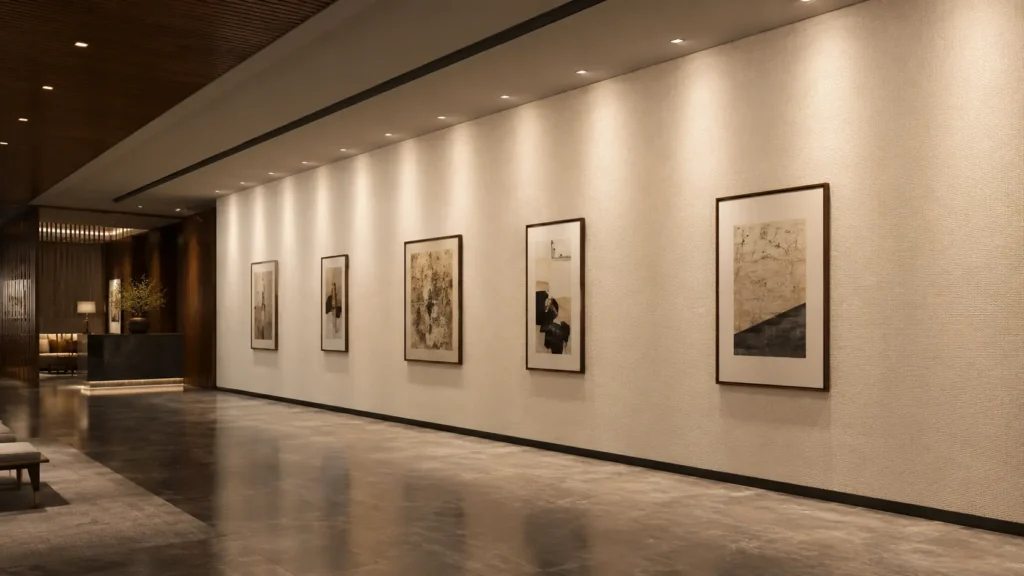
A wall washer downlight is a ceiling downlight specified to light a vertical plane evenly — a feature wall, gallery hang wall, or brand surface — not to flood the floor or punch one small accent spot.
Use it when the wall is the lighting job.
Skip it when you only need ambient fill or a single object highlight.
Ta strona jest when-to-use decision.
For aiming and directional context:
→ Oprawy kierunkowe downlight do oświetlenia akcentującego i zadaniowego
For wash vs graze, setback, and spacing maths:
→ Oświetlenie ścienne LED: mycie czy graze i jak daleko je rozmieszczać
For recessed vs surface mount first:
→ Metody montażu oświetlenia LED Downlight: wpuszczane, natynkowe i regulowane
Najważniejsze wnioski
– Use a wall washer downlight when the wall wash lighting technique must even a vertical plane.
– Do not use it as a substitute flood or as the room’s only ambient layer.
– An accent wall lighting fixture job is different from a narrow accent spot on one artwork.
– Wall washer vs flood light: flood lights volume/area; wall wash lights the plane.
– A gallery wall wash downlight row needs clear setback and a continuous hang wall — spacing on the Wall Washers guide.
Before you begin
Miej je pod ręką:
- Which plane must look bright and even (wall ID on the RCP)
- Wash vs graze intent
- Ceiling mount path still open or already frozen
- Whether furniture will sit in the setback zone
- Product sheet with wall-wash / wallwasher distribution
Difficulty: intermediate (specifier / designer).
Time: one concept pass before SKU freeze.
Step 1: Name the job — wall wash lighting technique
Wall wash lighting technique means controlled light on a vertical surface so brightness reads even from floor to ceiling (or graze for texture — see the Wall Washers guide).
A wall washer downlight is one hardware way to deliver that technique from the ceiling.
It is not required every time you “want the wall brighter.”
Sometimes a linear cove, track wash head, or surface cylinder is the better body — the technique comes first, the housing second.
🎯 What job does wall-wash technique own?
Even (or intentional graze) light on a vertical plane — not floor ambient and not a single-spot accent.
Step 2: When a wall washer downlight is the right tool
Użyj wall washer downlight when most of these are true:
| Sygnał | Why it points to wall washer downlight |
|---|---|
| Feature or hang wall must feel lit as a plane | Needs wall-wash distribution, not a floor cone |
| Ceiling grid can take a downlight family | Recessed or surface downlight path available |
| You want the wash in the same visual family as other downlights | Consistent trim/cylinder language on the soffit |
| Row layout with setback is acceptable | Wall-wash needs geometry, not one random head |
Strong commercial fits:
- Reception / brand accent wall lighting fixture rows
- Retail feature walls behind product
- Corridor art walls where scallops must stay controlled
- Gallery wall wash downlight layouts on continuous hang walls
Weak fits:
- Open office ambient only
- One sculpture that needs a narrow spot
- Façade flood at a distance (different optic and often outdoor package)
🎯 When is the downlight wall-washer the right body?
When a ceiling downlight row must even a vertical plane and setback geometry is available on the RCP.
Step 3: Wall washer vs flood light (and vs accent spots)
Wall washer vs flood light is a common mix-up.
| Wall washer downlight | Flood light | Narrow accent spot | |
|---|---|---|---|
| Cel | Vertical plane evenness | Broad area / volume | Small object or point |
| Typical aim | Toward the wall with setback | Into a space or yard | At the object |
| Fail mode if misused | Scallops / dark bands on the wall | Flat wash of the room, weak wall control | Hot ellipse, dark wall between art |
| Spec cue | Wallwasher table / asymmetric wash optic | Flood / area photometric | Spot candela peak |
If the brief says “make the wall glow evenly,” start wall-wash — not a higher-lumen flood aimed sideways.
If the brief says “light the artwork only,” start accent spot / directional — see:
→ Oświetlenie punktowe a oświetlenie downlight: jaka jest prawdziwa różnica?
Jakiś accent wall lighting fixture in catalogue language often means the wall-wash job.
Confirm the photometric family on the sheet before you trust the marketing name.
🎯 How is wall wash different from flood?
Wall wash evens a vertical plane with setback optics; flood covers area or volume — swapping them usually fails the wall.
Step 4: Gallery wall wash downlight — when it earns a row
A gallery wall wash downlight layout is justified when:
- Hang walls are continuous enough that scallops would show
- Curators/designers want the wall as a calm bright field behind art
- Setback can stay clear of benches and pedestals
- You will freeze spacing from a wallwasher table (not from “even centres that look nice”)
Defer setback ≈ height/3 and spacing caps to the Wall Washers guide — keep those numbers on that page, not re-derived here.
If the gallery is all spotlighted individual pieces with dark walls between, you may want accent spots instead of a wash row.
Recessed flush galleries vs surface paths: use the recessed wall-wash when-to guide; if mount family is still open, decide on the installation-methods overview i ceiling-types guide.
→ Jak wybrać oświetlenie downlight do różnych typów sufitów
🎯 When does a gallery need a wash row?
When hang walls should read as an even field and setback stays clear — otherwise prefer aimed accent spots.
Step 5: When not to use a wall washer downlight
Skip or change path when:
- No vertical plane is the hero — ambient downlight grid is enough
- The wall is fully glazed or mirror — wash becomes glare
- Setback is permanently blocked (built-in desks against the feature wall)
- You only need texture drama inches from the wall — that may be graze optics, still covered on the Wall Washers guide, not a random wide downlight
- Outdoor wet location without the right IP package
Mount still gates the body: no void → surface; void + flush → recessed — lock mount on the installation-methods overview first.
🎯 When should you refuse a wall washer downlight?
When there is no clear vertical plane job, setback is blocked, or flood/spot optics match the brief better.
Step 6: When-to-use criteria table
| Kontrola | Use wall washer downlight | Do not / other tool |
|---|---|---|
| Primary plane | Vertical wall must look even (or intentional graze) | Floor ambient only |
| Optic family | Wall-wash / wallwasher distribution on sheet | Flood or narrow spot photometrics |
| Geometria | Setback + spacing can be held | Furniture eats setback |
| Layer partners | Ambient (and optional spots) planned separately | One row expected to light the whole room |
| Uchwyt | Recessed or surface downlight path cleared | Track-only or outdoor flood scope |
| Name on quote | Matches wall-wash job, not “flood” mislabel | Catalogue word without wallwasher table |
🎯 What is the freeze order?
Technique (wash/graze) → wall washer vs flood/spot → mount path → setback/spacing on the Wall Washers guide.
Step 7: Verify before you specify
- [ ] Vertical plane job written on the concept
- [ ] Wall washer vs flood light (and vs accent spot) decided
- [ ] Wall wash lighting technique = wash or graze
- [ ] Mount path compatible with ceiling
- [ ] Setback clear for gallery wall wash downlight or feature wall
- [ ] Spacing/setback taken from the Wall Washers guide + product table
- [ ] Ambient partner layer listed
Deep dives
| Need | Przewodnik |
|---|---|
| Wash vs graze, setback, spacing | LED Wall Washers |
| Aiming / directional context | Directional downlights |
| Ambient vs accent wording | Downlight vs Spotlight |
| Recessed vs surface vs adjustable | Installation methods overview |
| Ceiling void go/no-go | Rodzaje sufitów |
Często zadawane pytania
Notatki dotyczące dowodów
Arrangement heuristics stay on the Wall Washers guide. Always override with the product wallwasher table or IES file.
Definition-style PAA for this primary is omitted from this FAQ to avoid same-pillar collision; this page keeps the short prose definition above and focuses on when-to-use.