 XHLUX
XHLUX
Wstęp
Adjustable led downlights are often selected after a project team realizes that fixed recessed fixtures cannot aim light precisely onto merchandise, artwork, feature walls, or hospitality focal points. The key question is not only whether the fixture can tilt, but whether its beam angle, glare control, optical accessories, trim depth, and driver configuration match the actual ceiling and application.
This article covers the decisions that matter for B2B buyers, lighting brands, distributors, and contractors specifying adjustable LED downlights for commercial projects. It walks through beam angle selection, glare control, CRI and CCT requirements, installation considerations, and the per-model checks to make before confirming a specification or placing an order.
What Makes a Downlight Adjustable — and When to Specify One
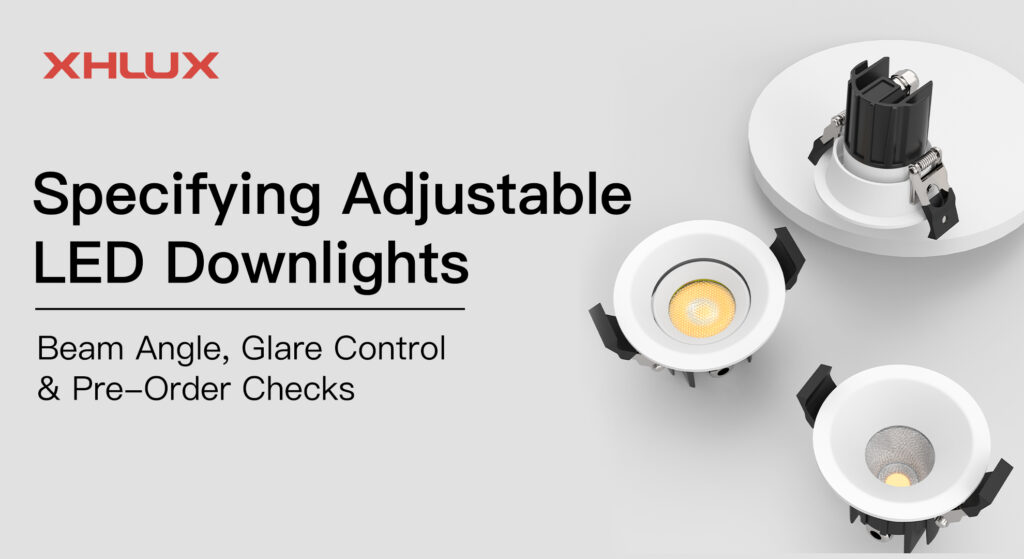
An adjustable downlight — also called a gimbal downlight or orientable downlight — has a mechanical mechanism that allows the light direction to be changed after installation. Unlike a fixed recessed downlight that points straight down, an adjustable downlight can be aimed toward a specific target: a mannequin in a retail display, an artwork on a gallery wall, a reception desk in a hotel lobby, or a feature table in a restaurant.
Fixed vs Adjustable Downlights: When Directional Control Matters
Fixed downlights work well for general ambient lighting in offices, corridors, and spaces where the lighting layout is uniform and static. They are simpler to install and typically cost less per unit.
Adjustable downlights are the correct choice when the lighting design requires directional control. In a retail store, the merchandise changes seasonally and the lighting needs to follow the display. In a gallery, each exhibition layout is different and the downlights must be re-aimed. In a hotel lobby, certain architectural features — a feature wall, a sculpture, the reception desk — need more light than the surrounding space.
The specification decision is not “fixed or adjustable” for the whole project. Most commercial installations use both: fixed downlights for ambient, adjustable downlights for accent and feature lighting.
Gimbal, Orientable, and Adjustable: How These Terms Are Used
Different manufacturers and markets use different terms for the same basic product concept. “Gimbal downlight” is common in North American lighting specifications. “Orientable downlight” appears in European manufacturer catalogs and is the term used in XHLUX product documentation. “Adjustable downlight” is the broadest and most widely understood term across markets.
The terms are related and refer to the same product function — a recessed downlight with an adjustable beam direction — but they are not always exact synonyms across every catalog and market. When reading a specification sheet, check which term the manufacturer uses, and confirm the actual rotation and tilt ranges rather than relying on the label alone.
Common Commercial Applications
Adjustable downlights are used wherever directional accent lighting adds value. Retail stores use them for window displays, mannequin lighting, and shelf accenting. Hotels use them for lobby features, art pieces, and reception areas. Museums and galleries rely on them for exhibit lighting where precise beam control is critical. Restaurants use them for table accent and feature wall highlighting. Showrooms use them for flexible product displays that change with each new collection.
Beam Angle Selection for Adjustable Downlights
Beam angle is the most consequential specification decision for an adjustable downlight. It determines whether a jewelry display sparkles under a tight spot or fades into the general wash, whether a gallery artwork reads as the designer intended, and whether a hotel feature wall draws the eye or disappears.
How Beam Angle Affects Light Spread
Beam angle options may vary depending on the selected XHLUX adjustable downlight model and optical configuration. As a general reference, beam angle options such as 15°, 24°, 36°, and 50° each produce a different balance of light intensity and coverage area from a given ceiling height. Confirm the exact beam angle list per model before specifying.
A 15° beam creates a tight, focused spot. At a 3m ceiling height, it produces a pool of light roughly 0.8m wide — suitable for a single mannequin, a jewelry case, or a small artwork. The light intensity at the center is high, and the falloff at the edges is sharp. This creates strong visual contrast and draws attention.
A 24° beam produces a wider spot with softer edges. At the same ceiling height, the pool is approximately 1.3m wide — suitable for a clothing rack, a wall display of handbags, or a feature table in a restaurant. It still creates visual hierarchy but with more forgiving coverage.
A 36° beam produces a flood distribution. The pool widens to roughly 1.9m at 3m, making it suitable for general accent across wider displays, hotel ambient lighting, or office feature areas. The contrast is lower, and the transition from lit to unlit is gentler.
A 50° beam produces a wide wash. At 3m, the pool covers approximately 2.8m — suitable for supermarket aisles, wide display tables, and circulation areas where even coverage matters more than dramatic highlighting.
Matching Beam Angle to the Application
| Kąt wiązki | Typ belki | Pool Width at 3m Ceiling | Najlepszy dla |
|---|---|---|---|
| 15° | Narrow spot | ~0.8m | Jewelry, mannequins, small artwork, luxury product displays |
| 24° | Średni | ~1.3m | Clothing racks, wall shelving, feature tables, reception desks |
| 36° | Powódź | ~1.9m | General retail floor, hotel ambient, office feature areas |
| 50° | Szeroki | ~2.8m | Supermarket aisles, wide displays, corridor accent |
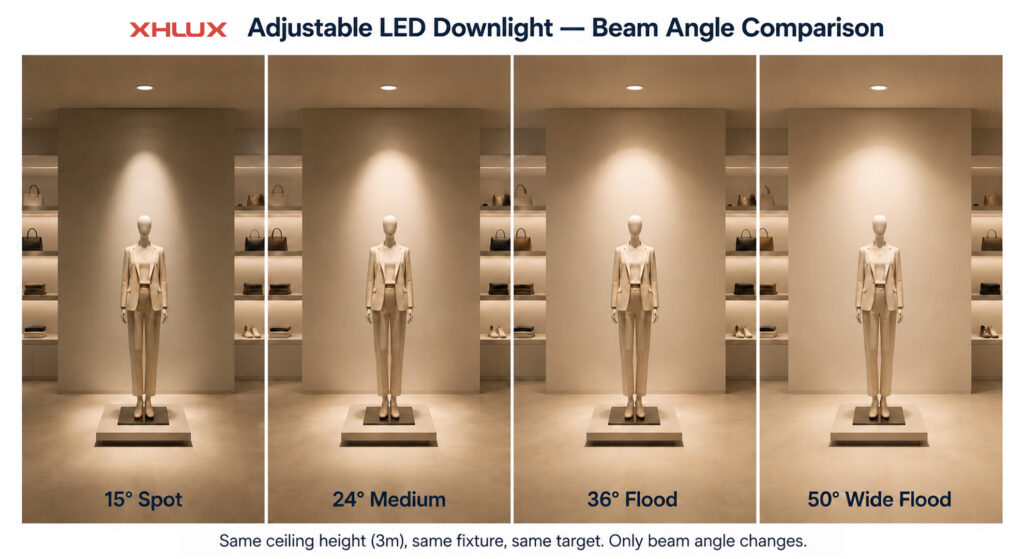
A single beam angle used throughout a commercial space produces poor results. Narrow beams alone create harsh shadows and dark gaps. Wide beams alone produce flat, undifferentiated lighting. Effective specification combines angles: 15° for hero products, 24° for general display, 36° or 50° for ambient fill.
Glare Control and Visual Comfort
Why Glare Control Matters
A customer who feels discomfort from glare will not describe it in technical terms. They will simply spend less time in that part of the store, finish their meal faster, or move through the lobby without stopping. In customer-facing commercial spaces, glare control is not just a compliance requirement — it directly affects dwell time, experience, and revenue.
Deep Reflectors, Honeycomb Louvers, and Aiming Angles
Three mechanical factors control glare from an adjustable downlight.
A deep reflector physically recesses the LED source inside the housing so that it is not directly visible at typical viewing angles (30°–60° from vertical). The deeper the reflector relative to the aperture diameter, the higher the cut-off angle and the less direct glare reaches the eye. XHLUX gimbal downlights in the Second Generation series use Miro reflector optics for this purpose, and the Anti Glare LED Downlight series specifically positions around deep-reflector design.
A honeycomb louver — available as an accessory for XHLUX downlights — sits inside the reflector and blocks off-axis light that would otherwise spill toward the viewer. The trade-off is a reduction in total light output, so lumen output should be checked again when a honeycomb louver is added. This is an acceptable compromise in museums, galleries, and high-end retail where visual comfort takes priority over raw output.
Aiming angle is the simplest and most overlooked glare control. An adjustable downlight aimed at 30°–35° from vertical toward a wall display produces less direct glare than one aimed at 45°–60° across a room. The specifier controls this, not the manufacturer — which makes aiming guidance part of the specification itself.
UGR Basics: What to Ask the Manufacturer
Unified Glare Rating (UGR) is a room-level calculation, not a fixture-level rating. A downlight with a deep reflector may contribute to a low-UGR installation, but the same downlight in a different room — with different surface reflectances, a different number of fixtures, and a different observer position — may produce a higher UGR.
For XHLUX adjustable downlights, UGR values are not shown in the catalog for most product lines. The exception is the Modular LED Lighting System, which states UGR < 16 on its overview page. For other adjustable product families, request per-model UGR data when glare control is a specification requirement. If UGR data is not available, the physical factors — reflector depth, louver availability, and aiming angle — provide practical glare control that can be specified without a UGR number.
CRI, CCT, and Color Quality for Adjustable Downlights
CRI Tiers and When Each Grade Is Appropriate
Selected XHLUX adjustable downlight families can be specified with CRI options such as Ra80+, Ra90+, or Ra95+, depending on the model and configuration.
Ra80+ is acceptable for back-of-house areas, stockrooms, and circulation spaces where color judgment is not part of the task. It is not recommended for customer-facing commercial spaces where merchandise, food, or materials are being evaluated.
Ra90+ is the baseline for most customer-facing commercial applications. In retail, it renders fabric colors and product finishes accurately enough that what the customer sees in the store is close to what they see at home or in daylight. In hospitality, it produces flattering skin tones and natural-looking food.
Ra95+ is appropriate for applications where color accuracy is critical: art galleries, museums, luxury jewelry, high-end fashion. The difference between Ra90 and Ra95 is visible to a trained eye and matters when the merchandise itself is color-critical.
CRI alone is not the full picture. The R9 value — representing deep red — is important for fashion (fabric tones), food (meat and produce), and hospitality (skin tones). R9 is not shown in the XHLUX catalog and should be requested per model when color quality is a project requirement.
Color Temperature Selection by Commercial Space Type
Selected XHLUX adjustable downlight models can be specified with CCT options such as 2700K, 3000K, 3500K, 4000K, and 5000K, depending on the product family and configuration.
| Przestrzeń komercyjna | Zalecane CCT | Notatki |
|---|---|---|
| Hotele — pokoje gościnne, hole, restauracje | 2700K–3000K | Ciepłe, zachęcające; przyciemniane i ciepłe, przydatne podczas wieczornych przejść |
| Handel detaliczny — moda, kosmetyki, biżuteria | 3000K–3500K | 3000K for luxury; 3500K for mainstream retail |
| Retail — supermarkets, general merchandise | 3500K–4000K | Neutral appearance; supports task visibility |
| Offices — workspace, meeting rooms | 3500K–4000K | Higher CCT for task-oriented spaces; confirm applicable workplace standards |
| Muzea, galerie | 2700K–3500K | Match to exhibit requirements; UV-free LED essential |
| Restauracje, bary | 2700K–3000K | Warm tones; dim-to-warm for evening |
| Salony wystawowe | 3000K–4000K | Regulowana biel jest przydatna w miejscach, gdzie wyświetlacze często się zmieniają |
Installation, Trim Types, and Ceiling Considerations
Cut-out Sizes, Driver Access, and Ceiling Compatibility
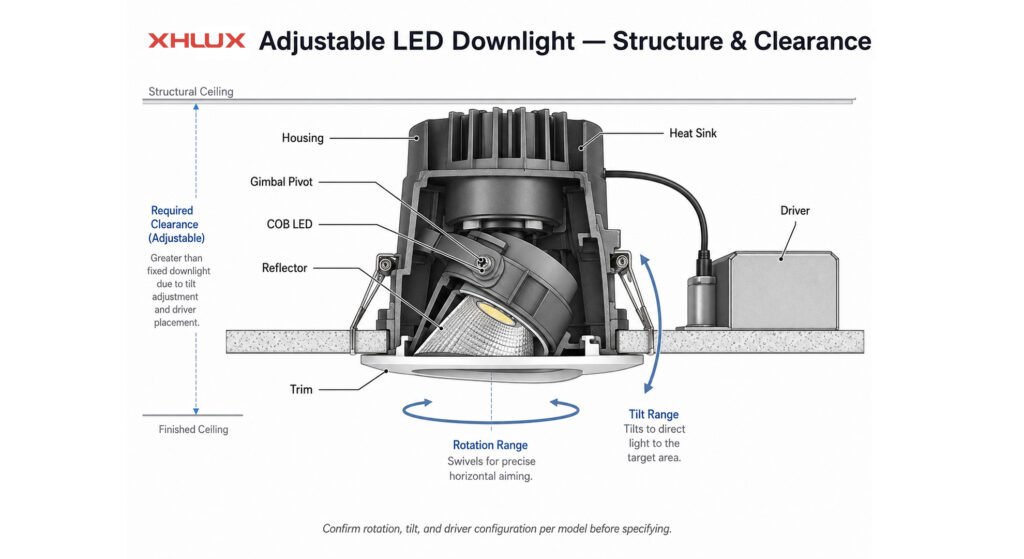
Adjustable downlights require more ceiling clearance than fixed downlights of the same aperture because the gimbal mechanism adds depth behind the ceiling plane. Before specifying, confirm the available ceiling void at each fixture position. In suspended ceilings, the void above the grid is usually sufficient. In plasterboard ceilings with shallow joist depth, the fixture depth plus driver dimensions must be checked against the available space.
Driver access matters for maintenance. If the driver is integral to the fixture, the entire unit must be accessible from below after installation. If the driver is remote, it needs an accessible location — above a suspended ceiling grid is acceptable; sealed inside a plasterboard void without an access hatch is not.
Trim Options
XHLUX adjustable downlights are available with round, square, and trimless (embedded part) trim options. Round is the most common and fits standard circular cut-outs. Square suits contemporary architectural interiors where the ceiling grid or design language uses rectilinear forms. Trimless versions install flush with the ceiling plane — the housing is fixed before plastering, and the joint compound is feathered over the flange so only the aperture is visible after painting.
Rotation and Tilt: What to Confirm Per Model
Adjustable downlights are designed for directional aiming, but the exact rotation and tilt ranges vary by product model and series. The XHLUX catalog describes orientable versions as “intended for directional wall-washing applications.” Exact rotation range (horizontal pan) and tilt range (vertical angle from nadir) should be confirmed per model before specifying. Do not assume all adjustable downlights have the same range of motion — confirm with the manufacturer for the specific product code being specified.
Adjustable Downlights by Application
| Aplikacja | Zalecany kąt wiązki | CRI | CCT | Kluczowe kwestie |
|---|---|---|---|---|
| Handel detaliczny — moda | 15° akcent, 36° otoczenie | Ra90+ | 3000 tys. | High R9 for fabric color. Accent-to-ambient 3:1. |
| Handel detaliczny — biżuteria/luksus | 15° | Ra95+ | 3000 tys. | Maximum sparkle. UV-free. DALI per-fixture control. |
| Handel detaliczny — supermarket | 36°–50° | Ra80+–Ra90+ | 3500K–4000K | Potwierdź wymagania projektu i potrzebę spójności kolorów. |
| Hotel — hol | 24°–36° | Ra90+ | 2700K–3000K | Dim-to-warm. Low glare. Deep reflector. |
| Hotel — restaurant | 15° table, 36° ambient | Ra90+ | 2700K–3000K | Dim-to-warm for evening. Quiet driver. |
| Muzeum / galeria | 15°–24° | Ra95+ | 2700K–3500K | UV-free. DALI addressable. Honeycomb louver recommended. |
| Salon wystawowy | mieszanka 15°–36° | Ra90+ | 3000K–4000K | Tunable white for changing displays. Modular for reconfiguration. |
| Biuro — sala konferencyjna | 24°–36° | Ra90+ | 3500K–4000K | Scene control. Flicker-free for presentation screens. |
Co należy potwierdzić przed złożeniem zamówienia lub określeniem specyfikacji
Before finalizing a specification or placing an order for adjustable LED downlights, confirm the following per product code.
Kontrole na model
| Parametr | Co potwierdzić |
|---|---|
| Kąt wiązki | Which beam angles are available for this model? Confirm the exact angle list by product code and optical configuration. |
| CRI | Is Ra90+ or Ra95+ available for this product code? Request R9 value if color-critical. |
| CCT | Which CCT options (2700K–5000K) are available for this model? |
| Protokół ściemniania | Which protocols are confirmed for this model and driver combination? |
| Stopień ochrony IP | Is the fixture IP20, IP54, or IP65? Confirm front and rear ratings separately for wet locations. |
| Zakres obrotu | What is the exact horizontal rotation range (degrees)? |
| Zakres nachylenia | What is the exact tilt range from nadir (degrees)? |
| Cut-out size | Confirm the exact cut-out diameter and tolerance. |
| Ceiling thickness | Confirm the compatible ceiling thickness range for trimless versions. |
| Ocena IC | Is the model IC-rated for insulation contact? |
Dokumentacja do żądania
For specification projects, request the following where available:
- Pliki IES — Photometric data for lighting design software (DIALux, Relux, AGi32)
- LM-79 reports — Photometric performance verification
- LM-80 / TM-21 data — LED lumen maintenance data and projected lumen depreciation, where available
- Driver specification sheet — Electrical characteristics, dimming compatibility matrix, flicker performance
- Dokumenty certyfikacyjne — Confirm which certificates apply to the exact product code, driver version, and target market
- SDCM data — Binning tolerance data if color consistency across fixtures is a project requirement (SDCM ≤ 3 is the industry recommendation)
Ocena próbki
Test 2–3 physical samples before committing to volume orders:
- Verify beam pattern and CCT against the specification.
- Test dimming performance across the full range with the specified protocol.
- Check build quality: housing finish, gimbal mechanism smoothness, spring clip tension.
- Run the sample for an extended period to check driver thermal behavior.
- Confirm the sample’s certification labels and documentation match what was provided.
Często zadawane pytania
Wniosek
Specifying adjustable LED downlights for a commercial project involves more than selecting a product code from a catalog. Beam angle determines whether merchandise is highlighted or lost. Glare control determines whether customers feel comfortable or leave sooner. CRI and CCT determine whether colors read accurately or disappoint. And the per-model checks — rotation range, IP rating, dimming protocol, driver compatibility, documentation availability — determine whether the specification holds up when the fixtures are installed and running.
For an overview of all commercial downlight types — fixed, adjustable, trimless, slim, IP65, smart, and GU10 — see the Commercial LED Downlights Guide, which covers the full product category and links to detailed specification articles for each type. For a representative example of an adjustable/orientable recessed downlight with confirmed specifications, see the Modułowa, orientowana lampa sufitowa LED Watex D80 Lens.
If beam angle selection, glare control, or OEM/ODM configuration for a specific project needs confirmation, contact our specification team with your ceiling height, application type, target quantity, preferred CRI/CCT, and dimming requirements.
![Jak naprawić oświetlenie LED Downlight: Poradnik rozwiązywania problemów [2025]](https://www.xhlux.com/wp-content/uploads/2025/07/How-To-Repair-LED-Downlight-560x560.webp "Jak naprawić oświetlenie LED Downlight: Poradnik rozwiązywania problemów [2025]")
![Czym jest downlight COB LED: Najlepszy przewodnik technologiczny [2025]](https://www.xhlux.com/wp-content/uploads/2025/07/What-is-COB-LED-Downlight-560x560.webp "Czym jest downlight COB LED: Najlepszy przewodnik technologiczny [2025]")