 XHLUX
XHLUX
There is no single best light for every office.
The right choice depends on the space, ceiling, visual task, glare requirements and how the area is used.
If you are choosing lights for an office space, this guide compares five common fixture types:
- which five types are commonly used
- which areas each type usually fits
- strengths and limits of each
- when another type may work better
- how to match options to specific office zones
Colour temperature matters, but it is only one part of choosing office lighting.
Kort samengevat: Office lighting is usually a mix of fixture types, not one “best” lamp. Start with panels or troffers, linear lighting, downlights, pendants and task lights. Then check glare, light distribution, ceiling type and the real work each area does.
Inhoudsopgave
- Quick answer: five common options
- LED panels and troffers
- Lineaire verlichting
- Downlights
- Hanglampen
- Task lights
- Which options suit different office areas?
- What else to compare before choosing
- Common selection mistakes
- Samenvatting
⚡ Quick Answer: Five Common Office Lighting Options
Use this table as a starting map, not as a single correct answer for every project.
| Fixture type | Common office uses | Main strength | Main limitation |
|---|---|---|---|
| LED panels / troffers | Open offices, standard work areas, private offices | Broad general illumination | Less flexible for some ceiling and design styles |
| Lineaire verlichting | Open offices, meeting rooms, collaboration areas | Flexible layouts and continuous lighting | Needs coordination with ceiling and workstations |
| Downlights | Private offices, meeting rooms, reception, corridors | Clean ceiling and flexible positioning | Distribution and glare need careful checking |
| Hanglampen | Meeting rooms, reception, breakout areas | Combines lighting with interior design | Rarely the only solution for every area |
| Task lights | Individual desks and detailed work | Local light and individual control | Does not replace general lighting |
Een LED office lighting comparison should start here: type and area fit first, then optics, glare and ceiling conditions.
🟦 1. LED Panels and Troffers
Panels and troffers are common ceiling-mounted general lighting for offices.
They often sit in modular or grid ceilings and carry the main ambient light across large work floors.
Common office uses
- open-plan offices
- standard work areas
- private offices
- back-office and support areas
Why they are commonly used
They usually give broad light distribution and relatively uniform general illumination.
They also integrate easily with many grid-ceiling systems, which is one reason panels and troffers remain common on standard office floors.
What to watch for
High lumen output does not automatically mean low glare.
Check the diffuser or optics, how screens face the luminaires, and whether the grid limits layout freedom.
When another fixture may work better
If the project has an open ceiling, emphasises architectural lines, needs continuous lighting, or wants the luminaire to read as part of the interior, linear options may fit better.
🎯 Are LED panels always best for an open office?
No. Ceiling type, light distribution, glare control and the desired visual effect all influence the choice.
📏 2. Linear Lighting
Linear lighting covers recessed, surface-mounted and suspended runs.
It is one of the most flexible general-lighting tools on modern office floors.
When the line form is the selection object, browse LED-lijnverlichting against the ceiling and workstation plan.
Common office uses
- open-plan offices
- meeting rooms
- collaboration spaces
- reception areas
- circulation spaces
Why designers choose it
Linear runs can form continuous lighting lines and follow desks, tables or architectural axes.
Mounting options are flexible, and the format often integrates well with contemporary office ceilings.
Where it works especially well
It often suits long workstation rows, long meeting tables, open ceilings and spaces that need a continuous visual rhythm.
What to watch for
Do not layout linear fixtures only for how the ceiling looks.
Workstation layout, screens and viewing direction still matter. Suspended linear also needs mount height, structure and room proportion checked.
Final spacing should be checked against the workstation layout, mounting height and light distribution.
🎯 When does linear beat panels?
When the project needs flexible mounting, continuous lighting or stronger architectural integration.
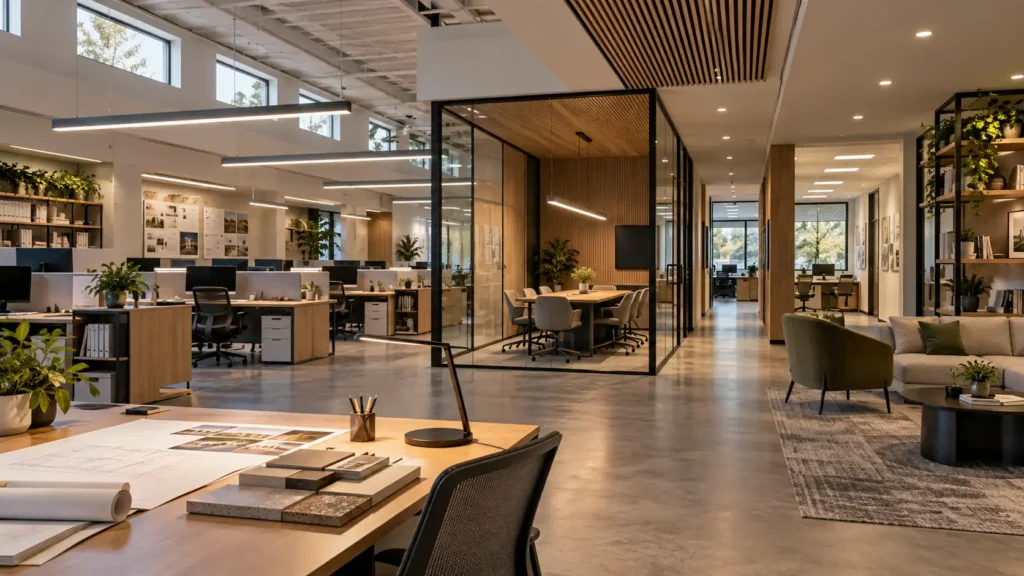
💡 3. Downlights
Recessed and surface-mounted downlights provide compact ceiling-mounted light points, while adjustable versions can redirect light where needed.
They often support enclosed rooms and supporting spaces rather than carrying every large open floor alone.
When downlights are the selection object, compare LED-downlights against beam distribution and glare needs.
Common office uses
- private offices
- meeting rooms
- reception
- corridors
- smaller enclosed rooms
Why designers use them
They keep the ceiling visually quiet and allow flexible positioning.
They can provide general light plus local emphasis. Adjustable versions can serve selected visual tasks.
What to watch for
Where a large work area needs broad, uniform illumination, beam distribution, spacing and glare performance need closer evaluation.
Also check source visibility, workplane coverage and how the beam meets screens.
When another fixture may work better
For large continuous work floors that need wide general lighting, panels or linear may form a simpler overall scheme.
🎯 Are downlights good for office lighting?
Yes. They suit many office zones, but suitability depends on the area and the light distribution required.
🔔 4. Pendant Lights
In this guide, pendant lighting means standalone decorative or task-oriented suspended fixtures.
Suspended linear luminaires stay under linear lighting above.
Common office uses
- meeting rooms
- reception
- breakout spaces
- lounge and social areas
Why use them
Pendants can tie light to a table or zone, lower the light source and add a visual centre.
They often combine ambient function with interior design intent.
What to watch for
A strong shape does not guarantee a good task result.
Check the desk or table, screens, sightlines and mounting height. A pendant alone may not carry general lighting for a whole floor.
When not to rely on pendant lighting alone
If a large work area needs even general lighting, relying only on decorative pendants usually needs careful evaluation and often a supporting ceiling system.
🎯 Can pendants light a whole office alone?
Not necessarily. Their role depends on distribution, mounting position and the visual tasks in the space.
🖊️ 5. Task Lights
Task lighting is an additional lighting layer for individual work.
It is not a replacement for the general ceiling system.
Common office uses
- desks
- detailed work
- individual workstations
- areas that need personal adjustment
Why it can be useful
It puts light on the local task and lets one user adjust without changing the whole office.
What to watch for
Watch screen reflections, source position, neighbouring users and excessive contrast.
General lighting still has to set a workable base visual environment.
Task-light levels and positioning should be checked against the specific visual task and workstation setup.
🎯 Do good ceilings remove the need for task lights?
Sometimes still useful; value depends on the task, workstation and need for local control.
🗺️ 6. Which Lighting Options Suit Different Office Areas?
The table below lists common options, not the only valid answer for every project.
| Office area | Common fixture options | Main selection factors |
|---|---|---|
| Open-plan office | Panel / troffer, linear | Ceiling type, distribution, glare, workstation layout |
| Private office | Panel / troffer, linear, downlight | Room size, ceiling type, desired appearance |
| Vergaderruimte | Linear, downlight, pendant | Table position, presentation use, zoning |
| Receptie | Downlight, pendant, linear + optional accent | General lighting, visual emphasis, interior design |
| Breakout / lounge | Pendant, downlight, linear | Atmosphere, furniture layout, visual character |
| Individual workstation | General lighting + task light | Visual task and individual control |
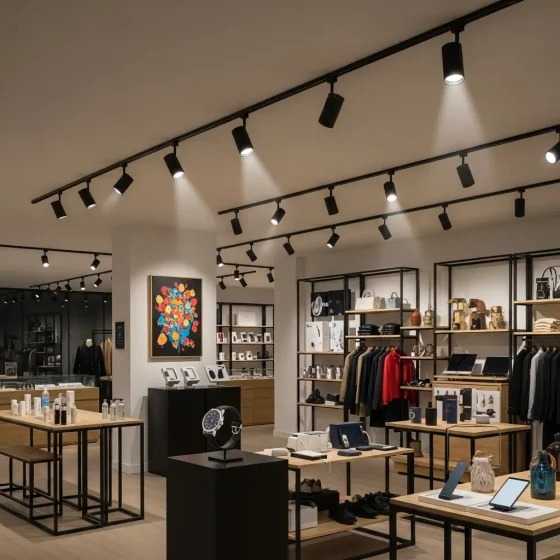
What about track lighting?
Track and accent lighting are not one of the five main types above.
They can still support logo walls, artwork, displays, feature walls and reception accents.
Track lighting usually works as a supporting accent layer rather than the main work-area lighting.
🎯 Should every office area use the same fixture?
No. Different areas do different jobs, so the most suitable fixture can change from space to space.
✅ 7. What Else Should You Compare Before Choosing Office Lights?
Fixture type is only the first cut.
Before you fix a schedule, compare the factors below.
1. Glare
A bright office is not automatically a comfortable office.
Good glare control in office lighting depends on source visibility, optical shielding, light distribution, screen and viewing direction, and luminaire position.
Office lighting guidance from bodies such as the Illuminating Engineering Society and CIBSE’s Society of Light and Lighting treats glare and display-screen interaction as core design checks, not afterthoughts.
For fixture selection, first check whether the light source is directly visible and whether luminaires create reflections on display screens.
2. Light distribution
The same lumen package can perform very differently in a real room.
Look at wide versus narrow distribution, direct versus indirect light, uniformity, and whether light reaches both horizontal and vertical surfaces.
3. Colour temperature
Office lighting color temperature changes how a space feels, but it cannot decide the fixture family alone.
Daylight, interior finishes, task type and the overall design all affect the choice.
For a deeper CCT walkthrough across commercial areas, see De juiste LED-kleurtemperatuur kiezen voor verschillende commerciële ruimtes.
4. Colour rendering
Colour rendering affects how faces, documents, materials and finishes look under the light.
Ask for the rendering performance that matches the visual tasks in each zone.
5. Ceiling type
Grid, gypsum and open ceilings change what you can recess, suspend or surface-mount.
Installation method and how the fixture reads in the room both follow the ceiling.
6. Controls
Dimming, zoning and occupancy or daylight control change how the office is used over the day.
7. Human-centric lighting
If the project also considers time-based and non-visual lighting needs, human-centric lighting becomes a separate design question for the office.
It is not solved by picking one warmer or cooler white product alone.
🎯 Should you choose office lights by wattage or CCT alone?
No. Fixture type, distribution, glare, ceiling conditions and visual tasks all matter.
⚠️ 8. Common Office Lighting Selection Mistakes
The following selection problems are consistent with office-lighting guidance on glare, display screens, task needs and ceiling conditions.
Choosing by brightness alone
More lumens on a datasheet do not guarantee comfort.
If glare and distribution are weak, a “brighter” floor can still feel harsh.
Ignoring screens and viewing direction
CIBSE Lighting Guide 7 and IES office lighting practice both treat display screens as part of the lighting problem.
Source position relative to monitors can materially affect reflections and visual comfort, alongside the light provided on the desk.
Using one fixture strategy everywhere
Open floors, meeting rooms, reception and breakout areas do different jobs.
LG7 and similar guidance describe different lighting techniques for different conditions; one product family rarely covers every zone well.
Specifying decorative fixtures without checking task performance
A pendant or feature light can organise a room visually and still fail the work on the table.
Check mounting height, light on the task and whether a general layer is still needed.
Ignoring ceiling constraints
Grid modules, open structure and shallow voids can block recessed options or force awkward mounts.
Ceiling type should enter the fixture shortlist early, not after the product list is already fixed.
🎯 What is a frequent office lighting selection mistake?
Choosing by brightness or product look alone while skipping glare, screens, ceiling limits and area-by-area fit.
📌 Summary
- Panels / troffers — broad general office lighting on many standard ceilings.
- Lineaire verlichting — flexible general lighting and architectural integration.
- Downlights — useful for enclosed rooms and supporting office areas.
- Hanglampen — meeting, reception and social areas (not usually the whole floor).
- Task lights — individual workstation needs on top of general lighting.
The best office lighting usually comes from matching the fixture to the area, not forcing one fixture type to do every job.
Veelgestelde vragen
What should you check first when an open office has an exposed ceiling?
Check whether recessed panels or troffers are even practical before shortlisting them. Open structure often favours surface or suspended linear options, then glare and workstation layout still need review.
Does a high-lumen LED panel automatically mean low glare?
No. Lumen output and glare are different checks. Optics, diffuser design, mounting position and how screens face the luminaires decide comfort more than a single lumen number.
Can you choose office lighting by colour temperature alone?
No. Colour temperature changes appearance, but fixture type, light distribution, glare and ceiling conditions still decide whether the scheme works for the task.
How can you reduce glare from office ceiling lights?
Start with shielded or well-diffused optics, then check luminaire position against viewing directions and screen faces. Lowering average brightness alone does not fix a visible source in the field of view.
When does a bright desk lamp make nearby workstations worse?
When it creates strong local contrast or reflects into neighbouring screens. Task lights should support one desk without raising glare for the next person.
Are LED lights suitable for office spaces?
Yes. DOE guidance on commercial troffer upgrades describes LED retrofit and replacement options that can reduce energy use compared with older fluorescent systems and can be integrated with lighting controls. Fixture distribution, glare and ceiling fit still need to be checked.
Conclusie
The best light for an office is not one universal fixture.
It is the fixture—or combination of fixtures—that best matches the ceiling, visual task and use of each area.
Bring Your Office Lighting Plans to Life with OEM/ODM Support
When an office project needs commercial fixtures matched to ceiling type and control plans, development can cover:
- linear lighting for open offices, meeting rooms and continuous runs
- downlights for enclosed rooms, reception and corridors
- driver and dimming options matched to the project’s control plan
- OEM/ODM development for a consistent commercial series
- 5-year warranty on supported product lines
E-mail: [email protected]
Website: www.xhlux.com
Browse the LED linear and LED downlight category pages linked earlier in this article when comparing office fixture forms.

![Wat is een dimbare inbouwrailverlichting: de beste gids [2025]?](https://www.xhlux.com/wp-content/uploads/2025/06/Recessed-Dimmable-LED-Track-Light-Wholesaler-560x560.webp "Wat is een dimbare inbouwrailverlichting: de beste gids [2025]?")