XHLUX
XHLUX

The awkward search phrase track light cob usually means an integrated track head built around a chip-on-board LED package. COB identifies the light-source package, but it does not grade the complete luminaire.
Use this page when two suppliers both claim “COB,” yet their beam control, colour, dimming, thermal design and documentation are not equivalent.
For track families, adapters and circuit compatibility, start here:
→ Track Lighting Systems Guide: Types, Parts & How to Choose
For a wattage-based comparison across different head constructions, use:
→ Hoe verhoudt het vermogen van 20W zich tot verschillende typen railspotkoppen?
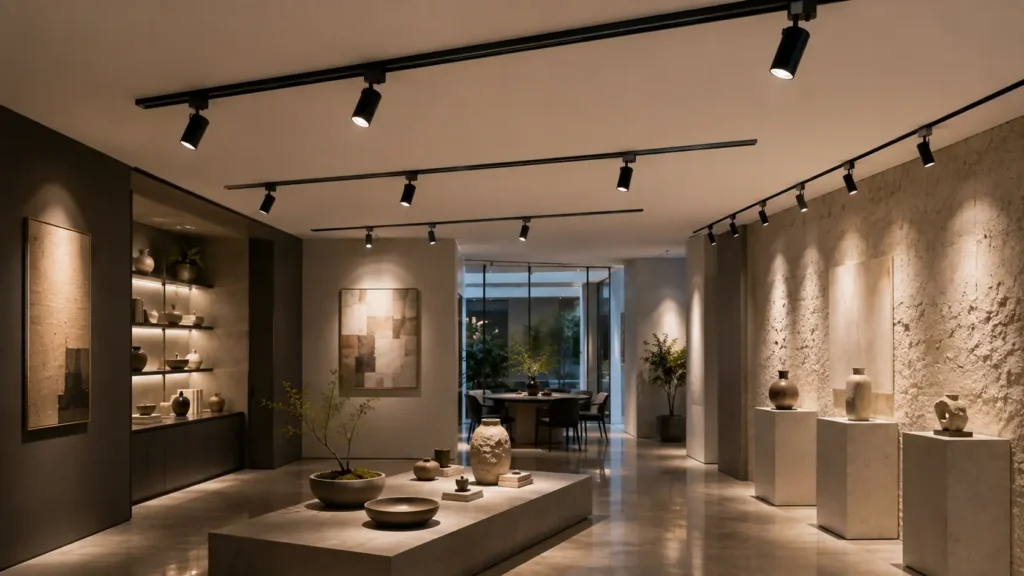
Kort samengevat: COB is a package architecture, not a luminaire performance grade. Approve a COB track head from model-specific optics, hot-condition thermal data, driver behaviour, colour evidence, control compatibility and complete photometric reports. If the supplier offers only a chip brand and wattage, the important specification work has not started.
1. Spec 1: Judge the optic, not the COB label
Does a COB package determine the finished beam?
No; the reflector, lens, aperture, shielding and alignment turn package output into the delivered beam.
A compact emitting surface can help an optical designer create a controlled directional beam. It does not guarantee that every reflector is efficient, every cut-off is comfortable or every nominal angle is accurate.
The CIE S 017:2020 definition places the beam-angle boundaries at directions where luminous intensity reaches 50% of centre-beam intensity. CIE TN 010:2019 then addresses how the optical axis, centre-beam intensity and beam angle should be determined for directional sources.
That matters because a catalogue angle is one point on an intensity distribution. It does not describe field light, spill, edge softness, striations or off-axis colour.
For the exact COB track head beam angle, request:
- Beam and field angles, with the definition used
- Centre-beam intensity
- Polar intensity diagram
- IES or LDT file for the ordered optic
- Lens or reflector code
- A sample viewed at the actual throw distance
Two heads can use the same COB family and still produce different spots. The luminaire manufacturer controls the optical system around the package.
🎯 Does COB automatically produce a narrow beam?
No. A COB can support narrow or wide distributions; the complete optic determines the result.
2. Spec 2: Check delivered performance at the real distance
Which output numbers matter more than package wattage?
Use fixture lumens, intensity distribution and target illuminance for the exact head, optic, CCT and drive current.
Package lumens are not fixture lumens. Light can be lost through the reflector, lens, protective cover and shielding. Changing CCT, CRI or drive current can also change the reported output.
CIE S 025 covers luminaire-level measurement of quantities including luminous flux, efficacy, intensity distribution, centre-beam intensity, CCT, CRI and angular colour uniformity. This is the correct level of evidence for a finished track head.
Use beam diameter only as an initial geometry check:
beam diameter ≈ 2 × distance × tan(beam angle ÷ 2)
At a 3 m throw, a nominal 24° beam has an approximate diameter of 1.28 m. A 36° beam reaches about 1.95 m. Neither result predicts lux because centre intensity and the full distribution are still missing.
Compare photometry at the planned mounting height. Do not compare one supplier’s package-lumen claim with another supplier’s tested fixture lumens.
🎯 Can equal-wattage COB heads deliver different light on a target?
Yes. Efficacy, drive current, optical losses and intensity distribution can produce very different results at the same wattage.
3. Spec 3: Verify the thermal path under operating conditions
Why is the heat sink more important than the word COB?
LED performance depends on junction and case temperature, so the complete thermal path must move heat from the package into the surrounding air.
A COB combines multiple LED dies in one package area. Heat still travels through package materials, the interface compound, mounting surface, heat sink and ambient air. A large housing may perform poorly if any interface in that path is weak.
The US Department of Energy’s solid-state lighting research explains that junction temperature affects efficacy and that relative output falls as junction temperature rises. DOE research on COB ageing also notes that one COB can contain many dies, so case temperature is commonly used to monitor thermal exposure.
Review COB track light heat dissipation through evidence, not fin count alone:
- COB case-temperature test point and limit
- Rated ambient temperature
- Drive current used in the luminaire
- Thermal interface material and assembly control
- Heat-sink material, mass and exposed surface
- Driver temperature and location
- Lumen-maintenance conditions for the exact configuration
Quick Math can expose an unrealistic thermal assumption. If a design estimate assigns 15 W of conducted heat and a total case-to-ambient resistance of 2°C/W, the estimated temperature rise is 15 × 2 = 30°C above ambient. This illustrative calculation is not approval data; the supplier must provide the real thermal model and measured temperatures.
🎯 Does a bigger heat sink prove better thermal performance?
No. Size can help, but interface quality, drive current, airflow and measured temperatures determine the real result.
4. Spec 4: Audit the driver and dimming behaviour
Can a premium COB compensate for a weak driver?
No; the driver controls current quality, dimming behaviour, protection and much of the system’s field reliability.
The package and driver operate as one electrical system. Excess ripple can produce visible or camera-detected modulation. Poor dimming can cause dropout, flashing, steps, delayed starts or inconsistent low-end output across a batch.
Ask for the exact driver model, not “brand driver available.” Then record:
- Input voltage and frequency
- Output current and voltage range
- Power factor and harmonic data at the stated load
- Dimming protocol and tested controller list
- Minimum stable dimming level
- Inrush current and permitted quantity per protective device
- Thermal and electrical protection
- Driver access and replacement method
Test several heads together. One sample on a bench cannot show circuit-level inrush, low-end synchronisation or variation between drivers.
🎯 Is a dimmable COB automatically compatible with every dimmer?
No. Compatibility belongs to the COB-driver-control combination, not to the LED package alone.
5. Spec 5: Specify colour beyond one CRI number
What colour evidence should a buyer request?
Specify CCT tolerance, chromaticity consistency and application-relevant colour rendition for the complete luminaire.
Two COB packages labelled 3000K and CRI 90 can render merchandise differently. CRI averages can hide hue-specific behaviour, while batch tolerance affects whether adjacent heads appear matched on one rail.
ANSI/IES TM-30 provides a broader colour-rendition framework than a single CRI value. IES guidance recommends requesting a full TM-30 report or spectral power distribution when deeper colour evaluation is needed.
For retail, galleries, hospitality or material selection, request:
- Nominal CCT and chromaticity tolerance
- SDCM or binning commitment across the order
- CRI Ra and R9 where relevant
- TM-30 Rf, Rg and colour vector graphic where appropriate
- Colour shift across beam angle
- Batch-replacement policy
Treat COB vs LED chip track lighting as an incomplete comparison. COB itself contains LED dies, while “LED chip” can refer to many package arrangements. Compare measured spectra and finished luminaires, not loose marketing categories.
🎯 Does COB guarantee high CRI or tighter colour consistency?
No. Those qualities depend on the selected package grade, phosphor system, binning, drive conditions and production controls.
6. Spec 6: Demand complete test evidence and service details
What turns a COB claim into an approvable track head?
Model-specific photometry, electrical data, thermal evidence, compliance documents and a workable replacement plan make the product specifiable.
Sterk COB track lighting applications include retail displays, galleries, hospitality accents and other directional tasks. The package can support compact optics, but suitability still depends on target distance, glare, colour, controls and operating environment.
Use this 90-second approval sequence:
- Does the IES or LDT file match the ordered optic, CCT and wattage? If no, stop.
- Does the sample create the required beam without objectionable spill or glare? If no, change the optic or head.
- Are hot-condition output and case-temperature limits documented? If no, request thermal evidence.
- Is the named driver tested with the project control? If no, run a multi-head mock-up.
- Do colour reports and binning limits match the visual task? If no, tighten the specification.
- Can the driver, optic or complete head be replaced within the project life? If no, document the maintenance consequence.
The failure pattern depends on the missing evidence. Weak optics create scallops and spill. Poor thermal design causes output loss or colour drift. Weak drivers flicker or fail. Loose colour control makes adjacent heads disagree. An integrated product may also require complete-head replacement after one component fails.
🎯 What is the fastest way to compare two COB track heads?
Compare matched photometry and colour reports, then run both samples at the real height with the intended dimming control.
Wat moet ik nu doen?
- Define the target surface, throw distance and required lighting effect.
- Use the track-system guide linked in the introduction to confirm adapter and circuit compatibility.
- Use the 20W comparison linked above to separate wattage from head construction.
- Request the exact IES or LDT file, driver data, thermal limits and colour reports.
- Test multiple samples at operating temperature and the intended dimming level.
- Ask XHLUX or another project supplier to identify every component in the approved configuration before bulk ordering.
Veelgestelde vragen
Noten en bronnen
- CIE S 017:2020, International Lighting Vocabulary, beam-angle definition.
- CIE TN 010:2019, Determination of the Optical Beam Axis, Centre Beam Intensity, and Beam Angle of Directional Light Sources.
- CIE S 025, Test Method for LED Lamps, LED Luminaires and LED Modules.
- ANSI/IES TM-30, Method for Evaluating Light Source Color Rendition, and IES colour-specification guidance.
- US Department of Energy, Solid-State Lighting R&D Plan and Investigation of the Long-Term Aging Characteristics of Chip-On-Board LEDs.
- External authorities are named as plain text only. No external website receives a clickable link.