 XHLUX
XHLUX

Table of Contents
- Why Framing Lighting Is One of the Most Demanding Tasks in Museums
- 1. What Is a Museum Track Light in Framing Projects?
- 2. Why Framing Projects Demand More Than Standard Commercial Lighting
- 3. Why CRI97 Is a Baseline Requirement for Framing Projects
- 4. Why Zoomable Optics Are Critical for Framing Lighting
- 5. CRI97 + Zoomable: The Core Framing Advantage
- 6. Technical Characteristics of CRI97 Zoomable Museum Track Lights
- 7. Typical Framing Applications in the U.S. Market
- 8. Decision Logic: CRI97 Zoomable vs Standard Museum Track Lights
- 9. Framing Project Selection Checklist (Practical)
- 10. Commercial Lighting Solutions & SKD Considerations
- 11. FAQ About High CRI97 Museum Track Light
- 12. Why CRI97 Zoomable Lighting Is the Professional Framing Standard
- Welcome to Cooperate
Why Framing Lighting Is One of the Most Demanding Tasks in Museums
In museums, galleries, and exhibition spaces, lighting is never a secondary detail.It directly influences how artworks are perceived, interpreted, and remembered.
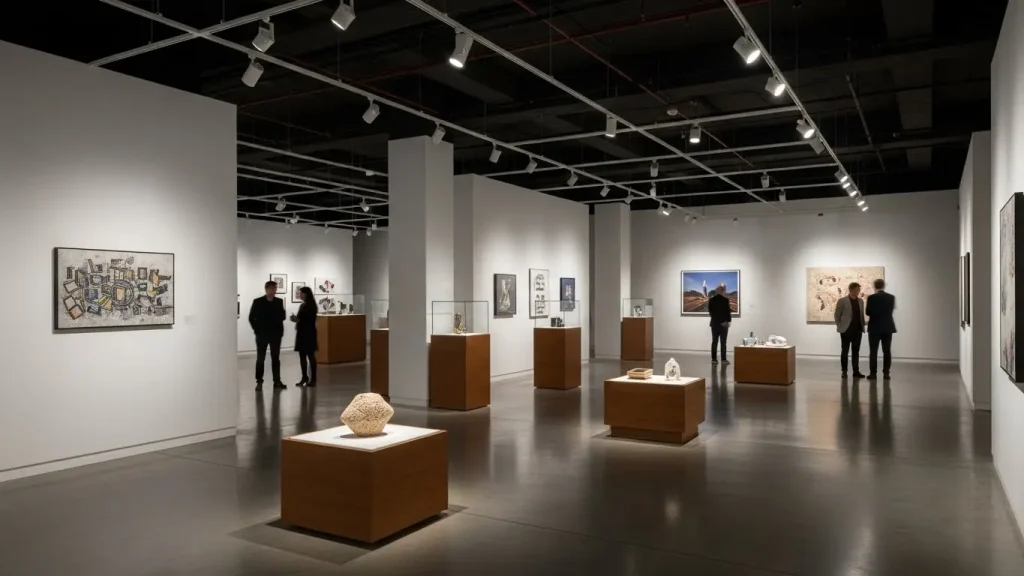
Among all lighting tasks, framing projects—the precise illumination of artworks within defined visual boundaries—represent one of the most demanding challenges in professional lighting design.
Unlike general commercial lighting, framing lighting is not about brightness or coverage.
It is about:
- Color fidelity
- Edge precision
- Visual hierarchy
- Long-term stability
- Curatorial intent
This is why professionals searching for “High CRI97 Zoomable Museum Track Light” are rarely looking for a standard track fixture.
They are looking for a tool that can faithfully present art without becoming visible itself.
This article explains, from a project-driven and museum-grade perspective, why CRI97 zoomable track lights have become the preferred solution for framing applications, and how they reduce risk in high-value cultural projects.
1. What Is a Museum Track Light in Framing Projects?
A museum track light is fundamentally different from a retail or commercial track fixture.
Its role is not to illuminate space, but to serve the artwork.
In framing projects, museum track lights must:
- Deliver light only where intended
- Avoid spill light on walls or frames
- Prevent glare and reflections
- Preserve original color appearance
- Remain visually discreet
In professional practice, lighting becomes a second curatorial tool—supporting how the artwork is framed, perceived, and contextualized.
Key Principle
If the lighting is noticeable, it is already failing its task.
Museum Track Light = a precision optical instrument designed for art presentation.
2. Why Framing Projects Demand More Than Standard Commercial Lighting
In typical commercial interiors, lighting prioritizes:
- Gelijkmatige verlichting
- Energy efficiency
- Cost optimization
In framing projects, priorities shift dramatically.
Framing Lighting Requires:
| Requirement | Commercial Lighting | Framing Lighting |
|---|---|---|
| Color accuracy | Moderate | Extremely high |
| Beam control | General | Highly precise |
| Flexibility | Beperkt | Essential |
| Spill light tolerance | Acceptable | Unacceptable |
| Visual discretion | Optional | Mandatory |
Framing lighting is evaluated not by illuminance alone, but by how accurately light respects the artwork’s boundaries.
3. Why CRI97 Is a Baseline Requirement for Framing Projects
Understanding CRI in Museum Context
CRI (Color Rendering Index) measures how accurately a light source reveals colors compared to a reference source.
- CRI90 is sufficient for most retail and hospitality spaces
- CRI95 improves color depth
- CRI97 reaches museum-grade fidelity
According to Wikipedia – Color Rendering Index, CRI is particularly critical for applications involving art, textiles, and pigments.
Why CRI97 Matters in Framing
Framing projects often involve:
- Oil paintings
- Watercolors
- Photographic prints
- Historical manuscripts
- Textiles and mixed media
Subtle color shifts—especially in reds, skin tones, and dark gradients—are immediately noticeable to trained viewers.
CRI97 advantages include:
- Superior R9 (deep red) performance
- Natural shadow transitions
- No color compression in dark areas
- Accurate material texture perception
Museum Standard Insight
In permanent exhibitions, CRI97 is not an upgrade—it is the baseline.
Data Comparison: CRI Levels in Art Presentation
| CRI Level | Suitable For | Limitations in Framing |
|---|---|---|
| CRI90 | Retail, offices | Color flattening |
| CRI95 | General exhibitions | Reduced depth |
| CRI97 | Museums & framing | Full color integrity |
4. Why Zoomable Optics Are Critical for Framing Lighting
The Reality of Museum Exhibitions
Framing projects are rarely static.
Exhibitions change.
Artwork sizes vary.
Mounting heights differ.
Layouts evolve.
Fixed-beam track lights struggle to adapt.
Common Issues with Fixed Beam Angles
- Beam too wide → spill light on frames and walls
- Beam too narrow → dark edges
- Constant lens changes → labor-intensive
- Reduced curatorial flexibility
The Value of Zoomable Track Lights
A zoomable museum track light allows continuous adjustment of the beam angle, typically covering multiple artwork sizes with a single fixture.
Key benefits:
- One fixture, multiple framing scenarios
- Precise beam boundary control
- Reduced inventory complexity
- Faster exhibition changes
Curatorial Efficiency Insight
Zoomable optics increase exhibition flexibility while lowering long-term operational cost.
5. CRI97 + Zoomable: The Core Framing Advantage
High CRI alone is insufficient without beam precision.
Zoomability alone is meaningless without color fidelity.
Together, CRI97 + zoomable optics solve the three core framing challenges:
- Color Accuracy
- Edge Control
- Exhibition Flexibility
Key Statement
High CRI without precise beam control still fails framing projects.
6. Technical Characteristics of CRI97 Zoomable Museum Track Lights
(Project-oriented, not spec-sheet driven)
Essential Technical Features
- True CRI97 LED modules with high R9 values
- Precision optical zoom system (no beam distortion)
- Clean beam edges without stray light
- Deep anti-glare architecture
- Flicker-free dimming capability
- Compatibility with DALI / DALI-2 control systems
- Minimal color shift over long operation cycles
According to the Illuminating Engineering Society (IES), consistent color performance and glare control are critical in museum environments.
7. Typical Framing Applications in the U.S. Market
CRI97 zoomable museum track lights are widely applied in:
- Permanent museum collections
- Art galleries
- Photography exhibitions
- Cultural institutions
- Private art collections
- High-end exhibition spaces
Rule of Thumb
Where the artwork matters more than the architecture, CRI97 zoomable lighting is justified.
8. Decision Logic: CRI97 Zoomable vs Standard Museum Track Lights
Evaluation Perspective
| Solution | Initial Cost | Flexibility | Framing Accuracy |
|---|---|---|---|
| Commercial track light | Laag | Laag | Insufficient |
| CRI95 fixed beam | Medium | Beperkt | Acceptable |
| CRI97 zoomable | Higher | Hoog | Professional-grade |
Museum lighting decisions prioritize exhibition success over fixture price.
9. Framing Project Selection Checklist (Practical)
✔ Verified CRI97 (measured, not nominal)
✔ Smooth continuous zoom range
✔ Clean beam edges
✔ Deep glare control
✔ Professional dimming compatibility
✔ Proven museum or gallery references
✔ Long-term supply and maintenance support
10. Commercial Lighting Solutions & SKD Considerations
In international museum and cultural projects, lighting solutions extend beyond fixtures.
Integrated Lighting Solutions Include:
- Museum-grade track lighting systems
- Optical configuration support
- Control system integration
- On-site or remote commissioning
- Long-term maintenance planning
SKD (Semi Knocked Down) Service in Cultural Projects
For international distributors and project partners, SKD services offer:
- Reduced import duties
- Optimized logistics cost
- Local assembly flexibility
- Compliance with regional certification strategies
SKD solutions are especially relevant in:
- Multi-country exhibition projects
- Government-funded cultural institutions
- Long-term framework supply agreements
11. FAQ About High CRI97 Museum Track Light
Q1: Is CRI95 sufficient for museum framing?
For temporary exhibitions, sometimes. For permanent or high-value framing, CRI97 is recommended.
Q2: Does zoomable optics reduce light quality?
Only with low-quality optics. Professional zoom systems maintain beam integrity.
Q3: Can one zoomable fixture replace multiple fixed-angle lights?
Yes. This is common practice in museums.
Q4: Are track systems mandatory for framing projects?
Track systems provide the highest curatorial flexibility.
Q5: Is CRI97 overkill for retail?
In most retail scenarios, yes. It is designed for art-focused environments.
12. Why CRI97 Zoomable Lighting Is the Professional Framing Standard
Framing projects are not ordinary lighting tasks.
They are art presentation tasks.
- CRI97 preserves true color
- Zoomable optics ensure precise framing
- Together, they reduce exhibition risk
- They enhance curatorial control
- They support long-term museum operations
Final Statement
CRI97 Zoomable Museum Track Lights are not premium accessories—they are professional tools designed for art.
Welcome to Cooperate
If you are planning or upgrading a museum, gallery, or exhibition lighting project, the following resources may be helpful:
- Contact Page – general project inquiries
- Project Consultation – framing lighting strategy discussion
- OEM Inquiry – private-label or customized solutions
- Download Catalog – review commercial interior lighting solutions
We support commercial interior lighting products and integrated lighting solutions, including museum-grade systems, global projects, and SKD services.