 XHLUX
XHLUX

Inhoudsopgave
- 1. Why Gothic Style Ceiling Lights Still Matter in Contemporary Architecture
- 2. The Design Essence & Artistic Language of Gothic Style Ceiling Lights
- 3. Where Gothic Style Ceiling Lights Work Best in Modern Architecture
- 4. Technical Implementation & Design Guidelines
- 5. Key Advantages of Gothic Style Ceiling Lights
- 6. Where Gothic Ceiling Lights Fail Modern Architecture
- 7. FAQ About Gothic Style Ceiling Lights
- Q1: Are Gothic ceiling lights suitable for all building types?
- Q2: What’s the difference between Gothic ceiling lights and regular ceiling lights?
- Q3: How to avoid a heavy look when using Gothic fixtures in modern spaces?
- Q4: Can Gothic ceiling lights be used in retail spaces?
- Q5: Are they energy-efficient?
- 8. Conclusion
1. Why Gothic Style Ceiling Lights Still Matter in Contemporary Architecture
Gothic style lighting, particularly Gothic Style Ceiling Lights, originally emerged from medieval architecture—cathedrals, basilicas, cloisters, chapels—where light functioned as both a spiritual symbol and an architectural force. Traditional Gothic motifs such as pointed arches, ribbed vaults, vertical lines, stained glass reflections, and dramatic shadow interplay shaped how people perceived sacred spaces.
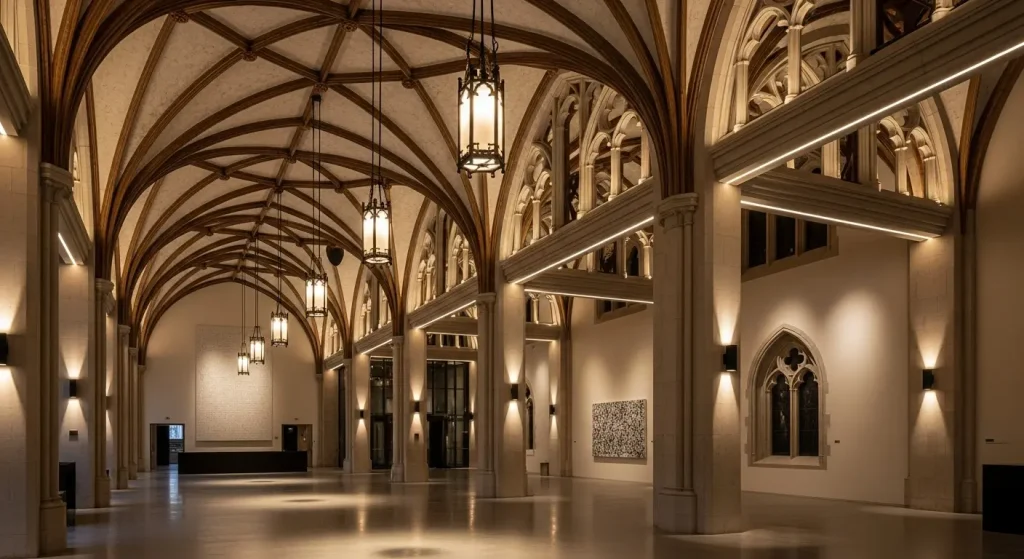
In modern design, we no longer recreate historical Gothic architecture literally. Instead, architects and interior designers borrow Gothic light logic to introduce:
- drama,
- emotional tension,
- verticality,
- decorative craftsmanship, and
- symbolic meaning
into contemporary commercial and cultural environments.
Ceiling lights—being the highest and most visually accessible lighting element—play a powerful role. They act as:
- primary ambient lighting,
- visual landmarks,
- architectural symbols, and
- narrative devices.
Thus, Gothic Style Ceiling Lights hold renewed significance today—not as nostalgic artifacts, but as tools for shaping spatial experience, atmosphere, and identity.
This guide analyzes where Gothic ceiling lights work best, where they fail, and how to apply them effectively in modern architectural projects.
2. The Design Essence & Artistic Language of Gothic Style Ceiling Lights
Gothic lighting design is defined not by “oldness,” but by aesthetic principles rooted in geometry, materiality, and theatrical light expression.Below are the core design languages of Gothic ceiling lights.
2.1 Key Gothic Design Elements
- Pointed arches and spire-like silhouettes
- Crossed rib structures and vault patterns
- Carved detailing and ornamentation
- Ironwork and forged metal craftsmanship
- Latticed frames and filigree patterns
- Stained or textured glass
- Bronze, wrought iron, rusted metal, or antique brass finishes
These elements communicate strength, verticality, and intricacy.
2.2 Light + Structure as a Unified Composition
Gothic lighting reinforces architectural rhythm in the ceiling.
It doesn’t simply “hang there”—it interacts with structure.
Modern interpretations emphasize:
- light that flows downward through carved patterns,
- shadows cast through iron motifs,
- glow that reinforces verticality,
- light that punctuates structural modules,
- a sense of upward pull toward ceiling geometry.
Architectural-lighting leaders such as ERCO emphasize that light should reinforce spatial geometry, not contradict it.
2.3 The Ceiling Philosophy
A Gothic ceiling light should:
- lead the eye upward,
- anchor the space,
- interact with surface textures,
- cast sculptural shadows,
- enhance depth and hierarchy.
In contemporary settings, it often becomes the main focal element or identity marker.
2.4 Color Temperature & Atmosphere Control
To evoke the Gothic aesthetic:
- 2700K–3000K warm light emphasizes antiquity, shadow richness, and historical warmth.
- 3000K–3500K warm-neutral light blends Gothic language with modern clarity.
Research from Signify Lighting Academy confirms that warm light increases emotional depth and experiential immersion.
2.5 Typical Materials & Finishes
- Forged iron
- Antique brass / brushed gold
- Patina bronze
- Textured or patterned glass
- Rusted or oxidized metal
- Matte black structural housings
In one sentence:
Gothic Style Ceiling Lights combine light + ornament + structure, functioning as a sculptural atmospheric instrument.
3. Where Gothic Style Ceiling Lights Work Best in Modern Architecture
Below are the categories where Gothic ceiling lights not only work—but excel.
3.1 Cultural Spaces: Museums, Heritage Centers, Art Galleries
Why they work:
- These spaces rely on storytelling En emotional resonance.
- Gothic ceiling lights create depth, heritage cues, and visual hierarchy.
- With stone, brick, metal, or concrete materials, Gothic fixtures complement the architectural palette.
Lighting strategies:
- Warm ambient glow
- Accent lighting for art
- Grazing for textured surfaces
- Layered light scenes for exhibitions
Zumtobel research shows that cultural lighting must reinforce architectural narrative.
3.2 Religious Buildings, Ceremonial Spaces & Adaptive Reuse Projects
Gothic lighting directly references its architectural origin.
Use cases:
- Atriums
- Chapels
- Wedding venues
- Converted churches
- Multi-faith ceremonial halls
Why it works:
- Reinforces vertical spirituality
- Evokes sacred atmosphere
- Blends functional light with symbolic meaning
- Can integrate modern LED while preserving historic character
3.3 Luxury Hotel Lobbies & Reception Areas
Hotels need impressive first impressions.
Gothic ceiling lights offer:
- Dramatic centerpieces
- Sculptural presence
- Warm, inviting ambience
- Theatrical welcome moments
With layered lighting—accent, wall-wash, grazing—Gothic ceiling fixtures anchor the lobby’s identity.
3.4 Themed Restaurants, Bars & Immersive Entertainment Spaces
Gothic ceiling lights thrive where atmosphere is the product.
Applications:
- Speakeasies
- Medieval-inspired dining
- Fantasy-themed spaces
- High-end bars
Key lighting strategies:
- Shadows + warm glow
- Iron lacework projection
- Candlelight-like softness
- Narrow accent beams to sculpt focal points
These spaces benefit from emotional storytelling through light.
3.5 Luxury Retail & Flagship Stores
In high-end retail:
- Lighting expresses brand identity
- Gothic fixtures provide drama & narrative
- Ceiling lights become sculptural decor
- Accent lighting supplements product visibility
However, designers must balance Gothic fixtures with functional retail lighting (track lights, wall-washers, spot accents).
4. Technical Implementation & Design Guidelines
How to use Gothic Style Ceiling Lights effectively in contemporary projects.
4.1 Layered Lighting Strategy
Gothic lighting is never “one light solves all.”
Use a layered approach:
Ambient Light (Base Illumination)
Gothic ceiling lights provide the primary glow.
Accent Light
Use:
- Track lights
- Spotlights
- Downlights
…to highlight objects, artwork, architectural features.
Task Light
Needed for:
- Reception desks
- Dining areas
- Retail product evaluation
This aligns with lighting-layer principles explained by ERCO.
4.2 Optical & Shadow Control
Key technical considerations:
- UGR <19 for commercial comfort
- Deep baffles to reduce harsh glare
- Iron-cut patterns for shadow projection
- Glass diffusers for softening light output
- Combine with wall-grazing to reinforce verticality
IES standards emphasize glare control for public and commercial environments.
4.3 Color Temperature & CRI Selection
Recommended ranges:
- 2700K–3000K: historical warmth, emotional depth
- 3000K–3500K: modern interpretation with Gothic influence
Gebruik CRI ≥ 90 for:
- Metal finishes
- Stone textures
- Carved details
- Retail products
4.4 Material Durability & Maintenance
Common materials:
- Iron, steel, brass
- Sculpted, etched, or patterned glass
- Cast components
Maintenance considerations:
- Iron may oxidize (requires coating)
- Glass elements need periodic cleaning
- Larger fixtures require professional installation
- Consider LED replacement access
For energy-saving compliance, use modern LED modules with DALI or 0–10V control.
DALI reference
5. Key Advantages of Gothic Style Ceiling Lights
5.1 Dramatic Spatial Experience
Gothic lighting introduces emotional layers:
- Mystery
- Verticality
- Sacredness
- Shadow complexity
5.2 Material & Architectural Expression
Strongly emphasizes:
- Stone
- Brick
- Metal
- Vaulted or ribbed ceilings
- High-contrast surfaces
5.3 Strong Brand Identity & Narrative
Ideal for:
- Hospitality
- Luxury retail
- Cultural design
- Immersive experiences
5.4 Works Well With Modern Minimalism
The juxtaposition of Gothic detail + modern clean architecture produces striking contrast.
5.5 High Aesthetic Value
More than illumination—Gothic ceiling fixtures contribute artistry, craft, and historical reference.
6. Where Gothic Ceiling Lights Fail Modern Architecture
Not every space benefits from Gothic lighting.
6.1 Not Suitable for Function-Centric Environments
Avoid in:
- Office floors
- Hospitals
- Clinics
- Educational facilities
- Labs
These require:
- uniformity,
- high visual comfort,
- minimal distraction,
- bright general lighting.
EN12464-1 defines illuminance standards that conflict with heavy decorative fixtures.
6.2 High Maintenance Burden
Challenges include:
- Heavy fixtures
- Fragile carved details
- Dust-prone metalwork
- Difficult access for cleaning or replacement
Large-scale commercial spaces must plan maintenance cycles carefully.
6.3 Higher Budget & Longer Construction Requirements
Gothic fixtures often require:
- Reinforced ceiling points
- Electric box repositioning
- Custom mounting solutions
Thus they are unsuitable for:
- Fast retail rollouts
- Budget-fitout commercial spaces
- Temporary installations
6.4 Risk of Glare or Shadow Overload
Decorative Gothic elements can:
- create unintended shadow patterns
- introduce harsh reflections
- cause visual clutter
Supplement with modern optics to balance visual comfort.
6.5 Not Designed for Uniform High-Brightness Coverage
For large general lighting, designers should combine:
- linear architectural lighting,
- recessed downlights,
- wall-washers,
- perimeter lighting
This maintains functional illumination while Gothic fixtures contribute atmosphere.
7. FAQ About Gothic Style Ceiling Lights
Q1: Are Gothic ceiling lights suitable for all building types?
No. They work best in atmospheric, narrative-driven, or luxury-oriented spaces—not in purely functional environments.
Q2: What’s the difference between Gothic ceiling lights and regular ceiling lights?
Gothic ceiling lights emphasize:
- craftsmanship,
- material storytelling,
- emotional expression, and
- decorative symbolism.
Regular ceiling lights emphasize:
- efficiency,
- uniformity,
- function-first design.
Q3: How to avoid a heavy look when using Gothic fixtures in modern spaces?
Combine with:
- linear lighting
- indirect lighting
- track lighting
- softer warm-neutral color temperatures
Keep proportions balanced.
Q4: Can Gothic ceiling lights be used in retail spaces?
Yes—especially luxury flagship stores, themed retail, or boutique spaces with storytelling ambition.
Q5: Are they energy-efficient?
Yes when paired with:
- LED modules
- DALI / 0–10V controls
- dimming scenes
- modern electronic drivers
Energy efficiency depends on fixture technology, not style.
8. Conclusion
Gothic Style Ceiling Lights should be understood as a design language, not simply a decorative category.
They are most powerful when used to shape:
- atmosphere,
- narrative,
- emotional tone,
- architectural identity,
- material richness.
Where they excel:
- Cultural institutions
- Hotels
- Thematic restaurants & bars
- Luxury retail
- Ceremonial spaces
- Architecture-driven commercial interiors
Where they fail:
- Standard offices
- Healthcare
- Educational environments
- Industrial lighting
- High-efficiency commercial floors
The optimal strategy:
Blend Gothic ceiling lights with modern architectural lighting systems
(linear lights, track lights, downlights, wall-washers, indirect lighting)
→ achieving balance between atmosphere and function.
For architects and lighting designers, Gothic ceiling lights are not simply luminaires—they are sculptural instruments that bring emotion, history, and theatricality into the built environment.