 XHLUX
XHLUX

Inhoudsopgave
- Why this guide matters in 2025
- 1 Understand Your Space And Intent
- 2 How bright should a commercial restroom be?
- 3 Pick the right fixture types (and where each works best)
- 4 Get the rating right: Damp vs. Wet vs. IP codes
- 5 Color quality your users will notice
- 6 Controls and codes
- 7 Emergency & egress lighting
- 8 Mounting, spacing, and glare control
- 9 Materials, hygiene, and durability
- 10 Spec cheat-sheet
- 11 Energy & sustainability
- 12 Budget planning: where to spend vs. save
- 13 Sample layouts
- 14 FAQ About Commercial Bathroom Light Fixtures
- Source Reference
Short answer first (for busy specifiers):
- Target light levels: about 50–150 lux for general restroom areas; ~150 lux at counters/vanities; showers ~100 lux. (U.S. UFC guidance uses 5 fc / 15 fc / 10 fc respectively.)
- Controls: occupancy or vacancy sensors required by modern energy codes (IECC/ASHRAE 90.1), with automatic shut-off; in California 20-minute time-out is typical under Title 24, Part 6.
- Ratings: pick UL 1598 Damp (most restrooms) or UL 1598 Wet/IP65+ near showers or where water jets apply.
- Emergency egress: provide 1 fc average on the egress path and 90 minutes of backup; use UL 924 emergency luminaires/signs.
- Color quality: aim for 3000–4000K, CRI 90+ (or TM-30 Rf ≥ 85 with balanced Rg ~ 95–105) for accurate skin tones at mirrors.
Why this guide matters in 2025
Commercial restrooms are small spaces with big expectations: safety, hygiene, easy maintenance, and a brand-right look. Codes keep tightening, LEDs and controls keep improving, and users judge the experience in seconds. The right commercial bathroom light fixtures save energy, reduce complaints, and help your project pass inspection the first time.
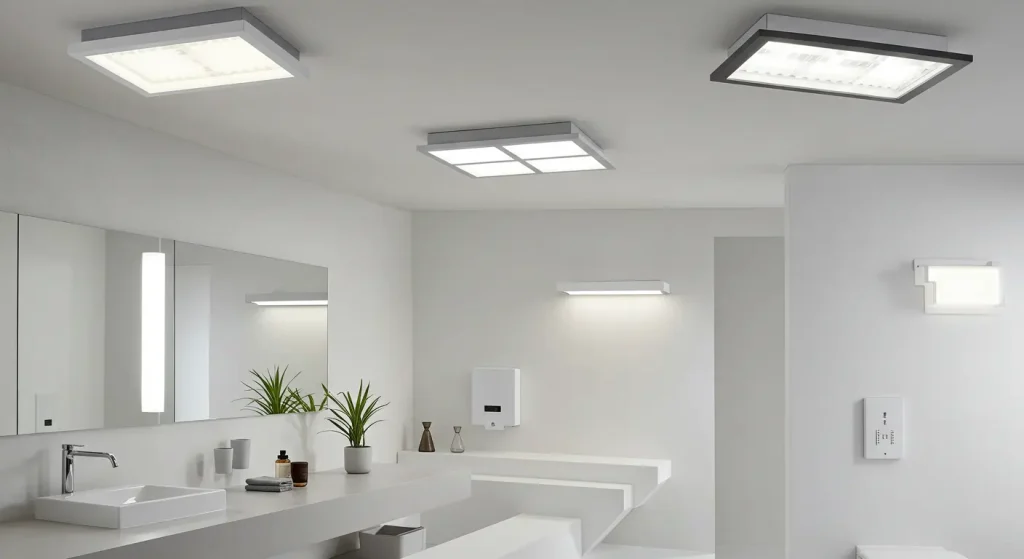
Below is a practical, human-friendly guide that blends code facts, designer tips, and checklists you can copy into specs.
1 Understand Your Space And Intent
Before you choose fixtures, map the space:
- Type: office, retail, restaurant, hotel, school, healthcare, gym.
- Features: mirrors only? baby-change? showers/steam?
- Use pattern: high traffic vs. low traffic; 24/7 vs. business hours.
- Brand goals: warm spa feel, clean clinical feel, or neutral.
- Maintenance limits: how often can staff service luminaires?
These answers drive light level, IP rating, lens choice, finish, and control strategy.
2 How bright should a commercial restroom be?
Two ideas matter:
- Horizontal illuminance on floors and counters (safety and cleaning).
- Vertical illuminance at the face/mirror (grooming, makeup, shaving).
Recommended targets (design starting points)
| Area | Footcandles (fc) | Lux (approx) | Source |
|---|---|---|---|
| General restroom | 5 fc | ~50 lux | U.S. UFC 3-3.6 |
| Vanity/counter | 15 fc | ~150 lux | U.S. UFC 3-3.6 |
| Showers | 10 fc | ~100 lux | U.S. UFC 3-3.6 |
| Washrooms (general) | — | 100–200 lux | CIBSE / EN 12464-1 summaries |
Notes:
- UFC values are widely used in U.S. government facilities and align with common IES-based practice for simple restrooms.
- European design guides (CIBSE / EN 12464-1) commonly show ~100–200 lux for washrooms, with higher light at mirrors. Use these as helpful cross-checks if you work on international standards.
Tip: For mirrors, design for good vertical light on faces (not just bright ceilings). Even if horizontal fc meets target, users will complain if faces are in shadow.
3 Pick the right fixture types (and where each works best)
a) Recessed downlights (sealed lens)
- Good for general ambient light.
- Choose damp location (most restrooms) or wet location for showers.
- Gebruik wide beams (80–100°) for uniform floors; add wall-wash or sconces at mirrors to avoid “raccoon eyes.”
b) Linear slot or surface wraps (vapor-tight for wet zones)
- Fast to clean; great in back-of-house or high-abuse areas.
- For showers/steam, pick IP65 or higher/UL Wet; look for corrosion-resistant housing and gaskets.
c) Vanity sconces / mirror-integrated LED
- Het beste voor vertical light at the face.
- Mount at eye height left and right of mirrors, or use a ring/halo mirror with diffused LED.
d) Wall-washers / cove
- Helps with uniform brightness and reduces glare.
- Use where you want a more upscale feel (hospitality, offices).
e) Vandal-resistant luminaires
- In public/high-school/transport hubs, look for IK ratings (impact resistance, IEC 62262). Higher IK10 means stronger housings.
4 Get the rating right: Damp vs. Wet vs. IP codes
- UL 1598 “Damp Location” is typical for general restrooms without direct water spray.
- UL 1598 “Wet Location” is needed near showers, under sprinklers with exposure, or where jets/cleaning hoses hit the fixture.
- IEC 60529 IP ratings describe dust/water ingress (e.g., IP65 = dust-tight + protected against water jets). In U.S. specs you can reference both UL location and IP for clarity in wet areas.
Quick picker:
| Zone | Typical Need | Suggested Rating |
|---|---|---|
| General stalls & circulation | Humidity but no spray | UL Damp |
| Over sinks with splash risk | Splash | UL Damp or Wet; IP44–IP54 helpful |
| Showers/steam rooms | Spray/cleaning | UL Wet; IP65–IP66 |
| Vandal-prone public restroom | Impact | Add IK rating; sealed lens |
5 Color quality your users will notice
CCT: choose 3000–4000K.
- 3000K = warm, spa-like.
- 3500K = neutral.
- 4000K = clean/modern.
Color rendering: use CRI 90+, or better, ask for TM-30 report:
- Rf (fidelity) ≥ 85, Rg (gamut) ~ 95–105 gives natural but lively skin tones.
- TM-30 evaluates 99 colors (far better than CRI’s 8), so it’s a more reliable check for mirror areas.
6 Controls and codes
Even a great luminaire fails the project if controls don’t meet code.
IECC / ASHRAE 90.1 (most U.S. states)
- Restrooms require occupancy sensing controls met automatic shut-off. Time-outs typically ≤20–30 minutes depending on the adopted code version.
California Title 24, Part 6 (stricter rules)
- Automatic shut-off in ≤20 minutes after vacancy is the common requirement for indoor spaces.
- Occupancy/vacancy sensors are mandatory in many spaces; acceptance testing applies.
- Some areas require partial-ON/partial-OFF behavior (e.g., automatic partial-ON to 50–70% and partial-OFF to 50% or less), depending on space type and system. Always verify the specific table for your project. (Energy Code Ace)
Practical picks:
- Dual-tech sensors (PIR + ultrasonic) in multi-stall rooms improve detection behind partitions.
- Manual-ON (vacancy) switches reduce false-ON in low-traffic restrooms.
- Tie mirrors/vanities to the same control zone as ambient—but allow a grace period (Title 24 suggests 15–30 seconds) so lights pop back on if a user waves.
7 Emergency & egress lighting
- Provide 1 footcandle average along the path of egress and maintain it for 90 minutes with emergency power.
- Gebruik UL 924 emergency luminaires and exit signs; many vanity lights are not listed for emergency—add remotes or integral battery where needed.
Tip: In single-occupant restrooms that open into an egress corridor, the corridor lighting often handles egress levels; check your AHJ and layout to be sure.
8 Mounting, spacing, and glare control
- Sconces: center 60–66 in (152–168 cm) above finished floor, or at eye height for most adults; pair on both sides of the mirror to reduce nose-shadow.
- Downlights: space 1.0–1.2× mounting height from the task plane for even coverage; avoid placing a single downlight directly above the face at the mirror.
- Glare: choose diffused lenses or micro-prismatic optics; avoid naked high-intensity point sources in small rooms. (EN 12464-1 addresses glare with UGR; while not a U.S. code, the concept is useful for design comfort.)
9 Materials, hygiene, and durability
- Sealed lenses and gaskets keep out moisture and insects; they also speed up cleaning.
- Chemical resistance: in high-cleaning environments (airports, stadiums), pick housings and lenses rated for common cleaners.
- Vandal resistance: consider IK10 fixtures for public restrooms and transportation hubs.
10 Spec cheat-sheet
Fixture family: LED, low-glare recessed downlight + mirror sconces
Location rating: UL 1598 Damp (general) / Wet in shower bays; IP65 where sprayed
Light levels: 5 fc general, 15 fc at vanity, 10 fc showers (UFC); or 100–200 lux general (CIBSE)
CCT/CRI/TM-30: 3500K, CRI ≥ 90, TM-30 Rf ≥ 85, Rg 95–105
Controls: Dual-tech occupancy sensor, ≤20-min time-out (Title 24) or per IECC/ASHRAE; partial-ON/OFF where required
Emergency: Provide UL 924 units/signs to meet 1 fc average for 90 minutes
Finish: Antimicrobial powder coat optional (healthcare); smooth lenses for cleaning
Garantie: 5- to 10-year, LM-80/TM-21 supported LED life data (ask manufacturers)
Submittals: photometry (IES file), TM-30 report, UL listings, IP/IK ratings, controls sequence
(Standards cited above: UFC restroom illuminance; CIBSE/EN summaries; UL 1598; IEC 60529; UL 924; Title 24 / IECC / ASHRAE control rules.)
11 Energy & sustainability
LEDs already cut energy, but controls double the savings:
- Occupancy controls in restrooms trim lighting hours dramatically—spaces are often empty. Both IECC/ASHRAE 90.1 En Title 24 treat restrooms as controlled spaces for this reason.
- National reports show LED adoption keeps climbing across U.S. buildings; pairing LEDs with sensors delivers the best ROI. (Inside Lighting)
If you track ESG, include:
- Lighting power density calculations,
- Occupant-centric controls (daylight dimming near windows),
- Low-glare optics to reduce visual fatigue.
12 Budget planning: where to spend vs. save
Spend on:
- Mirror lighting quality (color quality + glare control).
- Sensors that actually work in partitions (dual-tech).
- Listings/ratings (Wet/IP ratings where needed).
Save on:
- Over-spec’d lumen packages. Start from the targets above and size the run-time to your space.
- Overly narrow beams in small rooms (they cause scallops and hot spots).
13 Sample layouts
Office core restroom (no showers):
- 6–8 ft ceiling: sealed recessed downlights at ~1.2× spacing ratio; two vertical sconces per mirror; one dual-tech sensor by the door with partition coverage; UL Damp fixtures; 3500K, CRI 90+.
Gym/locker with showers:
- Ambient from vapor-tight IP65 linear; wet-listed downlights over showers; vertical mirror bars at vanities; dual-tech sensors per zone; 3500–4000K; anti-corrosion hardware.
Public transit restroom (vandal-risk):
- IK10 surface vandal-resistant luminaires; wet/damp as needed; mirror-integrated or narrow-aperture sconces behind tempered glass; sensor with short grace period; consider tamper-proof hardware.
14 FAQ About Commercial Bathroom Light Fixtures
Q1: Damp vs. Wet—what’s the real difference?
Damp handles humidity/occasional condensation but not direct spray. Wet handles water from jets, rain, or direct wash-down. For showers or hose-down cleaning, go Wet (and consider IP65+).
Q2: Can I meet code with a simple wall timer?
Sometimes for single-user restrooms, but many jurisdictions expect occupancy/vacancy sensors. In California, timers are limited and 20-minute automatic shut-off is the common standard. Check your local adoption.
Q3: How many lumens do I actually need?
Rule of thumb: Lumens ≈ Target lux × area (m²). For a 6 m² restroom at 100 lux, target ~600 lumens of delivered light to the task plane (allow for losses). Use photometry to size counts and spacing.
Q4: Do I need special mirror lights for makeup?
Gebruik CRI 90+ or TM-30 Rf ≥ 85 / Rg ~ 100 and place lights beside the mirror (or an integrated halo) for even faces.
Q5: Are impact-resistant lights worth it?
In public venues and schools, yes—look for IK10 and tamper-resistant fasteners.
Source Reference
- UFC Design: Engineering Weather & Lighting—Restroom light levels: 5 fc general, 15 fc vanity, 10 fc showers. (Overall Building Design Guide)
- IECC/ASHRAE 90.1—Spaces like restrooms require occupancy sensor shut-off.
- California Title 24, Part 6—≤20-minute shut-off, partial-ON/OFF behaviors, and acceptance testing. (Energy Code Ace, California Energy Commission)
- NFPA 101 / UL 924—1 fc average, 90-minute emergency egress illumination; UL listing for emergency equipment.
- UL 1598 Damp/Wet definitions; IEC 60529 IP ratings. (Emedco, ADA.gov)
- CIBSE / EN 12464-1 summaries—Washroom lux ranges for cross-reference. (Mount Lighting, knowledge.bsigroup.com)
- DOE / IES TM-30—Modern color rendering metrics beyond CRI. (The Department of Energy’s Energy.gov)