 XHLUX
XHLUX

Inhoudsopgave
- The 48V Difference: More Than Just a Number
- Powering and Dimming Your 48V System: The Control Hub
- 48V vs. The Old Guard: Why Low Voltage is Taking Over from 120V/240V
- The Magnetic Connection: The Perfect Partner for 48V Track
- Is a 48V Dimmable Track Lighting System Right for Your Project? Ideal Applications
- Installation and Planning: What You Need to Know
- Market Trends & The Rise of Low-Voltage Platforms
- The Final Verdict: Is a 48V System Your New Standard?
In the world of high-end design, elegance often lies in what you don’t see—the bulky hardware, the intrusive fixtures, the jarring transitions. There’s a powerful trend towards minimalism, safety, and seamless integration. Driving this trend in the lighting world is a specific and increasingly popular technology: the 48V Dimmable Track Lighting System.

You’ve likely seen the stunning results: razor-thin tracks that disappear into ceilings, impossibly small spotlights, and a clean, architectural aesthetic that feels years ahead of traditional lighting. But it’s that “48V” designation that holds the key. Why 48 volts? What does it unlock that standard 120V or 240V systems can’t? And most importantly, how do you harness this technology to create beautifully dimmed, perfectly controlled spaces?
The 48V Difference: More Than Just a Number
When you see a lighting system specified as “48V,” it’s telling you something fundamental about its design and capabilities. It’s a complete shift from the way traditional track lighting operates.
What is a 48V Track Lighting System? The Core Concept
A 48V Dimmable Track Lighting System is a type of low-voltage lighting platform. At its core, it operates on a safe, 48-volt Direct Current (DC) power, as opposed to the high-voltage Alternating Current (AC) that comes from your wall outlets (typically 120V in North America, 230V in Europe).
To achieve this, the system requires a crucial component: a driver, or power supply. This driver is the heart of the system, taking your standard mains voltage and “stepping it down” to a clean, stable 48V DC that is then fed into the track. Every light fixture on that track then draws from this 48V supply.
Why 48V? The Tangible Benefits for Your Space
This move to low voltage isn’t arbitrary; it unlocks three game-changing advantages that directly impact safety, design, and flexibility.
1. Uncompromised Safety: The “Safe to Touch” Advantage
This is perhaps the most significant benefit. 48V falls into the category of SELV (Safety Extra-Low Voltage). According to international safety standards, SELV circuits are considered safe from harmful electrical shock.
- What this means for you: The track itself is safe to touch. You can handle the fixtures, move them, and interact with the system without fear of electric shock. This makes it an incredibly user-friendly and safe choice for homes, retail spaces, and any area where people might come into close contact with the fixtures.
2. Design Freedom & Miniaturization: Sleek, Minimalist Fixtures
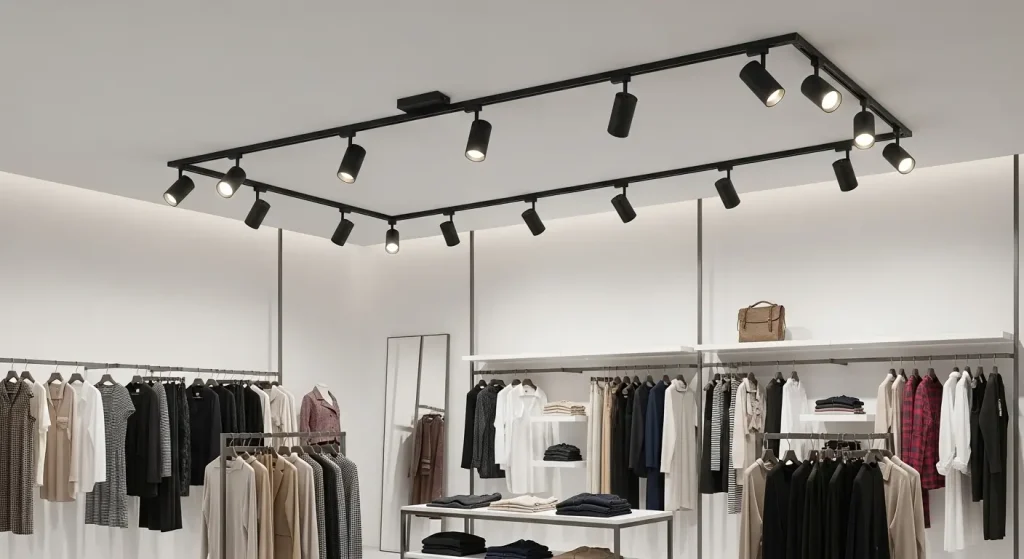
Because the system operates on low-voltage DC and the bulky power conversion is handled by a remote driver, the light fixtures themselves can be dramatically smaller, sleeker, and more refined.

- What this means for you: You can achieve that highly sought-after minimalist aesthetic. Tracks can be thinner, spotlights can be more discreet, and linear lights can be incredibly slender. This is how designers create those stunning, “barely there” architectural lighting details. The technology enables the design, not the other way around.
3. Enhanced Flexibility: The Perfect Match for Magnetic Tracks
The safety and simplicity of 48V power delivery make it the perfect partner for the most flexible track lighting innovation: magnetic track systems.
- What this means for you: Because the track is safe to touch, you can have fixtures that attach with nothing more than magnets. You can literally click lights on, pull them off, and slide them along the track with zero tools. This synergy between the safe 48V power and the convenience of magnetic attachment is why the 48V magnetic track lighting combination has become so incredibly popular.
Powering and Dimming Your 48V System: The Control Hub
So, the system is safe and sleek. But how do you actually control and dim it? This is where planning comes in, and you have several sophisticated options.
The Unsung Hero: The 48V Driver (Power Supply)
Everything starts with the driver. It’s a non-negotiable part of any 48V Dimmable Track Lighting System.
- Sizing is Key: You must choose a driver with enough wattage capacity to power all the lights you intend to use on a track run. Add up the wattage of all your fixtures, then choose a driver with a slightly higher capacity (a 15-20% buffer is good practice).
- Location, Location, Location: The driver needs to be installed somewhere. It can be placed in a ceiling void, a nearby closet, or a dedicated technical room. This needs to be planned for, as it requires ventilation and future access. Multiple drivers might be needed for very long track runs.
A Spectrum of Control: Your Dimming Options
How you dim your 48V track system depends on the type of driver you choose and the capabilities of your light fixtures. Here are the three primary methods:
| Control Method | How it Works | Individual Control? | Best For | Technical Notes |
|---|---|---|---|---|
| 1. Dimming the Driver | A central dimmable driver controls the power to the entire track. All lights dim together as one zone. | No | Simple zonal dimming, residential, budget-conscious setups. | Driver must be compatible with a specific wall dimmer (e.g., TRIAC, 0-10V). |
| 2. On-Board Wireless | The track gets constant 48V power. Each fixture has its own wireless chip (Zigbee, Bluetooth). | Yes | Smart homes, flexible digital grouping, app/voice control. | Requires a compatible hub/gateway (e.g., Zigbee hub) and a smart ecosystem. |
| 3. Integrated Data Bus | The track includes data wires (DALI). Fixtures are controlled digitally via the data bus. | Yes | Professional, high-end commercial, galleries, ultimate precision & reliability. | Requires a DALI controller and specialized DALI-compatible drivers/fixtures. |
Let’s look closer:
- Option 1: Centralized Dimming (Zonal)
This is the simplest approach. You buy a 48V dimmable driver that is compatible with a common wall dimmer type, like TRIAC (phase-cut) or 0-10V. All the track lights will respond in unison to that one wall dimmer. It’s straightforward and effective for creating a single, uniform mood. - Option 2: On-Board Wireless Intelligence (Smart)
This is a popular choice for smart homes. The driver provides constant 48V power, and the “smarts” are in each light fixture. For a Zigbee 48V track light, each fixture joins your Zigbee network. This allows you to use an app to control each light individually, group them on the fly (“living room spots,” “art wall lights”), create scenes, and use voice commands. - Option 3: Integrated Data Bus (Professional)
This is the top-tier solution for architectural and commercial projects. Here, the 48V track also includes dedicated data wires. With a DALI controlled 48V track, each fixture has a digital address and can be individually controlled with extreme precision. This system provides feedback for maintenance and integrates seamlessly into larger building management systems.
48V vs. The Old Guard: Why Low Voltage is Taking Over from 120V/240V
For decades, standard track lighting ran on mains voltage (120V in North America, 230V elsewhere). So why the shift to a 48V low voltage track lighting system?
| Functie | Traditional 120V/240V Track | Modern 48V Track System | The Real-World Impact |
|---|---|---|---|
| Safety | High Voltage. Requires careful handling and installation. | Extra-Low Voltage (SELV). Safe to the touch. | Peace of mind, user-friendliness, ease of adjusting fixtures without turning off power. |
| Fixture Size | Larger, bulkier fixtures needed to house electronics and dissipate heat. | Significantly smaller, more elegant and minimalist fixtures possible. | Enables cleaner, more integrated architectural designs where lighting disappears. |
| Flexibility | Fixtures must be mechanically locked in place. | Often paired with magnetic systems for tool-free, instant adjustment. | Unparalleled ease of use and adaptability for changing spaces (like retail or galleries). |
| Power Supply | Powered directly from mains. | Requires a separate driver to be planned for and located. | Adds a planning step to the installation process. |
| Control | Typically reliant on mains-level dimmers (e.g., TRIAC). | Natively supports advanced, low-voltage digital controls (DALI, Zigbee). | Generally offers a higher quality of dimming control and smart integration. |
The takeaway is clear: while traditional track is a known quantity, the 48V Dimmable Track Lighting System offers a fundamentally safer, more elegant, and more flexible platform that is better suited to modern design sensibilities and advanced control technologies.
The Magnetic Connection: The Perfect Partner for 48V Track
It’s almost impossible to discuss 48V track lighting without talking about its most popular application: magnetic track systems. The two technologies are a perfect match. The safety of the 48V system is what enables the effortless “click-and-play” functionality of magnetic fixtures.
This synergy allows you to treat your lighting as a truly modular system. On any given day, a single run of 48V magnetic track lighting could host:
- Three adjustable spotlights accenting artwork.
- A long linear light providing a general wash.
- Two decorative pendants dropping down over a counter.
And the next day, you could change that entire configuration in minutes, without an electrician, because the underlying 48V platform is inherently safe and designed for this interaction.
Is a 48V Dimmable Track Lighting System Right for Your Project? Ideal Applications
The unique benefits of 48V systems make them the ideal choice for a range of modern applications where aesthetics, safety, and flexibility are paramount.
- Minimalist Residential Architecture: For creating clean, uncluttered ceilings in kitchens, dining areas, living rooms, and corridors. The ability to recess the tracks makes them a favorite of architects.
- High-End Retail and Boutiques: The combination of sleek looks and the flexibility to constantly adapt lighting to new merchandise displays is invaluable.
- Art Galleries and Exhibition Spaces: The safety in handling fixtures and the potential for high-quality, individual dimming control make it perfect for showcasing art.
- Modern Corporate Offices: For creating adaptable, human-centric lighting in meeting rooms, breakout spaces, and executive offices that complements a clean, modern aesthetic.
- Hospitality Design: In hotels and restaurants where creating a sophisticated, high-end ambiance is key, and the lighting needs to adapt from day to night.
Installation and Planning: What You Need to Know
While user-friendly once installed, a 48V system requires proper planning.
- System Selection: Choose a reputable 48V track system. Be aware that most are proprietary, meaning you’ll need to use fixtures from the same manufacturer.
- Driver Calculation and Placement: Carefully calculate the total wattage of your lights and select a driver with adequate capacity. Plan a ventilated, accessible location for this driver.
- Layout and Design: Plan your track runs. Will they be recessed, surface-mounted, or suspended? How will they be powered?
- Control Strategy: Decide on your dimming method upfront (dimming the driver, on-board smart control, or a data bus system) as this will dictate your wiring and component choices.
For these reasons, especially for recessed installations or complex control schemes, working with a qualified electrician and lighting designer is highly recommended.
Market Trends & The Rise of Low-Voltage Platforms
The move towards systems like the 48V Dimmable Track Lighting System reflects a major shift in the lighting industry. Market analyses consistently show a strong trend towards:
- Miniaturization: Smaller, more powerful LED technology.
- Integration: Lighting that becomes part of the architecture itself.
- Smart and Connected Systems: Demand for IoT-enabled and user-centric controls.
- Safety and Efficiency: Low-voltage DC power distribution is becoming more common in smart buildings.
The 48V platform sits at the intersection of all these trends. Experts in architectural and lighting design see it not just as a product but as a foundational infrastructure that offers a superior combination of design elegance, safety, and control readiness for the future.
The Final Verdict: Is a 48V System Your New Standard?
So, is a 48V Dimmable Track Lighting System the right choice for you in 2025?
It is an outstanding choice, and likely the new standard for your projects, if:
- Aesthetics and minimalism are top priorities. You want your lighting to be sleek, elegant, and seamlessly integrated.
- Safety and user-interaction are key. You value a “safe to touch” system that allows for easy, tool-free adjustments.
- Ultimate flexibility is a goal. You want a modular platform, especially a magnetic one, that can adapt to changing needs.
- You want high-quality, modern dimming and control, whether it’s simple zonal control or sophisticated individual smart or DALI control.
- You are planning a new build or significant renovation and can accommodate the system’s infrastructure (i.e., planning for driver locations).
It might not be the most practical choice if:
- You are on a very strict, low-end budget for a minor update.
- You are simply replacing a few lights on an existing traditional high-voltage track.
De 48V Dimmable Track Lighting System represents a significant evolution, prioritizing the human elements of safety, beauty, and flexibility. It’s an investment in a superior lighting platform that offers not just illumination, but an entirely new level of interaction and design freedom. For anyone looking to create a truly modern, sophisticated, and future-ready space, the answer is clear: 48V isn’t just a number; it’s the future.
Ready to explore the possibilities of a 48V system? A conversation with a lighting design professional can help you tailor the perfect solution for your unique vision.