 XHLUX
XHLUX

Inhoudsopgave
- Understanding Single and Double Recessed Spotlights
- Key Differences Between Double and Single Recessed Spotlights
- Advantages and Disadvantages of Each Type
- When to Use Single or Double Recessed Spotlights
- Installation and Maintenance Considerations
- Performance Data Comparison Example
- Recommended Recessed Spotlight Solutions for Projects
- FAQ About Double Recessed Spotlight
- Conclusion
- Get Expert Advice for Your Lighting Project
Lighting defines how spaces feel and function — it can turn a simple room into a premium environment or make an upscale retail store feel flat. Among architectural lighting solutions, recessed spotlights stand out for their clean integration and directional control.
But for many designers and contractors, a common question arises:👉 Should I use single or double recessed spotlights for my project?
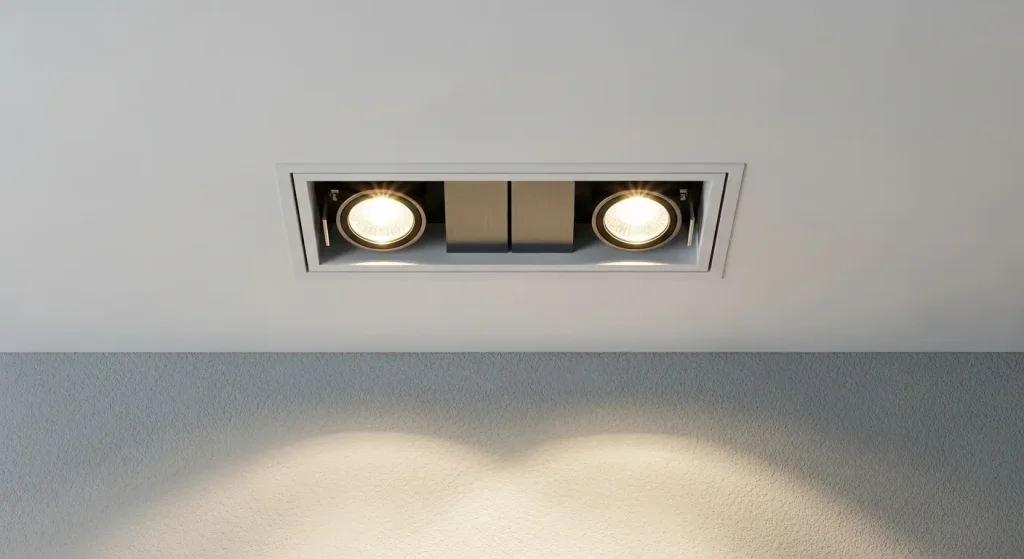
This comprehensive guide breaks down the technical, aesthetic, and cost differences between single and double recessed spotlights, helping professionals choose the right option for each lighting scenario.
Understanding Single and Double Recessed Spotlights
Before comparing their performance, it’s essential to understand what each type is and how it functions.
Single Recessed Spotlight
A single recessed spotlight features one LED light module inside a compact housing. It’s designed for focused, independent illumination and is the most common type used in residential and small commercial projects.
Key characteristics:
- Compact size and easy installation
- Independent beam direction and control
- Ideal for small spaces or distributed lighting layouts
Double Recessed Spotlight
A double recessed spotlight (also called a twin-head or dual spotlight) integrates two adjustable LED modules into one housing. Each light head can typically rotate and tilt individually, allowing more flexible illumination from a single fixture.
Key characteristics:
- Two light sources in one frame
- Dual-directional focus or wider coverage
- Ideal for commercial, retail, and exhibition projects
| Functie | Single Recessed Spotlight | Double Recessed Spotlight |
|---|---|---|
| Number of Light Sources | 1 LED | 2 Independent LEDs |
| Power Range | 5–15 W | 10–30 W |
| Beam Direction | Single | Dual adjustable |
| Ceiling Cut-Out | Small (e.g., Ø75 mm) | Larger (e.g., 160×80 mm) |
| Installation Complexity | Easy | Moderate |
| Ideal Application | Homes, corridors | Retail, showrooms, hotels |
Key Differences Between Double and Single Recessed Spotlights
Although both belong to the same product family, their structure and visual impact differ significantly. Understanding these differences helps specify the right fixture for each project.
| Comparison Aspect | Single Recessed Spotlight | Double Recessed Spotlight |
|---|---|---|
| Light Output | One source; moderate brightness | Two sources; higher total lumen output |
| Beam Flexibility | Fixed or slightly adjustable | Each head fully adjustable (tilt & rotation) |
| Aesthetic Appearance | Minimal and compact | More architectural and professional |
| Energy Efficiency | Lower power, lower coverage | Higher power but better per-area efficiency |
| Installation Effort | Simple; one hole per light | Larger hole, heavier body |
| Space Suitability | Small rooms or low ceilings | Wide or tall spaces with multiple focus points |
| Cost Factor | Lower purchase cost | Slightly higher, but fewer fixtures needed |
✅ Quick insight:
If your lighting plan requires many single fixtures close together, a double-head model may actually lower overall cost and installation time, since one fixture covers two lighting points.
Advantages and Disadvantages of Each Type
Both single and double recessed spotlights have their strengths depending on design intent and project scale.
Advantages of Single Recessed Spotlights
- Flexible placement – easy to position for balanced lighting layouts.
- Lower unit cost – ideal for budget-conscious or residential projects.
- Simplified maintenance – smaller cut-out and easier replacement.
- Better for small or low ceilings – compact housings fit in limited spaces.
Disadvantages:
- Limited brightness per fixture (usually ≤ 1000 lumens).
- Requires more fixtures for full area coverage, increasing wiring labor.
- May cause uneven light distribution if spacing isn’t well planned.
Advantages of Double Recessed Spotlights
- Higher illumination efficiency – two beams per fixture reduce fixture count.
- Dual-direction flexibility – each head can highlight different objects or areas.
- Professional look – rectangular housings provide architectural character.
- Better coverage – ideal for showrooms, galleries, or product displays.
- Optimized for accent lighting – combine narrow and wide beam angles in one body.
Disadvantages:
- Larger body size requires deeper ceiling voids.
- Slightly higher purchase cost.
- Installation is more complex due to heavier housing and dual drivers.
Quick Comparison Summary
| Factor | Single Spotlight | Double Spotlight |
|---|---|---|
| Installation | Easier | Moderate |
| Illumination Power | Lager | Higher |
| Visual Design | Minimalist | Architectural |
| Adjustability | Beperkt | Independent dual tilt |
| Onderhoud | Simple | Requires more ceiling depth |
| Ideal For | Small rooms, homes | Commercial & retail projects |
When to Use Single or Double Recessed Spotlights
Choosing between single and double recessed spotlights depends on the project’s space function, ceiling structure, and design objective. Below are professional recommendations for different applications.
1. Residential Projects (Houses & Villas)
- Recommended Type: Single recessed spotlight
- Reason: Residential interiors typically use lower ceiling heights and smaller lighting zones. Single fixtures provide balanced general and accent lighting without visual clutter.
- Example Use: Living rooms, corridors, bedrooms, kitchens
2. Retail Stores and Showrooms
- Recommended Type: Double recessed spotlight
- Reason: Retail environments benefit from higher brightness and focused accent lighting to highlight products or branding elements.
- Example Use: Clothing stores, jewelry counters, tech shops
3. Hotels and Restaurants
- Recommended Type: Combination of single and double units
Reason:
- Gebruik single spotlights for ambient or pathway lighting.
- Gebruik double spotlights for accenting art, architectural niches, or dining tables.
- Effect: Creates layered, comfortable, and premium ambiance.
4. Offices and Conference Rooms
- Recommended Type: Mixed configuration
Reason:
- Single downlights for general illumination.
- Double recessed fixtures above meeting tables or feature walls for focused light.
- Effect: Balanced brightness with professional tone.
5. Galleries and Museums
- Recommended Type: Double recessed spotlight with CRI ≥ 95
- Reason: Allows precise control of light angles and color accuracy on artworks.
- Effect: True color rendering and refined shadow play.
| Application Scenario | Recommended Type | Stroom | Beam Angle | Remark |
|---|---|---|---|---|
| Residential Living Room | Single | 10 W | 36° | Uniform general light |
| Retail Display | Double | 2 × 12 W | 24° | Focused accent lighting |
| Hotel Lobby | Double | 2 × 15 W | 30° | Layered brightness |
| Office Meeting Room | Single | 12 W | 40° | Soft, anti-glare light |
| Art Gallery | Double (CRI ≥ 95) | 2 × 10 W | 15° | Highlight artworks |
Pro Tip:
A typical 20 m² retail area may use 4–6 double-head fixtures instead of 8–10 single-head units, reducing wiring time and cost while achieving equal brightness.
Installation and Maintenance Considerations
Proper installation ensures that recessed spotlights deliver maximum efficiency and longevity. Below are essential technical notes for both single and double types.
1. Ceiling Cut-Out and Housing Depth
- Single spotlight: Ø75–90 mm cut-out, ceiling depth ≥ 80 mm
- Double spotlight: 160 × 80 mm rectangular cut-out, depth ≥ 110 mm
- Tip: Always confirm ceiling clearance before specifying fixture type.
2. Driver Placement
Most double recessed lights use two independent constant-current drivers.
- Install drivers in an accessible ceiling cavity or junction box.
- Use flicker-free models (<1% ripple) for video-safe performance.
- Group drivers logically by zone (ambient / accent / display).
3. Heat Dissipation
- Choose fixtures with aluminum alloy housings and heat vents.
- Avoid enclosing drivers in insulation or tight ceiling boxes.
- For double fixtures, verify independent heat sinks for each LED module.
4. Wiring and Control
- Gebruik 3-core or 5-core cabling for dimmable and DALI circuits.
- Ensure polarity consistency; mismatched polarity leads to driver failure.
- Label connections clearly for easy future maintenance.
5. Maintenance Tips
| Fixture Type | Maintenance Difficulty | Typical Lifetime | Notes |
|---|---|---|---|
| Single Spotlight | Easy | 40,000–50,000 hrs | Compact and replaceable |
| Double Spotlight | Moderate | 50,000–60,000 hrs | Two drivers, deeper housing |
✅ Design Note:
When specifying recessed lights for long-term commercial installations (retail, hotels, museums), prioritize removable trim and module designs for easier service access.
6. Aesthetic Integration
- Align multiple spotlights linearly for architectural consistency.
- Use trimless designs in luxury interiors for invisible integration.
- Choose frame color (white, black, silver, champagne gold) to match ceiling finish.
7. Safety and Certification
Always verify certifications like CE / RoHS / ETL / CB for international compliance.
For B2B clients, this builds trust and simplifies export logistics.
Performance Data Comparison Example
To help project managers make decisions, here’s an example comparison between standard single and double COB recessed spotlights:
| Specification | Single Recessed Spotlight | Double Recessed Spotlight |
|---|---|---|
| Stroom | 10 W | 2 × 10 W |
| Input Voltage | AC 220–240 V | AC 220–240 V |
| Luminous Flux | 950 lm | 1900 lm |
| Efficacy | 95 lm/W | 95 lm/W |
| Beam Angle | 24° / 36° | 24° + 36° |
| CRI | ≥ 90 | ≥ 90 |
| CCT | 2700–4000 K | 2700–4000 K |
| UGR | < 19 | < 19 |
| Body Material | Aluminum | Aluminum |
| Bestuurder | External | Dual external |
| Lifespan | 50,000 hrs | 50,000 hrs |
✅ Conclusion:
While the double model consumes more total power, it delivers higher light coverage efficiency, meaning fewer fixtures are required for the same brightness level — saving both material and installation costs in large projects.
Recommended Recessed Spotlight Solutions for Projects
Professional lighting projects demand reliability, visual comfort, and flexible design control. Below are some proven spotlight solutions ideal for residential, retail, and commercial applications.
1. COB Double Recessed Spotlight Series
- Power: 2 × 10 W – 2 × 20 W
- CRI: ≥ 90
- UGR: < 19 (deep anti-glare reflector)
- Material: Die-cast aluminum with powder-coated finish
- Beam Angles: 15°, 24°, 36°
Benefits:
- Dual adjustable modules for flexible direction
- High lumen efficiency and anti-glare comfort
- Perfect for galleries, boutiques, and hotels
2. Deep Anti-Glare Single Spotlight Series
- Power: 8 W – 15 W
- CCT: 2700–4000 K
- Housing Depth: 80–100 mm
Features:
- Trimless design option for invisible installation
- Black inner chamber for visual comfort
- Ideal for high-end residential and hospitality interiors
3. Multi-Head Modular Series
- Configuration: 2–4 heads in one frame
- Control Options: 0–10 V / DALI dimming
- Applications: Large showrooms, exhibition halls, luxury retail stores
- Advantages: Multiple adjustable light sources with consistent color temperature and CRI
4. Smart Dimming Series
- Control Protocols: Bluetooth, Zigbee, DALI
- CCT Range: Tunable white 2700–4000 K
Benefits:
- Scènegebaseerde besturing
- Remote operation for modern smart interiors
- Energy-saving through dynamic lighting schedules
5. OEM / ODM Customization
Customization Capabilities:
- Beam angle: 15° / 24° / 36° / 60°
- Housing color: white, black, silver, champagne gold
- Logo printing and packaging design
- Certifications: CE, RoHS, ETL, CB compliant
- Lead Time: 15–25 working days
- B2B Value: Private labeling, fast delivery, professional project support
| Product Type | Power (W) | CRI | Beam Angle | UGR | Best For |
|---|---|---|---|---|---|
| COB Double Recessed | 2 × 15 | ≥ 90 | 15–36° | < 19 | Retail / Hotel |
| Deep Anti-Glare Single | 10 | ≥ 90 | 24–60° | < 19 | Home / Office |
| Multi-Head Modular | 4 × 12 | ≥ 90 | 15–36° | < 19 | Showroom / Gallery |
| Smart Dimming | 12 | ≥ 90 | 24–60° | < 19 | Modern Buildings |
FAQ About Double Recessed Spotlight
1. Is a double recessed spotlight the same as using two single lights?
Not exactly. A double recessed spotlight integrates two adjustable light modules within one housing. This allows dual-direction illumination and reduces installation time, making it more efficient for commercial or large-scale layouts.
2. Do double recessed spotlights consume more power?
They use more total wattage, but offer higher lighting coverage per fixture. In many cases, fewer double-head lights are needed compared to single ones, resulting in balanced energy use.
3. Can each light head in a double fixture be controlled independently?
Yes. In most professional COB double recessed designs, each light source has an independent driver and can be angled or dimmed separately.
4. Are double recessed spotlights suitable for low ceilings?
It depends on ceiling depth. Standard double-head housings require around 110–120 mm clearance. For low ceilings, choose compact single-head models or surface-mounted alternatives.
5. Are double spotlights harder to maintain?
Maintenance is slightly more complex because of two LED modules and drivers. However, modular designs with replaceable light engines make servicing simple and cost-effective.
Conclusion
Both single and double recessed spotlights have their place in modern lighting design:
- Choose single recessed spotlights if your project values minimalist aesthetics, simpler installation, and lower cost — ideal for homes and small offices.
- Choose double recessed spotlights if you need stronger illumination, flexible dual-direction focus, and professional presentation — perfect for retail, galleries, and commercial interiors.
Ultimately, the “better” option depends on project goals:
🔹 Single = simplicity and elegance
🔹 Double = performance and versatility
For architects, designers, and contractors, collaborating with a trusted manufacturer ensures that technical standards (CRI, UGR, CCT) meet the project’s lighting requirements — guaranteeing both functional and aesthetic success.
Get Expert Advice for Your Lighting Project
Our lighting specialists help global clients create lighting solutions that enhance visual experience and energy efficiency.
We provide full B2B project support, from design consultation to OEM customization.
You’ll Get:
✅ Free photometric design & lux calculation
✅ Customized beam angle and color temperature
✅ Fast OEM/ODM service and professional technical support
Ready to start?
👉 Get a Quote
👉 Download Double Spotlight Catalog
👉 Request Free Lighting Design Layout