 XHLUX
XHLUX

Inhoudsopgave
- Why Many Retail Stores Still “Lose” Even After Upgrading to LED
- What Is Retail Lighting Design?
- Why Track Lights and Downlights Are Essential in Retail Stores
- Layered Retail Lighting Design Using Track Lights and Downlights
- Key Design Factors to Consider
- Retail Lighting Design Examples by Store Type
- Why are many retail projects affected by lighting
- Common Mistakes in Retail Lighting Design
- How to Plan Fast Without Overthinking
- Comparison Table: Track Lights vs Downlights in Retail Lighting Design
- FAQ About Retail Lighting Design
- 1) What lighting is best for retail stores?
- 2) How many track lights does a retail store need?
- 3) Are downlights enough for retail lighting?
- 4) What is the best lighting layout for retail?
- 5) Does retail lighting affect sales?
- 6) What CRI should retail lighting be?
- 7) What color temperature is best for retail lighting?
- 8) Are dimmable track lights worth it?
- Welkom om zakelijke samenwerking te bespreken.
Why Many Retail Stores Still “Lose” Even After Upgrading to LED
Many retail stores invest in LED lighting upgrades—new fixtures, higher lumen output, even “modern-looking” ceilings—yet the store still fails to create attractive displays or guide customer attention effectively. Products don’t stand out, focal zones feel weak, and the space looks bright but not expensive or inviting.
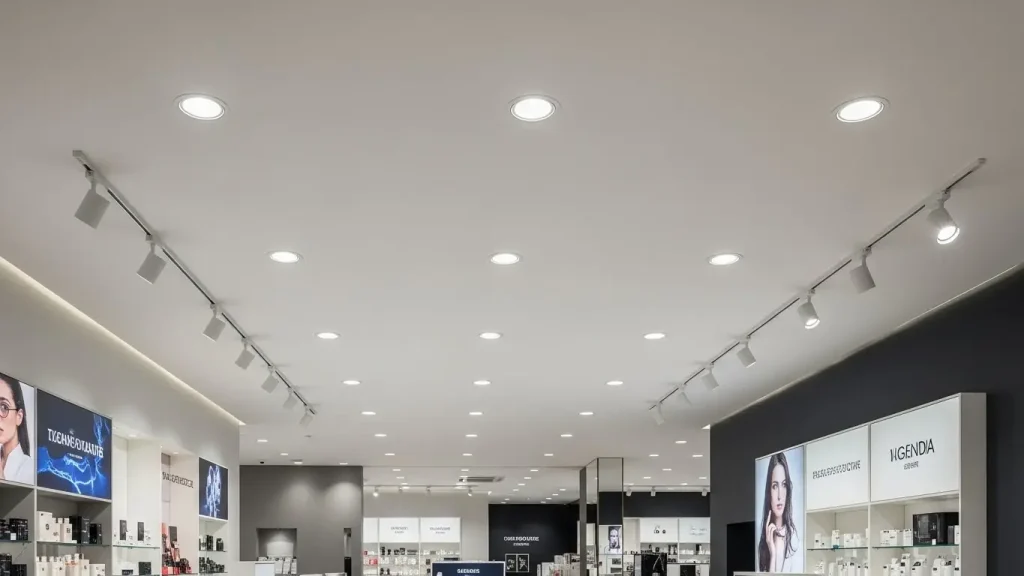
Without a proper retail lighting design, even high-quality products can look flat, colors appear inaccurate, and shoppers lose interest quickly. The most common hidden issues are not “too few lights,” but design mismatches:
- Wrong straalhoek: either harsh hotspots or washed-out shelves
- Incorrect kleurtemperatuur (CCT): merchandise looks dull, cold, or “off-brand”
- Laag CRI (color rendering index): colors shift, fabrics look cheaper, food looks less fresh
- Arm verblindingbeheersing: shoppers squint, shorten dwell time, and avoid certain aisles
- No layered strategy: everything is evenly bright, so nothing feels important
The most reliable path is not choosing either track lights or downlights. It’s combining them correctly. By pairing track lighting (for flexible accent lighting and spotlighting products) with LED-downlights (for clean, uniform ambient lighting), retailers can build gelaagde verlichting that improves visual merchandising, strengthens store atmosphere, and increases sales performance—without wasting power or overcomplicating installation.
If you’re sourcing fixtures for a retail project, you can quickly shortlist options from XHLUX LED Track Lighting Collection En LED-spotdownlights—these two categories are the core building blocks of most modern retail lighting layouts.
What Is Retail Lighting Design?
What is retail lighting design?Retail lighting design is the strategic use of different lighting types—such as ambient, accent, and task lighting—to highlight products, shape store atmosphere, and influence customer behavior in retail environments.
That definition sounds simple, but the key is this: retail lighting is not “lighting a space.” It is designing attention. In an office, lighting is often optimized for uniform visibility and comfort. In retail, lighting is optimized for visual hierarchy—the store must silently tell shoppers:
- “Look here first.”
- “This product is premium.”
- “This zone is new arrivals.”
- “This shelf is easy to browse.”
This is why visuele merchandising and lighting are inseparable. Retail lighting design is essentially a sales strategy implemented with optics, photometrics, and layout planning.
Retail ≠ Office: Why Copy-Paste Lighting Logic Fails
A common mistake is applying office rules directly to retail. Office lighting often prioritizes uniformity (flat distribution) because the task is consistent: reading screens, walking safely, reducing fatigue. Retail tasks change by zone:
- Browsing shelves (wide, comfortable base)
- Discovering hero products (high contrast, precise accent)
- Trying on clothing (excellent CRI and glare control)
- Paying at checkout (task clarity and facial recognition comfort)
So in retail, you still care about visual comfort—but you also must engineer contrast En focus intentionally.
What We See in Real Projects
In real retail renovations (clothing stores, supermarkets, and specialty shops), the “before vs after” difference rarely comes from doubling brightness. The biggest improvement comes from:
- Introducing accent lighting for focal points
- Upgrading to CRI ≥ 90 so product colors look accurate
- Fixing glare and aiming angles so customers feel comfortable
- Creating a layered approach where the ceiling looks clean, but displays feel premium
For project inspiration and real-world application patterns, many buyers like to review Projectcases to understand how different store types translate lighting theory into layout decisions.
Why Track Lights and Downlights Are Essential in Retail Stores
Many competitor articles talk about “ambient / accent / task,” but they stop right before the part that actually helps a buyer: what fixture types achieve each layer reliably? The most proven retail answer is:
- Downlights = clean, uniform ambient base
- Track lights = flexible accent and merchandising control
Treat them as a team with clear division of labor, not separate topics.
Role of Track Lights in Retail Lighting Design
Track lighting is the retail designer’s precision tool. A track rail system allows multiple adjustable track heads to slide along the rail, rotate, and tilt—so the lighting can follow merchandising changes without re-cutting ceilings or moving junction boxes.
Track lighting excels at:
- Spotlighting products (new arrivals, premium items, mannequins, endcaps)
- Building contrast (hero vs background)
- Adjusting as displays change (seasonal resets, promotions)
- Creating visual rhythm along walls and aisles
Why track lighting wins in retail: It turns lighting into a flexible merchandising asset instead of a fixed architectural element.
If your project needs fast configuration and many aiming options, start with the LED Track Light Category. If you want maximum flexibility for changing beam angles without swapping fixtures, consider Zoombare railverlichting for stores that frequently redesign displays.
Role of Downlights in Retail Lighting Design
Downlights are the store’s “quiet foundation.” They provide:
- A uniform ambient base so the store feels open and easy to navigate
- A clean ceiling aesthetic (especially in minimalist retail)
- Consistent aisle brightness that reduces shopper fatigue
Downlights are ideal when you need:
- Wide-area illumination without cluttering the ceiling
- Controlled glare and comfortable distribution
- A stable base layer that doesn’t require constant aiming
But downlights alone often fail in retail because they’re not designed for dynamic focal work. They illuminate space; they don’t merchandise products.
For ambient foundation and clean ceiling design, many retail projects rely on LED-spotdownlights (for controlled distribution) and sometimes pair them with linear ambient systems like LED Linear Lighting in supermarkets or large-format stores.
Layered Retail Lighting Design Using Track Lights and Downlights
How do track lights and downlights work together in retail lighting?Downlights provide general ambient lighting, while track lights add focused accent lighting to highlight products, creating a balanced and visually engaging retail environment.
Ambient Lighting – Creating a Comfortable Base
Ambient lighting should make the store feel comfortable and navigable. In practice, a strong ambient layer:
- Avoids dark corners and “dead zones”
- Keeps facial recognition comfortable (customers and staff)
- Supports safety and general browsing
Downlight strategy for ambient lighting:
- Use appropriate spacing for uniformity (avoid patchy brightness)
- Select optics that reduce glare—especially at checkout and fitting rooms
- Choose stable color temperature (CCT) aligned with brand identity
Glare control matters here. In comfort-critical retail zones, many designers aim for visual comfort benchmarks inspired by indoor lighting guidance such as EN 12464-1 (general indoor lighting guidance). A useful reference is the overview page for EN 12464-1.
Accent Lighting – Highlighting Products That Sell
Accent lighting is where retail converts. It creates visual hierarchy, telling shoppers where to look and what matters.
Track lighting strategy for accent lighting:
- Use narrow beam angles (often 15°–24°) for hero displays
- Prioritize high CRI so products look authentic and premium
- Aim lights intentionally (angle and distance) to control reflections and shadows
- Add contrast, not chaos—accents should be purposeful
A professional retail accent layer typically targets:
- CRI > 90 as a baseline; premium zones may prefer Ra97
- Strikte kleurconsistentie: SDCM < 3
- Stable optics for beam control (lens/reflector design)
This is also where adjustable track heads are a practical advantage: you can re-aim for new collections without changing fixtures.
Task Lighting – Supporting Staff and Checkout Areas
Task lighting supports staff performance and customer confidence at transaction points. Checkout, service counters, and stock-related areas need:
- Enough vertical and facial illumination
- Low glare (nobody likes a “spotlight in the eyes” while paying)
- Stable CCT and high CRI for accurate product and receipt handling
A practical approach:
- Use downlights or controlled wide-beam fixtures for general counter area
- Use track heads sparingly to add emphasis on point-of-sale displays
- Avoid strong hotspots that create discomfort
If your project includes modern suspended elements (common in boutique retail), pendant styles can complement layered design; you can review LED Pendant Lighting Options when needed for architectural emphasis.
Key Design Factors to Consider
Retail buyers and designers need both design logic and measurable specs. Below is a practical checklist combining both.
Beam Angle Selection
Straalhoek determines whether your lighting feels premium or messy. Use it like a merchandising tool:
Narrow beams (15°–24°): mannequins, feature tables, hero wall displays
- Strong contrast, higher perceived value
- Risk: hotspots if aiming is sloppy
Medium beams (24°–36°): general feature shelves, wall zones
- Balanced focus and coverage
Wide beams (36°–60°): aisles, broader browsing shelves, circulation
- Comfortable base for browsing
Retail best practice: combine beam angles.A store using only wide beams looks flat. A store using only narrow beams looks harsh and chaotic. The most professional retail display lighting uses both.
If your team wants flexibility without managing too many SKUs, zoomable optics reduce complexity—see Zoomable Tracklight Series.
Color Temperature (CCT) & CRI (Sales Psychology + Color Truth)
Color temperature (CCT) shapes mood and brand perception:
- 3000K: warm, premium, intimate (luxury, boutique)
- 4000K: neutral, mainstream (apparel chains, supermarkets)
- 5000K: crisp, tech-forward (electronics, modern showrooms)
CRI (color rendering index) protects product truth. In retail, low CRI isn’t just “less accurate”—it can change perceived quality. That’s why many professional specs insist on:
- CRI ≥ 90 minimum for serious retail
- Ra97 for high-end presentation (luxury, cosmetics, jewelry)
Also consider:
- Strikte kleurconsistentie: SDCM < 3 (critical for wall continuity and brand color integrity)
Glare Control and Visual Comfort (UGR, Optics, and Human Behavior)
Glare reduces dwell time. Even when customers can’t describe “UGR,” they feel it. For comfort-driven zones, designers often set targets like:
- UGR < 19 in sensitive zones (checkout, service areas, fitting rooms)
How to improve glare control:
- Choose optics designed for shielding (deep reflectors, lens control, honeycomb options)
- Richt de richtpunten weg van de directe zichtlijn.
- Avoid high-intensity beams hitting glossy packaging at bad angles
Energy Efficiency, Lifetime, and Thermal Reliability
Retail runs long hours. That makes total cost of ownership more important than fixture price.
A practical commercial LED lighting target range:
- Efficiency: 100–130 lm/W (project-dependent)
- Lifetime: L70/B50 50,000 hours
- Stable drivers and thermal design for long daily operation
Materials and thermal build matter:
- Die-cast aluminum heatsink for strong heat dissipation
- COB chip options for smooth beam quality and strong center intensity
- PMMA-lens for stable optical control and beam shaping
These aren’t buzzwords—they are directly tied to lumen maintenance and color stability in real retail conditions.
Installation and Customization
For wholesalers, contractors, and chain-store project managers, the winning system is:
- Easy installation (reliable adapters, consistent mechanical fit)
- Easy replacement and maintenance
- Stable supply for rollout projects
- Support for ODM customization (beam, finish, branding, driver options)
For buyers evaluating supplier capability and long-term support, it helps to review About XHLUX to understand manufacturing scope and service positioning.
Retail Lighting Design Examples by Store Type
Industry segmentation is a strong “expert signal” for Google and for buyers. Different store types sell different perceptions—so their lighting strategies should differ.
Clothing Stores (Fashion Retail)
Goal: make fabrics look real, premium, and flattering.
Recommended approach:
- Ambient base with downlights (clean ceiling)
- Track lighting for mannequins, feature walls, and new arrivals
- High CRI and good glare control around mirrors and fitting rooms
Specs that matter most:
- CRI > 90 (often premium: Ra97)
- SDCM < 3
- Thoughtful beam angles: narrow for mannequins, wider for racks
- Comfort targets: UGR < 19 in sensitive zones
For product selection starting points, many fashion projects browse Track Lighting Solutions plus Spot Downlights as the core fixture pairing.
Supermarkets and Grocery
Goal: comfortable browsing, strong shelf visibility, and energy efficiency.
Recommended approach:
- Strong ambient layer (downlights and/or linear systems)
- Track lighting used selectively for endcaps, promotional islands, or premium zones
- Wide beams for aisles; avoid excessive contrast that creates fatigue
Specs that matter:
- Hoog energy efficiency (100–130 lm/W)
- Stable operation for long hours
- Optics designed to reduce glare and maintain uniformity
Large supermarkets often benefit from an ambient backbone like Linear Lighting paired with focused accents using track heads.
Jewelry & Luxury Retail
Goal: create sparkle, contrast, and perceived value.
Recommended approach:
- Lower ambient level (still comfortable)
- Strong, precise accent lighting with narrow beams
- Very high color quality to protect gemstone and metal tones
Specs that matter:
- Ra97 (premium CRI) is often justified here
- Tight SDCM < 3 for consistency
- Beam control and glare shielding to avoid discomfort
- Precise aiming and careful reflection management
If a luxury store frequently changes display cases, Zoombare railverlichting can reduce the need to swap fixtures when beam requirements change.
Electronics Stores
Goal: clean brightness, tech-forward atmosphere, clear product visibility.
Recommended approach:
- Neutral/cool CCT (often 4000K–5000K depending on brand)
- Balanced ambient layer so the store feels bright and modern
- Accent lighting used to highlight hero products and feature walls
Key risk: glare on glossy screens.Use glare control optics and careful aiming angles to avoid direct reflections that annoy customers.
Why are many retail projects affected by lighting
Retail lighting performance isn’t only about the LED. It’s also about control, compatibility, and maintenance planning.
Dimming: TRIAC vs DALI
- TRIAC dimming: simpler, cost-effective, common in small shops
- DALI / DALI-2: scene setting, zoning, standardized control for chain stores
For professional reference, DALI standards are maintained by the DALI-alliantie. If your project needs consistent dimming across many stores and future scalability, DALI often becomes the safer long-term choice.
Track Standards and Adapters
Track systems vary by region and type (including common commercial formats like 3-phase). Compatibility issues can cause costly delays:
- wrong adapter type
- mechanical fit problems
- grounding/phase mismatches
A simple rule for B2B buyers: verify track standard before confirming the fixture order—especially for international sourcing.
For teams needing supplier support on layout, standards, and compatibility, a direct path is Neem contact op en vraag een offerte aan. (faster decisions, fewer back-and-forth cycles).
Common Mistakes in Retail Lighting Design
What are common retail lighting design mistakes?Common mistakes include relying only on downlights, poor spotlight positioning, low CRI lighting, and ignoring layered lighting principles.
Here are the most damaging mistakes, with real-world consequences:
- Using only downlights
The store looks evenly bright but lacks focal points. Products don’t “sell themselves.” - Random track light aiming
Track lights are powerful, but without a plan they create visual chaos, glare, and unflattering shadows. - Ignoring CRI
Low CRI can ruin the perception of fabrics, cosmetics, food freshness, and luxury finishes—causing lost trust and lower conversion. - Over-lighting everything
When everything is bright, nothing feels special. Retail needs contrast and hierarchy. - Skipping glare control
Glare reduces comfort and makes customers avoid certain zones—quietly lowering sales opportunities.
How to Plan Fast Without Overthinking
When a buyer asks “what is the best lighting layout for retail?” they usually want a repeatable process. Here’s a practical blueprint:
Step 1: Define Zones by Customer Behavior
Map the store into zones:
- Window / entry decompression zone
- Main browsing aisles
- Feature wall / hero displays
- Promotions / endcaps
- Checkout / service
Each zone needs a different balance of ambient and accent.
Step 2: Build Ambient First (Downlights or Linear)
Design a comfortable base:
- consistent brightness for navigation
- minimal glare
- clean ceiling appearance
Step 3: Add Accent Layer (Track Lighting)
Add contrast where it matters:
- new arrivals
- premium products
- mannequins and storytelling displays
- brand wall features
Step 4: Refine with Beam Angles and Aiming
- use narrow beams for hero points
- use wider beams for browsing shelves
- aim at products, not floors
- avoid direct line-of-sight glare
Step 5: Validate Specs Like a B2B Pro
For commercial projects, confirm:
- CRI > 90 / Ra97 (as needed)
- SDCM < 3
- UGR < 19 in sensitive zones
- 100–130 lm/W (target range)
- L70/B50 50.000 uur
- robust materials: die-cast aluminum heatsink, COB chip, PMMA lens
- dimming method (TRIAC or DALI)
- track compatibility
If you want to streamline model comparison, the Productcatalogus is a quick way to shortlist product families by application and configuration.
Comparison Table: Track Lights vs Downlights in Retail Lighting Design
| Category | Track Lighting | LED-downlights | Best Use in Retail |
|---|---|---|---|
| Primary role | Accent lighting, spotlighting products | Ambient lighting base, uniformity | Combine for layered lighting |
| Flexibility | High (aiming + positioning) | Low (fixed position) | Track for changing displays |
| Ceiling aesthetics | Visible fixtures, intentional look | Clean and minimal | Downlights for clean ceiling |
| Beam control | Strong (narrow to wide; zoomable options) | Moderate (depends on optics) | Use narrow beams for hero zones |
| De impact van visuele merchandising | Very high | Medium | Track is the merchandising driver |
| Glare risk | Medium–high if mis-aimed | Medium if optics are poor | Use glare control + aiming rules |
| Ideal pairing | Works best with a stable ambient base | Works best with accent layer support | Track + downlights = optimal |
FAQ About Retail Lighting Design
1) What lighting is best for retail stores?
The best approach is gelaagde verlichting: use LED-downlights (or linear systems) for ambient lighting, then add track lighting for accent lighting to highlight products and shape visual merchandising.
2) How many track lights does a retail store need?
It depends on ceiling height, beam angle, and how many focal zones you have. Stores with strong visual merchandising often use track heads mainly on feature walls, endcaps, and hero displays—rather than evenly across the entire ceiling.
3) Are downlights enough for retail lighting?
Usually not. Downlights provide a clean ambient base, but retail needs accent lighting to create contrast and guide attention. Track lighting is typically required to make products “pop.”
4) What is the best lighting layout for retail?
A proven layout starts with zoning (entry, aisles, hero displays, checkout), then builds ambient lighting first, and finishes with track accents aimed at merchandise. Layered lighting is the most reliable format.
5) Does retail lighting affect sales?
Yes. Lighting impacts perceived product quality, brand atmosphere, browsing comfort, and dwell time. High CRI, correct beam angles, and strong visual hierarchy can directly improve conversion performance.
6) What CRI should retail lighting be?
For serious retail, CRI ≥ 90 is recommended. For luxury, cosmetics, and jewelry, higher targets like Ra97 are often justified to preserve premium color appearance.
7) What color temperature is best for retail lighting?
Common choices:
- 3000K for warm luxury and boutique environments
- 4000K for mainstream retail and supermarkets
- 5000K for tech-forward electronics stores
Choose CCT to match brand identity and product category.
8) Are dimmable track lights worth it?
Often yes—especially for stores that change displays and run promotions. Dimming enables scenes (daytime, evening, promo focus) and can improve comfort while supporting merchandising.
Welkom om zakelijke samenwerking te bespreken.
Retail lighting design works when it does three things at once:
- Creates a comfortable base (ambient lighting)
- Builds attention and contrast (accent lighting)
- Supports staff efficiency (task lighting)
The most practical way to achieve this is combining LED-downlights + track lighting:
- Downlights keep the store clean, uniform, and navigable
- Track lighting provides adjustable control for spotlighting products and visual merchandising
- Together, they create layered lighting that improves both atmosphere and sales performance
If you want to shorten decision time and move faster from design to purchase, these pages are the most direct next steps:
- Start with the core fixture categories: LED-railverlichting + LED-spotdownlights
- For stores with frequent display changes: Zoombare railverlichting
- For ambient backbone in large retail: LED Linear Lighting
- For solution-level support: Verlichtingsoplossingen en -diensten
- For real implementation references: Projectcases
- To request a quote or discuss track standards / layout / specs: Neem contact op en vraag een offerte aan.
When you align layout strategy with specs like CRI > 90 / Ra97, SDCM < 3, UGR < 19, 100–130 lm/W, and L70/B50 50.000 uur, your lighting system becomes consistent, scalable, and merchandising-ready—exactly what professional retail projects demand.