 XHLUX
XHLUX

Inhoudsopgave
- What Is a Recessed Ceiling Spotlight?
- Types of Recessed Ceiling Spotlights
- Key Factors to Consider When Choosing Recessed Ceiling Spotlights
- Installation Methods and Ceiling Design Compatibility
- Lighting Design Tips for Different Interior Styles
- Common Mistakes to Avoid
- Recommended Recessed Ceiling Spotlight Solutions for Professionals
- FAQ About Recessed Ceiling Spotlight
- Conclusion
- Get Professional Lighting Advice for Your Project
Lighting has become one of the most defining elements of modern interior design. It influences how people perceive form, texture, and emotion. Among various lighting options, the recessed ceiling spotlight—often called an LED ceiling downlight—is a favorite for designers and architects seeking clean, minimal, and versatile illumination.
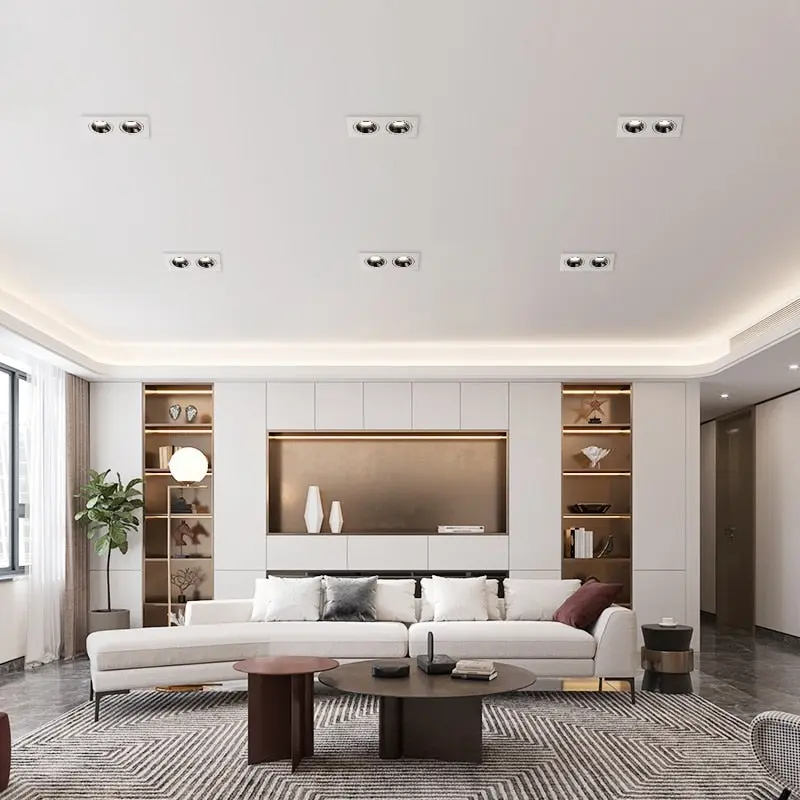
This guide explains how to select the best recessed ceiling spotlight for residential, retail, or commercial interiors. It covers technical parameters, design insights, and purchasing considerations for lighting professionals, contractors, and distributors.
What Is a Recessed Ceiling Spotlight?
A recessed ceiling spotlight is a luminaire installed into a ceiling cavity so that only the aperture is visible while the fixture body and wiring remain hidden.
It projects a focused or adjustable beam of light, allowing designers to shape visual layers without cluttering the ceiling.
Core Components
- Housing – encloses the LED module and reflector
- Trim – visible rim, defines style (trimless, round, square, or metallic)
- Light module – COB or SMD LED source
- Bestuurder – powers the LED, often mounted remotely
Difference from a Standard Downlight
| Functie | Recessed Ceiling Spotlight | Downlight |
|---|---|---|
| Beam Type | Directional / Focused | Wide & Diffused |
| Adjustability | Usually tilt or rotate | Vast |
| Application | Accent / Feature lighting | General lighting |
| Beam Angle | 15°–60° | 60°–120° |
Common Applications
Recessed ceiling spotlights are used in:
- Residences & Villas – to highlight art or furniture
- Retail Stores – to create accent zones
- Hotels & Restaurants – for ambiance and comfort
- Offices & Showrooms – for task or display lighting
Types of Recessed Ceiling Spotlights
Understanding different spotlight categories ensures the correct match between design needs and performance expectations.
| Type | Typical Power | Beam Angle | Key Feature | Application |
|---|---|---|---|---|
| Fixed Type | 8–15 W | 40°–60° | Uniform downward beam | Corridors, offices |
| Adjustable Type | 10–25 W | 15°–36° | Tiltable / rotatable head | Retail, showrooms |
| Deep Anti-Glare Type | 10–20 W | 24°–40° | Recessed light source for comfort | Homes, hotels |
| Multi-Head Type | 15–40 W × n | 15°–30° | Multiple adjustable modules | Commercial displays |
| Magnetic Recessed System | 10–35 W | 24°–60° | Modular, replaceable fittings | Modern offices |
1. Fixed Spotlights
Provide even general lighting with minimal maintenance. Ideal for corridors or open spaces where directional focus isn’t needed.
2. Adjustable Spotlights
Use gimbal or tilt mechanisms (typically 30°–45° tilt) to direct light toward shelves, paintings, or display units.
3. Deep Anti-Glare Designs
The light source is recessed deeper into the housing, reducing glare (UGR < 19) and improving comfort in residential or hospitality settings.
4. Multi-Head Modules
Contain two or more adjustable light sources in one frame. They simplify wiring and create balanced multi-directional lighting for showrooms.
5. Magnetic Recessed Systems
Modern 48 V systems combine recessed channels with plug-in modules—offering unmatched flexibility and clean architectural lines.
Key Factors to Consider When Choosing Recessed Ceiling Spotlights
Every interior has unique lighting needs. The right specification ensures both visual quality and energy efficiency.
| Parameter | Recommended Range | Beschrijving |
|---|---|---|
| Wattage (W) | 8 – 30 W | Choose based on space size and lux requirement |
| Luminous Flux (Lm) | 700 – 2500 lm | Determines brightness |
| Color Temperature (CCT) | 2700 – 4000 K | Warm = residential, Neutral = commercial |
| Color Rendering Index (CRI) | ≥ 90 | Reveals true material colors |
| Beam Angle | 15° – 60° | Narrow = accent, Wide = ambient |
| Glare Rating (UGR) | < 19 | Improves visual comfort |
| Dimming | 0-10 V / DALI | Enables scene control & energy savings |
1. Brightness and Power
Smaller rooms require 8 – 12 W; larger spaces or high ceilings may need 20 – 30 W.
Approximate target: 300–500 lux for living rooms and 700–1000 lux for retail areas.
2. Color Temperature (CCT)
- 2700 K – 3000 K: Cozy warmth for homes, lounges, restaurants.
- 3500 K – 4000 K: Neutral white for offices and retail shops.
3. CRI (Color Rendering Index)
For professional interiors—especially fashion or art—choose CRI ≥ 90 to ensure accurate color reproduction.
4. Beam Angle
- 15°–24°: Spot beam, highlight decor or products.
- 36°–60°: Flood beam, soft general light.
Combining both creates layered depth.
5. Glare Control
Deep reflectors and honeycomb lenses minimize discomfort and improve ambience.
Target UGR < 19 per EN 12464 lighting standards.
6. Dimming and Control Systems
Recessed ceiling spotlights now support Triac, 0-10 V, or DALI dimming.
For smart interiors, choose Bluetooth or Zigbee systems to automate brightness and color tone.
Installation Methods and Ceiling Design Compatibility
Correct installation ensures not only aesthetics but also longevity and performance.
Recessed ceiling spotlights vary in installation type, ceiling depth requirement, and driver configuration.
1. Recessed Mount Installation
The most common and elegant method — the light housing is fitted into a cut-out hole in the ceiling.
- Advantages: Sleek, hidden, modern appearance.
Requirements:
- Minimum ceiling void: 80–120 mm for standard housings.
- Ensure thermal insulation clearance to prevent overheating.
- Plan driver placement before false-ceiling construction.
2. Surface-Mounted Ceiling Spotlights
Used when the ceiling cannot be cut (e.g., concrete slabs).
- Benefits: Simple to install and maintain.
- Design impact: Slightly more visible, adds architectural rhythm.
- Ideaal voor: Renovations, cafes, galleries, and low ceilings.
3. Magnetic Recessed Track Systems
A 48 V low-voltage channel recessed in the ceiling, allowing magnetically attached modules.
- Advantages: Modular flexibility, tool-free installation, and mix of downlights, linears, or wall washers.
- Applications: Modern offices, retail stores, showrooms.
4. Ceiling Cut-Out Size and Depth Planning
Each model has a fixed cut-out diameter (e.g., 75 mm, 90 mm, 125 mm).
Mismeasurement can cause loose fitting or thermal stress.
✅ Tip: Always finalize the lighting schedule before drywall cutting.
5. Driver and Electrical Placement
Professional-grade fixtures use external drivers for better heat management.
- Use flicker-free constant-current drivers.
- Mount drivers in accessible ceiling boxes for future maintenance.
- Group circuits logically (ambient / accent / display) for easy control.
| Installation Type | Ceiling Depth | Onderhoud | Best Use |
|---|---|---|---|
| Recessed Mount | 80–120 mm | Moderate | Homes / Offices |
| Surface Mounted | None | Easy | Concrete / Retrofit |
| Magnetic Recessed | 60–100 mm | Easy | Retail / Gallery |
Lighting Design Tips for Different Interior Styles
Lighting is a creative language that defines spatial character.
De recessed ceiling spotlight can adapt to diverse interior aesthetics through color temperature, beam angle, and fixture design.
1. Minimalist Interiors
- Recommended Product: Trimless deep anti-glare spotlight.
- CCT: 2700–3000 K warm light.
- Design Strategy: Hide the fixture; let the light speak.
- Effect: Soft gradient illumination and “quiet ceiling” concept.
2. Modern Retail Stores
- Recommended Product: Adjustable COB spotlight, CRI ≥ 90.
- CCT: 3500–4000 K for product color accuracy.
- Design Strategy: Use narrow beams (24°–36°) on shelves or mannequins.
- Effect: Enhances merchandise texture and brand presentation.
3. Luxury Residences
- Recommended Product: Deep anti-glare recessed spot with gold or metallic trim.
- CCT: 3000 K warm white for elegant ambience.
- Design Strategy: Layered lighting — mix narrow beams (24°) for highlights with wide beams (60°) for comfort.
- Effect: High-end, cozy environment.
4. Art Galleries & Museums
- Recommended Product: Adjustable mini spotlight with CRI ≥ 95.
- Beam Angle: 15°–24°.
- Design Strategy: Precise accent on artwork, avoiding glare or reflection.
- Effect: True color fidelity and visual hierarchy.
5. Modern Offices & Showrooms
- Recommended Product: Magnetic recessed system with mixed modules.
- CCT: 4000 K for clear task lighting.
- Design Strategy: Combine downlight + linear + wall washer for balanced brightness.
- Effect: Professional and productive workspace.
| Style | Recommended Type | CCT (K) | Beam Angle | Key Feature |
|---|---|---|---|---|
| Minimalist | Trimless anti-glare | 2700–3000 | 36–60° | Seamless design |
| Retail | Adjustable COB | 3500–4000 | 24–36° | Accurate focus |
| Luxury Home | Metal trim deep light | 3000 | 24–60° | Warm, elegant tone |
| Gallery | Adjustable CRI 95 | 3000–3500 | 15–24° | True color |
| Office | Magnetic recessed | 4000 | 40–60° | Functional uniform light |
Common Mistakes to Avoid
Even experienced designers can make errors when specifying or installing recessed ceiling spotlights.
Avoid these pitfalls to ensure optimal lighting performance and aesthetics.
1. Over-Lighting the Space
Placing too many fixtures leads to glare and energy waste.
✅ Tip: Maintain 1 spotlight per 1.5 m² for accent zones or use simulation software to verify lux levels.
2. Mixing Color Temperatures
Combining 2700 K warm white and 4000 K cool white creates a chaotic, unbalanced atmosphere.
✅ Tip: Keep consistent color temperature within each functional area.
3. Ignoring Heat Dissipation
Tight ceilings without ventilation shorten LED lifespan.
✅ Tip: Use die-cast aluminum housings with thermal vents.
4. Using Incorrect Drivers
A mismatched driver can cause flickering or reduced output.
✅ Tip: Always use constant-current flicker-free drivers from certified suppliers.
5. No Maintenance Access
Hidden drivers inside sealed ceilings increase labor costs for replacement.
✅ Tip: Leave an inspection hatch or driver access panel.
6. Poor Beam Planning
Uneven spacing creates hot spots or dark patches.
✅ Tip: Use 1:1.2 ratio (fixture spacing to ceiling height) for smooth light distribution.
Recommended Recessed Ceiling Spotlight Solutions for Professionals
Professional lighting projects demand fixtures that offer both visual precision and dependable performance. Below are several spotlight solutions widely used across commercial, retail, and residential sectors.
1. COB Deep Anti-Glare Series
- Power Range: 8–20 W
- Luminous Efficacy: ≥ 90 lm/W
- Features: Deep reflector design, UGR < 19, CRI ≥ 90
- Benefits: Delivers comfort and high visual quality in homes and hotels
- Applications: Residential living areas, corridors, boutique showrooms
2. Multi-Head Adjustable Series
- Configuration: 2–4 adjustable light modules per frame
- Tilt Range: 30°–45° tilt, 355° rotation
- Advantages: Flexible aiming, reduced installation time
- Applications: Retail spaces, display counters, exhibition zones
3. Smart Dimming Series
- Control Options: 0–10 V, DALI, Bluetooth, Zigbee
- Features: Scene customization, tunable white (2700–4000 K)
- Benefits: Energy management and lighting automation
- Applications: Modern offices, intelligent buildings, hospitality projects
4. Magnetic Recessed Ceiling System
- Voltage: 48 V low voltage system
- Modules: Spotlights, linears, wall washers
- Advantages: Modular flexibility, easy installation, tool-free maintenance
- Applications: Retail stores, galleries, showrooms
5. OEM/ODM Customization
- Customization Options: Size, finish, color temperature, optical lens, beam angle
- Certifications: CE, RoHS, ETL, CB, SAA compliant
- Support: Free photometric data (IES files), lighting simulation, and packaging design
- Lead Time: 15–25 days for bulk orders
| Type | Power (W) | CRI | Beam Angle | CCT (K) | Key Feature | Application |
|---|---|---|---|---|---|---|
| Deep Anti-Glare | 8–20 | ≥ 90 | 24°–60° | 2700–4000 | Comfortable visual | Home / Hotel |
| Multi-Head | 15–40 × n | ≥ 90 | 15°–36° | 3000–4000 | Multi-direction | Retail / Gallery |
| Smart Dimming | 8–15 | ≥ 90 | 24°–60° | 2700–4000 | Intelligent control | Office / Store |
| Magnetic Recessed | 10–35 | ≥ 90 | 24°–60° | 3500–4000 | Modular system | Showroom / Art Space |
FAQ About Recessed Ceiling Spotlight
1. What is the difference between a recessed ceiling spotlight and a regular downlight?
A downlight is designed for general illumination with a wide beam angle (≥ 60°), while a recessed ceiling spotlight offers narrower, directional beams (15°–40°) for accent lighting and visual focus.
2. Are recessed ceiling spotlights suitable for low ceilings?
Yes. Many modern spotlights have compact housings (≤ 80 mm depth) En remote drivers, making them ideal for false ceilings or renovation projects.
3. How can I ensure anti-glare performance?
Choose fixtures labeled “deep anti-glare” or “UGR < 19” with a recessed light source and matte reflector finish. Honeycomb lenses further reduce discomfort.
4. What color temperature should I use for interiors?
- 2700 K – 3000 K: Warm, cozy tone (homes, hotels).
- 3500 K – 4000 K: Clean, neutral white (offices, stores).
Consistency across rooms enhances harmony and professionalism.
5. Do these spotlights support smart control systems?
Yes. Many professional fixtures integrate with DALI, Bluetooth, or Zigbee for dimming, scheduling, and scene programming—perfect for intelligent building projects.
Conclusion
A well-chosen recessed ceiling spotlight can transform ordinary interiors into inspiring spaces. By evaluating technical metrics (CRI, CCT, UGR) alongside aesthetic goals, designers and contractors can achieve both visual comfort and energy efficiency.
Whether your project involves a high-end residence, retail store, or corporate showroom, the right lighting design enhances brand image and user experience.
Working with a professional LED spotlight supplier ensures:
- Consistent product quality and certification support
- Flexible customization for OEM/ODM needs
- Fast delivery and expert after-sales service
Investing in premium recessed lighting is not just about illumination—it’s about shaping emotion, perception, and brand value.
Get Professional Lighting Advice for Your Project
Let our lighting experts help you bring your design vision to life.
We provide tailored support for interior designers, contractors, and distributors worldwide.
✅ Free lighting layout and lux calculation
✅ Custom color temperature and beam angle options
✅ OEM/ODM production with branding support
👉 Get a Quote
👉 Download Ceiling Spotlight Catalog
👉 Request Free Lighting Design Assistance