 XHLUX
XHLUX

Table of Contents
- 1. What Is “Sustainable Commercial Lighting”—and Why Does It Matter?
- 2. Key Components of a Sustainable Commercial Lighting System
- 3. Scenario-Based Sustainable System Design (By Commercial Application)
- 4. How to Evaluate Products and Suppliers for Sustainability
- 5. Common Pitfalls: How to Avoid “Fake Sustainability”
- 6. Why Choose XHLUX for Sustainable Commercial Lighting
- 7. FAQ About Sustainable Commercial Lighting
- Q1: What is sustainable commercial lighting?
- Q2: Is LED always the most sustainable option?
- Q3: How much can I realistically save by upgrading to a sustainable lighting system?
- Q4: Do I need smart controls to be considered “sustainable”?
- Q5: Are sustainable systems worth the higher upfront cost?
- Q6: How can I evaluate whether a supplier is truly serious about sustainability?
- 8. Conclusion
Sustainability is no longer a “nice to have” in commercial lighting projects—it’s a business requirement.
Whether you are planning a new office building, upgrading a retail chain, or retrofitting hotels and logistics centers, the commercial lighting system you choose will directly impact:
- Long-term energy cost
- Maintenance and replacement frequency
- Carbon footprint and ESG reporting
- Visual comfort and employee productivity
- Brand perception and tenant satisfaction
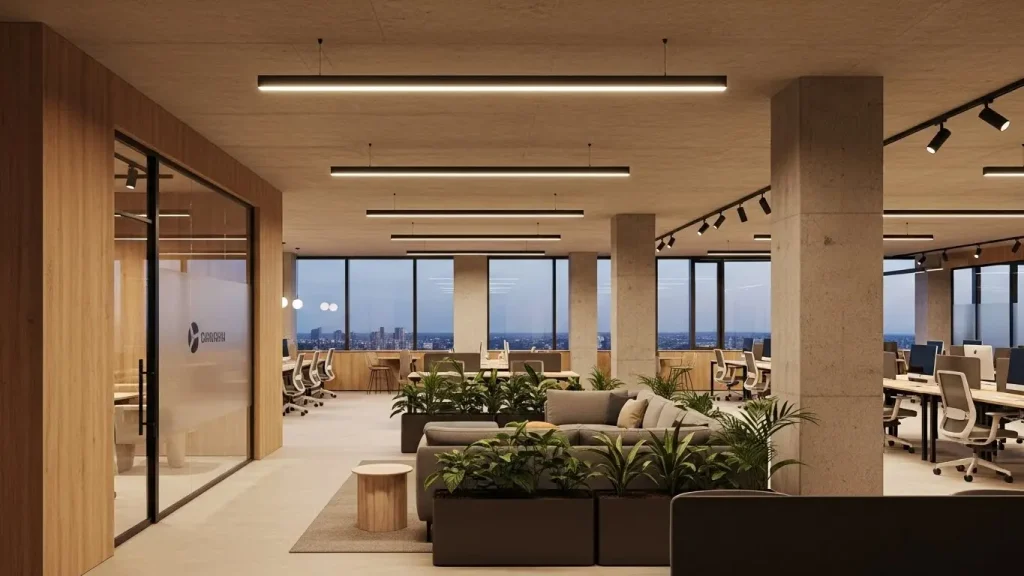
This guide will walk you step by step through how to choose the best sustainable commercial lighting system—from defining what “sustainable” really means, to evaluating products, suppliers, and long-term lifecycle performance.
Throughout the article, you’ll also find practical next steps, such as where to download a full product catalog, how to review project references, and how to talk directly with our engineering team about your own projects.
1. What Is “Sustainable Commercial Lighting”—and Why Does It Matter?
Before you select fixtures, controls, or suppliers, you need a clear definition of sustainable commercial lighting.
1.1 Core Definition and Principles
A sustainable commercial lighting system is one that:
- Minimizes energy consumption
- Uses high-efficacy LED light sources (high lumens per watt).
- Reduces wasted light through precise optical control.
- Maximizes lifetime and reduces maintenance
- Long LED life (typically L80 or L90 at 50,000–100,000 hours).
- Robust drivers and thermal management.
- Uses environmentally responsible materials
- Low-impact housing and optics.
- Reduced hazardous substances and recyclable materials.
- Supports smart control and real-time optimization
- Sensors, dimming, daylight harvesting, and scheduling.
- Minimizes light pollution and visual discomfort
- Proper beam control, low glare (UGR), and appropriate illuminance levels.
Sustainability is not just about “using LED”. It’s about systems thinking: optics, electronics, mechanics, control, and long-term operation working together.
1.2 Business and Environmental Value
A well-designed sustainable lighting system delivers measurable benefits:
- Energy savings: Up to 50–80% reduction compared with legacy fluorescent, metal halide, or halogen lighting—especially when combined with smart controls.
- Lower operating costs: Fewer replacements, less labor, fewer disruptions.
- ESG and green building compliance: Supports LEED, BREEAM, WELL, and corporate carbon reduction targets.
- Improved user experience: Better visual comfort, higher productivity, and more attractive spaces.
If you want a structured document to evaluate your current site, you can ask our team for a Sustainable Lighting White Paper & Checklist via the contact form or directly email our engineers.
2. Key Components of a Sustainable Commercial Lighting System
To choose the right system, you must understand its core building blocks—light sources, optics, controls, materials, and standards.
2.1 LED Light Sources and Luminaires
In 2025, LED is the default choice for sustainable commercial lighting because it combines:
- High efficacy: Often 110–150 lm/W or higher for professional fixtures.
- Long life: L80/B10 at 50,000+ hours, sometimes 100,000 hours in carefully engineered systems.
- No mercury and reduced hazardous materials compared with fluorescent.
- Excellent controllability: Fully dimmable, rapid response, compatible with digital control protocols.
When evaluating LED luminaires, look beyond the marketing and ask for:
- System efficacy (lm/W), not just LED chip efficacy.
- Photometric files (IES/LDT) to analyze distributions.
- Lifetime data based on LM-80 / TM-21 or equivalent.
- Color rendering index (CRI) En R9 value.
- Kleurconsistentie (SDCM).
You can quickly compare options using a structured spec sheet. If you need a template, request a Sustainable Lighting Spec Sheet through Contact XHLUX.
2.2 Optical Design and Light Distribution Efficiency
A sustainable system doesn’t just emit light—it delivers it efficiently and precisely where it’s needed.
Good optical design:
- Reduces over-lighting and wasted energy
- Improves uniformity and visual comfort
- Allows you to use fewer fixtures with better performance
Important optical aspects:
- Straalhoek selection (narrow, medium, wide)
- Optics type: reflectors, lenses, wall-wash optics, batwing lenses for offices
- Shielding and cut-off: to control glare and light pollution
- Task vs ambient balance: using targeted task lighting to reduce overall ambient levels
For example, in a retail environment, using high-efficacy track lights with well-controlled 24° beams on merchandise can be more sustainable than flooding the entire store with uniform high lux levels.
2.3 Smart Controls, Sensors, and Automation
LEDs unlock the full potential of smart controls, which are crucial for sustainability:
- Occupancy sensors: Turn lights on only when areas are in use.
- Daylight sensors: Reduce artificial light when natural daylight is available.
- Time scheduling: Different lighting levels for work hours, cleaning, or night.
- Scene control: Multiple presets for presentation, cleaning, reception, or energy-saving modes.
Common control technologies:
- DALI / DALI-2 – robust, widely used in professional buildings.
- 0–10V dimming – simple analogue control, still very common.
- Wireless controls (e.g., BLE, Casambi) – more flexible for retrofits and complex spaces.
A truly sustainable system is designed from day one with these controls integrated—not as an afterthought.
If you’re considering advanced control for offices, hotels, or retail, you can explore our lighting solution pages or request a control strategy proposal via the contact form【broken】.
2.4 Materials, Construction, and Recyclability
Sustainability also concerns how fixtures are built and what happens at end of life.
Consider:
Housing material:
- High-quality aluminum for thermal performance and recyclability.
- Reduced plastics, or recyclable plastics where possible.
Modularity:
- Replaceable LED modules and drivers instead of throwing away the entire fixture.
- Field-serviceable parts reduce waste and long-term cost.
Packaging:
- Optimized shipping volume to reduce logistics emissions.
- Recyclable or minimal packaging materials.
Lightweight, durable, and modular fixtures are more sustainable over the entire lifecycle than “cheap and disposable” products.
2.5 Certifications, Standards, and Compliance
A sustainable commercial lighting system should align with:
- Safety standards – e.g. CE, CB, UL, ENEC
- Performance standards – LM-80, TM-21, IEC photometric standards
- Energy/eco regulations – ERP, RoHS, local energy code compliance
- Green building frameworks – LEED, BREEAM, WELL, local green building schemes
Checking these helps you filter out non-professional suppliers and de-risk large projects.
To see what a professional documentation package looks like (photometry, compliance, test reports), you can review XHLUX project references or talk directly with us on WhatsApp.
3. Scenario-Based Sustainable System Design (By Commercial Application)
Different commercial spaces have very different lighting needs. Below is a practical overview of how to design a sustainable system by application.
3.1 Office Buildings and Workplaces
Typical system:
- LED linear fixtures
- Recessed panel lights or low-UGR downlights
- Task lighting where needed
- DALI or wireless dimming + presence and daylight sensors
Sustainability priorities:
- High efficacy linear luminaires
- UGR < 19 for visual comfort
- CCT 3500–4000K for focused work
- Daylight harvesting near windows
3.2 Retail and Shopping Malls
Typical system:
- LED track lights for merchandise
- Downlights for ambient
- Feature lighting for displays and window fronts
- Scene control for different times (day/evening/promotion)
Sustainability priorities:
- High CRI (≥90, often 95+) to reduce the need for excessive light levels
- Precise photometry to avoid lighting empty areas
- Use of targeted accent light to reduce overall ambient lux
- Smart scheduling and dimming outside peak hours
3.3 Warehouses and Logistics Centers
Typical system:
- High-bay LED luminaires or UFO LED fixtures
- Aisle optics
- High-mount occupancy sensors
Sustainability priorities:
- Very high efficacy (e.g. 140–160 lm/W)
- Long service life (often running 16–24 hours per day)
- Occupancy and daylight-dependent control
- Robust housing and thermal design
3.4 Public Buildings, Corridors, and Lobbies
Typical system:
- Recessed downlights
- Linear lights for continuous lines
- Cove lights for ambience
Sustainability priorities:
- Appropriate illuminance levels, not over-lighting
- Time-based dimming in off-peak hours
- Low maintenance, easy access
3.5 Hotels and Hospitality
Typical system:
- High-CRI downlights
- Decorative pendants
- Linear and cove lighting
- Tunable white in guest rooms or wellness areas
Sustainability priorities:
- Balancing luxury ambience with energy use
- Using Warm Dim or tunable white with efficient LED engines
- Intelligent scenes (check-in, night, cleaning, event)
If you’d like ready-to-use example layouts for these scenarios, you can request the “5 Typical Commercial Lighting Schemes PDF” from our team via the lighting solutions page or by emailing us.
4. How to Evaluate Products and Suppliers for Sustainability
Choosing fixtures is one thing. Choosing the right partner is another. This section gives you a practical evaluation framework.
4.1 Product Performance Metrics
When evaluating products, always ask for:
- Luminous efficacy (lm/W)
- Rated lifetime and test basis (LM-80/TM-21)
- CRI and R9 values
- Color temperature options and SDCM (color consistency)
- UGR performance for office and education applications
- Dimming and control compatibility (DALI/0–10V/wireless)
- Photometric files (IES/LDT) for simulation
4.2 Sustainability & Control Capabilities
Ask:
- Does the system support presence sensing En daylight harvesting?
- Are drivers compatible with your chosen control protocol?
- Can you integrate BMS (Building Management System) or cloud analytics?
A system that cannot be properly controlled will never achieve its full energy-saving potential.
4.3 Materials, Packaging, and Serviceability
Your questions might include:
- Are the LED modules and drivers replaceable?
- How is the fixture designed for heat dissipation?
- What materials are used in housings and optics?
- Is the packaging optimized and recyclable?
4.4 Documentation and Data
A serious, sustainability-driven manufacturer will provide:
- Detailed datasheets
- IES/LDT files
- LM-80/TM-21 lifetime data
- Compliance and certification reports
- Installation guides and wiring diagrams
You can see examples of full documentation bundles by checking the XHLUX product catalog En project pages.
4.5 Supplier Stability and Support
Important questions for long-term projects:
- How many years has the company been focused on commercial lighting?
- Do they have references in your region or segment?
- What is the warranty period (typically 3–5 years for professional LED)?
- How fast do they respond to technical questions?
- Are they a true manufacturer or a trading company without engineering depth?
For a structured approach, many buyers use a Supplier & Product Sustainability Evaluation Checklist.
You can request an editable version by contacting us via the Neem contact met ons op page or by chatting directly on WhatsApp.
5. Common Pitfalls: How to Avoid “Fake Sustainability”
Even today, many products are marketed as “eco-friendly” or “green” but fail basic sustainability criteria. Here are frequent mistakes and how to avoid them.
5.1 Focusing Only on Low Wattage, Ignoring Lighting Quality
Using very low-wattage fixtures without considering:
- Uniformity
- Glare
- CRI
- Correct illuminance
…can lead to poor visual environments, eye strain, and complaints—even if the calculated energy use looks low.
Solution: Always balance efficacy (lm/W) with proper lighting design and standards.
5.2 Ignoring Lifetime and Maintenance
A cheap fixture that fails after 2–3 years is never sustainable:
- More waste
- More labor cost
- More logistics emissions
Solution: Prioritize proven lifetime performance, robust heat management, quality drivers, and long warranties.
5.3 Not Considering Materials and End-of-Life
Green lighting is not only about energy—it’s also about materials and disposal.
Solution: Look for:
- Durable extruded aluminum bodies
- Reduced hazardous substances
- Clear end-of-life or recycling policies
5.4 Buying Non-Controllable Fixtures
If your luminaires cannot dim, you lose a huge part of potential savings.
Solution: Specify fixtures with at least 0–10V or DALI dimming, and consider wireless control in retrofit projects.
5.5 Ignoring Daylight and Layout
Even efficient fixtures can be used inefficiently if:
- They’re placed in the wrong positions
- They are not zoned
- They ignore available daylight
Solution: Integrate lighting design met daylighting strategy, and validate using a simulation tool like Dialux or Relux.
If you’re unsure whether your current concept is truly sustainable, our engineering team can review it and provide suggestions—simply send your layout and requirements or email us directly.
6. Why Choose XHLUX for Sustainable Commercial Lighting
If you are a lighting brand, wholesaler, contractor, or project developer looking for a long-term sustainable lighting partner, here is how XHLUX positions itself.
6.1 High-Efficacy, Long-Life Commercial LED Portfolio
- Track lights, downlights, linear systems, and smart-ready fixtures.
- Engineered for commercial use: offices, retail, hospitality, galleries, and more.
- Focus on high lm/W, optimized optics, and excellent thermal performance.
You can see the full portfolio in the XHLUX Product Catalog.
6.2 Smart Control Integration (DALI / 0–10V / Casambi)
- Control-ready drivers
- Support for multi-scene control, presence sensing, and daylight harvesting
- Guidance on designing energy-optimized control strategies
Explore typical control solutions on our Lighting Solutions pages.
6.3 Environmentally Conscious Design and ODM Capability
- Modular systems that reduce waste over the product lifecycle
ODM support for:
- Custom optics
- Custom CCT/CRI combinations
- Mechanical and aesthetic variations
- Ability to align with your brand’s sustainability strategy as an OEM partner
Learn more about who we are and our manufacturing background on the About XHLUX page.
6.4 Full Engineering Support and Project Experience
We offer:
- IES/LDT files
- 3D models
- Dialux/Relux simulation support
- On-site or remote design consultation
- After-sales and technical training
You can review selected applications on the Project Reference page and then discuss your specific needs via WhatsApp or Neem contact met ons op.
7. FAQ About Sustainable Commercial Lighting
Q1: What is sustainable commercial lighting?
It’s a lighting system that balances energy efficiency, lifetime, material impact, visual comfort, and controllability over the entire lifecycle of a commercial building.
Q2: Is LED always the most sustainable option?
In almost all commercial scenarios, well-designed LED systems are more sustainable than legacy technologies, especially when combined with intelligent controls and quality components.
Q3: How much can I realistically save by upgrading to a sustainable lighting system?
Typical retrofit scenarios:
| Scenario | Energy Saving vs Old System |
|---|---|
| T8 Fluorescent → Standard LED | ~40–50% |
| T8 Fluorescent → High-efficacy LED + controls | ~60–70% |
| Metal Halide High-Bay → LED High-Bay + sensors | ~60–80% |
Actual results depend on operating hours, control strategy, and fixture selection.
Q4: Do I need smart controls to be considered “sustainable”?
Strictly speaking, yes.
LED alone is a huge first step, but without scheduling, dimming, or sensors, you are leaving a lot of potential savings unused.
Q5: Are sustainable systems worth the higher upfront cost?
For most commercial projects, the payback period is often between 1.5–4 years, depending on energy prices and operating hours. After that, the system continues to save money every year.
If you’d like a rough payback calculation based on your building, you can send us your basic project data or chat via WhatsApp.
Q6: How can I evaluate whether a supplier is truly serious about sustainability?
Look for:
- Transparent data (efficacy, lifetime, CRI, SDCM)
- Clear certifications
- Real project references
- ODM/engineering capabilities rather than pure trading
- Willingness to provide simulation support and lifecycle guidance
You can request a Supplier Evaluation Checklist in Excel format from us via Email.
8. Conclusion
Choosing a sustainable commercial lighting system is not just a technical decision—it is a strategic business decision.
The right system helps you:
- Reduce operating cost year after year
- Support ESG and green building goals
- Improve the experience of occupants and customers
- Strengthen your brand and project portfolio
- Future-proof your buildings for upcoming regulations
The key is to think in systems:
LED quality + optical design + intelligent control + robust materials + reliable supplier.
If you’re planning a new project or considering a retrofit, now is the best moment to design sustainability in from the start.