XHLUX
XHLUX
A track lamp fits only when its adapter matches the rail mechanically and electrically. A familiar product name, similar housing or shared colour does not prove compatibility.
Use this guide before ordering replacement heads or adding another supplier to an existing project. If the rail family itself is still undecided, begin with the Track Lighting Systems Guide: Types, Parts & How to Choose.
For a complete rail, feed, connector and head package, use the Track Light Kit Buying Guide: 6 Checks Before You Buy.
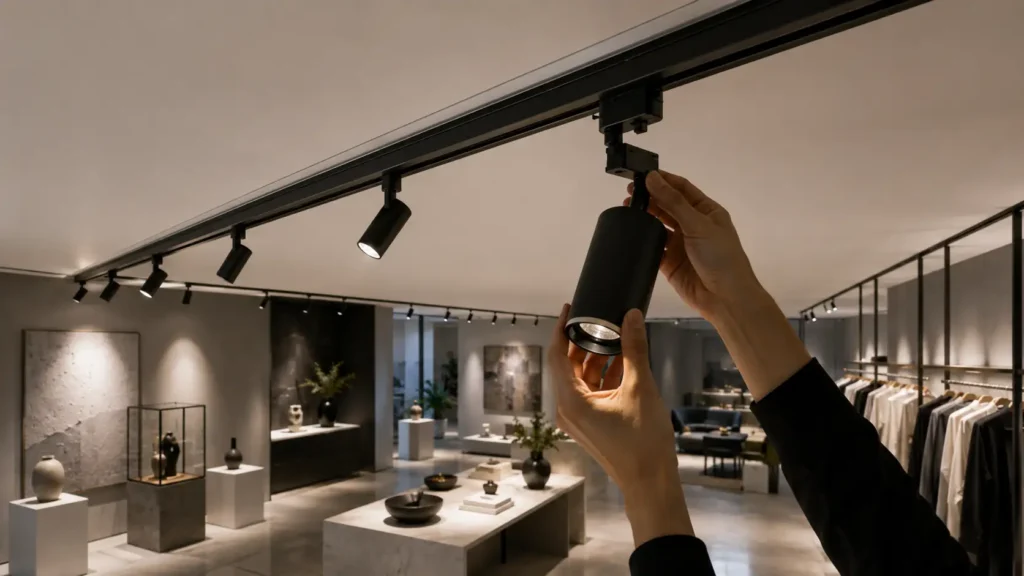
TL;DR: Name is not compatibility. Match the exact rail family, adapter profile, contacts, voltage, circuit arrangement, load and control method first. Check beam and LED performance only after the head can safely connect and operate on that rail.
1. Treat “track lamp” as a product label, not a fit standard
Suppliers use track lamp, track head, track fixture and track spotlight with different levels of precision. The terms may describe an integrated LED luminaire, a holder for a replaceable lamp, or the visible head plus its adapter.
That variation in track lighting fixture terminology does not create a universal interface. The purchase order needs catalogue codes, not only a generic noun.
Ask the supplier to identify these parts separately:
- Luminaire head or body
- LED module or replaceable light source
- Driver and control interface
- Track adapter
- Compatible rail family
- Required accessories
The available track lamp head types can include spot, flood, wall-wash, zoomable, linear and pendant forms. Head type describes the lighting duty; it does not prove that the adapter fits the installed rail.
🎯 Does the name “track lamp” prove fit?
No. Only the exact adapter and rail documentation can establish compatibility.
2. Identify the rail family before comparing lamp heads
Start with the rail, not the desired lamp appearance. Photograph the end profile, label, live end, connector and an existing adapter before requesting a replacement.
Traditional North American line-voltage systems commonly use H-, J- or L-type descriptions. Juno’s current track documentation states that these types differ in wiring and bus-bar shape, and it offers particular luminaires with separately ordered adapter variants.
Those letters are not a worldwide compatibility language. Commercial three-circuit rails, 48 V magnetic rails and proprietary systems can use entirely different profiles and contact arrangements.
A commercial track lighting system schedule should therefore identify:
| Item to record | Evidence to request | Why it matters |
|---|---|---|
| Manufacturer and rail series | Label, drawing or catalogue code | Similar-looking profiles may belong to different systems |
| Nominal voltage | Rail and power-supply data | A low-voltage module cannot be assumed to accept line voltage |
| Circuit arrangement | One-circuit, multi-circuit or addressable system | The adapter contacts and controls must match |
| Physical profile | Dimensioned cross-section | Width alone does not show slot and bus-bar geometry |
| Existing accessories | Feed and connector codes | These often reveal the actual family and polarity |
Do not identify a rail from finish or external width alone. Openings, keyways and internal conductors carry the useful evidence.
🎯 What should be identified first?
Identify the rail manufacturer, series, voltage, circuit arrangement and profile before the head.
3. Match the adapter profile, contacts and locking method
The track rail attachment mechanism has two jobs: retain the luminaire mechanically and connect it to the correct conductors. Both must work in the intended orientation.
An adapter may use a twist lock, lever, tab, clip or magnetic retention. Its contacts may be fixed, movable or selected for a particular circuit. A head that enters the slot but cannot lock is not “nearly compatible.”
Use a dimensioned adapter drawing and rail cross-section to check:
- Key and slot orientation
- Contact number, position and travel
- Protective-earth or grounding contact where required
- Polarity feature
- Mechanical latch and release method
- Permitted insertion direction
- Adapter load and luminaire weight limit
Signify’s current Lightolier documentation, for example, describes polarized track and model-specific locking features. Its track-head specifications also offer separate adapter codes for named rail families. That is the level of specificity a mixed-supplier order requires.
🎯 Is insertion into the slot enough?
No. The adapter must lock correctly and contact only the intended conductors.
4. Verify voltage, circuit selection and polarity
Mechanical engagement does not prove electrical compatibility. The lamp and adapter must be rated for the rail voltage and intended supply architecture.
Check whether the rail is:
- Line-voltage AC
- Low-voltage DC with a remote supply
- One-circuit or multi-circuit
- DALI or another addressable control variant
- A proprietary combined power-and-data system
For a multi-circuit adapter, confirm how the circuit is selected and whether the contact can reach only the intended bus bar. For a low-voltage system, confirm polarity and the permitted power-supply family.
IEC 60570:2003+A1:2017+A2:2019 covers electrical supply track systems for luminaires within its stated scope. It is a safety framework, not a declaration that any two products assessed to the standard are interchangeable.
The strongest track rail compatibility evidence is a manufacturer compatibility table or an explicit written statement naming both catalogue families.
🎯 Does a shared voltage prove compatibility?
No. Voltage can match while the profile, contacts, circuit selection or polarity remain incompatible.
5. Check load, driver, dimming and control together
A compatible adapter can still be paired with the wrong electrical load or control method. Record the exact input power and driver configuration for every head.
Check these project limits:
| Check | Pass evidence | Typical failure signal |
|---|---|---|
| Rail and feed rating | Exact system datasheet | Too many heads or an overloaded branch |
| Adapter rating | Adapter schedule | Heating or damaged contacts |
| Driver input | Exact luminaire code | Failure to start or unstable operation |
| Dimming method | Published compatibility data | Flicker, dropout or limited dimming range |
| Inrush current | Driver data and protective-device review | Nuisance tripping at switch-on |
| Control protocol | Matching driver, adapter and controller | Head powers on but cannot join the intended zone |
Do not multiply nominal wattage and stop there. A circuit review also needs connector limits, inrush, protective devices, control zoning and applicable local rules.
The phrase track lamp LED may appear in a marketplace listing, but it does not reveal whether the driver is phase-cut, 0-10 V, DALI, constant-voltage or integrated into a proprietary low-voltage system.
🎯 Can the right adapter still perform badly?
Yes. Driver, dimmer, inrush and control mismatches can remain after the mechanical fit is solved.
6. Separate rail fit from optical performance
Compatibility gets the head onto the rail. It does not prove that the light reaches the target correctly.
The track lamp beam angle must be checked for the exact optic, CCT and CRI configuration. Also request fixture lumens, intensity distribution, aiming limits and an IES or LDT file where available.
Evaluate rail fit and lighting performance as two approval gates:
- System gate: rail, adapter, contacts, voltage, load and controls match.
- Lighting gate: output, beam, glare, colour quality and aiming suit the target.
Juno’s current product guide demonstrates this separation clearly: adapter type and optical distribution are distinct ordering fields. Changing one does not automatically validate the other.
🎯 Does rail compatibility prove the beam is right?
No. Mechanical and electrical fit must pass before a separate photometric review.
7. Approve catalogue codes, not visual similarity
Before purchase, issue one compatibility schedule that pairs each luminaire code with its adapter and rail.
Record:
- Rail manufacturer, family and profile code
- Feed, connector and circuit arrangement
- Adapter code, contact layout and locking method
- Luminaire code, weight and input power
- Driver, dimming and control protocol
- Optic, beam, CCT, CRI and photometric file
- Applicable certification and installation instructions
For an existing installation, test one sample head on an isolated and correctly commissioned rail before approving a volume order. The test should confirm locking, retention, circuit selection, dimming and intended aiming.
Reject substitutions that say only “H compatible,” “universal” or “fits standard track” without identifying the exact tested rail and adapter families. Universal is a claim to verify, not a system type.
🎯 What should appear on the purchase order?
List the exact rail, adapter, luminaire, driver, optic and control codes as one approved combination.
What to do next
Photograph the installed rail label, profile, feed and one existing adapter. Add the project voltage, circuit arrangement, control method and target schedule.
Send that evidence with the requested head quantity and optics. If XHLUX is evaluating a mixed-supplier project, ask for written confirmation of the exact rail-and-adapter pairing before a sample or production order is released.
Notes & Sources
- IEC 60570:2003+A1:2017+A2:2019, Electrical supply track systems for luminaires.
- IEC 60598-1, Luminaires, Part 1: General requirements and tests.
- Juno Lighting, Track Lighting Guide and current track-fixture compatibility documentation.
- Signify Lightolier, Basic Track System and current track-head specification sheets.
- External standards and manufacturer documents are named for verification but intentionally not hyperlinked.