 XHLUX
XHLUX
Table of Contents
- How to Choose Twin Head Recessed LED Spotlights for Retail Shops
- 1 Why Retail Shops Are Switching to Twin Head Recessed LED Spotlights
- 2 What “Twin Head Recessed LED Spotlight” Really Means
- 3) Why Twin Head Is Especially Effective in Retail Shops
- 4 Twin Head vs Single Head: The Real Decision Logic (Not the Unit Price)
- 5 Spec That Actually Matters (Retail-Grade, Engineering-First)
- 5.1 Color quality (don’t compromise if you sell products)
- 5.2 Beam angles (how you avoid “flat store syndrome”)
- 5.3 Glare control (the comfort layer that protects premium perception)
- 5.4 Efficiency and lifetime (because stores run long hours)
- 5.5 Thermal and materials (what separates project fixtures from commodity)
- 5.6 Dimming & control (where projects win or fail)
- 6 “Good” Twin Head Recessed Spotlight Checklist
- 7 Common Design Mistakes (And How to Avoid Them)
- 8 Data Tables & Mini “Charts”
- 9 Twin Head Recessed Spotlights by Retail Type
- 10 Contractor Sourcing: How Wholesale Buyers Think
- 11 OEM / ODM + SKD: When Projects Need More Than a Catalog Item
- 12 Comparison Table (Twin Head Recessed vs Alternatives)
- 13 FAQ About Twin head recessed LED spotlight
- Conclusion
- Welcome to collaborate.
How to Choose Twin Head Recessed LED Spotlights for Retail Shops
Retail lighting fails in a very predictable way: you either get a “bright store” that doesn’t sell, or a “beautiful mood” that hides the merchandise. Twin head recessed LED spotlights (also called dual-head / double gimbal recessed spotlights) are one of the cleanest ways to fix both—more controllable accent light with fewer ceiling cutouts—but only if you spec and place them correctly.
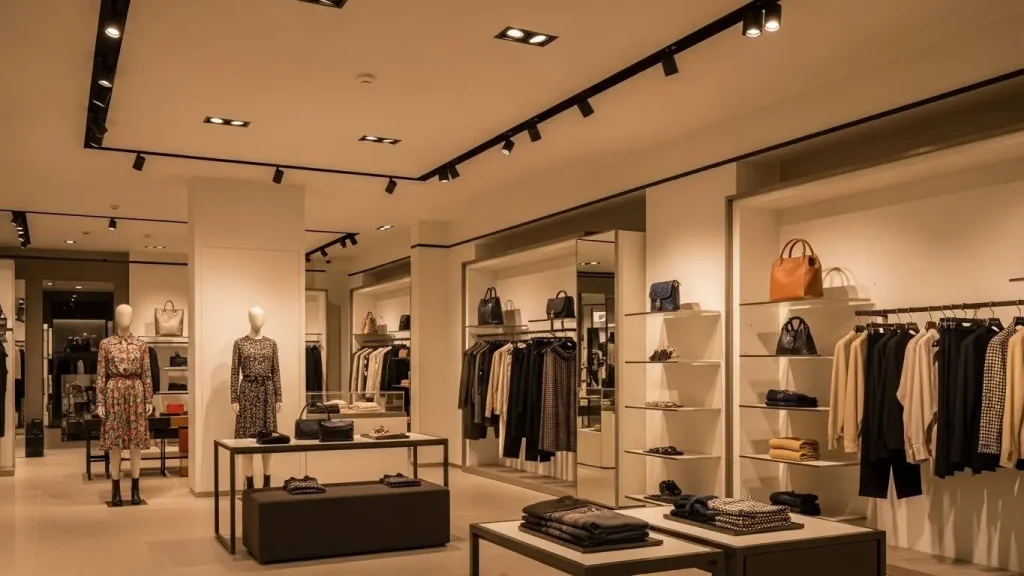
This guide breaks down where twin head recessed spotlights actually work, how to choose beam angles / glare control / CRI / dimming, how to avoid common mistakes, and how contractors source them for repeatable rollouts—with practical checklists, decision tables, and quick “math you can use.”
1 Why Retail Shops Are Switching to Twin Head Recessed LED Spotlights
Modern retail lighting is not “general illumination.” It’s visual merchandising: guiding attention, shaping perceived quality, and making products “read” correctly from 2–8 meters away.
A key principle from retail lighting practice is that accent light must be noticeably brighter than ambient to create hierarchy (so merchandise stands out rather than blending into a uniformly lit room). Retail recommended practice discussions often cite accent-to-ambient contrast targets (e.g., commonly referenced ratios like ~3:1 to 5:1 depending on merchandise and concept).
Why single-head recessed spots hit limits
Single-head recessed spots can work, but they create three typical problems in stores:
- Too many cutouts → ceiling looks busy, higher labor, more coordination with HVAC/sprinklers.
- Coverage not flexible → one head can’t “split the task” (wall + table, mannequin + signage, etc.).
- Re-merchandising pain → every layout change triggers re-aiming across many fixtures.
What twin head recessed spots do better
A twin head recessed spotlight is essentially two independently aimable light engines in one recessed housing:
- One cutout, two aim points
- Higher “accent density” per ceiling opening
- Cleaner ceiling aesthetic for premium brands
- Better for repeatable store prototypes (rollout designs)
In retail terms: it’s a high-efficiency merchandising tool, not a basic downlight.
2 What “Twin Head Recessed LED Spotlight” Really Means
A true retail-grade twin head recessed spotlight usually has:
- Two gimbal heads with independent aiming (tilt + rotate)
- Replaceable / selectable optics (10° / 15° / 24° / 36° / 45–60°)
- Glare control architecture (deep baffle, black reflector, honeycomb/louver options)
- High color quality: CRI ≥ 90 is the baseline for most retail; CRI 95/97 for luxury, cosmetics, art-like displays (CRI concept reference).
- Tight color consistency: SDCM < 3 (often written as 3-step MacAdam) for clean multi-fixture uniformity
If the two heads cannot be aimed independently, or the optics are “one-size-fits-all,” you’re basically buying two small lamps in a box, not a merchandising fixture.
3) Why Twin Head Is Especially Effective in Retail Shops
Retail environments share constraints:
- Dense product zones
- Frequent display changes
- Limited ceiling real estate
- High expectations on product appearance
Twin head recessed fixtures excel because they let you:
- Split one ceiling position into two merchandise targets
- Keep walls, mannequins, and feature tables “alive” without doubling cutouts
- Maintain a clean “architectural” ceiling (important for high-end boutiques)
Where you feel the payoff fastest (common placements)
- Wall bays + aisle edge: one head grazes/accents the wall; one head highlights the pathway or feature.
- Mannequin + signage: one head tight beam for mannequin; second head medium beam for branding wall.
- Island displays: two heads cover two product groupings from one cutout.
- Transition zones: highlight the “story points” (hero product + texture wall).
4 Twin Head vs Single Head: The Real Decision Logic (Not the Unit Price)
Retail procurement fails when teams compare fixture price but ignore installed system cost.
Quick comparison table (decision-friendly)
| Metric | Single Head Recessed Spot | Twin Head Recessed Spot |
|---|---|---|
| Ceiling cutouts | More | Fewer |
| Aiming flexibility per cutout | Low | High (two aim points) |
| Rollout repeatability | Medium | High |
| Labor (per delivered accent point) | Higher | Lower |
| Best use | Simple layouts | Merchandising-heavy zones |
A simple “installed cost” lens
Even if a twin head costs more per unit, it can reduce:
- cutout quantity
- wiring points
- install time
- coordination complexity
Result: the system can be cheaper or at least more controllable.
5 Spec That Actually Matters (Retail-Grade, Engineering-First)
Below is a project-proven spec stack that keeps performance predictable.
5.1 Color quality (don’t compromise if you sell products)
- CRI ≥ 90 (baseline retail)
- CRI 95 / CRI 97 for luxury, cosmetics, jewelry, premium fashion, and brand flagships
- SDCM < 3 for consistent “white” and product tones across the store (multi-head / multi-fixture)
Why it matters: poor color quality makes products look cheaper and inconsistent across zones, especially with mixed materials.
5.2 Beam angles (how you avoid “flat store syndrome”)
Use optics to create hierarchy:
- 10°–15°: hero items, mannequins, logo walls, feature pods
- 24°–36°: standard shelf/table merchandising
- 45°–60°: background fill, broader feature areas (use carefully to avoid spill)
5.3 Glare control (the comfort layer that protects premium perception)
Retail needs bright accents, but glare kills dwell time.
- Target: UGR < 19 where applicable for comfort expectations (especially mixed retail/office front-of-house zones).
- Preferred hardware: deep baffle, dark anti-glare reflector, optional honeycomb/louver, proper cutoff
5.4 Efficiency and lifetime (because stores run long hours)
- Practical efficiency band for quality accent fixtures: 100–130 lm/W (depending on optics and CRI level)
- Lifetime target: L70/B50 50,000 hours (for predictable maintenance planning)
5.5 Thermal and materials (what separates project fixtures from commodity)
Look for:
- Die-cast aluminum heatsink (stable thermal path)
- COB LED chip for clean beam and good focusing control
- PMMA lens (or equivalent optical-grade material) for consistent optics
5.6 Dimming & control (where projects win or fail)
- DALI / DALI-2: best for zoning, scenes, and multi-fixture consistency
- 0–10V: common commercial standard; workable for many rollouts
- TRIAC / phase-cut: retrofit-friendly, but needs careful driver compatibility
6 “Good” Twin Head Recessed Spotlight Checklist
Bring this into your vendor calls:
Mechanical & aiming
- Two heads independently aimable (tilt + rotate)
- Aiming holds position (no drift after months of vibration/heat cycles)
Optical performance
- Beam options (at least 15° / 24° / 36°)
- Clean beam edge (low stray light)
- Optional glare control accessory (honeycomb/louver)
Light quality
- CRI ≥ 90 minimum; CRI 95/97 available
- SDCM < 3 stated and controlled
Driver & control
- Flicker-safe dimming
- DALI / 0–10V / TRIAC options depending on project type
Documentation
- IES files / photometrics available for calculation and approval
- Installation guide and cutout drawings
Project realities
- Stable lead time
- Spare parts or replacement plan
- Warranty clarity (typical 3–5 years in commercial discussions)
7 Common Design Mistakes (And How to Avoid Them)
Mistake 1: Two heads aimed to overlap too much
Result: hot spot, uncomfortable brightness, wasted contrast.
Fix: use different optics per head (e.g., 15° + 36°) to create layered hierarchy.
Mistake 2: Ignoring glare because “it looks bright”
In retail, glare becomes fatigue. People leave sooner.
Fix: specify anti-glare architecture and check viewing angles at shopper eye level.
Mistake 3: Treating CRI90 and CRI97 as “almost the same”
For premium materials, cosmetics, or color-critical products, it’s not.
Fix: match CRI level to merchandise category (luxury/cosmetics → CRI95/97). (CRI definition context).
Mistake 4: Over-lighting everything
Accent loses meaning if everything is accented (a known pitfall in accent strategies).
Fix: plan hierarchy—hero zones, secondary zones, background zones.
8 Data Tables & Mini “Charts”
8.1 Beam angle selection map (retail-practical)
| Retail task | Recommended beam | Why |
|---|---|---|
| Logo wall / hero mannequin | 10°–15° | Crisp focal point, high contrast |
| Standard shelf / table display | 24°–36° | Balanced coverage, fewer hot spots |
| Background fill / broad feature area | 45°–60° | Softens contrast, supports ambience |
8.2 “How many fixtures do I need?” (rule-of-thumb planning)
A quick concept:
- If your design intent is accent-driven retail, plan accent points first, then add ambient support.
Simple planning heuristic (not a substitute for photometrics):
- 1 twin head recessed spotlight can often replace ~2 single-head accent points in merchandising zones (because it delivers two aimable heads per cutout).
8.3 SKU simplification effect (rollout benefit)
When you standardize on twin head + a few optics, you reduce SKUs:
Typical rollout SKU count (illustrative)
Fixed-angle approach:  12–18 SKUs  ████████████████
Twin-head + optics:     6–10 SKUs  █████████
Why this matters: fewer SKUs = fewer mistakes, fewer substitutions, faster maintenance.
9 Twin Head Recessed Spotlights by Retail Type
Fashion / apparel
- Needs texture rendering, fabric depth
- Recommended: CRI ≥ 90, strong contrast accents, glare control
Cosmetics
- Needs accurate skin tones and color consistency
- Recommended: CRI 95/97, tight SDCM, careful glare control
Jewelry / watches (high reflection risk)
- Needs bright sparkle but minimal glare
- Recommended: narrow beams + strong anti-glare accessories
Footwear / accessories
- Often vertical merchandising (walls) + tables
- Twin head is excellent for splitting targets from one cutout
Lifestyle / concept stores (frequent re-merch)
- Twin head improves adaptability; pair with scene control for seasonal shifts
10 Contractor Sourcing: How Wholesale Buyers Think
Contractors sourcing commercial lighting at wholesale aren’t “shopping.” They’re building a supply chain.
They typically prioritize:
- delivery reliability
- batch consistency
- documentation (IES, drawings, install guides)
- dimming/control compatibility
- warranty responsibility clarity
This is why many pros prefer project-capable manufacturers over random trading pipelines—because the hidden cost of instability is enormous.
11 OEM / ODM + SKD: When Projects Need More Than a Catalog Item
If you’re doing multi-store rollouts or region distribution, twin head recessed spotlights are often part of a broader package:
- track lighting for flexible merchandising
- linear lighting for ambient layers
- wall washing for brand architecture
For import-sensitive markets, SKD (Semi Knocked Down) shipment can reduce logistics cost and potentially optimize duty structure depending on local rules—but it must be planned correctly and declared properly (SKD is a logistics/compliance design, not a shortcut).
If you sell across multiple countries, OEM/ODM + SKD can be a competitive lever—especially when you want consistent optics, consistent driver options, and predictable production scale.
12 Comparison Table (Twin Head Recessed vs Alternatives)
| Option | Best for | Where it struggles |
|---|---|---|
| Twin head recessed spotlights | Merchandising density, clean ceilings, rollouts | Needs correct optics + glare control |
| Single head recessed spotlights | Simple layouts | Too many cutouts in high-merch zones |
| Track spotlights | Maximum flexibility, easy re-aim | Visible hardware; ceiling aesthetic differs |
| Linear ambient lighting | Uniform base layer | Doesn’t “sell” product alone |
13 FAQ About Twin head recessed LED spotlight
Q1: Are twin head recessed LED spotlights better than track lights for retail?
They’re different tools. Twin head recessed is ideal when you want a clean ceiling and high accent density. Track lights win when you need constant re-aiming and visible adjustability.
Q2: What CRI do I really need in a retail shop?
Most retail works with CRI ≥ 90, but luxury/cosmetics/jewelry and premium brand flagships often benefit from CRI 95–97 for more faithful color rendering (CRI concept reference). (energy.gov)
Q3: Will twin head fixtures cause more glare because they’re brighter?
They can—if glare control is ignored. Specify anti-glare optics and consider comfort metrics like UGR expectations in mixed-use zones. (LED Lighting Retrofit Services)
Q4: What beam angles should I stock for retail rollouts?
A practical set is 15° + 24° + 36°, plus optional 45–60° for broader fills. Keep it minimal to reduce SKU chaos.
Q5: Do I need DALI, or is 0–10V enough?
For multi-zone scene control and consistent dimming across many fixtures, DALI/DALI-2 is usually the more scalable architecture; 0–10V is common and workable for many projects.
Q6: How do I avoid “over-accenting” the entire store?
Build hierarchy: hero zones, secondary zones, and background zones. Accent-to-ambient contrast is a known retail technique, but accenting everything removes the visual effect. (Colorbeam Lighting)
Q7: What documents should a project-ready supplier provide?
At minimum: IES files, cutout drawings, wiring/dimming details, installation guidance, and a warranty statement.
Conclusion
Twin head recessed LED spotlights work best when you treat them as merchandising instruments:
- Use them to reduce ceiling clutter
- Create strong but controlled contrast
- Specify CRI (90–97), SDCM < 3, UGR-minded glare control, and proper optics
- Choose dimming/control that matches the project scale
- Standardize a small set of beams and options to improve rollout repeatability
If you want, I can turn your store plan into a simple “fixture schedule” (beam + wattage + CRI + control + quantity) and a sourcing-ready checklist for bids.
Welcome to collaborate.
If your goal is to build a reliable retail lighting package (recessed spots + track + linear + controls) with consistent specs, stable supply, and OEM/ODM flexibility—including SKD component options for duty/logistics planning—you can use these pages as your next step:
- Contact Page
- OEM Inquiry
- Project Consultation
- Download Catalog
- Explore related product lines: Spot Downlights, Track Lights, Zoomable Tracklights, Linear Lighting, and reference installs in Project Cases.
Fast next step: send a short message with your ceiling height, store type, preferred CCT (2700K/3000K/3500K/4000K), dimming type (DALI/0–10V/TRIAC), and 1–2 photos of the merchandising zones—then you can get a tighter beam/fixture recommendation without guesswork.