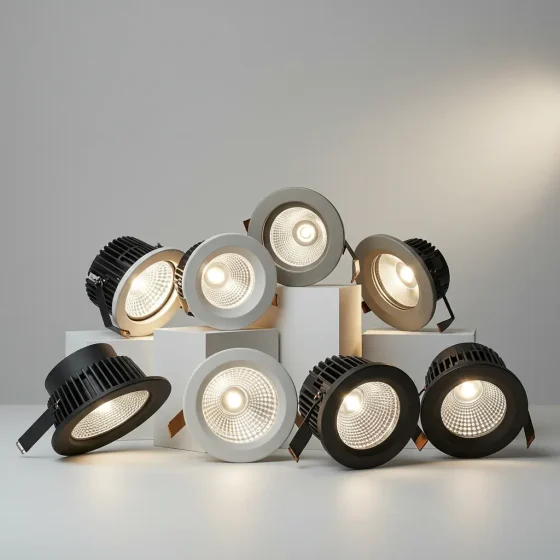
XHLUX
XHLUX
When precast planks form the ceiling, the plenum measures less than 30mm, or the heritage listing says no cutting, surface-mounted downlights are the working answer. You fix the body to the soffit face and aim the beam down without ever opening the void.
The form factor you pick decides how the room looks, how the beam spreads, and whether the installation meets the brief or fights it.
This page is a ceiling downlight type guide for the surface-mount family only. It covers five form factors, when each one fits, and the basic spacing rules that stop a surface layout from failing on site.
If the recessed versus surface decision is still open, route it on the installation methods overview first:
→ LED Downlight Installation Methods: Recessed vs Surface Mount vs Adjustable
Key Takeaways
– Surface discs give wide ambient beams (60°-120°) from a low-profile body and suit most corridor and office layouts.
– Cylinders add height and direction (15°-60° beam) for accent, task, and commercial-aesthetic applications.
– COB surface options deliver cleaner accent beam quality than multi-die SMD arrays, with CRI >90 on premium models and 50,000+ hour life.
– Space surface downlights at 1.6 to 2.0 times the mounting height. Wider ratio for discs; tighter for narrow-beam cylinders.
– Multi-head bars and surface gimbals solve the problem of coverage when a single fixed head is not enough.
Before you use this page
Have these on hand:
- Confirmed reason recess is not possible (concrete slab, shallow void, heritage rules, fire membrane restrictions)
- Room dimensions, ceiling height, and target light levels for the application
- Product datasheets for the form factors you are evaluating (beam angle, wattage, lumen output, dimensions)
- Approval on the visual height the surface fitting will project from the soffit (discs read shorter than cylinders)
Step-by-step install craft belongs on the surface-mount downlight installation guide. The downlights pre-order checklist handles depth, IP, and fire checks before ordering.
Disc (round low-profile): the default choice, general ambient, wide beam
The disc is the most common ceiling surface mounted led downlight form factor. It sits flat against the soffit with a low profile, typically projecting 25-50mm from the ceiling plane.
A disc uses an SMD LED array behind a wide optic to spread light evenly, not in a focused pool. Beam angles run 60° to 120°, which makes the disc a general ambient tool, not an accent tool.
Typical disc specifications:
| Disc diameter | Power range | Beam angle | Common application |
|---|---|---|---|
| 2.5″ (65mm) | 5-8W | 100-120° | Corridor, small office, utility |
| 4″ (100mm) | 10-15W | 90-120° | Office, reception, meeting room |
| 5″ (130mm)+ | 18-25W | 60-100° | Open plan, lobby, retail ambient |
The wide beam means fewer fittings for a given area compared to a narrow-beam cylinder. A 4″ disc at a 2.7m ceiling can cover about 4-5m of floor between centres, depending on the beam angle and target lux.
Specify a disc when the ceiling cannot be cut and the room needs uniform ambient light spread across a large area without visible glare from a tall body. Offices, corridors, open-plan work areas, and hospitality ambient layers fit this use case.
Surface mount downlight installation for discs is straightforward: mount to a listed junction box or base plate, splice supply conductors, and seat the body. The wide body diameter gives good access for wiring and driver placement.
A disc is not the right choice when you need a tight accent pool on a display or a directional beam for task lighting. Those jobs point toward cylinders or COB optics.
The disc is a surface mount ceiling light that answers the question “I need light everywhere, evenly, and the ceiling cannot be cut.” It does not try to be decorative or directional.
🎯 Best use for surface disc downlights?
Even ambient on no-recess ceilings where wide beam and low profile are the priority. Default for offices and corridors.
Cylinder: directional, more height, accent/task, commercial look
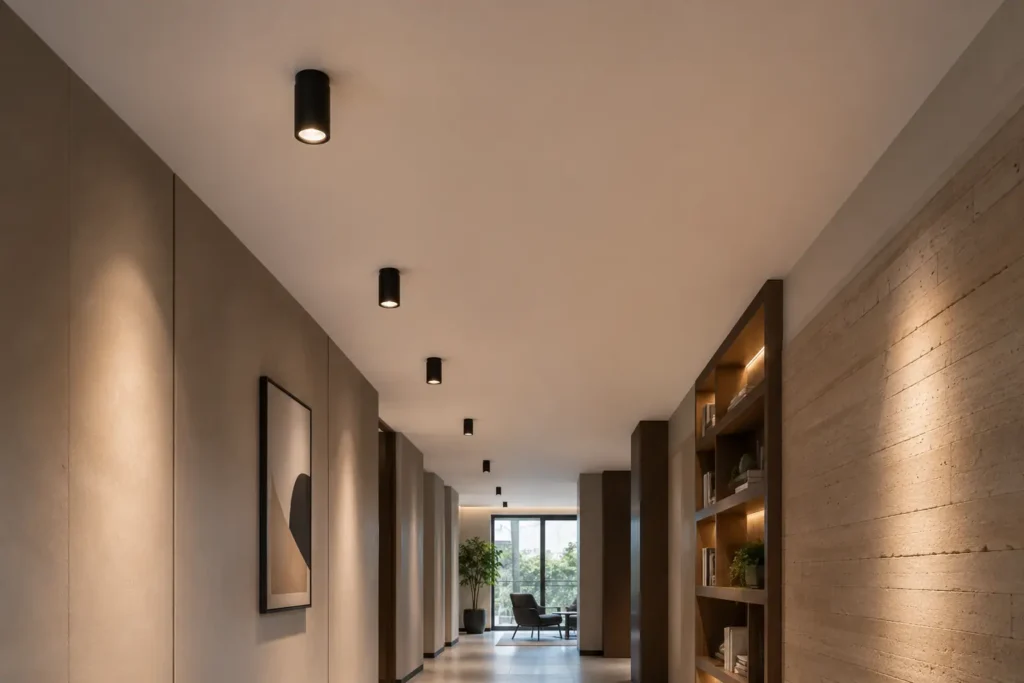
Where the disc spreads light wide, the cylinder throws it in a controlled direction. The body is taller and narrower, producing a more deliberate visual on the soffit.
Cylinder specifications span a wider range than discs because the form factor serves both accent and general lighting roles:
| Diameter | Height | Power range | Beam angle | Use case |
|---|---|---|---|---|
| 50mm | 70mm | 6-12W | 40-60° | Task, counter, display |
| 75mm | 110mm | 12-30W | 24-50° | Retail accent, feature lighting |
| 95mm | 162mm | 30-60W | 15-40° | High ceiling, long throw, accent |
The height of a cylinder (70-162mm) means it projects further from the ceiling plane than a disc. This is an acceptance decision: the body will read in sightlines and on photos. Get approval on the profile before ordering a bulk quantity.
Specify a cylinder when the job needs a directional beam. Retail displays, counter task lighting, feature walls at reception, and gallery accents all benefit from a cylinder’s narrower beam control.
A cylinder also reads as a more commercial, intentional aesthetic than a disc. Hospitality venues, boutique retail, and higher-end office zones often specify cylinders for visual weight even when the beam angle is relatively wide.
The narrowest cylinders (15°-24°) produce tight accent pools. At these beam angles, the spacing tightens and the number of fittings goes up compared to a disc layout. That is not a mistake: it is the cost of aimed light.
Cylinders often accept optional accessories such as honeycomb louvres, snoots, or spread lenses. Check the datasheet for accessory compatibility before the order if glare control or beam shaping is required.
For installation, cylinders share the same surface mount downlight installation pattern as discs: listed enclosure path, dead-circuit splice, and seated body. The taller body may require more careful torque to avoid a tilted mount.
🎯 When does a cylinder beat a disc?
When the job needs a directional beam for accent or task and the extra body height is acceptable on the soffit.
COB surface options: beam quality, uniform vs spotty, where COB wins
COB surface downlights combine a Chip-on-Board LED package with a soffit-mounted body. The single optical centre produces a cleaner beam than a multi-die SMD array of the same wattage class.
The difference shows on the target. A multi-die SMD disc can produce multiple shadows or a slightly uneven pool at close range. A COB source with the right reflector or TIR lens gives a single clean circle with a smooth centre-to-edge rolloff.
COB surface fixtures typically carry CRI >80 as standard and CRI >90 on premium models. The higher CRI matters for retail colour rendering, gallery lighting, and food displays where the surface colour of the object determines the sale.
Life rating runs 50,000+ hours at L70 for most commercial COB surface fixtures, matching SMD equivalents. Heat path is the critical variable: COB packs more source lumens per square millimetre, so the aluminum body and thermal interface must clear the rated ambient.
COB surface is not a separate mounting method. It is a surface downlight housing option with a specific source package.
| Characteristic | COB surface | SMD surface disc |
|---|---|---|
| Beam uniformity | Single clean pool | Multi-die array, may show multiple shadows |
| CRI | >80 standard, >90 premium | >80 typical |
| Life | 50,000+ hrs | 50,000+ hrs |
| Best use | Accent, display, feature | General ambient wash |
Specify COB surface when the job demands a clean accent beam and the ceiling cannot accept a recessed housing. Retail feature displays, museum cases, reception art, and hospitality focal points are common fits.
Do not specify COB for general ambient coverage across a large office. The narrow beam and higher cost per fitting make it the wrong tool. Partner a surface mounted led downlight COB accent layer with a separate ambient approach such as linear luminaires or wide-beam discs.
COB fixtures also need more careful heat planning than an SMD disc. Check the rated ambient (Ta) on the sheet against the real soffit temperature. A COB cylinder buried in a hot pocket will derate or fail earlier than its SMD equivalent.
🎯 Where does COB win in surface mount?
Accent and display where beam uniformity matters. COB produces a cleaner pool than multi-die SMD of the same wattage.
Spacing: basic rules for surface-mount (ceiling height, spacing ratio, beam overlap)
Surface-mounted downlights follow the same spacing logic as any ceiling-mounted luminaire. The mounting height sets the maximum distance between centres.
The general rule: space at 1.6 to 2.0 times the mounting height. Mounting height is the distance from the ceiling plane to the working plane (typically a desk at 0.75m or the floor for general circulation).
Example: a 2.7m ceiling with a 0.75m working plane gives a mounting height of 1.95m. At a 1.8 spacing ratio, the centre-to-centre distance is 3.5m for wide-beam discs. That same ceiling with narrow-beam COB cylinders at a 1.2-1.6 ratio would space closer, around 2.3-3.1m.
Beam angle determines which end of the ratio to use:
| Beam class | Typical angle | Spacing ratio | Notes |
|---|---|---|---|
| Wide ambient (disc) | 90-120° | 1.8-2.0× | Good beam overlap at wider spacing |
| Medium (cylinder) | 40-60° | 1.5-1.8× | Tighter grid for even coverage |
| Narrow accent (COB cylinder) | 15-40° | 1.2-1.6× | Spot overlap limited; aim for target, not floor fill |
Target light levels by application help confirm the spacing:
| Application | Target lux | Lumens per fitting (typical) | Spacing ratio |
|---|---|---|---|
| Office general | 300-500 | 1000-1500 lm | 1.6-1.8× height |
| Retail accent | 500-1000 | 2000-3000 lm | 1.2-1.6× height |
| Corridor | 150-200 | 800-1200 lm | 1.8-2.0× height |
Beam overlap matters for uniformity. At the recommended spacing ratios, the beam of one fitting should reach the centre line of the next fitting before the intensity drops below 50%. For wide-beam discs at 2.0× height, this overlap holds. For narrow cylinders at 1.2× height, the overlap is tighter but the accent pools separate deliberately.
Ceiling surface downlight spacing is not a substitute for a photometric layout. Use the ratios here as planning bands, then confirm against the product IES file and project light level targets.
Surface-mount layouts also need to clear obstructions. Beams, sprinkler heads, diffusers, and signage all block or redirect the light path. Adjust the grid to avoid these before the spacing calculation goes to the RCP.
🎯 What is the spacing rule for surface downlights?
Space at 1.6 to 2.0 times mounting height. Wider for discs; tighter for narrow-beam cylinders targeting accent pools.
Multi-head and adjustable: when one head isn’t enough, gimbal surface options
One fixed surface head per bay does not always provide enough coverage or aim flexibility. Two solutions exist: multi-head bars and surface gimbal downlights.
Multi-head surface bars place two, three, or four downlight heads on a single linear ceiling plate. Each head can often swivel and tilt independently. The bar replaces multiple single-point mounts with one electrical feed and one mounting pattern.
Use a multi-head bar when the room layout needs several closely spaced heads along a corridor, above a counter run, or over a display wall. The bar keeps the mounting points aligned and the wiring in one enclosure.
Surface gimbal downlights add tilt (usually 0-30°) and rotation (0-360°) to a cylinder or disc that mounts on the soffit. The gimbal ring allows the head to aim off-nadir while the base plate stays fixed.
Specify a surface gimbal when the target sits off the centre of the fitting axis. Retail displays, artwork, or task areas where the mounting point is offset from the target benefit from the adjustability. The gimbal does not change the mount family: the body still fixes to the soffit face.
| Option | Best for | Trade-off |
|---|---|---|
| Single fixed head | Even ambient, predictable layout | No aim adjustment |
| Multi-head bar | Linear runs, close-spaced heads | Fixed bar length; fewer layout options |
| Surface gimbal | Off-nadir aiming, accent flexibility | Taller profile; extra depth for tilt clearance |
Check the envelope of a surface gimbal at maximum tilt. The head may extend beyond the base plate footprint or increase the apparent body height. Factor that into the RCP clearance and soffit sightlines.
Multi-head bars and gimbals both follow the same surface mount downlight installation sequence: listed box or base plate, dead-circuit splice, body seat. The wiring cavity in gimbals is typically tighter, so check the sheet for wire bend radius and driver placement before installing.
A multi-head or gimbal surface fixture is still a no-recess ceiling downlight. It does not require a void or a cut-out. It only changes the number of heads or the aiming axis on the same surface-mount platform.
🎯 When to use multi-head or gimbal surface lights?
When a single fixed head cannot cover the area. Multi-head bars spread light; gimbals add tilt for off-nadir aiming.
FAQ
Notes on evidence
Form factor classification (disc, cylinder, COB) follows commercial lighting catalogues from major manufacturers. Specific dimension and wattage bands are typical ranges, not a universal standard.
Spacing ratios (1.6-2.0× mounting height) follow IES-recommended practice for ambient downlight layouts. Target lux levels for office (300-500 lux) and retail (500-1000 lux) follow common CIBSE and IES design targets. Always confirm against the project brief and the product IES file.
COB CRI ratings and life (50,000+ hrs at L70) are commonly published on COB manufacturer datasheets. Heat planning guidance follows industry practice for COB thermal management.
Beam angle bands listed for discs (60°-120°) and cylinders (15°-60°) are typical values from manufacturer spec sheets and are not guaranteed for every SKU. Cylinder beam angle ranges in the §2 table are grouped by physical size class (diameter/height), which is a different dimension from the accent ladder used on Directional Downlights (narrow 15-24°/medium 25-38°/wide 40-60° — grading optics inside accent/gimbal use). A “50mm cylinder at 40-60°” and a “wide 40-60° accent beam” share numbers but belong to different classification systems: one is a physical-size band, the other is an aiming-class band. They are not contradictory, but they are not the same scale.
Always override planning bands with the product photometric file, rated ambient, and the project lighting design.
What to Do Next
Route the mount family first if recessed versus surface is still open:
→ LED Downlight Installation Methods: Recessed vs Surface Mount vs Adjustable
For installation steps once the form factor is locked, refer to the surface-mount downlight installation guide.
To freeze cutout, depth, IP, and fire checks before ordering, use the downlights pre-order checklist.
You should now have the form factor you need for your no-recess ceiling. Take that decision to the datasheet, verify the beam and spacing on the IES file, then order a sample before rolling out the full layout.