 XHLUX
XHLUX
Table of Contents
- What Is Custom Commercial Lighting and Why Is It More Important Than Traditional Lighting?
- How to Choose Lighting Based on the Functional Space
- How to Select the Right LED Fixture Types
- Key Parameters That Determine Commercial Lighting Quality
- Energy Efficiency, Lifetime, and ROI Assessment
- Lighting and Brand Identity
- Why Choose Custom Commercial Lighting Over Standard Products?
- Final Summary
- Comparison Table: Commercial Lighting Fixture Types
- FAQ About Custom Commercial Lighting
- 1. What CRI level is recommended for commercial lighting?
- 2. What is UGR and why does it matter?
- 3. How long do LED fixtures typically last?
- 4. What control systems are compatible with commercial lighting?
- 5. How does beam angle affect lighting?
- 6. Can your lighting be customized for size and color?
- 7. Do you provide lighting design services?
- 8. How do I get pricing?
Commercial lighting plays a decisive role in shaping spatial experience, customer perception, work efficiency, and brand identity. In modern offices, retail stores, hotels, and industrial sites, lighting is no longer treated as a standalone component. Instead, it functions as part of an integrated system involving optics, fixtures, controls, architecture, and visual strategy.
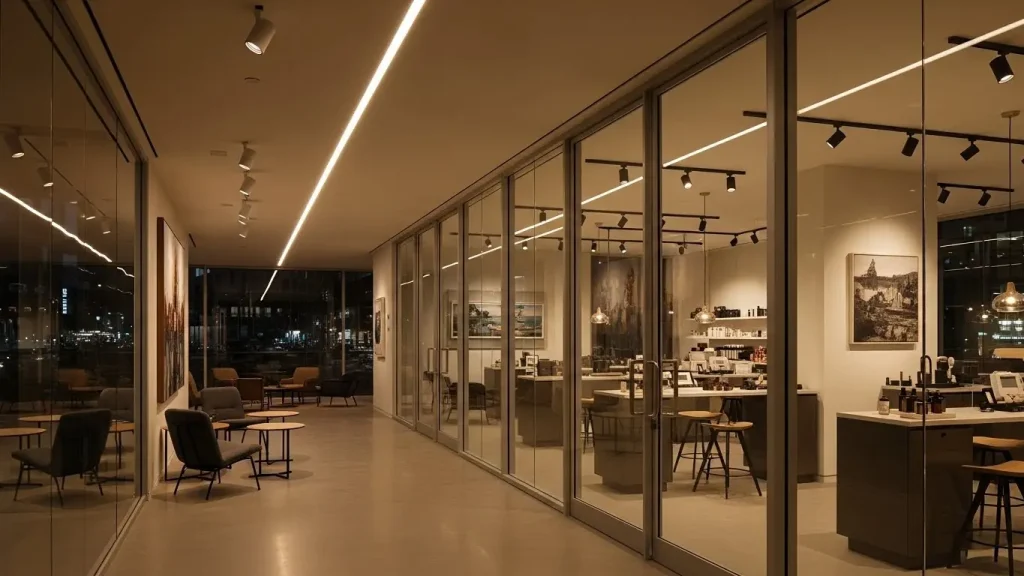
A lighting product alone cannot guarantee the desired effect. Beam angle, luminous flux, color rendering accuracy, color uniformity, installation method, and control protocol must work together as a cohesive solution. For this reason, choosing commercial lighting requires a systematic approach: understanding functional requirements, identifying technical parameters, evaluating light distribution, and selecting the right fixture families.
This guide provides a complete, engineer-level framework for selecting custom commercial lighting solutions, helping lighting designers, contractors, and wholesalers make precise, long-term decisions.
What Is Custom Commercial Lighting and Why Is It More Important Than Traditional Lighting?
Core Concept of Custom Commercial Lighting
Custom commercial lighting refers to lighting systems designed and optimized for a project’s unique functional and architectural requirements. Unlike generic consumer lamps, these solutions allow tailored adjustments in:
- Luminous flux and wattage
- Beam angle distribution
- Correlated color temperature (CCT)
- Color rendering index (CRI>90 or Ra97 options)
- Fixture dimensions and housing color
- Mounting methods (recessed, track, surface, suspended)
- Control protocols (0-10V, DALI-2, Bluetooth, wireless systems)
Commercial projects demand customization because they involve multiple zones—entrances, working areas, display shelves, circulation paths—each requiring distinct light levels and distributions. A one-size-fits-all lamp cannot support such varied needs.
Traditional Lighting vs Custom Lighting
Traditional lighting products typically suffer from:
- Fixed wattage and limited beam options
- Poor glare control
- Low color accuracy (CRI < 80)
- No smart control compatibility
- Outdated optical design
By contrast, commercial spaces are highly complex. Offices require UGR<19 lighting to meet EN12464-1 standards. Retail environments need high color fidelity and flexible aiming, such as LED track lights instead of static downlights. Hotels demand layered lighting for ambiance.
Thus, custom lighting becomes essential for visual performance and brand consistency.
Key Advantages of Custom Commercial Lighting
- Precise Functional Matching
Lighting levels match the exact needs of tasks, circulation, or merchandising. - Superior Visual and Emotional Experience
High CRI, SDCM<3 color consistency, and optimized optics enhance clarity and comfort. - Unified Brand Identity
Housing color, trims, beam quality, and lighting temperature stay consistent across all stores or properties. - Long-Term Cost Control
Efficiency of 100–130lm/W and L70/B50 50,000-hour lifetime drastically reduces energy and maintenance cost. - Flexible Upgrade and Expansion
Modular linear systems or LED track lights allow easy reconfiguration as space layouts evolve.
How to Choose Lighting Based on the Functional Space
Office Lighting – Comfort, Uniformity, and Low Glare
Office lighting must meet ergonomic standards to support productivity and minimize eye strain. Modern workspaces combine LED linear lights as primary illumination with anti-glare downlights for visual comfort.
Open Office Lighting Recommendations
- Achieve UGR<19 for visual comfort (EN12464-1 requirement)
- Use 4000K neutral white light
- Apply continuous linear lights with uniform spacing
- Integrate DALI-2 controls for dimming scenes
Recessed LED spot downlights with deep reflectors provide supplemental task areas without glare.
Retail & Showroom Lighting – Highlighting Merchandise
Why Track Lights Are Ideal for Retail
Retail lighting demands flexibility and emphasis. Track-mounted luminaires—especially those with COB chips and PMMA lenses—allow precise aiming and beam control.
Key technical priorities:
- Adjustable focus direction
- Multiple beam angle options (15°/24°/36°)
- High CRI≥90 or Ra97 for lifelike color
- SDCM<3 uniformity across all fixtures
Our LED track lights and Zoomable spotlights provide these features.
Different Retail Categories Require Different Lighting
- Fashion: 3000–3500K, high CRI for fabrics
- Jewelry: narrow beams, high contrast, Ra97
- Home décor: warm ambient + accent light mix
Warehouse / Industrial Lighting – High Brightness, Safety, and Efficiency
Warehouses and factories require strong illumination to guarantee visibility and safety.
- High Bay lights with 120° distribution
- 5000K cool white
- Motion sensors for energy savings
- High lumen packages (130lm/W)
Aisle Lighting Strategies
- Narrow beam optical lenses to minimize spill light
- Layout aligned with shelving orientation
- Daylight sensors for skylight compensation
Hotel / Restaurant Lighting – Atmosphere Comes First
Hotels rely on ambiance-driven lighting layers:
- Entrance lobbies: vertical washing + accent lighting
- Restaurants: 3000K warm white for comfort
- Guestrooms: low-UGR downlights + smart dimming
Lighting Ambience and Customer Dwell Time
Studies from IESNA show that warm, low-contrast lighting increases dwell time, enhancing customer satisfaction and revenue.
How to Select the Right LED Fixture Types
LED Track Lights – Best for Retail and Display Areas
Track lights dominate retail and galleries because:
- Adjustable aiming
- Beam flexibility
- High CRI≥90 ensures product authenticity
- Excellent for visual merchandising
Explore LED track light options for various output and beam combinations.
LED Downlights / Spotlights – Versatile for Commercial Interiors
Downlights serve as a fundamental layer in offices, malls, corridors, and hospitality spaces.
- Anti-glare baffle
- Deep-recessed optical design
- Uniform light distribution
- CRI>90, UGR<19 versions
Visit LED spot downlights for architectural applications.
LED Linear Lights – Modern Architectural Aesthetics
Linear systems are essential for modern offices:
- Seamless continuous strips
- Customizable dimensions
- Surface, suspended, recessed installations
- High efficiency (100–130lm/W)
View our LED linear lighting systems for modular layout solutions.
Smart Commercial Luminaires
Smart controls significantly enhance energy management and lighting comfort.
- DALI-2 compliant drivers — see DALI Alliance
- 0-10V dimming
- Bluetooth / WiFi / Tuya integrations
- Scene presets and daylight harvesting
Key Parameters That Determine Commercial Lighting Quality
Color Temperature and Its Impact
- 3000K – warm, relaxing (hotels, restaurants)
- 4000K – balanced neutral (offices)
- 5000K – alert, high visibility (industrial, medical)
Why CRI Matters
- CRI≥90 ensures accurate colors
- CRI<80 leads to dull or distorted visuals
- Retail and hospitality should aim for Ra97 for premium quality
Beam Angle Applications
- 15° spot: dramatic focus
- 24° accent: merchandise
- 36° flood: general lighting
Light Distribution Types
- Wall washing
- General uniform illumination
- Accent task lighting
Each plays different roles in visual hierarchy creation.
Energy Efficiency, Lifetime, and ROI Assessment
LED Efficiency
Modern LED systems reach 100–130lm/W, significantly outperforming older technology.
Lifetime and Maintenance
- L70/B50 at 50,000 hours
- Maintenance labor usually costs more than the lamp itself
- Custom optics and heat sinks (Die-cast aluminum) reduce junction temperature and extend life
Smart Control Reduces Energy Further
- PIR sensors
- Time-based dimming
- Daylight sensors
- Scene automation
Lighting and Brand Identity
Lighting as Visual Marketing
Lighting guides customer attention, highlights premium areas, and reinforces visual storytelling.
Aligning Lighting with Brand DNA
Fixture color, beam softness, CRI, and light contrast should all reflect brand identity.
Styles for Different Business Types
- Luxury stores: high contrast, warm tones
- Tech offices: clean white + linear patterns
- Coffee shops: soft, warm, layered lighting
Why Choose Custom Commercial Lighting Over Standard Products?
What Customization Can Achieve
- Tailored dimensions
- Enhanced optical performance
- Custom housing colors
- Integrated smart control
- Perfectly engineered layout plans
Business Value of Custom Solutions
- Higher space quality
- Stronger brand perception
- Higher sales conversion
- Lower operational cost
How to Choose a Reliable Supplier
- Engineering expertise
- Certifications
- Proven project portfolio – see Project Cases
- Delivery capability
- Safety and reliability
Learn more About Us.
Final Summary
Five Questions to Clarify Your Requirements
- What type of space do you have?
- What lighting efficiency do you need?
- Which areas require accent lighting?
- What CCT / CRI levels are needed?
- Do you need smart control systems?
Get Your Free Lighting Design & Quotation
Provide us with your floor plans or dimensions.
We will deliver a complete project-ready lighting design and bill of materials.
👉 Contact us today for a custom proposal
👉 View our Lighting Solutions
👉 Download the Product Catalog
Comparison Table: Commercial Lighting Fixture Types
| Fixture Type | Best For | Key Specs | Advantages |
|---|---|---|---|
| LED Track Light | Retail / Galleries | CRI>90, 15°–36° beams | Flexible aiming, strong accents |
| LED Downlight | Offices / Hospitality | UGR<19, SDCM<3 | Comfort, uniformity |
| LED Linear Light | Offices / Public Areas | 100–130lm/W, modular | Modern aesthetics, continuous light |
| Zoomable Track Light | Retail / Showroom | Variable beam | Multi-scene flexibility |
| Smart Luminaire | Offices / Hotels | DALI / 0-10V / wireless | Scene control, energy savings |
FAQ About Custom Commercial Lighting
1. What CRI level is recommended for commercial lighting?
CRI≥90 is recommended; Ra97 for premium retail and hospitality.
2. What is UGR and why does it matter?
UGR<19 reduces glare and meets EN12464-1 office standards.
3. How long do LED fixtures typically last?
High-quality commercial LEDs offer L70/B50 50,000 hours.
4. What control systems are compatible with commercial lighting?
DALI-2, 0-10V, Bluetooth, and WiFi-based smart systems.
5. How does beam angle affect lighting?
Narrow beams create focus; wide beams create general illumination.
6. Can your lighting be customized for size and color?
Yes — dimensions, colors, optics, and controls can be fully customized.
7. Do you provide lighting design services?
Yes. Free professional lighting design with CAD/Plan support.
8. How do I get pricing?
Contact our engineering team with project details for a custom quote.