XHLUX
XHLUX
The quote folder shows six suppliers, every line item tagged “modern linear,” and no shared vocabulary for what that means on your floor plate. The owner or site lead keeps asking which brochure to trust first—and the answer is not “pick the prettiest render.”
That stall is a sequence problem. Modern linear lighting for offices and retail only gets easier when you set decisions in order, not when you compare wattages on page one.
This page is a four-step buying process for modern linear lighting in offices and retail spaces. It does not cover suspension-specific drop and cable detail, covered in Modern Linear Suspension Lighting for Offices and Lobbies, and it does not walk through technical fixture selection criteria in How to Choose Linear LED Luminaires for Office and Retail Ceilings.
For the wider suspend / surface / recess map, start with How to Choose Linear LED Lighting: Suspended, Surface, or Recessed?—then return here for the four-step modern look-and-layout sequence.
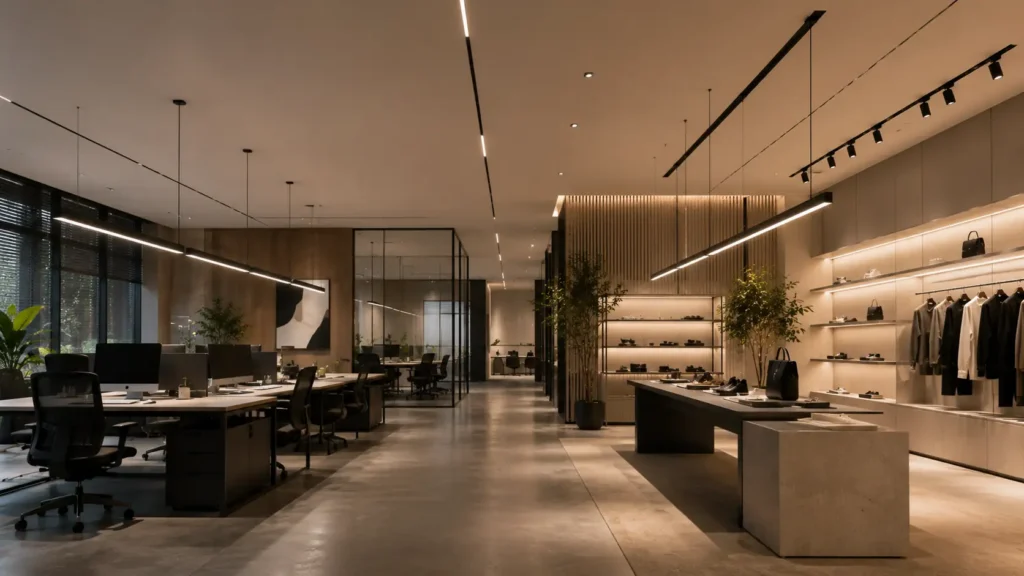
TL;DR: Choose modern linear lighting in four steps—set minimalist fixture form, sketch layout on the plan, pick a contemporary pendant style only if suspension fits the layout, then scale the package to the open space. Do not shop all four at once.
Table of contents
- 1️⃣ Step 1: Settle on a minimalist fixture form
- 2️⃣ Step 2: Sketch the layout before you shop
- 3️⃣ Step 3: Pick a pendant style that fits the ceiling
- 4️⃣ Step 4: Scale the design to the open space
- ✅ Four steps at a glance
- What to do next
- 🏁 Conclusion
- Notes & Sources
- FAQ
1️⃣ Step 1: Settle on a minimalist fixture form
Do Step 1 before any catalog shortlist. Minimalist linear fixture design here means a slim bar or slot with quiet edges—little or no decorative housing, consistent section height, and one finish family across the run. Traditional linear rows often mix grilles, stepped bezels and mixed widths; modern minimalist forms drop that visual noise so the line reads as architecture, not a stack of parts.
On one reference sheet, note:
- Profile height and width band you will allow (flush slot, thin surface bar, or slim suspended housing)
- Finish rule—one metal tone or one powder coat across the zone
- What you are not buying (heavy end caps, mixed pendant shapes, feature pendants in the same sightline)
You may already know the floor is open plan or a narrow retail unit—that context stays on the brief. Step 1 still comes first in the buying order so every later quote uses the same form language.
🎯 Can you skip Step 1 if the supplier sent a nice render?
No. Without a form rule, every “modern” SKU looks valid and Step 2 layout keeps shifting.
2️⃣ Step 2: Sketch the layout before you shop
Do Step 2 only after Step 1 is written down. Modern linear lighting layout belongs on the reflected ceiling plan or a simple overlay—not in a cart. Draw axis lines for desk banks, aisles, checkout, or feature tables; mark where a continuous run should start and stop; note where structure or HVAC already blocks a straight line.
Before you request prices:
- One layout option for the main zone (not three incompatible sketches)
- Mount intent label on each run: ceiling plane, suspended, or wall wash—without sizing drops yet
- A short list of “no-go” zones (signage, sprinklers, existing grilles)
Shopping before Step 2 is how teams order four metre bars for a three metre bay or miss a column that breaks the visual line.
🎯 Is Step 2 only for large offices?
No. Small retail units need layout even more—one wrong run length dominates the whole shopfront.
3️⃣ Step 3: Pick a pendant style that fits the ceiling
Do Step 3 after Steps 1–2 and only where the layout calls for suspension. Contemporary linear pendant styles are the visible half of a suspended run—cable entry, corner treatment, lens line, and whether the bar floats as one plane or stepped segments. This step is style and family choice, not drop height, cable count or hanger load; those stay on the suspension technical guide linked in the boundary.
Compare candidates against the Step 1 form rule:
- Single continuous bar versus segmented “floating sticks”
- Direct-only versus direct/indirect when the ceiling is dark or high
- End-cap treatment—flush cap versus small drop finial (avoid mixing both on one axis)
If Step 2 marked runs as surface or recess on the ceiling plane, skip Step 3 for those runs and carry the Step 1 form into the luminaire selection guide linked in the boundary.
🎯 Must every modern linear project use a contemporary pendant?
No. Step 3 applies only where suspension is the chosen mount for that axis.
4️⃣ Step 4: Scale the design to the open space
Do Step 4 last. Linear lighting for open spaces needs the same form and layout tuned to volume—ceiling height, aisle width, and how far a visitor can read the line. A minimalist run that works in a compact office can overpower a low boutique ceiling or look thin in a wide sales floor if you only change length without adjusting density or beam choice.
Calibrate without inventing universal area numbers:
- Compare run length and count to the actual floor plate on the drawing—not a generic “open plan” photo
- For retail, check whether one hero run is enough versus parallel aisles; for offices, check whether rows align to desk modules or circulation only
- Note where glare or dark corners showed up on a phone photo or mock-up and adjust length or add a short cross-run before PO—not after install
Step 4 does not replace lighting calculations. It keeps the Step 1–3 package honest for the room you have.
🎯 Can you run Step 4 before picking a form?
You can measure the room anytime, but scaling a look you have not set in Step 1 wastes revision time. Keep the sequence.
✅ Four steps at a glance
| Step | Do this | Common mistake |
|---|---|---|
| 1 — Minimalist fixture form | Write profile, finish and “not this” on one sheet | Comparing suppliers before you define form language |
| 2 — Modern linear lighting layout | Draw runs on the plan; label mount intent | Buying bar lengths from a catalog with no bay dimensions |
| 3 — Contemporary linear pendant styles | Choose suspended bar family only where Step 2 says hang | Picking pendant style before layout—or sizing drops here |
| 4 — Linear lighting for open spaces | Tune run count and length to the real floor plate | Copying a hero image from a much larger or smaller space |
This table is a fixed spec order for buying. Site surveys may start with a floor plate size you already know; still set form before layout before pendant style before scale tuning.
What to do next
- Complete Steps 1–2 on one page before you email suppliers.
- Run Step 3 only on axes marked suspended; skip it for surface or recess runs.
- Walk Step 4 on site or on a marked-up plan photo; adjust counts before PO.
- Attach the one-page sequence to the quote request so bids use the same form and layout.
Triage:
- If suspension is set and you need drop, cable and hanger detail, use the modern linear suspension guide linked in the boundary.
- If form and layout are set and you need mounting, beam and access criteria for the PO, use the office and retail luminaire selection guide linked in the boundary.
If you want a second pass on the four-step package against your plan, XHLUX can review form, layout and scale notes before you release quotes.
🏁 Conclusion: How do you choose modern linear lighting in 4 steps?
Back at that stack of “modern” quotes, you now have an order: form, layout, pendant style where suspension applies, then scale to the open space. You do not need to judge every line item at once—work the steps and compare catalogs only after each step is set.
Explore our related blog posts:
- Linear Hanging Lights in Open-Plan Ceilings: Drop, Cables and Layout
- How to Choose Black Linear Lighting for Commercial Ceilings
- How to Tell if Your Ceiling Needs Suspended or Surface Linear Lighting
Notes & Sources
- No universal floor-area square-metre or foot thresholds for “large open space” appear in this draft. Scale tuning uses project drawings and mock-ups, not a single size class.
- Suspension drop height, cable kits and structural hang loads stay on the modern linear suspension guide—not duplicated here.
- Luminaire mounting, continuous-run mechanics and beam distribution stay on the office and retail luminaire selection guide—not duplicated here.
- Structural, electrical and code requirements still apply. Check local rules and the installation sheet before install.