 XHLUX
XHLUX
Table of contents
- 1. Why Mark Architectural Lighting Matters in Modern Building Projects
- 2. Mark Architectural Lighting introduce
- 3. Typical Applications of Mark Architectural Lighting in Modern Projects
- 4. Mark vs. Common Lighting Brands — Why It Excels in Complex Projects
- 5. Comparison: Mark Architectural Lighting vs. DIY / Low-End Lighting
- 6. Design Recommendations When Choosing Mark Architectural Lighting
- 7. FAQ About Mark Architectural Lighting
- 8. Conclusion
In contemporary architecture, lighting has evolved far beyond the traditional concept of providing sufficient brightness. Today, lighting must deliver visual comfort, aesthetic integration, energy efficiency, intelligent controls, flexibility, and architectural coherence. As building environments grow more dynamic and design-driven—from corporate offices to hospitality spaces—professional-grade lighting systems have become essential for achieving both function and atmosphere.
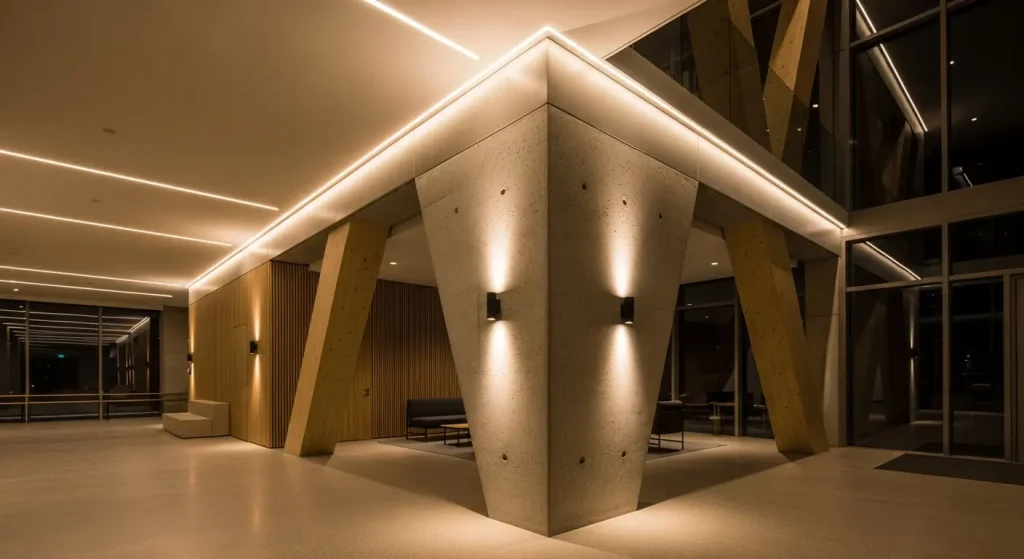
1. Why Mark Architectural Lighting Matters in Modern Building Projects
Mark Architectural Lighting, a division of Acuity Brands, has positioned itself as one of the most influential architectural lighting manufacturers in North America. Its reputation is built on quality of light, system integration, modular design, and architectural-grade engineering—making it a preferred choice among lighting designers, architects, MEP engineers, and project developers.
This article explores:
- The technical capabilities of Mark Architectural Lighting
- Its role in modern commercial, hospitality, retail, and public-space projects
- How it compares with basic residential-grade or retail lights
- Professional design recommendations for using Mark in real projects
2. Mark Architectural Lighting introduce
Mark Architectural Lighting is known for delivering architectural-quality luminaires engineered for high visual performance, energy optimization, and seamless system integration. Its product families cover a broad range of applications, allowing designers to build entire lighting schemes using consistent optics, color quality, and form factors.
Below are the major capability pillars.
2.1 Broad Product Spectrum for All Architectural Needs
Mark’s product ecosystem includes:
- Recessed linear systems
- Recessed downlights
- Cove / slot lighting
- Accent & perimeter lighting
- Surface-mounted and wall-mounted fixtures
- Pendant and suspended linear systems
- Custom architectural solutions
This wide coverage is essential for building projects because it ensures design continuity across ceilings, walls, and open environments.
2.2 Architectural Quality of Light — Optics, LEDs & Visual Comfort
Mark emphasizes “Quality of Light,” which includes:
- Consistent SDCM < 3 for color quality
- High CRI (90–95+) options for material fidelity
- Precision optics for UGR control
- Uniform linear illumination for long architectural runs
- Flicker-free LED drivers
Acuity Brands’ commitment to optical engineering strengthens the credibility of Mark’s performance.
2.3 Customization & Configurability for Complex Projects
One of Mark’s biggest advantages is its design flexibility:
- Multiple beam angles
- Tunable white (2700K–6500K)
- Custom lengths & shapes for linear systems
- Corner modules & geometric shapes
- Perimeter slots
- Mounting variations
Mark often collaborates directly with design teams to engineer project-specific solutions, a capability rarely found in low-end lighting brands.
2.4 Sustainability, Certifications & Compliance
Architectural projects often require strict compliance:
- DLC certification
- Wet-listed options
- IC-rated / airtight / plenum-rated fixtures
- Energy-efficient LED platforms
- Support for LEED, WELL, and other environmental standards
These attributes make Mark particularly suitable for public institutions, government buildings, advanced commercial facilities, and long-term operational spaces.
3. Typical Applications of Mark Architectural Lighting in Modern Projects
Mark is widely used across multiple building sectors because its systems can achieve uniformity, comfort, visual hierarchy, and aesthetic integration. Below are key application categories.
3.1 Commercial Offices & Workspaces
Modern workspaces focus on:
- Wellness
- Productivity
- Visual comfort
- Flexible, collaborative zones
Mark’s recessed linear lighting, downlights, and accent systems help achieve:
- Uniform ambient lighting
- Low-glare illumination (UGR-compliant)
- Integration with daylight and smart controls
- Architectural expression through ceiling design
ERCO research emphasizes the role of vertical and ambient contrast in workplace lighting quality, which aligns with Mark’s lighting philosophy.
3.2 Hospitality — Hotels, Lobbies & Public Spaces
Hotels need lighting that enhances both guest experience and brand identity. Mark provides:
- High-performance wall-washers
- Architectural pendants
- Cove lighting for ambience
- Perimeter lighting for depth
- Accent lighting for art and decor
Lighting in hospitality must support storytelling, a concept reinforced by Zumtobel’s hospitality case studies.
3.3 Retail, Showrooms & Commercial Facilities
Retail and showroom environments require:
- Visual contrast
- Merchandise emphasis
- Circulation clarity
- Aesthetic brand language
Mark’s systems excel in:
- Long continuous linear runs
- Perimeter slot lighting
- Accent + ambient layered designs
- Flexible modular layouts
This aligns with Signify’s guidance that lighting is central to “customer perception and sales conversion in retail environments.”
3.4 Public Buildings — Healthcare, Education & Civic Architecture
Public projects often have:
- Strict safety codes
- Demanding energy standards
- Long operational hours
- High maintenance expectations
Mark’s compliance-ready portfolio includes:
- Plenum-rated systems
- Wet-listed fixtures
- High-efficiency LED platforms
- Durable architectural housings
- Long lifetime ratings (L70/B50 ≥ 50,000 hours)
These attributes make it suitable for:
- University buildings
- Libraries
- Hospitals
- Museums
- Cultural venues
IES standards provide additional reference for quality expectations in these spaces
4. Mark vs. Common Lighting Brands — Why It Excels in Complex Projects
Below are the advantages that differentiate Mark from lower-tier or residential-grade lighting options.
4.1 Design Flexibility & System-Level Integration
Typical low-end lighting provides isolated fixtures, but Mark enables:
- Unified ceiling design
- Consistent optical performance
- Modular layouts
- Mixed lighting layers (ambient + accent + perimeter)
- Integrated controls
This is crucial in premium architectural projects.
4.2 Engineering Quality, Certifications & Reliability
Mark’s products are engineered for:
- Long lifetime
- High consistency
- Performance stability
- Compliance with commercial codes
Low-tier lighting rarely meets:
- UGR standards
- Plenum restrictions
- DLC / LEED requirements
- Tunable white or DALI integration
4.3 Custom Solutions & Project Support
Mark provides:
- Technical documentation
- Specification support
- Engineering drawings
- BIM objects
- Project collaboration
This is extremely valuable for architects and MEP consultants.
4.4 Quality of Light & Sustainability
With:
- High-CRI options
- High-efficiency LED modules
- Controlled glare
- Long-distance uniformity
Mark supports both aesthetic goals and operational sustainability, which are foundational in modern building design.
5. Comparison: Mark Architectural Lighting vs. DIY / Low-End Lighting
| Category | Mark Architectural Lighting | Low-End / DIY Lighting |
|---|---|---|
| Light Quality | High CRI, controlled glare, consistent CCT | Inconsistent color, uneven output |
| Certifications | DLC, plenum-rated, wet-listed, WELL/LEED-ready | Few or none |
| Design Options | Recessed, linear, perimeter, custom | Limited choices |
| System Integration | Tunable white, DALI, networked controls | Basic on/off |
| Reliability | Engineered for long-term operation | Unstable performance |
| Support | Project documentation + custom solutions | Minimal or no support |
| Suitability | Offices, hotels, retail, public spaces | Simple residential use |
6. Design Recommendations When Choosing Mark Architectural Lighting
Below are actionable suggestions for lighting designers, architects, and project managers.
6.1 Align Fixture Types with Functional Zones
Early in the design phase, map out:
- Recessed linear for open offices
- Downlights for circulation
- Accent lighting for hospitality features
- Cove lighting for ambience
- Perimeter lighting for boundaries
6.2 Use Lighting to Support Spatial Hierarchy
Avoid a “fixture-heavy” design.
Focus on:
- Luminance distribution
- Task vs. ambient balance
- Highlighting architectural features
- Visual comfort
6.3 Consider Control Systems Early
Integrate:
- DALI-2
- Tunable white
- Networked lighting controls
- Daylight harvesting
Acuity Brands offers control ecosystem guidance.
6.4 Plan for Long-Term Maintenance
For commercial or public-space installations:
- Ensure accessible driver locations
- Choose long-lifetime modules
- Verify plenum & safety requirements
- Maintain consistent color bins
7. FAQ About Mark Architectural Lighting
Q1. Does Mark Architectural Lighting only make downlights?
No. It produces recessed linear systems, pendants, surface fixtures, cove lighting, accent lights, perimeter systems, and custom architectural luminaires.
Q2. Which project types benefit most from Mark?
- Corporate offices
- Hotels & hospitality spaces
- Retail stores
- Showrooms
- Universities
- Cultural and public buildings
- Healthcare facilities
- Premium residential
Any project requiring quality, consistency, aesthetics, and system performance.
Q3. Why choose Mark over low-cost LED fixtures?
Because Mark offers:
- Better light quality
- Longer lifetime
- Certification-ready luminaires
- Integrated systems
- Expert project support
Low-end fixtures lack these critical attributes.
Q4. Does Mark support sustainable and energy-efficient design?
Yes. Mark provides high-efficacy LED solutions, DLC options, tunable white controls, and compatibility with LEED/WELL building standards.
Q5. Can Mark fixtures be customized?
Yes. Mark supports custom lengths, geometric configurations, special optics, and project-specific solutions.
8. Conclusion
Mark Architectural Lighting is far more than a lighting manufacturer. It is a design partner for modern buildings, supporting:
- Architectural expression
- Visual comfort
- System integration
- Sustainability
- Long-term performance
- Aesthetic refinement
In offices, hotels, retail stores, public buildings, and high-end residences, Mark provides project-grade lighting solutions that cannot be replaced by generic or consumer-level products.
For architects, lighting designers, developers, and consultants, Mark represents a strategic asset—helping ensure that the lighting system supports both design intent and long-term operational excellence.