 XHLUX
XHLUX
Table of contents
- Quick answers
- What does “High Lumen” mean?
- How bright should your room be?
- High ceilings: more than just higher wattage
- Why high-lumen LEDs pay off
- Key specifications explained
- Three-step selection method
- Example: 20 m² living room
- High-lumen vs. standard ceiling lights
- Commercial & project buyer checklist
- Smart & connected lighting in 2025
- Comfort & safety
- FAQ About Ceiling Light High Lumens
- Final buyer’s checklist
- Closing thought
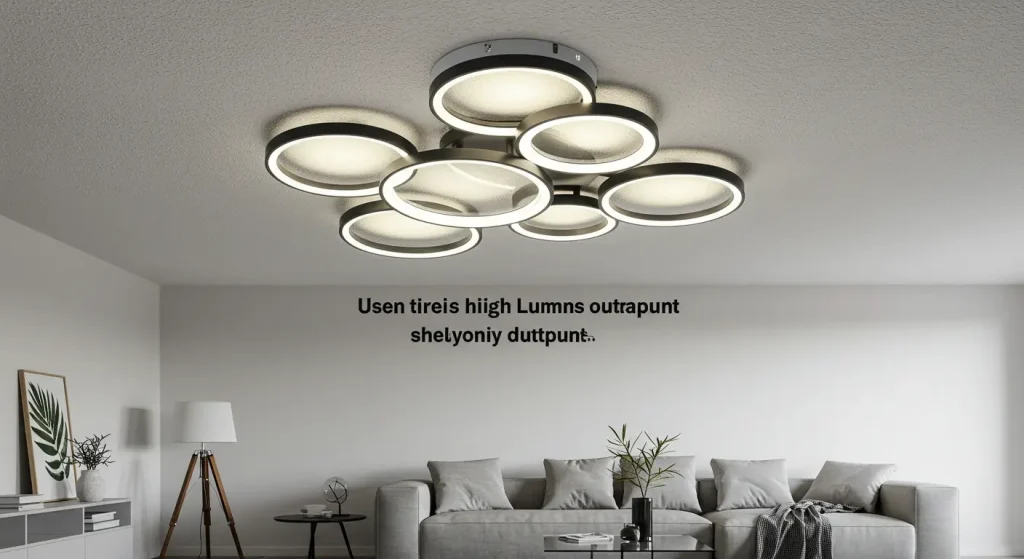
If you searched “high lumen ceiling lights,” you probably want a brighter space, fewer fixtures, or a safer, more efficient lighting solution. This guide explains how many lumens you actually need, how to evaluate specifications (lumens, lm/W, UGR, CRI, CCT, IP), and how to balance brightness, comfort, and efficiency. It also includes trusted industry data and standards, making the content reliable and people-first.
Quick answers
- High lumen = more light output (lumens), not more watts. Target illuminance (lux) for each room/task.
- Start with lux targets. Living room ~150–300 lux, kitchen/task ~300–500 lux, offices ~300–500 lux. Formula: Lumens = Lux × Area (m²).
- Choose high efficacy (lm/W). Today’s ceiling lights often exceed 160 lm/W.
- Manage glare. For offices/screens, look for UGR < 19.
- Check quality & compliance. DLC, ENERGY STAR, LM-79/LM-80/TM-21 reports are key.
- LEDs save big. DOE: LEDs use ~75–90% less energy than incandescent. Smart controls can add ~28–49% extra savings.
What does “High Lumen” mean?
Lumens (lm) measure brightness. Watts (W) measure power. With LEDs, the real efficiency metric is lumens per watt (lm/W). The higher this value, the more light you get for each unit of energy consumed. Modern LED ceiling lights often deliver over 160 lm/W, meaning you can have bright rooms without high energy bills.
How bright should your room be?
The right approach: define lux targets (illuminance) for each space, then calculate required lumens.
- Formula: Lumens = Lux × Area (m²)
- (1 foot-candle ≈ 10.764 lux)
Recommended lux levels & examples
| Space | Lux target | Example area | Required lumens |
|---|---|---|---|
| Living room | 150–300 | 20 m² | 3,000–6,000 |
| Kitchen (task areas) | 300–500 | 12 m² | 3,600–6,000 |
| Bedroom | 100–200 | 15 m² | 1,500–3,000 |
| Bathroom | 200–300 | 8 m² | 1,600–2,400 |
| Home office | 300–500 | 10 m² | 3,000–5,000 |
| Open-plan office | 300–500 | 50 m² | 15,000–25,000 |
High ceilings: more than just higher wattage
For tall spaces, you need more than “bigger wattage.” Consider:
- Higher lumen output per fixture
- Narrower beam angles to push light downward
- Fixture spacing to cover the area evenly
- UGR/glare control – especially in offices, target UGR < 19 for eye comfort
Why high-lumen LEDs pay off
- Lower energy: LED save 75–90% energy compared to incandescent.
- Fewer fixtures needed: One high-lumen ceiling light can replace several smaller ones.
- Smart savings: Adding controls such as occupancy sensors and daylight harvesting yields 28–49% additional savings in studies.
Key specifications explained
- Total Lumens: Match to your lux × area calculation.
- Efficacy (lm/W): Today’s high-performance ceiling lights often exceed 160 lm/W.
- UGR (Glare): Aim for UGR < 19 in offices and classrooms.
- CRI (Color Rendering Index): 80+ for general use, 90+ for retail/design.
- CCT (Color Temperature): 2700–3000K warm, 3500–4000K neutral, 5000K+ cool.
- IP Rating: Bathrooms/outdoor: IP44–IP65 or higher.
- Dimming & Smart: Enables more comfort and energy savings.
- Certifications: DLC (for rebates), ENERGY STAR, LM-79/LM-80/TM-21 reports prove quality.
Three-step selection method
- Set brightness: Calculate lumens from lux × area.
- Set fixture count: Divide required lumens by fixture output.
- Optimize: Check UGR, efficacy, CCT, CRI, and add controls.
Example: 20 m² living room
- Target: 200 lux → 200 × 20 = 4,000 lumens
- Option A: Two ceiling lights @ 2,000 lm each
- Option B: One 4,000 lm ceiling light with dimming
- Best setup: 3000K warm white, CRI 90
High-lumen vs. standard ceiling lights
| Factor | High Lumen | Standard |
|---|---|---|
| Fixture count | Fewer | More |
| Energy per lux | Lower | Higher |
| Glare risk | Must be managed | Typically lower |
| Upfront cost | Higher | Lower |
| Lifetime cost | Lower | Higher (more fixtures, energy use) |
Commercial & project buyer checklist
- DLC QPL listing – required for rebates in North America
- Test data: LM-79, LM-80, TM-21 reports
- UGR targets – especially in offices, UGR < 19
- IP rating – match damp/dusty environments
- High efficacy – aim for ≥ 130–160 lm/W
Smart & connected lighting in 2025
The global smart lighting market continues double-digit CAGR growth. Networked Lighting Controls (NLC) deliver ~49% average savings beyond LEDs alone. Pairing high-lumen lights with sensors and automation maximizes both brightness and ROI.
Comfort & safety
- Glare: Keep UGR under control; lenses and diffusers help.
- Color: High CRI shows true colors; choose CCT to match mood.
- Ingress protection: Bathrooms and outdoor: IP44–IP65.
FAQ About Ceiling Light High Lumens
Q1. How many lumens is “high lumen” for ceiling lights?
Typically 2,500–6,000 lumens for home fixtures; much higher for commercial.
Q2. Is more lumens always better?
No. Match to your lux target. Too much = glare + wasted energy.
Q3. What certifications matter?
DLC QPL, ENERGY STAR, LM-79/LM-80/TM-21.
Q4. What IP rating suits bathrooms?
IP44 (splash zones); IP65 (high steam/water).
Q5. Why combine high lumens with smart controls?
Because dimming and sensors cut energy when full brightness isn’t needed.
Final buyer’s checklist
- ✔ Lux target & lumen calculation done
- ✔ Fixture count confirmed
- ✔ UGR checked (≤19 for offices)
- ✔ High efficacy (≥130–160 lm/W)
- ✔ Correct CCT & CRI
- ✔ IP rating correct
- ✔ Controls selected (dimming, sensors, NLC)
- ✔ Documentation (DLC, LM-79/LM-80, TM-21)
Closing thought
High lumen does not mean high energy waste — it means smarter, more efficient light. By combining lux-based calculations, high efficacy, glare control, and smart automation, you create spaces that are bright, comfortable, and cost-effective.