 XHLUX
XHLUX
Table of contents
- 1. Why Workplace Lighting Is Different from Normal Indoor Lighting
- 2. Key Technical Parameters That Define “Good” LED Workplace Lighting
- 3. Best LED Workplace Lighting Fixture Types for Productivity
- 3.1 Suspended Linear LED Fixtures – The Modern Workplace Standard
- 3.2 Recessed LED Panels and Downlights – Clean, Efficient, and Familiar
- 3.3 Track-Based and Modular LED Systems – Flexibility for Hybrid Workspaces
- 3.4 Anti-Glare Task Lighting – Precision for High-Intensity Work
- 3.5 Smart and Tunable White LED Systems – Human-Centric Workplace Lighting
- 4. How to Choose LED Workplace Fixtures – A Practical Workflow
- 5. Common Workplace Lighting Mistakes (And How to Avoid Them)
- 6. Why Partner with XHLUX for LED Workplace Lighting
- 7. FAQ About LED Workplace Lighting
- 8. Lighting as a Productivity Tool, Not Just a Cost
In today’s world, “workplace” no longer means rows of cubicles under harsh fluorescent panels. Modern offices, co-working spaces and project rooms are flexible, collaborative, and increasingly design-driven. But behind every successful workspace, there is one invisible asset that directly impacts productivity, health, and business performance:Lighting.
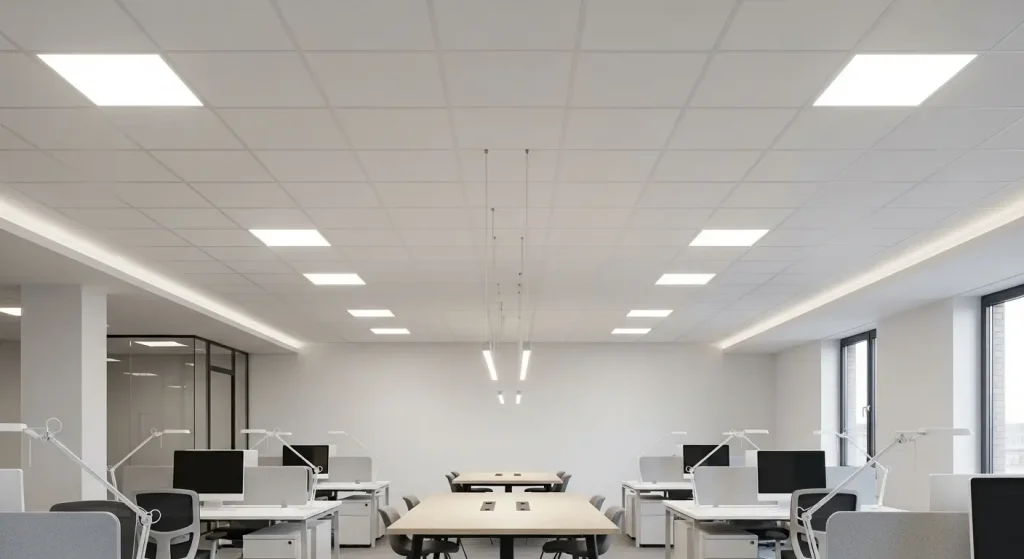
The right LED workplace lighting fixtures do much more than “make the room bright.” They:
- Support visual comfort and reduce eye strain
- Improve concentration and task accuracy
- Enhance employee mood and wellbeing
- Reinforce your brand image and office design
- Cut energy costs and maintenance overhead
If you already have a project in mind and want quick professional feedback, you can Contact Our Team for a free technical discussion.
1. Why Workplace Lighting Is Different from Normal Indoor Lighting
Many projects fail because workplace lighting is treated like simple “general indoor lighting.” In reality, a workplace is a performance environment where people spend 6–10 hours per day performing visually demanding tasks.
1.1 Workplace vs. Standard Office vs. Retail
| Space Type | Main Objective | Lighting Priorities |
|---|---|---|
| Standard Office | Comfort + basic visibility | Uniformity, low glare, 300–500 lx |
| Workplace (desks, teams) | Productivity + accuracy | Higher lux, task lighting, low UGR, high CRI |
| Retail / Shop | Attraction + customer engagement | Accent lighting, contrast, vertical illuminance |
A workplace is where people:
- Read and write continuously
- Stare at screens all day
- Handle complex documents or designs
- Participate in online meetings and presentations
That means lighting must:
- Control glare on screens
- Keep contrast comfortable
- Maintain stable light levels across the working plane
To see how this looks in real projects, you can browse real installations in the Project Gallery.
2. Key Technical Parameters That Define “Good” LED Workplace Lighting
Before discussing fixture types, we must understand the technical backbone of a productive lighting system.
2.1 Lux (lx) vs. Lumens (lm)
- Lumens (lm): how much light the fixture emits
- Lux (lx): how much light reaches the working surface
For most office workplaces:
- Open-plan workstations: 300–500 lux
- Technical / detailed tasks: 500–750 lux
- Meeting rooms: 300–500 lux
- Circulation areas: 100–200 lux
Good practice: use Dialux / Relux to simulate lux levels before finalizing fixture quantities and layout.
If you prefer not to run simulations yourself, you can send basic floor plans and we’ll help prepare calculations—just Request a Quote and mention “workplace lux planning”.
2.2 Unified Glare Rating (UGR)
Glare is a silent productivity killer. Even when the lux level is correct, workers may still suffer from headaches and eye fatigue if the fixture creates harsh brightness contrasts.
- For offices and workplaces, the recommended target is:
UGR < 19 - For premium, visually demanding environments:
UGR < 16
Low-UGR fixtures typically use:
- Deep reflectors
- Micro-prismatic diffusers
- Dark-light or low-brightness optical systems
You’ll find multiple UGR<19 options in the Product Catalog optimized for office and workplace use.
2.3 Color Rendering Index (CRI)
Color rendering strongly affects how people perceive skin tones, printed materials, brand colors, and product samples.
- CRI ≥ 80: minimum acceptable standard
- CRI ≥ 90: recommended for modern workplaces
- CRI ≥ 95: ideal for design studios, creative agencies, branding teams
High CRI also contributes to a more “natural” and less stressful viewing environment.
2.4 Color Temperature (CCT)
Color temperature influences mood and energy levels.
| CCT Range | Mood & Application |
|---|---|
| 2700–3000K | Warm, relaxed; lounges, waiting areas |
| 3500K | Soft neutral; comfortable yet focused |
| 4000K | Most popular for offices; clean, bright, professional |
| 5000K+ | Very cool; suitable for labs, inspection, special tasks |
A powerful combination is: warm or 3500 K in lounges and collaboration zones, 4000 K in work areas.
Increasingly, EU clients request tunable white systems that change color temperature during the day. You can explore this type of solution in the Lighting Solutions section.
2.5 Luminous Efficacy (lm/W)
This is about efficiency: how much light you get per watt.
- Good: ≥ 110 lm/W
- Better: ≥ 130 lm/W
- Excellent: 140–150 lm/W+
Higher efficacy = lower energy bills and easier compliance with green building standards.
2.6 Uniformity
Uniformity describes how evenly light is spread across a space.
- For workplaces, aim for U₀ (Emin / Eavg) ≥ 0.6
Poor uniformity leads to “bright patches” and dark zones, which cause eye fatigue when your eyes constantly adapt between levels.
2.7 Flicker and Driver Quality
Invisible flicker can still cause headaches, eye strain, and discomfort, especially in spaces where people work under artificial light for 8+ hours per day.
- Always choose flicker-free drivers
- Ask the manufacturer for flicker test data or “low flicker / flicker-free” confirmation
If you want fixtures with proven driver quality and long lifetime, you can Email Us with your spec sheet, and we will suggest compatible models.
3. Best LED Workplace Lighting Fixture Types for Productivity
Now we move to the core: what are the best LED fixtures for workplace productivity, and where should you use them?
We’ll cover five major categories:
- Suspended linear LED fixtures
- Recessed office panels and downlights
- Modular / track-based LED systems
- Anti-glare task-oriented luminaires
- Smart tunable white and connected LED systems
3.1 Suspended Linear LED Fixtures – The Modern Workplace Standard
Suspended linear fixtures are now the signature of contemporary offices. They combine aesthetics, performance, and flexibility.
Key Advantages:
- Provide high uniformity above workstations
- Work well with higher ceilings (2.8–3.5 m and beyond)
- Allow continuous lines and grid layouts
- Can integrate direct + indirect lighting (up-light + down-light)
- Enable low-UGR optical systems
Typical Specifications:
- Power: 30–60 W per 1.2–1.5 m module
- Luminous flux: 3000–6500 lm
- CCT: 3500 K or 4000 K
- CRI: ≥ 90
- UGR: < 19 with dark-light or lens optics
Best Applications:
- Open-plan workplaces
- Co-working centers
- Design and engineering offices
- Modern corporate headquarters
To see how linear systems are used in real projects, check the Project Gallery and filter by office installations.
3.2 Recessed LED Panels and Downlights – Clean, Efficient, and Familiar
Recessed LED panels and downlights remain popular due to their clean ceiling appearance and easy integration into standard grid ceilings.
Benefits:
- Simple planning and layout
- Easy to replace legacy fluorescent troffers
- Cost-effective for large spaces
- Provide comfortable, diffuse illumination
Typical Specifications:
- Panel sizes: 600×600 mm, 300×1200 mm, 600×1200 mm
- CCT: 3000–4000 K
- CRI: ≥ 80 or ≥ 90
- UGR: < 19 with micro-prismatic diffusers
- Efficacy: 110–130 lm/W
Recommended Areas:
- Standard office floors
- Administrative zones
- Economical workplaces
- Refurbishment projects
You can view panel and recessed options suitable for global office projects in the Product Catalog.
3.3 Track-Based and Modular LED Systems – Flexibility for Hybrid Workspaces
Traditional offices are static. Modern workplaces are dynamic: teams grow, rearrange, and collaborate differently over time. That’s where track and modular systems shine.
Advantages:
- Easy to move or add fixtures without rewiring
- Allow mix-and-match of modules (spotlights, linear, wall washers)
- Ideal for creative spaces, studios, and agile offices
- Can highlight feature walls, branding elements, or collaboration zones
Use Cases:
- Hybrid offices with flexible zones
- Creative / marketing departments
- Meeting areas with changing layouts
- Semi-retail workplace lobbies
Track and modular workplace systems can also be used as a bridge between office and showroom/retail environments.
If you’re considering a flexible track-based concept, you can Chat on WhatsApp to quickly discuss compatibility with Global / Eutrac / Stucchi tracks.
3.4 Anti-Glare Task Lighting – Precision for High-Intensity Work
In task-heavy environments—accounting, coding, detailed review, data analysis—standard ceiling lighting is often not enough. You need targeted, anti-glare task lighting.
Core Features:
- Narrower beam angles for the workplane
- Deep reflectors or baffles to limit glare
- High CRI (≥ 90) and stable CCT
- Often combined with general linear lighting
Applications:
- High-focus workstations
- Trading floors and control rooms
- Laboratories and technical workspaces
- Shared desks that need extra brightness on demand
Advanced anti-glare options are described in the Lighting Solutions section, especially for EU workplace compliance.
3.5 Smart and Tunable White LED Systems – Human-Centric Workplace Lighting
The future of workplace lighting is adaptive. Tunable white and smart control allow you to:
- Use 4000–5000 K in the morning to stimulate alertness
- Shift to 3500–4000 K in the afternoon for sustained focus
- Reduce intensity and warm up to 3000–3500 K in the late day to reduce visual stress
Benefits include:
- Support for circadian rhythms
- Better sleep quality reported by employees
- Increased satisfaction and perceived comfort
- Alignment with WELL and LEED certification strategies
If you plan to position your brand as a premium human-centric lighting supplier, integrating tunable white workplace fixtures is now a strong differentiator. You can learn more about such systems in the About XHLUX section and related solution pages.
4. How to Choose LED Workplace Fixtures – A Practical Workflow
Many B2B buyers feel overwhelmed by data sheets, standards, and marketing claims. Here is a practical decision process you can use in every project:
Step 1 – Define Zones and Tasks
- Map the floor into zones: open desks, enclosed offices, meeting rooms, collaboration areas, focus rooms, circulation.
- Assign each zone a target function and approximate working hours.
Step 2 – Set Target Lux and Quality Criteria
For each zone, define:
- Target lux (e.g., 300 / 500 / 750)
- UGR requirement (e.g., <19)
- CRI requirement (≥80 / ≥90)
- Preferred CCT (3000 / 3500 / 4000 K)
If you’d like a ready-to-use Excel template, simply Contact Our Team and mention “workplace lighting planning sheet”.
Step 3 – Pre-Select Fixture Types
Use this simplified decision table:
| Zone Type | Recommended Fixture Type |
|---|---|
| Open-plan office | Suspended linear LEDs + recessed panels |
| Meeting rooms | Low-UGR recessed or linear fixtures |
| Collaboration areas | Linear + modular track lights |
| Focus workstations | Anti-glare task luminaires + general light |
| Executive / premium | Tunable white workplace fixtures |
Step 4 – Request Photometric Files and Run Simulations
From each shortlisted vendor, request:
- IES / LDT files
- UGR tables
- LM-80 / TM-21 documents
- Driver specifications
Use these in Dialux / Relux to verify:
- Average illuminance
- Uniformity
- Glare index
If you don’t have in-house lighting design capability, you can offload this work by Requesting a Quote and asking for a full layout + calculation pack.
Step 5 – Evaluate Manufacturer Capabilities
A high-quality workplace lighting project needs more than good products. Check whether your supplier offers:
- OEM / ODM support (branding, custom optics, special lengths)
- EU and global certifications (CE, RoHS, ENEC where applicable)
- Real project references
- 5-year or longer warranty
- Spare part and service policy
To understand how one manufacturer positions itself as a long-term workplace partner, you can Learn About XHLUX and its experience in commercial lighting exports.
5. Common Workplace Lighting Mistakes (And How to Avoid Them)
Even large projects fall into predictable traps. Avoid these, and your proposals will immediately look more professional in front of overseas clients.
5.1 Only Looking at Wattage, Ignoring Lumens and Optics
Clients sometimes compare fixtures by “Watt” instead of lumens or lux levels. This leads to:
- Under-lit spaces
- Over-lit but uncomfortable areas
- Inefficient energy use
Solution: Always speak in lumens, lux, and UGR, not just “Watt”.
5.2 Choosing the Wrong CCT for the Workspace Culture
Too warm (2700 K) may feel sleepy; too cold (5000–6500 K) can feel sterile and stressful.
Solution: Propose 4000 K as the main working CCT, with variation for lounges and special zones.
5.3 Ignoring Glare Control
Cheap panels or bare LED strips may “meet lux requirements” but cause:
- Strong reflections on screens
- Uncomfortable brightness in the field of view
- Increased visual fatigue
Solution: Prioritize UGR < 19 and show clients clear UGR data in your proposal. You can find suitable UGR-optimized fixtures in the Product Catalog.
5.4 No Plan for Maintenance or Future Expansion
If fixtures are non-modular and hard to maintain:
- Every failure may require full fixture replacement
- Expanding the office becomes complex and costly
Solution: Choose modular linear systems, track-based layouts, and fixtures with front-maintenance design, especially in high-value workplaces.
5.5 Working with Suppliers Who Provide No Technical Support
Without photometric files, calculations, or design assistance, even good products can result in poor implementations.
Solution: Work with partners who supply design support + documentation.
You can explore structured solution packages in the Lighting Solutions area, which are designed exactly for this purpose.
6. Why Partner with XHLUX for LED Workplace Lighting
- A professional indoor commercial lighting specialist with strong focus on track lights, downlights, and linear systems
- Offering high-CRI (90–95+) workplace-ready fixtures
- Capable of DALI, 0–10 V, and Casambi integration
- Supporting OEM/ODM services for brand owners and engineering companies
- Download Product Catalog for technical references
- View Project Gallery for real applications
- Explore Lighting Solutions to see system-level thinking
- Chat on WhatsApp for quick questions
- Contact Our Team for RFQ and engineering support
- Or simply Email Us with drawings and specifications
7. FAQ About LED Workplace Lighting
Q1: What is the best color temperature for workplace lighting?
For most modern offices, 4000 K is the best balance between clarity and comfort. You can mix in 3000–3500 K for lounges and hospitality-style areas.
Q2: How many lux should I target in a normal workplace?
- Common workstations: 300–500 lux
- Technical or detailed work: 500–750 lux
- Corridors and support areas: 100–200 lux
For exact values based on your layout, you can Request a Quote and ask for a lighting study.
Q3: Why is UGR < 19 so important?
Because glare directly impacts comfort. Even when the space looks bright enough, people may feel tired or uncomfortable if glare is high. A UGR<19 layout helps maintain comfort during long hours of screen-based work.
Q4: Do I really need CRI 90+ in a workplace?
Yes, if you care about:
- Natural skin tones
- Brand color accuracy
- Comfort for long-term visual tasks
CRI 90+ is quickly becoming the standard in quality offices, especially in Europe.
Q5: Are smart and tunable white fixtures “nice to have” or “must have”?
For basic workplaces, they’re optional.
For premium offices, WELL/LEED projects, and companies focused on employee wellbeing, tunable white is increasingly considered a strategic investment.
Q6: Can XHLUX provide OEM/ODM workplace lighting solutions?
Yes. From housing design to optics, drivers, and packaging, you can develop your own branded workplace series. To discuss this, simply Chat on WhatsApp or Contact Our Team.
8. Lighting as a Productivity Tool, Not Just a Cost
The best LED workplace lighting fixtures for productivity are not the brightest or the cheapest. They are the ones that:
- Deliver the right lux level on the workplane
- Control glare to UGR<19 or better
- Use CRI ≥ 90 and appropriate CCT
- Support smart control and future adaptation
- Come from a partner who understands projects, not just products