XHLUX
A diffuser spreads light across a luminous surface. It does non guarantee comfortable lighting in every room or at every desk.
Ceiling lights with diffusers can still cause visual discomfort for two main reasons:
- Direct visual discomfort — the illuminated face of the fixture looks harsh from a normal viewing angle.
- Reflections — the same face appears as a bright patch on a computer screen or other glossy surface.
The right fix depends on which of those is happening. Having a diffuser does not mean the glare problem has been solved.
For the wider office design sequence, start with the Guida alla progettazione dell’illuminazione per uffici moderni.
In breve: Diffusion softens how the source looks; it does not erase glare. A bright diffuser can still be uncomfortable to look at, and it can still mirror on a monitor. Test dimming and workstation geometry first. If the problem remains, review shielding, recess depth and layout—not only the diffuser sheet.
Sommario
- 💡 1. Why Can Ceiling Lights with Diffusers Still Cause Glare?
- 🖥️ 2. Why Do Ceiling Lights with Diffusers Reflect on Computer Screens?
- 🔅 3. Why Doesn’t Dimming Always Fix Glare from a Diffused Ceiling Light?
- 🔧 4. Can a Different Ceiling Light Design Reduce Glare Better Than a Diffuser Alone?
- 📋 5. How Can You Reduce Glare from a Ceiling Light with a Diffuser?
- 🏁 Conclusione
- FAQ
💡 1. Why Can Ceiling Lights with Diffusers Still Cause Glare?
Spreading light is not the same as controlling glare.
A diffuser scatters light so individual LED points are less obvious. That can improve the estetica of the source. Glare control also depends on how bright that surface looks from the eye, how large it is in the field of view, and whether it sits in a sensitive viewing direction.
A large, evenly lit diffuser can still act as a high-luminance patch. From some angles it remains uncomfortable even though you no longer see sharp LED dots. Office guidance on discomfort glare and display-screen reflections treats the luminance of luminous parts toward the observer—and toward screens—as real design checks, not a checkbox labelled “has diffuser.”
So a diffuser can soften source structure without removing every form of glare. Diffusion changes how light is distributed, but it does not guarantee visual comfort.
🎯 Does adding a diffuser make the light glare-free?
No. It softens how the source looks; bright surfaces and bad viewing angles can still cause discomfort.

🖥️ 2. Why Do Ceiling Lights with Diffusers Reflect on Computer Screens?
Reflections follow geometry. Diffuser material does not cancel the mirror path.
If a ceiling fixture sits in the screen’s reflection zone for a seated viewer, the eye sees a bright image of that luminous face—diffused or not. Monitor tilt, desk orientation and fixture layout decide where that image lands. Glossy desks and other specular surfaces can create similar veiling reflections beside the keyboard.
Practical first moves (before buying a new housing):
- Adjust monitor angle and height; watch whether the reflection leaves the normal reading area.
- Shift the workstation relative to the fixture and windows when the furniture allows.
- Review the ceiling layout if several desks share the same mirrored luminaires.
A diffuser may make the reflected patch look softer or more “filled in.” It does not remove the patch if the geometry still aims the fixture at the glass.
🎯 Can a diffuser stop monitor reflections by itself?
No. If the fixture sits in the reflection zone, the screen can still show it.
🔅 3. Why Doesn’t Dimming Always Fix Glare from a Diffused Ceiling Light?
Dimming is a useful test—not a universal cure.
Lowering output can help when the main problem is excess luminance. It may also make a reflection less distracting. But a fixture can stay uncomfortable when:
- the illuminated diffuser remains relatively bright against a darker ceiling;
- the source or luminous face stays in a sensitive viewing direction;
- shielding is weak, so the bright surface stays visible even at reduced drive.
Dim too far and the room can feel underlit while the optical problem is still there. Do not assume the cause must be “too many watts” or a wrong colour temperature. Those can contribute in some installs; source visibility and surface luminance often matter more.
If comfort only improves when the room becomes too dark, the optical design or layout needs attention—not another dimming app setting.
🎯 Will turning the dimmer down always remove diffuser glare?
No. It can help as a test; persistent discomfort points to optics or layout.
🔧 4. Can a Different Ceiling Light Design Reduce Glare Better Than a Diffuser Alone?
Sometimes the housing and optic matter more than swapping the diffuser sheet.
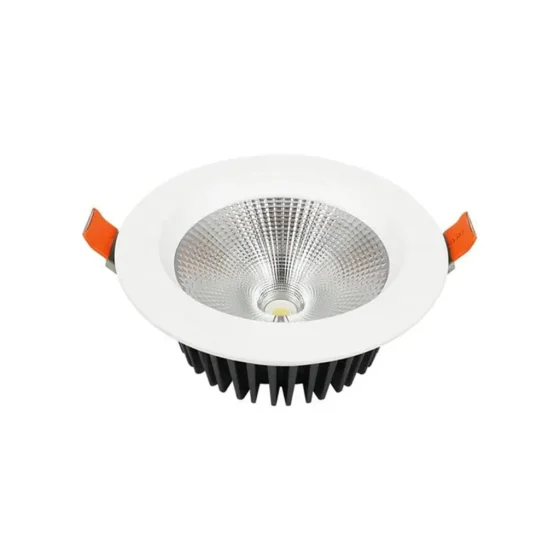
A recessed or regressed source can hide the bright emitter from high viewing angles. Baffles and louvers can shield the light source from direct view at certain angles. Microprismatic optics, by contrast, help control light distribution and luminance at different viewing angles. That is different from simply spreading light into a wide, bright Lambertian face.
A replacement must still deliver suitable room illumination. A “darker looking” fixture that starves the desk is not a win. Results depend on the complete design—optic, recess, luminance distribution—and on how it is installed in that ceiling.
Do not treat recessed lights, prismatic lenses or any single category as automatically better. Compare shielding, high-angle behaviour and layout fit for the actual room.
🎯 Is replacing the diffuser panel enough when glare persists?
Often not. Review the full optical package and mounting, not only the sheet.
📋 5. How Can You Reduce Glare from a Ceiling Light with a Diffuser?
Match the fix to the cause. Do not run every step as if they solve the same problem.
- Check where the glare occurs. Is the fixture uncomfortable to look at directly, or does it appear on a screen (or both)?
- Test dimming. See whether lower output helps without leaving the room too dark.
- Adjust the workstation if a reflection is involved. Change monitor position or angle; check from the normal seated view.
- Inspect the optical design. Is the diffuser face excessively bright? Is the source poorly shielded or too shallow?
- Consider a different fixture design if needed. Look for more suitable shielding or recessed optics—and verify the room still gets enough light.
A workstation tweak can clear a reflection and leave direct glare untouched. Dimming can soften both a little and still fail either. For a broader office checklist that starts from reflected vs direct glare, see How to Reduce Glare from Office Ceiling Lights after you settle the diffuser-specific questions here.
🎯 What is the first step when a diffused ceiling light still glares?
Name whether it is direct discomfort or a screen reflection—then pick the matching fix.
🏁 Conclusion: Why Do Ceiling Lights with Diffusers Still Cause Glare?
Ceiling lights with diffusers can still cause glare because diffusing light does not automatically eliminate direct visual discomfort or reflections.
Identify the type of glare, test simple adjustments, and review the fixture’s optical design when the problem persists.
Scopri gli articoli del blog correlati:
- Come scegliere gli apparecchi di illuminazione per uffici commerciali che garantiscano il massimo comfort.
- Standard di illuminazione per uffici: spiegazione di EN, IES e WELL
- Illuminazione consigliata per l'ufficio, per massimizzare la produttività e il comfort visivo.
FAQ
Optical Configurations for Commercial Projects
XHLUX produce apparecchi per l’illuminazione commerciale Luci lineari a LED E Faretti a LED da incasso for office and workplace projects. Shielding, light distribution, dimming options and screen-comfort requirements can be considered when configuring lighting solutions for specific projects. La configurazione OEM/ODM is available when optics and mounting details must match a defined layout.
If you already have ceiling plans, diffuser type and glare or screen-comfort criteria, send those for a configuration review. We do not claim any product is glare-free without supporting photometry for the installed condition.