XHLUX
XHLUX
Choosing an LED light factory in China is not only about finding a manufacturer with the right product and price.
Buyers also need to verify who is actually making the product, whether the factory can control the required specification, whether its compliance documents match the destination market, and whether the approved sample can be repeated in mass production.
This guide follows that decision in order:
Identity → Capability → Quality → Compliance → Sample → Mass Production → Order Control
A real factory is not automatically the right factory. The right factory must be able to repeat your required product specification at production scale.
In breve: Check the legal entity first. Then look at whether the factory already makes your type of fixture and which processes it controls itself. Treat ISO 9001 as a quality-system certificate, not a product approval, and match every compliance file to your exact model and market. Before mass production, put the sample, the critical components and the acceptance plan in writing.
Sommario
- Who you are buying from
- Can the factory make your type of lighting
- The quality system behind the certificate
- Compliance documents vs product and market
- The sample as the product reference
- Repeating the sample in mass production
- What to fix before the purchase order
- Red flags
- Qualification checklist
- Summary
- FAQ
- Conclusione
🪪 Start by Verifying Who You Are Buying From
Start with the company behind the quotation, not the sales pitch.
China’s National Enterprise Credit Information Publicity System (gsxt.gov.cn), organised by the State Administration for Market Regulation, publishes company registration details, administrative licences, administrative penalties and spot-check results.
Ask the supplier for its full legal name and Unified Social Credit Code, then look the company up there.
| Controllo | What the buyer should look at |
|---|---|
| Legal company name | Matches the contract, quotation and invoice |
| Unified Social Credit Code | The registered entity exists under that name |
| Business scope | Includes lighting manufacturing-related activity |
| Company status | Registered as operating normally |
| Registered / production address | Different addresses can be normal; the supplier should explain where production actually happens |
| Contracting entity | Which company takes responsibility for the order |
| Payment beneficiary | Ask for an explanation if it differs from the contracting company |
The registered address and production address do not have to be the same, but the supplier should be able to explain and document where production actually takes place.
A manufacturing-related business scope is useful evidence, but it does not prove by itself that the supplier actually manufactures your product.
Production capability is the next check.
🎯 What does a company registry check prove?
That the entity exists and what it may do—not that it builds your product; production evidence comes next.
🏭 Can the Factory Actually Make Your Type of Lighting?
Having production lines does not make a factory suitable. Category fit does.
A mature bulb factory is not automatically right for track lights. An outdoor lighting plant is not automatically right for high-end commercial OEM work.
Look at product fit, not product count
Per OEM LED factory sourcing, check whether the factory:
- has made the same or a similar fixture category for years
- already runs wattages, sizes or optical platforms close to your specification
- understands how the driver, LEDs, optics and thermal design work together
- can deliver the dimming and control options you need
- has handled OEM or ODM development similar to yours
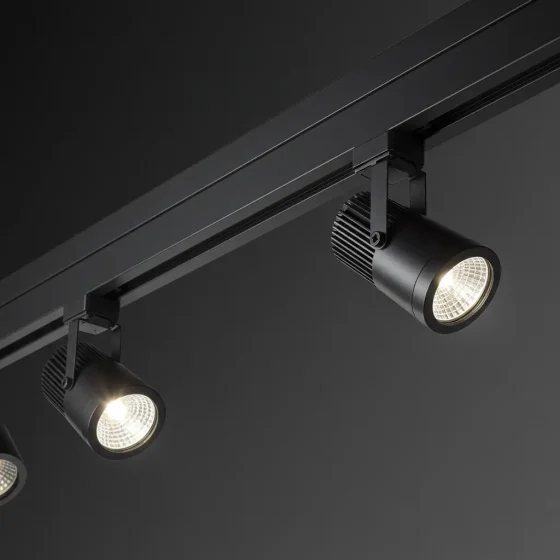
Our own range at XHLUX, for example, centres on commercial Faretti a LED, Faretti a LED da incasso E Luci lineari a LED, with control options such as TRIAC, DALI, 0/1-10V and ZigBee.
A factory whose catalogue already sits close to your fixture type starts your project with fewer engineering unknowns.
In-House vs Outsourced Processes
A factory does not need to manufacture every component in-house. What matters is which processes it controls and how outsourced processes and suppliers are managed.
| Process | What the buyer should understand |
|---|---|
| Product engineering | Who handles mechanical, electrical and optical changes |
| PCB / SMT | Made in-house or by a subcontractor |
| Housing / die casting | Made in-house or by a supplier |
| Painting / finishing | How colour and surface consistency are controlled |
| Autista | Own design, branded or third-party |
| Ottica | Who defines the beam angle and optical specification |
| Final assembly | Done in the main factory or elsewhere |
| Testing | Which tests run in-house and which go to a third-party lab |
Asked this way, “in-house vs outsourced” becomes a question of supply-chain control rather than a marketing claim.
🎯 Must a factory make every part itself?
No. It must control the processes that shape your product and manage the suppliers behind the outsourced ones.
✅ Check the Quality System Behind the Certificate
An ISO 9001 certificate shows that a quality management system is in place. It is not a product certificate for any LED fixture.
ISO 9001 sets requirements for establishing, running, monitoring and improving a quality management system. The current edition, ISO 9001:2026, was published on 16 September 2026 and replaces the 2015 edition.
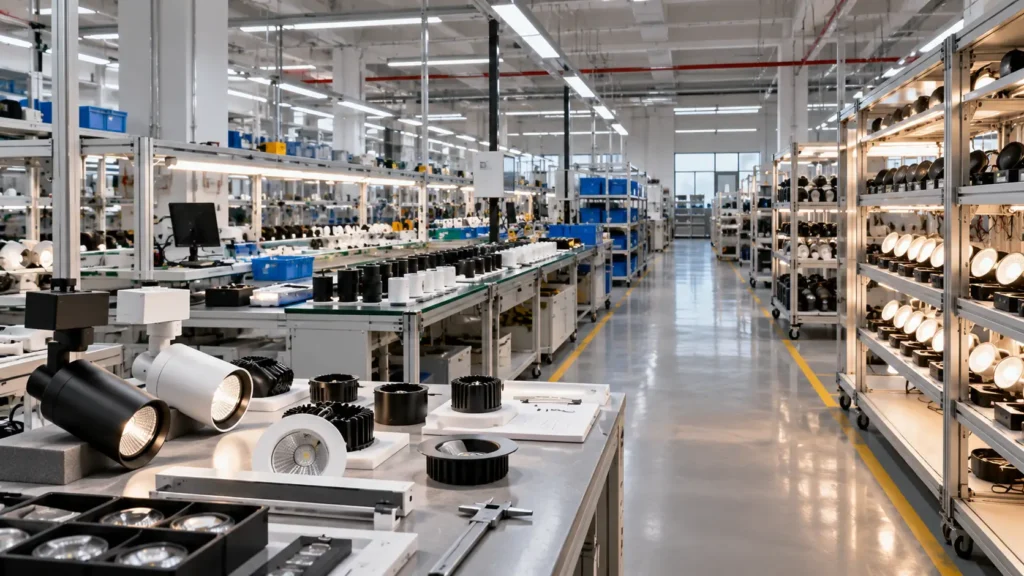
What matters for your order is how that system handles your parts. LED factory quality control shows up in records such as:
- incoming quality control (IQC) for LEDs, drivers, housings and optics
- first-article or production-start checks
- in-process inspection
- final inspection
- test-equipment calibration
- handling of non-conforming product
- corrective-action records
- batch and production traceability
- controls on approved components and suppliers
Ask for evidence, not just a certificate.
“Show me the current QMS certificate” is only a start. Then ask: Can you show how this system controls the LED, driver, housing and optical components used in my order?
A China LED factory audit, whether you visit, send an inspector or run it remotely, should follow those records all the way to your product line.
At XHLUX, our QC team inspects goods before they ship, and we supply IES and LDT photometric files on request so buyers can compare product data with their own requirements.
🎯 Does a QMS certificate prove product quality?
No. It proves a management system exists; IQC, inspection and traceability records show whether it controls your order.
📑 Do the Compliance Documents Match the Product and Market?
Start with the destination market, then check whether each document covers the exact product you are buying.
Many sourcing lists line up CE, RoHS, CB, ENEC and SAA as if more logos meant less risk. The useful question is narrower:
Country → Product → Electrical configuration → Control technology → Applicable requirements
What CE marking actually means
CE marking is not an EU safety approval.
Under EU rules, the manufacturer identifies the applicable legislation, carries out the conformity assessment, prepares the technical documentation and signs the EU Declaration of Conformity before affixing the mark. No central EU body issues permission to use it.
For mains-connected LED luminaires, the EU rules buyers meet most often include:
- Low Voltage Directive 2014/35/EU: electrical safety for equipment rated 50–1000 V AC or 75–1500 V DC
- EMC Directive 2014/30/EU: electromagnetic emissions and immunity
- RoHS Directive 2011/65/EU: restricts ten hazardous substances in electrical and electronic equipment
Products with wireless control modules can fall under further EU rules, so the exact control version matters.
What to check in each document
Do not stop at the logo on a PDF. Check:
- the applicant or manufacturer named
- the exact model or model family
- the product description
- voltage and electrical configuration
- the referenced standards
- report date and validity, where applicable
- the laboratory or certification body
- the Declaration of Conformity
- whether it covers the version you plan to order
A certificate for a similar-looking product is not automatically evidence for the product you are ordering.
If the driver, wireless module, housing or a key electrical configuration changes, do not assume the original file still covers the product fully.
🎯 Can a report for a similar model be reused?
Only if it covers your exact configuration; a different driver, module or housing can leave the file incomplete.
🧪 Use the Sample to Lock the Product Specification
A sample earns its value when it becomes the documented reference for the production specification and inspection criteria.
Build an Approved Sample Specification from it:
| Articolo | Example of what to fix |
|---|---|
| Potenza | Agreed value and tolerance |
| Luminous output | Requisiti del progetto |
| CCT | Required option |
| CRI | Required level |
| Colour consistency | Required specification |
| angolo del fascio | Agreed optic |
| Autista | Brand and model, or agreed specification |
| Dimming / control | Exact required version |
| Alloggi | Dimensions and material |
| Fine | Colour and texture |
| Etichetta | Market and order information |
| Packaging | Agreed configuration |
For commercial fixtures like the ones we build, beam, CRI, CCT, driver, dimming and control, housing and finish matter far more than whether the sample simply looks bright.
An approved sample is not permission to change the BOM later
The sample only protects the order if the parts behind it stay the same. Pair it with:
- a retained golden sample held by both sides
- an agreed bill of materials (BOM) or critical-component list
- a rule that substitutions need the buyer’s written consent
- engineering change notification before any change reaches production
These are the base for batch consistency in the next step.
🎯 What should a signed-off sample do for the order?
Become the documented reference for specs, parts, finish and the inspection criteria used in production.
🔁 Can the Factory Repeat the Sample in Mass Production?
The real test of an LED factory is not whether it can make one good sample. It is whether it can reproduce that specification across a production batch.
The path from sample to bulk usually runs like this:
Approved sample → Pilot / first production → Incoming control → Assembly → In-process inspection → Testing → Final inspection → Shipment
What to check for batch consistency
Compare each batch with the project specification rather than a generic standard:
- power
- power factor (PF)
- lumen output
- CCT
- CRI
- colour consistency
- beam distribution
- dimming behaviour
- housing dimensions
- surface finish
- labels and packaging
Capacity is more than pieces per month
LED factory production capacity only means something for your product line. Ask:
- Which line will actually build your product?
- How many production days does one batch need?
- How is capacity shared in peak season?
- Which process is the bottleneck?
- Does a custom order need extra tooling or engineering time?
- Will any part of the order be passed to another factory?
🎯 What proves a factory can handle your order?
A full production batch that matches the signed-off sample and specification, not one good-looking prototype.
📝 What Should Be Fixed Before the Purchase Order?
Many supplier problems are not capability failures. The buyer and the factory simply never wrote the requirements down.
The purchase order or technical agreement should state at least:
- the agreed product specification
- the agreed driver or control module
- the critical components
- that substitutions require the buyer’s consent
- tolerances
- marking and labels
- packaging
- the inspection method
- the compliance documents required
- the delivery schedule
- how defects are handled
- warranty responsibility
- the pre-shipment inspection arrangement
Name the export documents you need in the order as well, so they are part of the China lighting export process from the start rather than a request after loading.
There is no single AQL number that suits every product and market.
Define the sampling and acceptance plan before production rather than arguing about acceptable defects after the shipment is finished.
🎯 When should acceptance terms be agreed?
Before production starts, so inspection judges the batch against written terms instead of opinions after shipment.
🚩 Red Flags That Need More Verification
None of these signals rules a supplier out on its own. Each one is a reason to pause and ask for more evidence.
| Signal | Why it needs verification |
|---|---|
| Website says factory but production evidence is vague | The manufacturing role is unclear |
| Company name changes across documents | The contracting entity needs to be pinned down |
| Certificate model does not match the quotation | The compliance evidence may not apply to your order |
| Supplier cannot explain critical outsourced processes | Supply-chain control is unclear |
| Sample is signed off but component substitutions are unrestricted | Batch consistency is at risk |
| No traceability from batch to components | Problems are hard to trace later |
| Very short lead time with no production explanation | Real capacity needs checking |
| Factory refuses reasonable inspection access | The buyer cannot see the order status |
🎯 Should one red flag end the talks?
Not by itself; pause, ask for the missing evidence and decide once the supplier has answered it or failed to.
🧾 LED Light Factory Qualification Checklist
Usa questo LED factory verification checklist as the final qualification record before the first order:
| Zona | Status |
|---|---|
| Legal entity verified | □ |
| Manufacturing role verified | □ |
| Product-category capability confirmed | □ |
| Critical in-house / outsourced processes understood | □ |
| Quality-management evidence reviewed | □ |
| Product compliance checked for destination market | □ |
| Sample and specification approved | □ |
| Critical components / BOM controlled | □ |
| Production capacity confirmed | □ |
| Batch QC and traceability defined | □ |
| Pre-shipment inspection agreed | □ |
| Warranty / defect process agreed | □ |
Do not qualify a supplier because one box looks strong. The decision should come from the complete evidence set.
📌 Summary
- Verify the legal supplier before evaluating the sales pitch.
- Choose a factory that already fits your product category and specification complexity.
- Treat ISO 9001 as evidence of a QMS—not as product certification.
- Verify compliance against the exact product and destination market.
- Lock the sample, components and production controls before mass production.
FAQ
🏁 Conclusion: Which LED Light Factory Is the Right One for an Export Buyer?
The best LED light factory for an export buyer is not simply the factory with the lowest quotation, the largest workshop or the longest certificate list. It is the factory that can show how your approved specification will be controlled from components and samples through mass production and shipment.
Each check in this guide adds one piece of that evidence. Together they tell you whether a China LED lighting factory belongs in your supply chain.
Scopri gli articoli del blog correlati:
- Come una fabbrica di faretti a LED magnetici garantisce la qualità del prodotto
- Cosa cercano gli acquirenti di progetti nei fornitori di illuminazione commerciale
- Come scegliere un produttore di illuminazione LED commerciale
Note e fonti
- State Council — Interim Regulations on Enterprise Information Disclosure (企业信息公示暂行条例), Articles 5–7 and 14: the market regulator organises the National Enterprise Credit Information Publicity System and publishes registration, administrative licence, administrative penalty and spot-check information there (samr.gov.cn; gsxt.gov.cn).
- ISO 9001:2026 Quality management systems — Requirements: published 16 September 2026, replacing ISO 9001:2015 (ANSI and BSI announcements, 16 September 2026). Transition requirements for accredited certification (Global ACI-TECH-3-TR, published 16 September 2026, with ISO transition guidance): organisations certified to ISO 9001:2015 have until 30 September 2029 to complete the transition; from 31 March 2028, new and initial accredited certifications may only be issued to ISO 9001:2026.
- European Union — Your Europe: CE marking: manufacturer responsibility, own-name or own-brand sellers treated as manufacturers, no central EU body issuing permission, technical documentation and EU Declaration of Conformity (europa.eu).
- European Commission — Low Voltage Directive (LVD) page: Directive 2014/35/EU, 50–1000 V AC and 75–1500 V DC; warning that voluntary certificates are not a recognised means to prove compliance and must not bear the CE marking (single-market-economy.ec.europa.eu).
- European Commission — Electromagnetic Compatibility (EMC) Directive page: Directive 2014/30/EU on emissions and immunity (single-market-economy.ec.europa.eu).
- European Commission — RoHS Directive page: Directive 2011/65/EU restricting ten hazardous substances in electrical and electronic equipment (environment.ec.europa.eu).
- Signify — press release “Signify publishes 2025 Annual Report”, 24 February 2026: world leader in lighting; 2025 sales of EUR 5.8 billion (signify.com).
- US Department of Energy — 2020 LED Manufacturing Supply Chain (2021): LED lamp manufacturing dominated by China; LED luminaire manufacturing distributed worldwide; China the largest LED luminaire exporter in 2019, with about USD 15.52 billion in exports (energy.gov).
Sourcing Commercial LED Lighting from China?
XHLUX designs and manufactures commercial LED track lights, downlights and linear lights, with OEM and ODM options and TRIAC, DALI, 0/1-10V or ZigBee control configurations. Depending on the product and target market, XHLUX can provide relevant certification and compliance documentation, including CE and RoHS documentation and CB, ENEC or SAA certifications where applicable.
Send us your specification and target market, and we will show you which files cover the version you plan to order.