 XHLUX
XHLUX

Sommario
- Why Beam Angle Flexibility Is Quietly Becoming a Project-Critical Decision
- 1. Why Zoomable LED Track Lights Are Replacing Fixed-Beam Fixtures in Commercial Projects
- 2. What Is a Zoomable LED Track Light? (Project-Level Definition)
- 3. Why the 15–55° Beam Angle Range Is the “Golden Zone” for Commercial Projects
- 4. How 15–55° Zoomable Track Lights Perform in Real Commercial Scenarios
- 5. Why Fixed Beam Track Lights Are Becoming a Liability in Long-Term Projects
- 6. What Makes a High-Quality 15–55° Zoomable LED Track Light
- 7. Zoomable Track Lights in OEM, Private Label, and Global Distribution
- 8. Comparing 15–55° with Other Zoom Ranges
- 9. Procurement Checklist: What to Confirm Before Specifying a Zoomable Track Light
- 10. FAQ About Zoomable LED Track Light
- 11. Why 15–55° Zoomable LED Track Lights Are a Smarter Long-Term Choice
- Welcome to Cooperate
Why Beam Angle Flexibility Is Quietly Becoming a Project-Critical Decision
In today’s commercial lighting projects, the biggest risk is no longer insufficient brightness.
It is inflexibility.
Retail spaces rebrand. Exhibitions rotate. Museums re-curate. Offices reconfigure.Yet many lighting systems are still designed around fixed beam angles, locking projects into decisions made months—or years—before actual use.
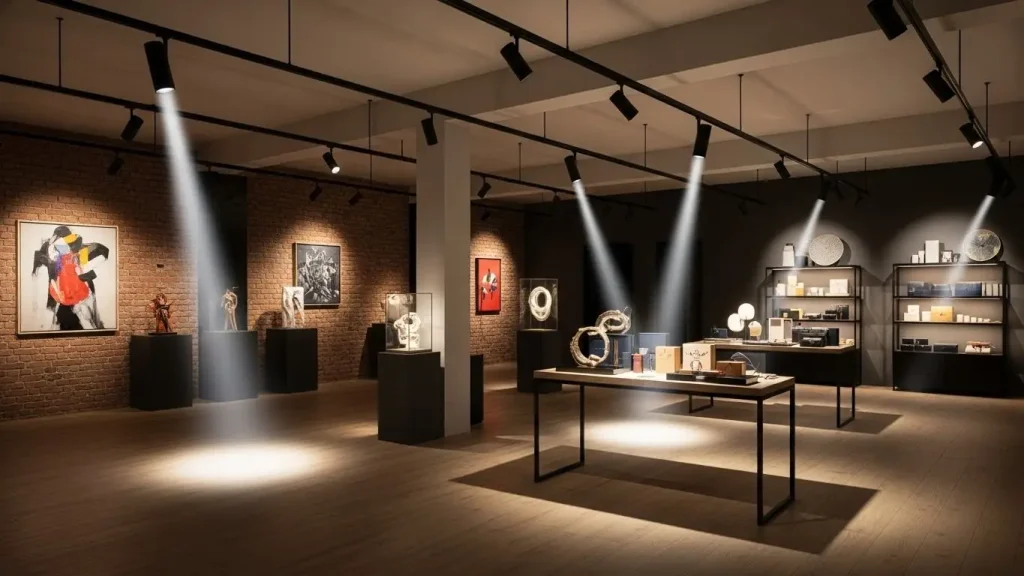
This is why Zoomable LED Track Light has rapidly become a high-intent search term across global SERPs, especially among:
- Commercial lighting designers
- Retail and showroom project managers
- Museum and gallery consultants
- OEM and private-label lighting brands
But not all zoomable track lights are created equal.
This article focuses on one critical, experience-driven question:
Why is a 15–55° beam angle range widely considered the most practical and project-safe choice for commercial track lighting?
If you are designing, sourcing, or specifying track lights for long-term commercial use, this guide will help you make a decision based on real project logic, not marketing parameters.
1. Why Zoomable LED Track Lights Are Replacing Fixed-Beam Fixtures in Commercial Projects
The Shift from Static to Adaptive Lighting
Modern commercial spaces are no longer static environments. They are living systems.
Across global projects, we consistently see the same pattern:
| Space Type | Frequency of Layout Change |
|---|---|
| Retail stores | High (seasonal / campaign-based) |
| Showrooms | Very high (product rotation) |
| Museums & galleries | Continuous (curation-driven) |
| Offices & public spaces | Medium to high (functional change) |
Fixed-beam track lights were designed for predictable, permanent layouts.
Commercial reality has moved on.
The Hidden Cost of Fixed Beam Angles
At first glance, fixed beam lights appear economical. In practice, they often lead to:
- Frequent fixture replacement
- Lens swaps requiring labor access
- Over-lighting or under-lighting compromises
- Increased SKU complexity for distributors
- Higher total cost of ownership (TCO)
Zoomable LED track lights address these issues by allowing light to adapt after installation.
Instead of replacing hardware, you adjust light distribution.
2. What Is a Zoomable LED Track Light? (Project-Level Definition)
A zoomable LED track light is a track-mounted luminaire that allows continuous beam angle adjustment—typically via a mechanical or optical zoom system—without changing lenses or fixtures.
Key Differences vs Fixed-Beam Track Lights
| Feature | Fixed Beam | Zoomable |
|---|---|---|
| angolo del fascio | Single, fixed | Adjustable range |
| Flexibility | Low | High |
| Reconfiguration cost | High | Minimal |
| SKU requirements | Multiple | Reduced |
| Long-term adaptability | Limited | Excellent |
From a project perspective, the value of zoomable track lighting is not technological novelty—it is operational resilience.
Zoomable track lights are not designed to impress.
They are designed to survive change.
3. Why the 15–55° Beam Angle Range Is the “Golden Zone” for Commercial Projects
This is the most important section of the article.
The 15–55° beam angle range did not become popular because of datasheets—it became popular because of project experience.
Beam Angle Coverage and Real-World Application
| Beam Angle | Typical Use Case |
|---|---|
| 15–20° | Accent lighting, focal objects, artwork |
| 24–30° | Product highlighting, vertical displays |
| 36–40° | General accent + partial area lighting |
| 45–55° | Zonal lighting, background illumination |
Together, 15–55° covers over 80% of commercial lighting needs across retail, exhibition, cultural, and office environments.
Why Not Narrower Than 15°?
Ultra-narrow beams (8–10°):
- Require extremely precise aiming
- Are unforgiving of mounting height variations
- Increase glare risk
- Reduce margin for installation error
They are powerful—but high risk in general commercial use.
Why Not Wider Than 55–60°?
Overly wide beams:
- Lose accent definition
- Cause light spill beyond target areas
- Reduce contrast and visual hierarchy
At that point, linear or diffuse lighting systems are often more appropriate.
15–55° strikes the balance between precision, tolerance, and usability.
4. How 15–55° Zoomable Track Lights Perform in Real Commercial Scenarios
Retail & Brand Stores
Retail lighting lives in a constant state of change.
With 15–55° zoomable track lights:
- Narrow beam for hero products
- Medium beam for shelves
- Wider beam for seasonal layouts
- No fixture replacement required
This is especially valuable for chain stores, where maintenance simplicity equals cost control.
Showrooms & Experience Centers
Showrooms demand adaptability without disruption.
Zoomable lights allow teams to:
- Reframe exhibits overnight
- Avoid re-wiring or re-aiming complexity
- Maintain consistent lighting language across displays
Museums & Galleries
In museum and gallery environments, lighting must respect:
- Artwork boundaries
- Conservation requirements
- Frequent curatorial changes
Zoomable track lights support:
- Small works → narrow beam
- Large works → wider beam
- Re-curation without hardware intervention
This is why zoomable track lighting is widely specified in museum framing projects.
Offices & Public Spaces
Modern offices are increasingly hybrid and reconfigurable.
15–55° zoomable fixtures allow:
- Task lighting emphasis
- Informal zone highlighting
- Flexible adaptation to layout changes
5. Why Fixed Beam Track Lights Are Becoming a Liability in Long-Term Projects
The False Economy of Fixed Beams
While fixed beam lights may reduce initial cost, they often increase:
- Labor expenses
- Downtime during reconfiguration
- Inventory complexity
- Inconsistent lighting outcomes
| Cost Type | Fixed Beam | Zoomable |
|---|---|---|
| Initial fixture cost | Lower | Slightly higher |
| Reconfiguration cost | High | Low |
| Maintenance labor | High | Low |
| Long-term TCO | Higher | Lower |
Commercial lighting should be evaluated over years, not at purchase order stage.
6. What Makes a High-Quality 15–55° Zoomable LED Track Light
Not all zoomable systems deliver professional results.
A project-grade zoomable track light must achieve consistency across its entire zoom range.
Critical Quality Indicators
- Smooth, continuous zoom (no step jumps)
- Stable beam shape at all angles
- Clean beam edges with minimal stray light
- Balanced center-to-edge distribution
- Effective glare control (deep optics, shielding)
- Durable mechanical structure (no looseness over time)
- Compatibility with high-CRI light engines (CRI90 / CRI95 / CRI97)
The challenge is not making light adjustable.
The challenge is making it adjustable without degrading quality.
7. Zoomable Track Lights in OEM, Private Label, and Global Distribution
From an OEM and distribution perspective, zoomable track lights deliver structural advantages.
OEM / ODM Benefits
- Fewer SKUs to manage
- Unified product platforms across markets
- Easier certification strategy
- Reduced inventory risk
Global Distribution Advantages
- One product fits multiple project scenarios
- Simplified training for sales teams
- Easier after-sales support
For large-scale buyers, a single 15–55° zoomable model can replace multiple fixed-beam products.
8. Comparing 15–55° with Other Zoom Ranges
Rather than tables, experienced buyers use logic:
- Ultra-narrow zoom ranges → specialized, low tolerance
- Ultra-wide zoom ranges → impressive specs, limited real use
- 15–55° → balanced, repeatable, project-safe
Projects succeed on probability, not extremes.
9. Procurement Checklist: What to Confirm Before Specifying a Zoomable Track Light
✔ True 15–55° continuous zoom
✔ Consistent light quality across range
✔ Compatibility with DALI / DALI-2 / 0–10V
✔ Proven commercial project references
✔ OEM / ODM customization capability
✔ Long-term supply stability
✔ Support for commercial lighting solutions, not just fixtures
✔ Optional SKD supply for cost-optimized international projects
10. FAQ About Zoomable LED Track Light
Q1: Are zoomable track lights less reliable than fixed beam lights?
Not when properly engineered. Poor design—not zooming—is the risk factor.
Q2: Is 15–55° suitable for all commercial projects?
It covers the majority of retail, exhibition, museum, and office applications.
Q3: Does zooming reduce brightness?
Beam distribution changes, but quality designs manage output effectively.
Q4: Can one zoomable light replace multiple fixed beam models?
Yes—this is its core economic value.
Q5: Are zoomable lights suitable for residential use?
They are typically over-specified for residential environments.
11. Why 15–55° Zoomable LED Track Lights Are a Smarter Long-Term Choice
Commercial environments change.
Lighting systems must anticipate that change—not resist it.
A 15–55° zoomable LED track light offers:
- Flexibility for designers
- Stability for project owners
- Simplicity for maintenance teams
- Scalability for brands and OEM clients
It is not the cheapest solution—but it is often the most rational one.
15–55° Zoomable LED Track Light = lighting designed for the life of the space, not the day of installation.
Welcome to Cooperate
If your project involves commercial interior lighting, retail environments, exhibition spaces, or long-term OEM programs, working with a supplier who understands lighting systems—not just luminaires—matters.
You may find the following helpful:
- Contact Page – general inquiries
- Project Consultation – discuss application scenarios
- OEM Inquiry – private label & long-term cooperation
- Download Catalog – review commercial lighting solutions
We support commercial lighting products, system matching, OEM/ODM programs, SKD services, and project-oriented lighting solutions—designed for real-world commercial environments.