 XHLUX
XHLUX

Table of contents
- 1. Why Flos Architectural Lighting Matters in Contemporary Design
- 2. Product Qualities & Core Philosophy of Flos Architectural Lighting
- 3. Where Flos Architectural Lighting Fits Exceptionally Well
- 4. Advantages of Flos Architectural Lighting
- 5. Where Flos Fails / Is Not Ideal (Limitations & Misfits)
- 6. How to Use Flos Architectural Lighting Correctly (Design Guidelines)
- 6.1 Begin with Light Positioning (Lighting Layout), Not Fixture Layout
- 6.2 Use Layered Lighting: Ambient + Accent + Wall-Wash + Perimeter
- 6.3 Choose High CRI (90–95+) to Emphasize Material Quality
- 6.4 Plan Controls Early (Dimming, Scenes, Integration)
- 6.5 Coordinate Closely with Contractors
- 6.6 Avoid Over-Illumination
- 7. FAQ About Flos Architectural Lighting
- Q1. Is Flos Architectural Lighting suitable for normal residential spaces?
- Q2. What makes Flos different from typical commercial lighting brands?
- Q3. Should Flos be used in large retail chain rollouts?
- Q4. Can Flos integrate seamlessly with minimalist interiors?
- Q5. Is Flos a good option for export or OEM projects?
- 8. Conclusion
1. Why Flos Architectural Lighting Matters in Contemporary Design
Flos, the iconic Italian lighting brand, has long represented the fusion of architecture, industrial design, optical innovation, and emotional experience. While the decorative side of Flos is widely known for its collaborations with masters like Castiglioni, Prouvé, and Grcic, the Flos Architectural division plays a critical role in shaping the lighting language of today’s built environments.
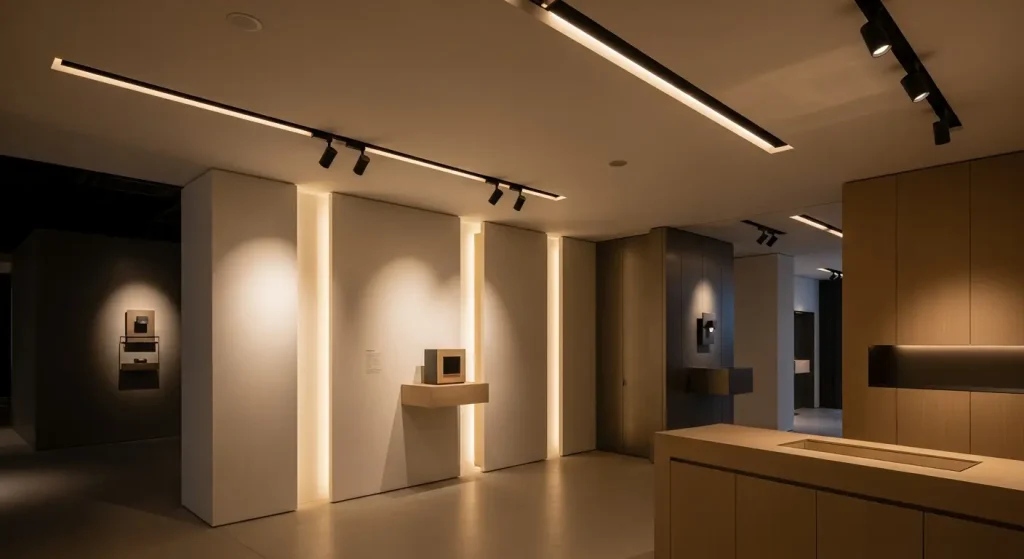
Flos Architectural is defined by:
- Minimalist forms
- Integrated lighting systems
- High optical precision
- A “light-first, fixture-invisible” philosophy
- High-end performance suitable for contemporary premium spaces
As contemporary architectural design moves toward:
- Purity
- Integration
- Seamless surfaces
- Hidden luminaires
- Ambient atmospheres
- Soft gradients and shadow control
…Flos Architectural has become a preferred choice for architects and designers seeking light as the protagonist, not the luminaire.
This article explores where Flos Architectural Lighting truly excels, where it may not be the ideal fit, and how to use it strategically in demanding contemporary projects.
2. Product Qualities & Core Philosophy of Flos Architectural Lighting
Flos Architectural is built on the idea that light should shape the environment while fixtures remain understated, discreet, or even completely invisible. This aligns with the contemporary trend of “architecture as atmosphere.”
2.1 Product Categories
Flos Architectural offers a comprehensive range of systems that fall into the following families:
1. Recessed Systems
- Trimless downlights
- Integrated slot lights
- Recessed linear systems
- Adjustable accent modules
- Wall-wash optics
These systems create clean ceilings with almost no visible hardware.
2. Track & Ceiling Systems
- Track-mounted spotlights
- Magnetic track systems
- Grid ceiling integrations
These focus on flexibility + minimal aesthetic presence.
3. Surface & Suspension Minimalist Fixtures
- Slim pendants
- Linear suspended systems
- Architectural tubes
- Ceiling surface modules
4. Optical Tools & Architectonic Light Engines
- Controlled cutoff
- Low-glare modules
- High-CRI LED platforms
- Specialized wall-wash optics
Flos’ commitment to optical research and engineering is well documented.
2.2 Design Philosophy — “Make the Light Visible, Not the Fixture”
The architectural lighting division is built on three pillars:
1. Fixtures should “disappear.”
Ceilings remain intact, uncluttered, and visually calm.
2. Light should define space.
Not through brightness alone, but through:
- Vertical gradients
- Ambient softness
- Shadow balance
- Perimeter emphasis
- Precise accenting
3. Optical performance must be exceptional.
Flos incorporates:
- High CRI (90–95+)
- Consistent CCT
- Controlled UGR
- Sophisticated shielding systems
- Clean beam edges
For reference, ERCO guide also emphasizes optical precision and clean beams as essential qualities in architectural lighting.
2.3 Suitable for High-Integration Architecture
Flos Architectural systems are best used when the design intent requires:
- Seamless integration
- Minimal visual noise
- Hidden technical elements
- Soft, atmospheric light
- Highly controlled optical directionality
This aligns with the goals of premium residential, boutique hospitality, modern commercial spaces, and galleries.
3. Where Flos Architectural Lighting Fits Exceptionally Well
Below are spaces where Flos Architectural Lighting fully expresses its design and technical advantages.
3.1 High-End Residential, Modern Apartments & Loft Spaces
Flos is a perfect match for:
- Natural materials (wood, stone, concrete)
- Large surface purity
- Minimalist interior design
- Open lofts
Key lighting effects achieved:
- Shadow softness
- Architectural continuity
- Layered ambient light
- Trimless integration
- Narrow-beam accents for art or sculpture
3.2 Boutique Hotels, Resorts & Premium Hospitality Spaces
In hospitality, Flos Architectural creates:
- Luxury ambience
- Emotional, immersive environments
- Smooth wall-wash layers
- Decorative + architectural hybrid lighting concepts
Flos systems help create “wow moments,” essential in hospitality branding.
Zumtobel’s case studies affirm the importance of layered ambient lighting in boutique hotels.
3.3 High-End Retail & Fashion Showrooms
Fashion spaces require:
- Clean, minimal ceilings
- High CRI
- Controlled accent beams
- Geometry that supports brand aesthetics
Flos excels because:
- The fixture disappears
- Merchandise becomes the focal point
- Accents remain adjustable for changing displays
3.4 Creative Offices & Corporate Headquarters
Corporate spaces today prioritize:
- Wellness
- Design minimalism
- Quiet ceilings
- High uniformity with low glare
Flos linear systems and recessed downlights contribute to:
- Calm visual environments
- Clean architectural expression
- High comfort for long work hours
Signify’s Lighting University also highlights vertical light + ambient minimalism as key to contemporary office comfort.
3.5 Galleries, Museums & Art Exhibition Spaces
Flos Architectural is widely used in exhibition design due to:
- High CRI (95+)
- Clean beam control
- Precise wall-wash optics
- Adjustable accent lighting
- Completely minimal ceiling presence
This allows artwork—not luminaires—to dominate the visual hierarchy.
4. Advantages of Flos Architectural Lighting
Flos is successful not only because of design aesthetics but also technical excellence.
4.1 Extreme Architectural Integration (“Disappear Into the Space”)
- Trimless integration
- Minimal edge profiles
- Ultra-thin linear systems
- Low-glare optics
This enables a pure architectural reading of the ceiling plane.
4.2 Highly Professional Optical Systems
Flos emphasizes:
- Clean beam edges
- High cutoff angles
- Shielding systems
- Anti-glare engineering
- Wall-wash uniformity
- Precise asymmetrical optics
These are key features that differentiate architectural-grade lighting from general LED fixtures.
4.3 Ideal for Premium, Design-Focused Projects
Flos is often selected for:
- High-end residential
- Ospitalità
- Art spaces
- Luxury retail
- Award-winning architecture
Because its products match the aesthetic demands of top-tier architects.
4.4 Consistency, Brand Prestige & Long-Term Value
Flos provides:
- CCT consistency
- High material craftsmanship
- Long-term portfolio stability
- Architectural system integrity
This matters deeply in design-driven projects.
5. Where Flos Fails / Is Not Ideal (Limitations & Misfits)
Flos is exceptional—but not universal. Certain projects benefit more from commercial-grade or cost-optimized lighting brands.
5.1 Budget-Sensitive Projects
Flos pricing is premium:
- Higher upfront cost
- Higher installation precision cost
- Higher replacement cost
Not suitable for:
- Large retail chains
- Fast-move commercial renovations
- Cost-controlled rollouts
5.2 Construction-Heavy or Low-Precision Environments
Trimless systems require:
- Perfect gypsum alignment
- Millimeter-level tolerances
- Skilled installation teams
In rough or timeline-pressed projects, this is risky.
5.3 Large-Scale Chains or Spaces with Rapid Display Changes
Although Flos offers track systems, they are not optimized for:
- Cost efficiency
- Quick reconfiguration
- High-volume retail deployments
5.4 Industrial Spaces or High-Power Lighting Requirements
Flos emphasizes light quality, not high lumen output.
Industrial or high-bay spaces may require:
- 20,000 lm fixtures
- High efficiency
- Utility-grade performance
This is not Flos’ domain.
5.5 OEM / ODM / Export Projects
Flos:
- Does not support OEM
- Does not offer customized SKD/CKD
- Is not suited for large-scale export projects
For those needs, brands like XHLUX Lighting are more fitting.
6. How to Use Flos Architectural Lighting Correctly (Design Guidelines)
For success in real-world projects, follow the guidelines below.
6.1 Begin with Light Positioning (Lighting Layout), Not Fixture Layout
Architectural lighting must respond to:
- Volume
- Surfaces
- Material direction
- Visual axes
Flos works best when lighting intent is planned before ceiling details.
6.2 Use Layered Lighting: Ambient + Accent + Wall-Wash + Perimeter
Combining these layers creates:
- Soft atmosphere
- Visual hierarchy
- Perceived brightness without glare
A typical Flos mix:
- Ambient linear
- Accent spots
- Wall-wash for texture
- Decorative minimal pendant (optional)
6.3 Choose High CRI (90–95+) to Emphasize Material Quality
Flos is frequently selected for spaces with:
- Stone
- Timber
- Leather
- Fabric texture
- Fine art
High CRI is critical.
6.4 Plan Controls Early (Dimming, Scenes, Integration)
Flos supports:
- DALI
- Casambi
- 0–10V
- Tunable white
Controls should be planned during early design phases.
DALI reference
6.5 Coordinate Closely with Contractors
For trimless systems:
- Install at the exact drywall stage
- Level with ceiling planes
- Ensure recess depth accuracy
- Maintain uniform linear gaps
A single construction error can compromise the entire aesthetic.
6.6 Avoid Over-Illumination
Flos is designed for minimalism.
Too much brightness destroys:
- Ambience
- Shadow softness
- Architectural calmness
7. FAQ About Flos Architectural Lighting
Q1. Is Flos Architectural Lighting suitable for normal residential spaces?
Yes—if the budget is sufficient and the homeowner values design.
No—if cost efficiency is the priority.
Q2. What makes Flos different from typical commercial lighting brands?
Flos is a light-environment design brand, not a cost-performance utility brand.
It focuses on aesthetics, optical precision, and architectural integration.
Q3. Should Flos be used in large retail chain rollouts?
Usually no.
Cost, maintenance, and flexibility concerns make other brands more suitable.
Q4. Can Flos integrate seamlessly with minimalist interiors?
Yes—this is their strongest advantage.
Q5. Is Flos a good option for export or OEM projects?
No. Flos does not offer OEM/ODM/SKD.
8. Conclusion
Flos Architectural Lighting is the ideal choice when the project requires:
- High design quality
- Subtle, integrated light
- Minimalist architectural aesthetics
- Precision optical performance
- Premium brand identity
Flos fits best in:
- Luxury residential
- Boutique hotels
- Galleries
- High-end retail
- Creative corporate spaces
However, it is not suitable for:
- Cost-sensitive commercial rollouts
- Industrial environments
- OEM/SKD-based international projects
- Large-scale chain stores
For clients requiring commercial efficiency, custom manufacturing, or large-scale import, brands like XHLUX Lighting complement or replace Flos with more flexible, economical solutions.