 XHLUX
XHLUX

Table of contents
- 1. Why “Rotatable + Pull-Out” Commercial Spotlights Are Rapidly Gaining Adoption
- 2. What Is a Rotatable Pull-Out Commercial LED Spotlight?
- 3. Why Fixed Commercial Spotlights Fail in Real Projects
- 4. Core Value of Rotatable Pull-Out Structures in Commercial Projects
- 5. Typical Application Scenarios for Rotatable Pull-Out Commercial LED Spotlights
- 6. Rotatable Pull-Out vs Adjustable Angle Downlights
- 7. Key Considerations When Choosing Pull-Out Commercial Spotlights
- 8. What Pull-Out Spotlights Mean for High-End Projects and Designers
- 9. Common Misunderstandings in Using Pull-Out Spotlights
- 10. FAQ About Pull-Out Commercial Spotlights
- 11. Conclusion
1. Why “Rotatable + Pull-Out” Commercial Spotlights Are Rapidly Gaining Adoption
Commercial lighting today is no longer judged by how evenly a space is illuminated on opening day. In real commercial environments—especially retail, branded showrooms, hospitality public areas, and exhibition-driven spaces—lighting is expected to adapt long after installation.
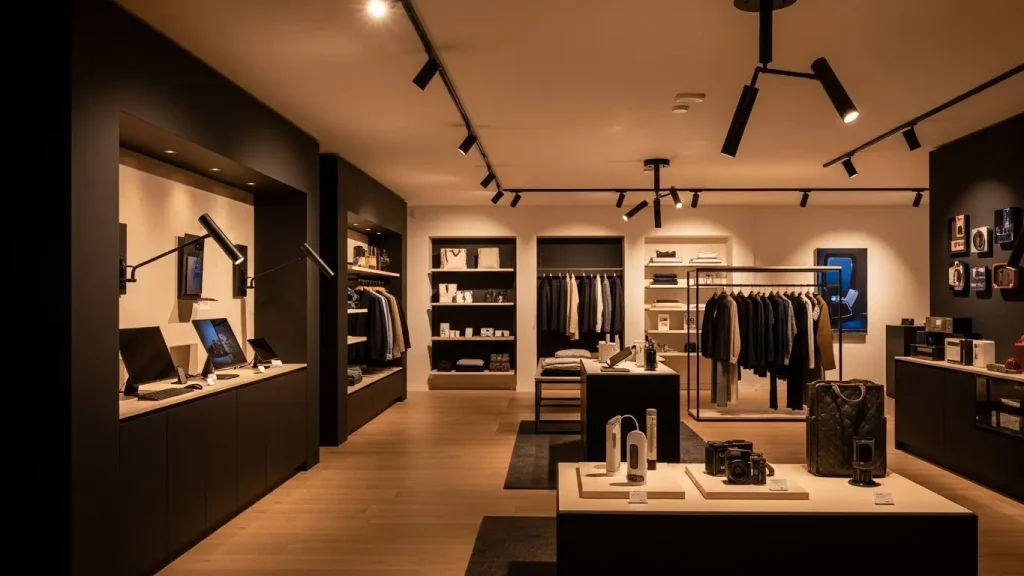
Merchandising changes. Displays move. Shelving depth shifts. Feature zones are added or removed. Yet the ceiling, once built, is one of the least flexible elements in any project.
This reality exposes the growing limitations of traditional recessed commercial spotlights:
- The luminaire position is fixed
- Beam direction is limited or completely locked
- Any layout change can instantly misalign the lighting
As a result, professionals searching for commercial LED spotlights are no longer satisfied with products that only work under ideal conditions. Instead, they are asking a more practical question:
Is there a recessed lighting solution that keeps the ceiling clean while offering track-light-level flexibility?
This is precisely why Rotatable Pull-Out Commercial LED Spotlights are gaining rapid adoption across modern commercial projects.
2. What Is a Rotatable Pull-Out Commercial LED Spotlight?
From a project perspective, a Rotatable Pull-Out Commercial LED Spotlight is defined not by aesthetics, but by what it allows you to correct after installation.
Pull-Out: Changing the Position of Light
The luminaire body can be pulled down from the ceiling by a controlled distance. This physically relocates the light source closer to the target rather than leaving it locked at the ceiling plane.
This delivers:
- Improved beam accuracy
- Better contrast on vertical displays
- Reduced dependency on ceiling-to-target distance
Rotatable: Changing the Direction of Light
Once pulled out, the spotlight can rotate horizontally and tilt vertically, enabling multi-axis aiming around obstacles and toward new focal points.
Core Difference vs Standard Adjustable Downlights
- Adjustable (gimbal) downlights: direction correction only
- Pull-Out spotlights: direction + position correction
In practice, Pull-Out spotlights behave like track spotlights hidden inside the ceiling.
One-sentence definition:
A Rotatable Pull-Out Commercial LED Spotlight delivers near-track-light flexibility within a recessed architectural form.
3. Why Fixed Commercial Spotlights Fail in Real Projects
This is the fundamental problem Pull-Out designs are solving.
The Reality of Commercial Operations
Commercial interiors are dynamic by nature:
- Retail planograms change to improve conversion
- Exhibitions rotate content
- Showrooms update hero products
- Hospitality spaces are re-zoned for events
Fixed recessed spotlights assume that everything remains perfectly aligned with the original lighting layout—an assumption that rarely holds.
Typical Failure Scenarios
When fixed spotlights meet real-world change, issues appear immediately:
- Accent light lands on the floor instead of the product
- Wall graphics are uneven or washed out
- Glass cabinets produce glare
- Visual hierarchy collapses
For brand-driven environments, these are not minor issues. Lighting mistakes directly impact perception, dwell time, and sales.
Data Snapshot: Fixed vs Flexible Lighting Outcomes
| Project Change Scenario | Fixed Recessed Spotlight | Rotatable Pull-Out Spotlight |
|---|---|---|
| Display wall moves 300–600 mm | ❌ Light misses target | ✅ Beam + position corrected |
| Shelf depth increases | ❌ Shadows / glare | ✅ On-site re-aiming |
| Mannequin height changes | ❌ Hotspot on floor | ✅ Corrected without rework |
| Feature zone added late | ❌ New cutout required | ✅ Existing fixture reused |
| Seasonal re-merchandising | ❌ Compromise lighting | ✅ Flexible adaptation |
For high-standard commercial projects, fixed beam lighting represents a structural risk, not a cost-saving.
4. Core Value of Rotatable Pull-Out Structures in Commercial Projects
Pull-Out spotlights are not about novelty—they are about risk control.
4.1 Fixed Ceiling, Flexible Light
Ceiling cutouts are expensive to change. Pull-Out designs decouple lighting performance from ceiling constraints, allowing correction without reconstruction.
4.2 Optimized Light-to-Target Distance
Pulling the light source closer to the display improves:
- Beam definition
- Contrast
- Visual focus
4.3 Obstacle Avoidance
Rotatable structures allow designers to aim around shelving, signage, and architectural elements—now a standard requirement in dense retail layouts.
4.4 One Luminaire, Multiple Display Scenarios
The same fixture can support different merchandising strategies over time, extending system life.
4.5 Higher Tolerance for Real-World Error
Design assumptions and site realities rarely align perfectly. Pull-Out designs provide a safety margin.
Pull-Out is not about “showing off mechanics.” It exists to correct real-world deviation.
5. Typical Application Scenarios for Rotatable Pull-Out Commercial LED Spotlights
Pull-Out spotlights excel wherever change is expected, not exceptional.
- Retail and chain stores
- High-end showrooms
- Museums and temporary exhibitions
- Commercial galleries
- Hotels and public areas
- Multi-purpose commercial spaces
Common trait: displays change frequently, but ceilings cannot.
6. Rotatable Pull-Out vs Adjustable Angle Downlights
Instead of comparing wattage or lumen output, compare project flexibility.
Decision Matrix
| Decision Factor | Adjustable Angle Downlight | Rotatable Pull-Out Spotlight |
|---|---|---|
| Beam direction adjustment | ✔️ Yes | ✔️ Yes |
| Light position adjustment | ❌ No | ✔️ Yes |
| Effective accent distance | Ceiling-limited | Adjustable / closer |
| Tolerance to layout change | Medium | High |
| Ceiling appearance | Clean | Clean |
| Track-light-like flexibility | Low–Medium | High |
| Best suited for | Mild variation | Frequent change environments |
When direction adjustment is no longer enough, position adjustability becomes essential.
7. Key Considerations When Choosing Pull-Out Commercial Spotlights
Not all Pull-Out spotlights are commercial-grade. Selection must consider mechanics, optics, and longevity.
7.1 Pull-Out Length vs Practical Use
| Pull-Out Length | Practical Effect | Typical Applications |
|---|---|---|
| 30–50 mm | Minor correction | Boutique shelves, shallow displays |
| 60–90 mm | Clear beam relocation | Retail wall displays, mannequins |
| 100–150 mm | Near track-light behavior | Showrooms, galleries, feature zones |
| >150 mm | Special design-driven use | Museums, high ceilings |
7.2 Mechanical Stability
Commercial-grade fixtures must:
- Hold position after repeated aiming
- Resist sagging over time
- Remain stable under heat cycles
7.3 Visual Integration
After retraction, the fixture should:
- Sit flush with the ceiling
- Maintain consistent trim appearance
7.4 Glare Control
Essential for premium spaces:
- Deep recessed optics
- Baffles or honeycomb louvers
- Controlled cut-off angles
7.5 Light Quality (Non-Negotiable)
| Performance Aspect | Commercial Expectation |
|---|---|
| Color Rendering | CRI ≥ 90 (Ra97 for premium) |
| Color Consistency | SDCM < 3 |
| Optical Precision | Defined beam edges |
| Lifetime | L70/B50 ≥ 50,000 hrs |
7.6 Control Compatibility
Professional projects often require compatibility with:
- Triac / Phase-cut (retrofits)
- 0–10V (standard commercial)
- DALI / DALI-2 systems aligned with the DALI Alliance
Commercial Pull-Out spotlights are judged by how they perform after years of adjustment—not on day one.
8. What Pull-Out Spotlights Mean for High-End Projects and Designers
For designers, Pull-Out spotlights allow fine-tuning during installation and re-tuning as spaces evolve—without sacrificing architectural restraint.
For owners, they reduce future modification costs.
For contractors, they increase delivery success and reduce post-handover complaints.
In premium projects, Pull-Out spotlights are a strategic tool, not a decorative upgrade.
9. Common Misunderstandings in Using Pull-Out Spotlights
Typical mistakes include:
- Weak pull-out mechanisms that loosen over time
- Focusing on movement while ignoring optical quality
- Insufficient glare control
- Poor ceiling integration
- Treating Pull-Out fixtures as standard downlights
Pull-Out capability adds value only when used as part of a complete lighting strategy.
10. FAQ About Pull-Out Commercial Spotlights
Q1: Are Pull-Out spotlights more complex than standard downlights?
Yes structurally, but the added complexity delivers significantly higher flexibility.
Q2: Are they suitable for small commercial spaces?
Yes, especially where ceiling positions are constrained.
Q3: Can they replace track lighting entirely?
Not entirely, but they can replace track lighting in many fixed-ceiling zones.
Q4: Does Pull-Out affect heat dissipation?
Proper commercial designs maintain effective thermal management.
Q5: Are Pull-Out spotlights suitable for long operating hours?
Yes, when designed to commercial standards.
11. Conclusion
Commercial environments evolve faster than ceilings ever will. Once lighting positions are fixed, redesign becomes expensive and disruptive.
Rotatable Pull-Out Commercial LED Spotlights address this reality by offering:
- Directional adjustability
- Positional flexibility
- Higher tolerance for real-world change
For designers: more freedom.
For owners: less risk.
For contractors and brands: higher project success rates.
Rotatable Pull-Out Commercial LED Spotlights are not a trend—they are a professional response to real commercial change.
Next Steps
If you are planning a commercial project, consider aligning on:
- Ceiling height + target size
- Pull-Out range + beam angles
- Anti-glare requirements
- Dimming and control systems
- Submittal-ready documentation (IES, cut sheets, wiring diagrams following practices from the Illuminating Engineering Society)
When integrated with broader solutions—such as LED spot downlights, track lighting, and complete commercial lighting systems—Pull-Out spotlights become part of a flexible, future-ready lighting strategy.